

AI has entered the world of network security and it is changing everything. AI-powered security systems can reduce false positive rates by up to 70% compared to old approaches. That seems like the real breakthrough everyone wanted. Most people expect the magic to be in faster threat detection, but the real twist is how AI learns and adapts to new attacks in real time. That shift turns network defense from a guessing game into a smart, evolving shield.
Table of Contents
- What is AI in network security?
- Why AI Matters in Today's Cyber Threat Landscape
- How AI Enhances Network Security Operations
- Key Concepts and Technologies in AI-Driven Security
- Real-World Applications of AI in Network Defense
Quick Summary
| Takeaway | Explanation |
|---|---|
| AI improves threat detection accuracy. | AI can drastically reduce false positive rates by up to 70%, enhancing system reliability. |
| Dynamic systems adapt to new threats. | Unlike traditional methods, AI-powered solutions evolve continuously, learning from network behavior to combat emerging cyber threats. |
| Automated responses speed up incident management. | AI facilitates quicker threat containment and response actions, minimizing operational downtime and resource expenditure. |
| Proactive security identifies vulnerabilities early. | AI can predict potential security weaknesses before they are exploited, aiding in preventative measures. |
| AI empowers security teams with insights. | The integration of AI provides professionals with actionable intelligence, enhancing decision-making capabilities in cybersecurity. |
What is AI in Network Security?
AI in network security represents a transformative approach to cybersecurity that leverages machine learning and advanced algorithms to detect, predict, and respond to potential network threats with unprecedented speed and accuracy. AI powered recommendation engine technologies are revolutionizing how organizations protect their digital infrastructure.
Understanding the Fundamental Concepts
At its core, AI in network security functions as an intelligent system capable of analyzing massive volumes of network traffic, identifying patterns, and distinguishing between normal network behavior and potential security incidents. Unlike traditional rule-based security systems that rely on predefined parameters, AI-driven solutions can dynamically adapt to emerging threats in real time.
The primary mechanisms through which AI enhances network security include:
- Anomaly Detection: Identifying unusual network behaviors that deviate from established baseline patterns
- Predictive Threat Intelligence: Forecasting potential security vulnerabilities before they can be exploited
- Automated Threat Response: Initiating immediate protective measures against detected security risks
How AI Transforms Network Protection
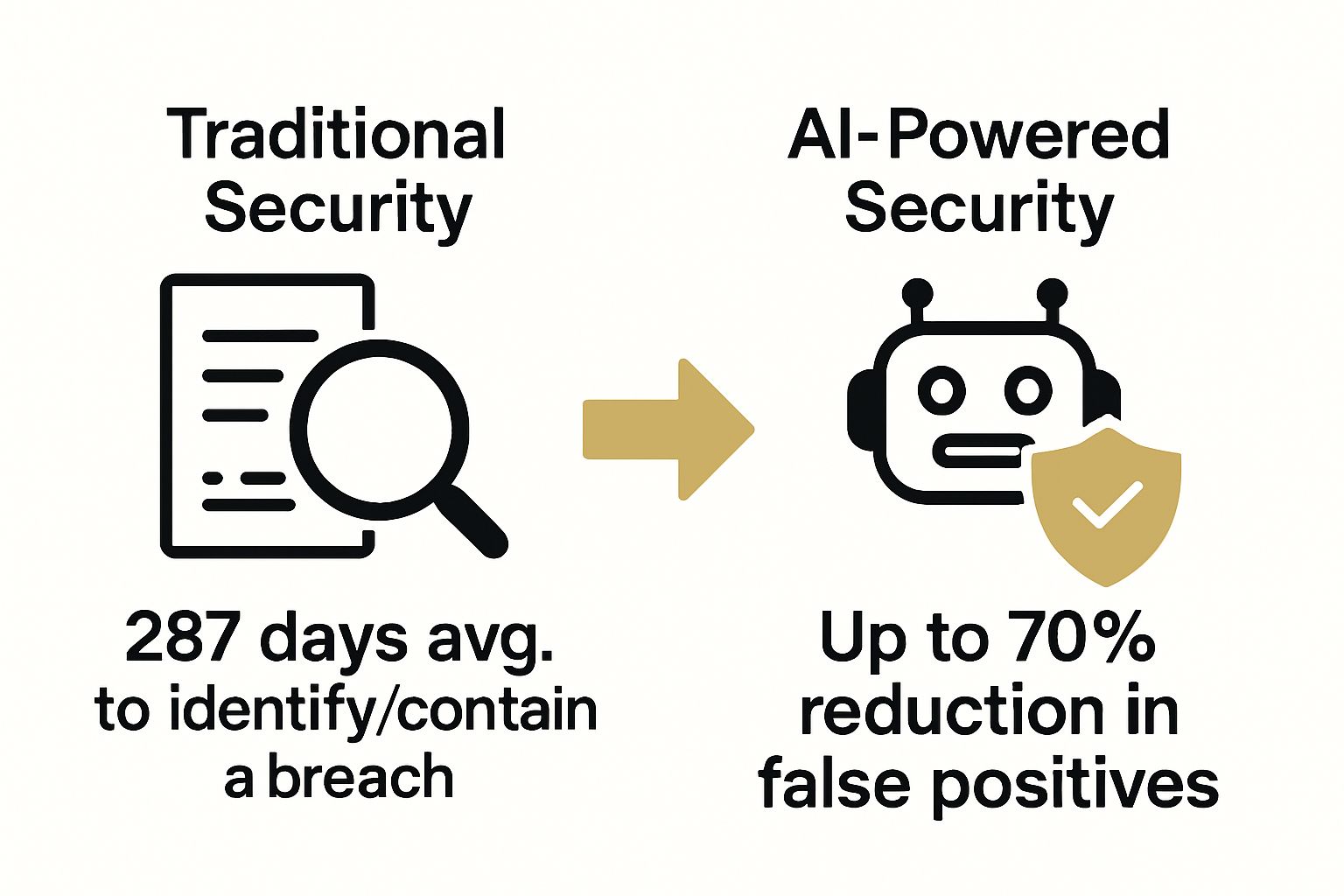
Traditional network security models often struggled with high false positive rates and delayed threat detection. According to Gartner Research, AI-powered security systems can reduce false positive rates by up to 70% while significantly accelerating threat identification and mitigation processes.
By employing sophisticated machine learning algorithms, AI network security systems continuously learn from each interaction, becoming progressively more intelligent and precise in distinguishing between legitimate network activities and potential cyber threats. This adaptive capability ensures that security protocols remain robust and responsive in an increasingly complex digital landscape.
The integration of AI into network security represents more than just a technological upgrade—it signifies a paradigm shift towards proactive, intelligent cybersecurity strategies that can keep pace with the rapidly evolving threat ecosystem.
Below is a table comparing traditional security models and AI-powered security systems to clarify how AI addresses limitations in network defense.
| Aspect | Traditional Security Models | AI-Powered Security Systems |
|---|---|---|
| Threat Detection Approach | Relies on predefined rules and signature-based detection | Uses dynamic machine learning and behavior analysis |
| Adaptability | Limited, slow to update | Continuously learns and adapts in real time |
| False Positive Rate | High | Can reduce false positives by up to 70% |
| Response Speed | Delayed, manual processes | Automated, real-time threat containment |
| Handling Emerging Threats | Struggles with new/unknown threats | Predicts, identifies, and responds to novel threats |
| Role of Human Analysts | High dependence | Supports and empowers human teams |
Why AI Matters in Today's Cyber Threat Landscape
In the rapidly evolving digital ecosystem, cybersecurity challenges have become increasingly complex and sophisticated. Cybersecurity GRC: Essential Strategies for 2025 Success highlights the critical role of advanced technologies in addressing emerging security threats.
The Escalating Complexity of Cyber Threats
The modern cyber threat landscape has transformed dramatically, moving beyond simple malware and predictable attack vectors. Cybercriminals now leverage advanced techniques like polymorphic malware, machine learning-powered attacks, and intricate social engineering strategies that can bypass traditional security mechanisms.
Key characteristics of contemporary cyber threats include:
- Rapid mutation and adaptation of attack methodologies
- Increased sophistication of penetration techniques
- Ability to exploit multiple vulnerabilities simultaneously
- Leveraging artificial intelligence for more targeted attacks
Why Traditional Security Models Fall Short
Traditional security approaches rely heavily on predefined rules and signature-based detection, which become obsolete almost immediately after new threat patterns emerge. According to IBM Security Research, organizations using only conventional security approaches experience an average of 287 days to identify and contain a data breach.
AI represents a paradigm shift in cybersecurity by providing dynamic, intelligent defense mechanisms that can:
- Analyze vast amounts of network traffic in real time
- Detect subtle anomalies invisible to human analysts
- Predict potential security vulnerabilities before they are exploited
- Automatically respond to emerging threats with minimal human intervention
The Transformative Potential of AI in Cybersecurity
By integrating machine learning and advanced algorithms, AI enables security systems to learn continuously from network interactions. This adaptive approach allows for proactive threat detection and mitigation, transforming cybersecurity from a reactive discipline to a predictive and intelligent defense strategy.
The integration of AI does not replace human expertise but amplifies it, providing security professionals with unprecedented insights and capabilities to protect complex digital infrastructures against an ever-evolving threat landscape.
How AI Enhances Network Security Operations
AI has fundamentally transformed network security operations by introducing intelligent, adaptive mechanisms that dramatically improve an organization's ability to detect, analyze, and respond to complex cyber threats. AI powered recommendation engine technologies provide critical insights into evolving security landscapes.
Advanced Threat Detection and Analysis
AI-powered security systems excel at processing and analyzing vast quantities of network data with unprecedented speed and precision. Unlike traditional security approaches that rely on manual investigation, these intelligent systems can automatically correlate complex data points across multiple network layers, identifying potential security incidents that would typically escape human observation.
Key capabilities of AI in threat detection include:
- Real-time network traffic pattern analysis
- Automated identification of suspicious behavioral anomalies
- Predictive threat modeling based on historical data
- Continuous learning and adaptation of threat detection algorithms
Intelligent Incident Response Mechanisms
Traditional incident response workflows often involve significant human intervention and time-consuming manual processes. According to European Union Agency for Cybersecurity, AI can automate routine security tasks such as log analysis, threat detection, and incident response, substantially reducing response times and operational overhead.
AI enhances incident response through:
- Automated threat containment protocols
- Rapid prioritization of security alerts
- Intelligent decision support for security teams
- Minimal false-positive generation
Predictive Security Optimization
Beyond immediate threat management, AI introduces a proactive dimension to network security operations. By continuously analyzing network behaviors, machine learning algorithms can predict potential vulnerabilities, recommend preemptive security configurations, and help organizations stay ahead of emerging cyber risks.
This predictive capability transforms network security from a reactive discipline to a strategic, intelligence-driven approach that anticipates and neutralizes potential threats before they can cause significant damage. AI does not replace human expertise but empowers security professionals with unprecedented insights and actionable intelligence.
Key Concepts and Technologies in AI-Driven Security
AI-driven security represents a sophisticated approach to cybersecurity that leverages advanced technologies to transform how organizations detect, analyze, and respond to potential threats. 7 Effective Security Questions Examples for Your Business helps contextualize the importance of intelligent security strategies.
Core Machine Learning Technologies
At the heart of AI-driven security are sophisticated machine learning algorithms capable of processing and analyzing massive datasets with unprecedented speed and accuracy. These technologies enable intelligent pattern recognition that goes far beyond traditional rule-based security systems.
Key machine learning technologies include:
- Supervised learning for threat classification
- Unsupervised learning for anomaly detection
- Deep learning neural networks for complex threat analysis
- Reinforcement learning for adaptive security responses
Advanced Threat Detection Mechanisms
Unlike conventional security approaches, AI-powered systems can dynamically adapt and learn from network interactions. According to European Union Agency for Cybersecurity, key concepts in AI-driven security encompass machine learning-based anomaly detection, sophisticated behavior analytics, and automated threat intelligence integration.
The most sophisticated AI security technologies provide:
- Real-time contextual threat analysis
- Predictive vulnerability assessment
- Automated threat hunting capabilities
- Intelligent security orchestration
Emerging AI Security Paradigms
Emergent AI security technologies are moving beyond passive detection towards proactive threat prevention. These advanced systems can now anticipate potential security breaches by analyzing complex interaction patterns, understanding contextual nuances, and predicting potential attack vectors before they materialize.
This represents a fundamental shift from reactive security models to intelligent, anticipatory defense mechanisms that can learn, adapt, and respond to the most sophisticated cyber threats with minimal human intervention. The future of network security lies not in building higher walls, but in developing smarter, more adaptive intelligent systems that can dynamically protect digital infrastructures.
Real-World Applications of AI in Network Defense
AI has transitioned from a theoretical concept to a practical, mission-critical tool in network defense strategies across various industries. Cybersecurity GRC: Essential Strategies for 2025 Success underscores the transformative potential of intelligent security approaches.
Financial Sector Threat Mitigation
Financial institutions face some of the most sophisticated and high-stakes cyber threats, making AI an essential component of their defensive infrastructure. Intelligent fraud detection systems powered by machine learning algorithms can analyze millions of transactions in real-time, identifying suspicious patterns that traditional rule-based systems would miss.
Key applications in financial network defense include:
- Anomaly detection in transaction patterns
- Real-time credit card fraud prevention
- Automated risk assessment for financial transactions
- Predictive modeling of potential security breaches
Healthcare Network Protection
Healthcare organizations manage extremely sensitive patient data, requiring robust and adaptive security mechanisms. According to National Institutes of Health Research, organizations deploy AI-based security solutions to monitor network traffic in real-time, recognizing abnormal patterns and stopping attacks before they cause damage.
AI-driven security applications in healthcare encompass:
- Protected health information (PHI) access monitoring
- Detecting unauthorized network intrusions
- Predictive threat modeling for medical systems
- Automated compliance and privacy protection
Enterprise-Level Cybersecurity Deployment
Large enterprises are increasingly leveraging AI to create comprehensive, adaptive network defense ecosystems. These intelligent systems go beyond traditional perimeter security, providing dynamic threat intelligence that can anticipate and neutralize potential security risks across complex, distributed network infrastructures.
The most advanced AI network defense strategies integrate multiple layers of intelligent protection, transforming cybersecurity from a reactive discipline to a proactive, predictive discipline that can continuously learn, adapt, and defend against emerging threats with unprecedented sophistication and speed.
This table summarizes the primary AI-driven security applications across three major industries to illustrate real-world network defense implementations.
| Industry | AI Network Security Applications |
|---|---|
| Financial | Real-time transaction anomaly detection, fraud prevention, automated risk scoring |
| Healthcare | Monitoring health data access, intrusion detection, predictive threat modeling |
| Enterprise | Dynamic threat intelligence, adaptive defense, security orchestration |

Ready to Harness Real AI for Your Network Security and Compliance?
You have seen how AI is transforming network security in the article "Understanding AI in Network Security: Key Concepts Explained." But theory alone will not protect your organization. The rapid shift to intelligent, automated defense means traditional methods are no longer enough. If you are facing overwhelming security reviews, mounting response pressures, or growing client expectations for proof of trust, it is time to act.

Experience the difference that purpose-built AI technology can make. Skypher empowers your team to answer even the toughest security questionnaires in less time with better accuracy and real intelligence. Our AI Questionnaire Automation Tool uses proprietary models to complete hundreds of questions in under a minute, supporting fast collaboration and secure data management across platforms like Slack, ServiceNow, and more. Discover how quickly you can increase trust and speed up contracts when your network defense is powered by leading automation. Do not wait for the next security challenge. Visit Skypher now and see how easily you can modernize your compliance workflow.
Frequently Asked Questions
What is AI in network security?
AI in network security refers to the use of machine learning and advanced algorithms to detect, predict, and respond to network threats with enhanced speed and accuracy compared to traditional rule-based systems.
How does AI improve threat detection in network security?
AI enhances threat detection by dynamically analyzing network traffic, identifying anomalies, and predicting vulnerabilities in real time, allowing for quicker and more accurate threat identification.
Why do traditional security models struggle with modern cyber threats?
Traditional security models often rely on predefined rules and signatures, making them less effective against rapidly evolving threats that can mutate and adapt, leading to delayed detection and increased breach containment times.
What are the benefits of using AI for incident response?
AI automates routine security tasks, minimizes false positives, and enhances the speed of threat containment, allowing security teams to focus on more complex issues and respond to incidents more efficiently.
Recommended
- AI powered recommendation engine | Security Questionnaire Automation | Skypher
- 7 Effective Security Questions Examples for Your Business
- Understanding GRC Cyber Security: Concepts and Importance
- Smart Security Knowledge Base | Security Questionnaire Automation | Skypher
- Are Smart Locks Secure? Safety Insights for Toronto Homes & Businesses - My Locksmiths CA
- How AI Understands Interview Questions Explained