

Every major business today faces a minefield of shifting regulations and hidden threats. Companies with strong GRC strategies can cut operational risk by up to 40 percent, according to Gartner. Most leaders think of GRC as just a compliance chore, but it actually holds the keys to faster decisions, smarter growth, and a real shot at outpacing the competition.
Table of Contents
- Defining the GRC Acronym: Governance, Risk, Compliance
- The Importance of GRC in Business Operations
- Key Components of GRC Frameworks: Understanding Integration
- Real-World Applications of GRC in B2B Software Companies
Quick Summary
| Takeaway | Explanation |
|---|---|
| Implement GRC for operational resilience | Integrating Governance, Risk, and Compliance strengthens business operations against regulatory changes and operational threats. |
| Enhance risk management with GRC strategies | Proactively addressing potential threats helps organizations avoid major operational disruptions and resource losses. |
| Leverage technology for GRC integration | Advanced technologies facilitate real-time monitoring and predictive analyses, enhancing organizational responsiveness to risks and regulations. |
| Foster cross-functional collaboration | Collaboration between departments enhances communication and alignment in governance, risk, and compliance efforts, creating a unified strategy. |
| Cultivate a culture of compliance and transparency | A strong GRC framework encourages accountability, helps maintain regulatory compliance, and builds trust with stakeholders. |
Defining the GRC Acronym: Governance, Risk, Compliance
The GRC acronym represents a strategic framework critical for modern organizations navigating complex business environments. Governance, Risk, and Compliance (GRC) is an integrated approach that helps companies align their operational strategies with regulatory requirements, manage potential threats, and maintain organizational integrity.
Understanding the GRC Framework Components
Each component of the GRC acronym plays a unique and interconnected role in organizational management:
- Governance: Establishes the overall strategic direction, decision making processes, and leadership structures within an organization
- Risk: Identifies, assesses, and mitigates potential threats that could impact business objectives
- Compliance: Ensures adherence to external regulations and internal policies
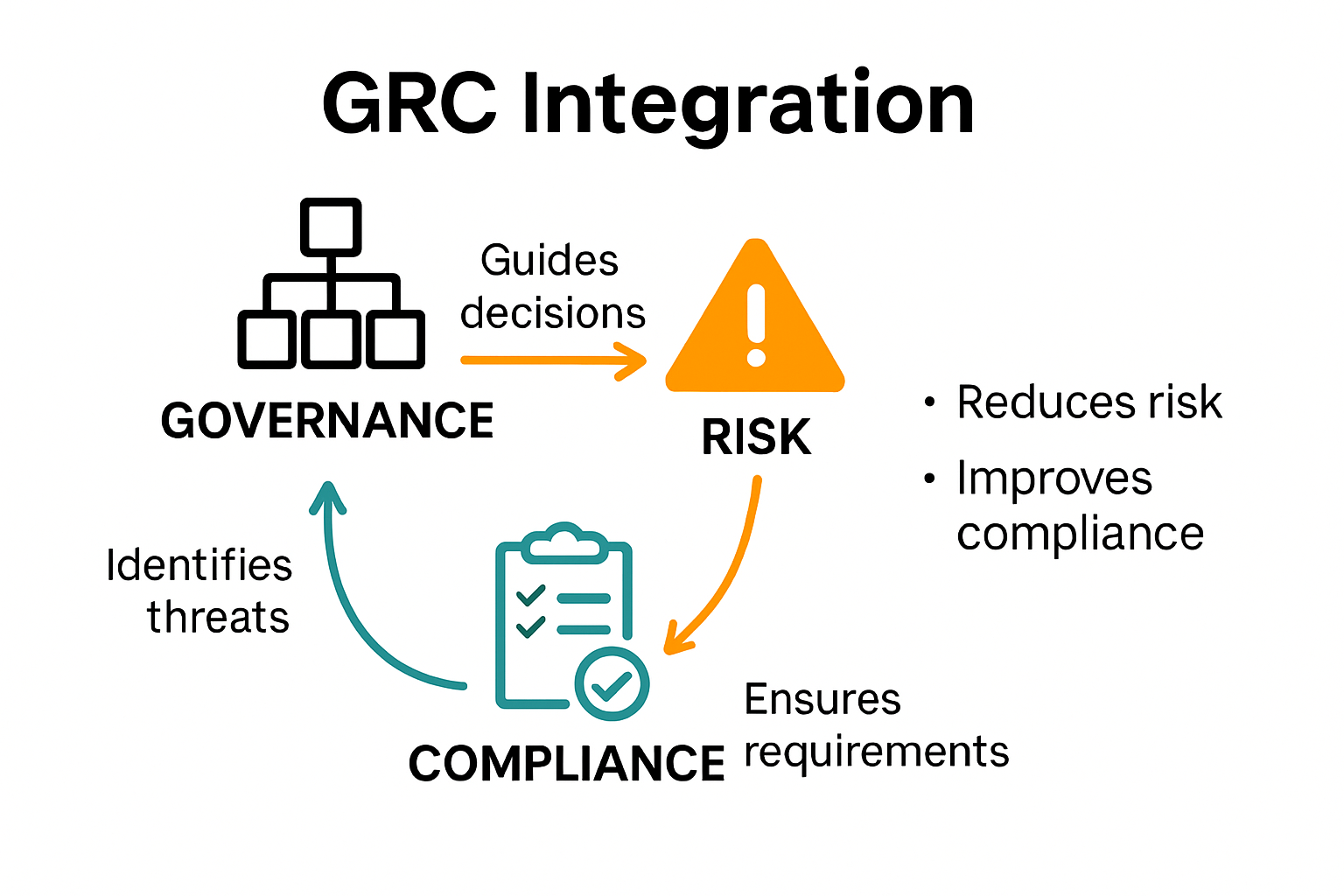
The relationship between these components is symbiotic. Effective governance provides the foundation for identifying risks and maintaining compliance. Organizations that successfully integrate these elements create a robust framework for sustainable business operations.
Below is a comparison table outlining the three core components of the GRC (Governance, Risk, Compliance) framework. This table helps clarify their unique roles and how each contributes to an integrated strategy.
| Component | Description | Role in GRC Framework |
|---|---|---|
| Governance | Establishes strategic direction, decision making processes, and leadership structures | Provides foundation for risk identification and compliance |
| Risk | Identifies, assesses, and mitigates threats to business objectives | Facilitates proactive management of potential vulnerabilities |
| Compliance | Ensures adherence to external regulations and internal policies | Maintains organizational integrity and regulatory alignment |
Strategic Importance of GRC
In today's rapidly evolving business landscape, GRC has transformed from a siloed approach to a holistic strategy. According to Gartner Research, organizations implementing comprehensive GRC strategies can reduce operational risks by up to 40% and improve overall strategic decision making.
Successful GRC implementation requires cross functional collaboration, leveraging technology, and maintaining a proactive approach to organizational management. By understanding and effectively executing GRC principles, companies can build resilient, transparent, and legally compliant operational ecosystems that adapt to changing regulatory landscapes and emerging business challenges.
The Importance of GRC in Business Operations
In an increasingly complex regulatory environment, the Governance, Risk, and Compliance (GRC) framework has become essential for organizations seeking to maintain operational excellence and strategic resilience. Modern businesses face unprecedented challenges that demand a comprehensive approach to managing organizational risks and regulatory requirements.
Strategic Risk Management
GRC provides a structured methodology for identifying, assessing, and mitigating potential business risks. Organizations utilizing robust GRC strategies can proactively address challenges before they escalate into significant operational disruptions. Key strategic benefits include:
- Proactive Risk Detection: Early identification of potential threats across financial, technological, and operational domains
- Resource Optimization: Efficient allocation of organizational resources by understanding and prioritizing risk factors
- Competitive Advantage: Creating a resilient organizational infrastructure that can adapt to changing regulatory landscapes
By integrating risk management into core business processes, companies transform potential vulnerabilities into strategic opportunities for growth and innovation.
Regulatory Compliance and Organizational Transparency
As regulatory requirements become increasingly complex, GRC frameworks enable organizations to maintain compliance while fostering a culture of transparency and accountability. According to research from the International Journal of Environmental Research and Public Health, comprehensive GRC processes support organizational resilience by creating systematic approaches to governance and risk management.
Businesses that effectively implement GRC strategies demonstrate significant improvements in operational efficiency, stakeholder trust, and long term sustainability. The framework helps organizations navigate intricate regulatory environments, reduce potential legal risks, and maintain a clear understanding of their operational boundaries and responsibilities.
This table summarizes the strategic benefits of implementing a GRC framework, making it easy to scan how each benefit helps organizations strengthen their performance and resilience.
| Strategic Benefit | Explanation |
|---|---|
| Proactive Risk Detection | Early identification of threats across financial, technological, and operational domains |
| Resource Optimization | Efficient allocation of resources by understanding and prioritizing risk factors |
| Competitive Advantage | Builds a resilient infrastructure to adapt to changing regulatory environments |
| Operational Efficiency | Streamlines processes and reduces risk of disruptions through integrated management |
| Enhanced Stakeholder Trust | Fosters transparency and accountability, strengthening relationships with regulators and partners |
| Legal and Regulatory Safety | Protects against fines and penalties by ensuring consistent compliance with laws and regulations |
Key Components of GRC Frameworks: Understanding Integration
Governance, Risk, and Compliance (GRC) frameworks represent more than a collection of independent processes. They are intricate systems designed to create seamless interactions between organizational strategies, risk management, and regulatory adherence. The true power of GRC lies in its ability to integrate these critical components into a cohesive, strategic approach.
Interconnected Framework Architecture
Effective GRC frameworks function like sophisticated organizational nervous systems, where each component communicates and responds dynamically. The integration process involves establishing clear communication channels, shared metrics, and unified decision making processes across different organizational departments.
Key integration strategies include:
- Centralized Information Management: Creating single repositories for risk and compliance data
- Cross Functional Collaboration: Encouraging communication between legal, IT, finance, and operational teams
- Standardized Reporting Mechanisms: Developing consistent metrics and evaluation protocols
Technology and GRC Integration
Modern organizations increasingly rely on technological solutions to facilitate GRC integration. According to NIST Special Publication 800-39, integrated information security programs require sophisticated technological platforms that can connect governance structures with risk management processes.
Advanced GRC technologies enable real time monitoring, predictive risk analysis, and automated compliance tracking. By leveraging data analytics and artificial intelligence, organizations can transform complex regulatory requirements into actionable strategic insights, creating more responsive and adaptive operational frameworks.
Real-World Applications of GRC in B2B Software Companies
B2B software companies operate in increasingly complex technological and regulatory landscapes where Governance, Risk, and Compliance (GRC) frameworks are no longer optional but essential strategic imperatives. These organizations face multifaceted challenges that demand sophisticated, integrated approaches to managing organizational risks and regulatory requirements.
Cybersecurity and Risk Management
In the technology sector, GRC frameworks play a critical role in addressing complex cybersecurity challenges. B2B software companies leverage GRC strategies to:
- Protect Sensitive Data: Implement robust security protocols and data protection mechanisms
- Manage Third Party Risks: Assess and monitor vendor and partner security infrastructures
- Ensure Regulatory Compliance: Navigate intricate industry specific regulations and standards
By integrating comprehensive risk management strategies, software companies can proactively identify potential vulnerabilities and develop targeted mitigation strategies.
Compliance and Operational Efficiency
According to NIST Special Publication 800-39, integrated information security programs require sophisticated technological platforms that connect governance structures with risk management processes. Modern B2B software companies use advanced GRC technologies to streamline compliance workflows and learn more about managing complex security questionnaires.
Successful GRC implementation enables organizations to transform regulatory challenges into strategic opportunities, creating more adaptable and resilient business models that can quickly respond to emerging technological and regulatory landscapes.

Ready to Simplify Your GRC Challenges?
Staying ahead in Governance, Risk, and Compliance is tougher than ever. If your team feels overwhelmed by complex risk assessments or endless security questionnaires, you are not alone. Many organizations struggle to maintain accuracy and speed, even with a strong GRC framework. Inefficient processes can slow down sales cycles and introduce unnecessary risk. What if you could automate these burdens and finally focus on what matters most?
Experience the smarter way to manage security questionnaires and compliance challenges. Skypher equips your team with an AI-driven Questionnaire Automation Tool that cuts response times and reduces manual errors. With seamless integration to your favorite tools and real-time collaboration features, you gain a practical edge in staying compliant and building client trust. Take the next step today. Visit Skypher’s platform now and see how your organization can move faster and stay secure. Don’t let compliance bottlenecks hold you back—achieve operational excellence with Skypher.
Frequently Asked Questions
What does the GRC acronym stand for?
The GRC acronym stands for Governance, Risk, and Compliance, representing a strategic framework that organizations use to align their operations with regulatory requirements, manage risks, and maintain integrity.
Why is GRC important for organizations?
GRC is essential for organizations as it enables them to proactively manage risks, ensure regulatory compliance, and establish effective governance structures, which ultimately lead to operational efficiency and strategic resilience.
How do governance, risk, and compliance work together in GRC?
Governance, risk, and compliance are interconnected components. Effective governance lays the foundation for identifying and mitigating risks, while compliance ensures that organizations adhere to regulations and internal policies, creating a cohesive and strategic framework for operations.
What are some key benefits of implementing a GRC framework?
Implementing a GRC framework provides benefits such as proactive risk detection, improved resource optimization, enhanced operational efficiency, increased stakeholder trust, and a competitive advantage in adapting to changing regulatory landscapes.
Recommended
- The ever growing number of security questionnaires and what you and your company can do to face it
- The different formats & mistakes made when writing or answering security questionnaires
- Breaking Waves & Building Teams: The Thrilling Adventure of Wakeboarding
- Gaspard de Lacroix - Saasy - Webflow HTML Website Template
- What Is Crew Resource Management? Essential Guide 2025 - VictorOne