

Healthcare companies face strict rules for handling patient data and the consequences for mistakes are no joke. One HIPAA violation can cost up to $50,000. Most people expect the biggest challenge is memorizing endless regulations. Actually, the real problem is finding the right tech to manage privacy and security while keeping things running smoothly.
Table of Contents
- What is HIPAA compliance software?
- Why HIPAA Compliance Matters for Businesses
- How HIPAA Compliance Software Functions
- Key Features of Effective HIPAA Compliance Software
- Real-World Applications and Challenges
Quick Summary
| Takeaway | Explanation |
|---|---|
| Implement HIPAA compliance software for data protection | This software helps safeguard sensitive patient information and manage security risks effectively. |
| Failure to comply can lead to severe penalties | Non-compliance may result in significant financial fines and potential legal actions against the organization. |
| Compliance impacts reputation and trust | Maintaining HIPAA standards is crucial for healthcare organizations to uphold patient trust and organizational credibility. |
| Adapt technology to evolving regulations | Effective HIPAA software evolves with changing laws and cybersecurity threats, ensuring ongoing compliance and data security. |
| View compliance as a strategic advantage | Organizations that prioritize HIPAA compliance position themselves as trustworthy partners, enhancing their market differentiation and operational resilience. |
What is HIPAA Compliance Software?
HIPAA compliance software represents a specialized technological solution designed to help healthcare organizations, medical practices, and businesses handling protected health information (PHI) meet the complex regulatory requirements established by the Health Insurance Portability and Accountability Act (HIPAA).
Understanding HIPAA Compliance Technology
At its core, HIPAA compliance software serves as a comprehensive digital framework that enables organizations to protect sensitive patient data, manage security risks, and demonstrate adherence to federal healthcare privacy regulations. According to the U.S. Department of Health and Human Services, these software solutions are critical in maintaining the confidentiality, integrity, and availability of electronic protected health information (ePHI).
Key functionalities of HIPAA compliance software typically include:
- Automated risk assessment and management
- Security control monitoring and documentation
- Privacy policy development and tracking
- Breach detection and incident response mechanisms
- Comprehensive audit trail generation
Technical and Operational Safeguards
The primary objective of HIPAA compliance software is to implement robust technical and administrative safeguards that protect patient data across multiple dimensions. These solutions integrate advanced encryption protocols, access control mechanisms, and real-time monitoring capabilities to prevent unauthorized data access and potential security vulnerabilities.
Research from the National Institute of Standards and Technology highlights that effective HIPAA compliance software goes beyond mere checklist completion. Instead, these platforms provide dynamic, adaptable frameworks that evolve with changing regulatory landscapes and emerging cybersecurity threats.
Healthcare organizations, medical billing services, insurance providers, and technology vendors dealing with patient information can leverage these specialized software solutions to streamline compliance processes, reduce potential legal risks, and maintain patient trust through demonstrable data protection strategies.
Why HIPAA Compliance Matters for Businesses
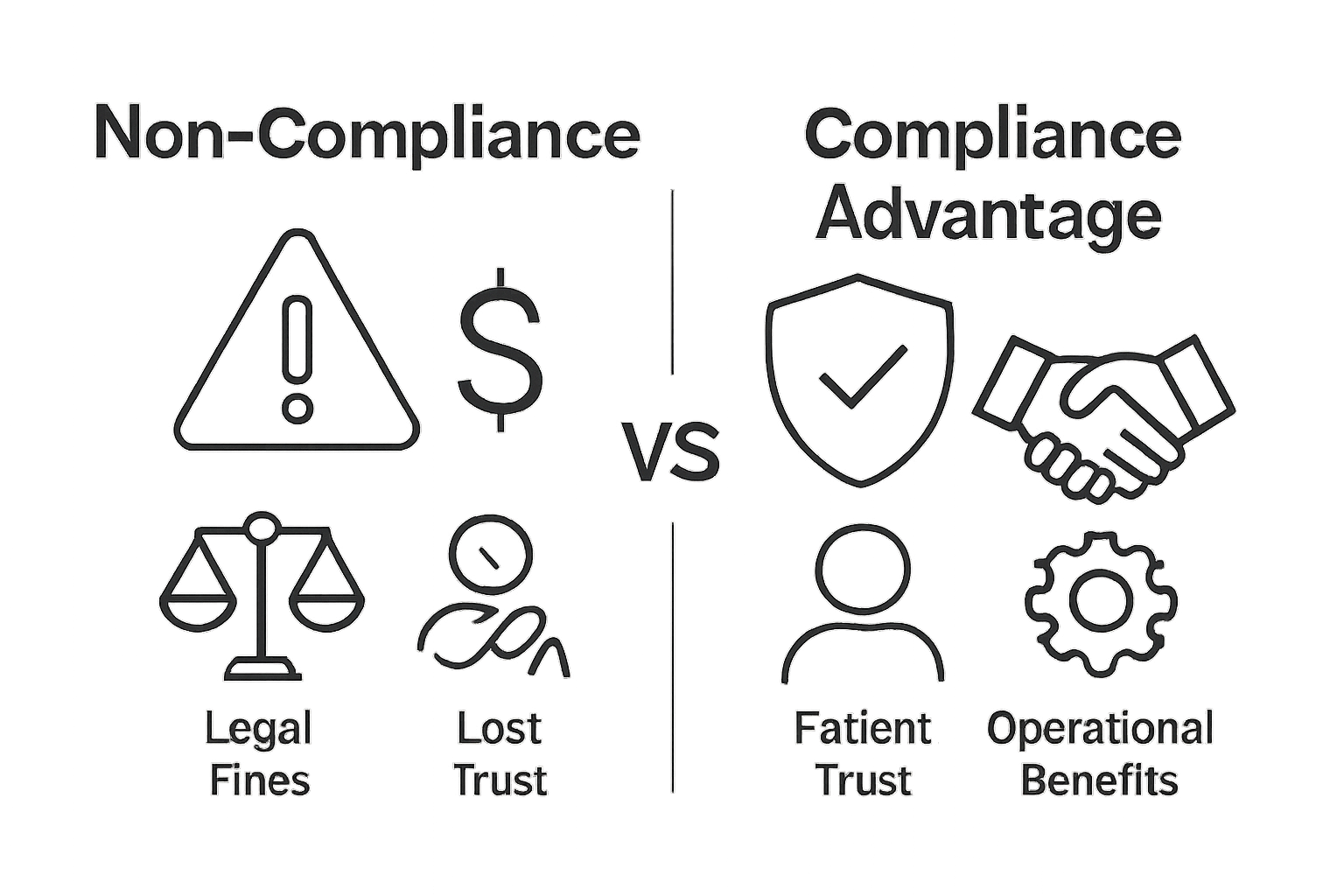
HIPAA compliance transcends simple regulatory adherence and represents a critical strategic imperative for businesses operating in healthcare and handling sensitive patient information. Understanding its significance is crucial for mitigating substantial legal, financial, and reputational risks.
Legal and Financial Consequences
According to the U.S. Department of Health & Human Services, organizations that fail to maintain HIPAA compliance can face severe penalties. These consequences are not merely administrative but can dramatically impact an organization's financial stability and operational continuity.
The following table summarizes the potential legal and financial consequences organizations face when failing to comply with HIPAA regulations, highlighting the severity and range of risks discussed in the article.
| Consequence | Description |
|---|---|
| Financial Fines | Penalties can range from $100 to $50,000 per violation, impacting financial health |
| Criminal Charges | Willful violations may result in prosecution and criminal liability |
| Corrective Action Plans | Organizations may be required to implement mandatory compliance improvements |
| Loss of Business Licenses | Non-compliance might lead to licenses being revoked or suspended |
| Legal Defense Expenses | Organizations can incur significant costs related to defending against lawsuits |
Potential financial repercussions of non-compliance include:
- Substantial monetary fines ranging from $100 to $50,000 per violation
- Potential criminal charges for willful violations
- Mandatory corrective action plans
- Potential loss of business licenses
- Significant legal defense expenses
Reputation and Trust Management
Beyond financial penalties, HIPAA compliance directly influences an organization's reputation and ability to maintain patient trust. Healthcare providers, insurance companies, and technology vendors handling protected health information must demonstrate unwavering commitment to data privacy and security.
Patient data protection is not just a regulatory requirement but a fundamental ethical obligation. Breaches can lead to catastrophic reputational damage, potentially causing irreparable harm to an organization's credibility and patient relationships.
Strategic Business Advantage
Research from the National Institutes of Health emphasizes that robust HIPAA compliance represents more than a defensive strategy. Forward-thinking organizations view compliance as a competitive differentiator that signals technological sophistication, operational excellence, and commitment to patient welfare.
Businesses that proactively invest in comprehensive HIPAA compliance demonstrate:
- Advanced cybersecurity capabilities
- Commitment to patient privacy
- Organizational maturity and risk management expertise
- Readiness to adapt to evolving regulatory landscapes
By prioritizing HIPAA compliance, organizations transform a regulatory obligation into a strategic asset that enhances operational resilience, builds stakeholder confidence, and positions themselves as trustworthy healthcare technology partners.
How HIPAA Compliance Software Functions
HIPAA compliance software operates as a sophisticated technological ecosystem designed to protect, monitor, and manage sensitive healthcare information through comprehensive digital safeguards and automated regulatory adherence mechanisms.
Core Functional Architecture
According to the University at Buffalo's information security guidelines, HIPAA compliance software integrates multiple layers of protection to ensure electronic protected health information (ePHI) remains secure and confidential. The software functions through interconnected systems that continuously assess, detect, and mitigate potential security risks.
Key architectural components include:
- Advanced encryption protocols
- Real-time access monitoring systems
- Comprehensive risk assessment engines
- Automated compliance documentation tools
- Incident response and reporting mechanisms
Data Protection and Security Mechanisms
The software employs multi-dimensional security strategies to protect patient information. These strategies go beyond simple password protection, implementing sophisticated techniques that create comprehensive barriers against unauthorized access and potential data breaches.
Critical security mechanisms involve:
- Granular user access controls
- Persistent activity logging
- Automatic threat detection algorithms
- End-to-end data encryption
- Continuous vulnerability scanning
Compliance Workflow Automation
Research from Purdue University's security program emphasizes that HIPAA compliance software transcends traditional security tools by providing dynamic, intelligent workflow automation. These platforms intelligently adapt to changing regulatory requirements, generating necessary documentation, tracking compliance activities, and providing actionable insights for healthcare organizations.
By integrating advanced technological capabilities with robust regulatory frameworks, HIPAA compliance software enables organizations to transform complex compliance requirements into streamlined, manageable processes that protect patient data while maintaining operational efficiency.
This table provides an overview of essential features and capabilities that define effective HIPAA compliance software according to the article, helping readers quickly compare and understand each major aspect covered.
| Feature | Description |
|---|---|
| Automated Risk Assessment | Identifies and manages vulnerabilities in ePHI systems |
| Security Control Monitoring | Tracks and documents the effectiveness of data security measures |
| Privacy Policy Management | Develops, updates, and tracks compliance-related privacy policies |
| Breach Detection & Incident Response | Detects security breaches and coordinates incident response actions |
| Compliance Documentation | Creates and organizes audit trails and compliance paperwork |
| Real-Time Access Monitoring | Observes user activities and access to sensitive data as they happen |
| Workflow Automation | Streamlines compliance tasks, documentation, and regulatory updates for increased efficiency |
Key Features of Effective HIPAA Compliance Software
Effective HIPAA compliance software represents a sophisticated technological solution that goes beyond basic security measures, offering comprehensive protection and management of sensitive healthcare information through advanced, integrated features.
Risk Assessment and Management
According to Georgetown University's Office of Compliance and Ethics, robust HIPAA compliance software must provide comprehensive risk analysis capabilities. These tools enable organizations to proactively identify, evaluate, and mitigate potential vulnerabilities in their electronic protected health information (ePHI) management systems.
Critical risk management features include:

- Automated vulnerability scanning
- Comprehensive security gap analysis
- Predictive threat detection mechanisms
- Customizable risk scoring algorithms
- Detailed compliance readiness reporting
Data Security and Privacy Controls
Advanced data protection stands as the cornerstone of effective HIPAA compliance software. These solutions implement multi-layered security protocols that ensure the confidentiality, integrity, and availability of sensitive patient information across various digital platforms and communication channels.
Essential security and privacy features encompass:
- End-to-end data encryption
- Granular access control mechanisms
- Real-time activity monitoring
- Secure data transmission protocols
- Comprehensive audit trail generation
Compliance Workflow and Documentation
Research from LegalClarity emphasizes that top-tier HIPAA compliance software must provide intelligent workflow automation and comprehensive documentation capabilities. These features transform complex regulatory requirements into manageable, trackable processes that demonstrate ongoing compliance and organizational preparedness.
By integrating sophisticated technological capabilities with nuanced understanding of healthcare privacy regulations, HIPAA compliance software empowers organizations to navigate complex regulatory landscapes while maintaining the highest standards of patient data protection and operational integrity.
Real-World Applications and Challenges
HIPAA compliance software transcends theoretical frameworks, presenting complex real-world applications across diverse healthcare and technology ecosystems. Organizations encounter multifaceted challenges while implementing robust digital protection strategies for sensitive patient information.
Healthcare Technology Integration
According to the Journal of Information and Technology, mobile health (mHealth) applications represent a critical domain where HIPAA compliance software demonstrates significant practical implementation. These technologies must navigate intricate regulatory landscapes while maintaining seamless user experiences and stringent data protection protocols.
Key integration challenges include:
- Complex interoperability requirements
- Diverse technological infrastructures
- Rapidly evolving digital health platforms
- Varying security protocol standards
- Inconsistent implementation approaches
Industry-Specific Compliance Dynamics
Sector-specific compliance requirements create nuanced challenges for organizations implementing HIPAA compliance software. Different healthcare segments such as medical practices, insurance providers, and digital health startups encounter unique technological and regulatory obstacles.
Critical compliance considerations encompass:
- Tailored security configurations
- Specialized risk management protocols
- Comprehensive staff training programs
- Adaptive technological frameworks
- Continuous regulatory monitoring mechanisms
Emerging Technological Challenges
Research from Kennesaw State University highlights the continuous technological evolution challenging traditional HIPAA compliance approaches. Open-source Electronic Health Record (EHR) systems and emerging digital health platforms demand increasingly sophisticated security and privacy protection strategies.
By proactively addressing these complex challenges, organizations can transform regulatory compliance from a mandatory requirement into a strategic advantage, leveraging advanced technological capabilities to protect patient data while maintaining operational agility and innovation.
Turn HIPAA Compliance Challenges into Seamless Security Workflows
Struggling to keep up with constant risk assessments, audit trails, and security documentation required for HIPAA compliance? The article above highlights how overwhelming managing protected health information can be—and how much is at stake. You deserve a way to transform complex compliance burdens into an efficient, automated process. With Skypher’s AI-driven Questionnaire Automation Tool, your team can tackle those daunting security reviews, safeguard sensitive data, and prove your HIPAA compliance much faster and with total confidence.
Why wait until another manual security questionnaire derails your team’s productivity? Visit Skypher now to explore how our advanced integrations, real-time collaboration, and customizable Trust Center give you the tools to simplify HIPAA response workflows and impress auditors. Take the next step today to safeguard your operations and earn greater trust from clients and regulators alike.
Frequently Asked Questions
What is HIPAA compliance software?
HIPAA compliance software is a specialized technological solution designed to help healthcare organizations manage protected health information (PHI) and comply with the regulations set by the Health Insurance Portability and Accountability Act (HIPAA).
Why is HIPAA compliance important for healthcare organizations?
HIPAA compliance is crucial for healthcare organizations as it helps prevent legal, financial, and reputational risks associated with mishandling sensitive patient information. Non-compliance can result in severe penalties and loss of patient trust.
How does HIPAA compliance software protect sensitive data?
HIPAA compliance software protects sensitive data through advanced encryption protocols, access control mechanisms, continuous monitoring, and automated risk assessments to prevent unauthorized access and data breaches.
What are the key features of effective HIPAA compliance software?
Key features of effective HIPAA compliance software include risk assessment tools, data security measures, compliance workflow automation, and comprehensive documentation capabilities to ensure ongoing adherence to HIPAA regulations.
Recommended
- The Case for Security Questionnaire Automation
- 3 Ways to Speed Up Your Response to Security Questionnaires with Skypher
- The ever growing number of security questionnaires and what you and your company can do to face it
- The different formats & mistakes made when writing or answering security questionnaires