

Figuring out if a new vendor is secure enough can feel like an endless guessing game. Now here is a number that might flip your expectations. Sig Lite uses about 128 targeted questions to unveil a vendor’s security gaps without the avalanche of paperwork. Most people think doing security right means bigger audits and even bigger headaches. The surprise is Sig Lite makes fast, reliable security screening possible and does it with less hassle than you ever imagined.
Table of Contents
- Defining Sig Lite: What Is It?
- The Importance of Sig Lite in Cybersecurity
- How Sig Lite Facilitates Risk Management
- Key Concepts and Components of Sig Lite
- Real-World Applications of Sig Lite in Business
Quick Summary
| Takeaway | Explanation |
|---|---|
| Sig Lite simplifies vendor assessments | It provides a streamlined framework that helps organizations evaluate third-party security postures efficiently with minimal documentation. |
| Offers 128 targeted questions | The concise questionnaire covers essential security areas without overwhelming vendors, fostering quicker assessments. |
| Supports proactive risk management | By identifying potential vulnerabilities early, Sig Lite aids organizations in mitigating risks before they escalate into significant threats. |
| Flexible across various industries | Organizations can tailor Sig Lite to meet specific compliance needs, making it a versatile tool in any sector. |
| Enhances vendor onboarding processes | This framework accelerates the evaluation of potential vendors, allowing for quicker decision-making in vendor selection. |
Defining Sig Lite: What Is It?
Sig Lite represents a streamlined security assessment framework designed to provide organizations with a foundational understanding of a third party's information security controls. Developed by the Shared Assessments Program, this standardized questionnaire offers a concise yet comprehensive approach to evaluating vendor security risks.
The Core Purpose of Sig Lite
At its fundamental level, Sig Lite serves as a preliminary risk assessment tool that enables businesses to quickly gauge the security posture of potential vendors or partners. Unlike more extensive security questionnaires, Sig Lite focuses on high-level control areas without requiring exhaustive documentation. This makes it particularly valuable for organizations seeking efficient due diligence processes.
Key characteristics of Sig Lite include:
- Simplified structure with approximately 128 targeted questions
- Suitable for low to moderate risk vendor assessments
- Provides a baseline understanding of information security practices
- Enables faster initial vendor risk evaluation
Understanding the Scope and Application
The Sig Lite questionnaire is strategically designed to address fundamental security domains without overwhelming respondents. It covers critical areas such as information security governance, risk management, compliance, and technical controls. Organizations can use this framework as an initial screening mechanism before potentially conducting more in-depth security assessments.
By offering a standardized yet flexible approach, Shared Assessments enables companies to conduct preliminary security reviews efficiently. The questionnaire helps organizations rapidly identify potential security gaps or risks associated with third-party relationships, ultimately supporting more informed vendor selection and management strategies.
The Importance of Sig Lite in Cybersecurity
In an increasingly complex digital landscape, organizations face significant challenges in managing third-party security risks effectively. Sig Lite emerges as a critical tool that addresses these challenges by providing a standardized, efficient approach to assessing vendor security controls.
Reducing Complexity in Security Assessments
Traditional security assessment methods often involve lengthy, resource-intensive processes that can overwhelm both organizations and vendors. Sig Lite revolutionizes this approach by offering a streamlined framework that focuses on essential security controls. By simplifying the assessment process, companies can conduct more frequent and thorough evaluations without expending excessive time and resources.
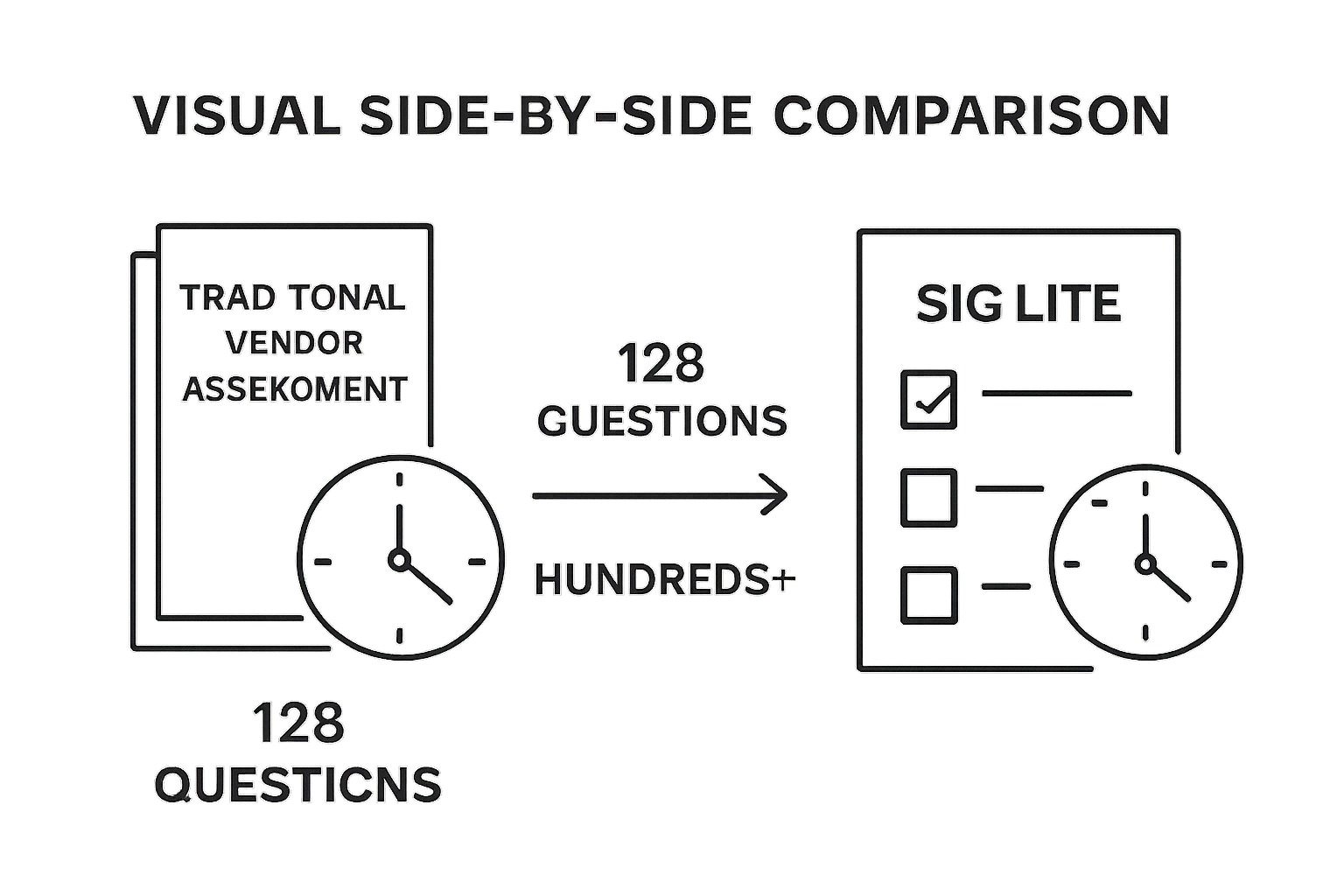
Key benefits of Sig Lite in risk management include:
- Accelerated vendor onboarding processes
- Reduced administrative overhead
- Consistent evaluation criteria across different vendors
- Improved visibility into potential security vulnerabilities
Enhancing Organizational Cybersecurity Resilience
The strategic value of Sig Lite extends beyond mere compliance. According to NIST's Risk Management Framework, effective security assessments are crucial for determining acceptable risk levels. Sig Lite provides organizations with a comprehensive yet concise mechanism to evaluate vendor security postures, enabling more informed decision-making.
By implementing Sig Lite, organizations can systematically identify and mitigate potential security risks before they escalate. The framework encourages a proactive approach to vendor risk management, helping businesses build more robust and secure digital ecosystems. This approach not only protects sensitive information but also establishes a culture of continuous security assessment and improvement.
How Sig Lite Facilitates Risk Management
Risk management in cybersecurity demands strategic approaches that balance thoroughness with efficiency. Sig Lite emerges as a powerful mechanism for organizations to systematically evaluate and mitigate potential security risks associated with third-party vendors and partnerships.
Structured Risk Assessment Framework
Sig Lite provides a methodical approach to identifying and categorizing potential security vulnerabilities. By offering a standardized questionnaire with targeted questions, the framework enables organizations to conduct comprehensive yet streamlined risk assessments. This structured methodology allows businesses to quickly understand the security posture of potential vendors without getting bogged down in excessive documentation.
Key risk management capabilities of Sig Lite include:
- Rapid identification of potential security gaps
- Consistent evaluation criteria across different vendor relationships
- Scalable assessment process for organizations of varying sizes
- Alignment with industry-standard security control frameworks
Proactive Risk Mitigation Strategies
The true value of Sig Lite lies in its ability to transform risk assessment from a reactive to a proactive process. According to Shared Assessments, the framework enables organizations to systematically evaluate third-party security controls before potential vulnerabilities can escalate into significant threats.
By providing a standardized mechanism for assessing security controls, Sig Lite empowers organizations to make informed decisions about vendor relationships. The questionnaire covers critical domains such as information security governance, technical controls, and compliance mechanisms. This comprehensive yet concise approach allows businesses to quickly determine the potential risks associated with new or existing vendor partnerships, ultimately supporting more robust and secure digital ecosystems.
Key Concepts and Components of Sig Lite
Sig Lite represents a sophisticated yet accessible framework for evaluating organizational security controls. Understanding its core components provides insight into how this tool transforms vendor risk assessment processes and supports comprehensive cybersecurity strategies.
Structural Framework and Questionnaire Design
The architectural foundation of Sig Lite centers on a meticulously crafted questionnaire comprising 128 targeted questions. These questions are strategically organized to capture essential security information without overwhelming respondents. The framework covers multiple critical domains, ensuring a holistic approach to security assessment.
Key structural components include:
- Comprehensive coverage of information security domains
- Standardized question formats
- Scalable assessment methodology
- Consistent evaluation criteria
Fundamental Security Control Categories
Sig Lite's questionnaire systematically examines security controls across several fundamental categories. According to NIST's security framework guidance, these categories are designed to provide a comprehensive view of an organization's security posture.
The primary security control domains typically encompass:
- Information Security Governance
- Risk Management Practices
- Compliance and Regulatory Adherence
- Technical Security Controls
- Operational Security Processes
By breaking down security assessment into these structured categories, Sig Lite enables organizations to conduct thorough yet efficient evaluations.
The table below summarizes the key security control domains included in the Sig Lite framework, along with brief descriptions and representative examples.
| Security Control Domain | Description | Example Focus Area |
|---|---|---|
| Information Security Governance | Overseeing and directing information security policies and programs | Organizational security policies |
| Risk Management Practices | Identifying, assessing, and mitigating potential risks | Vendor risk assessment procedures |
| Compliance and Regulatory Adherence | Ensuring alignment with industry and legal security requirements | HIPAA, PCI DSS, or GDPR controls |
| Technical Security Controls | Implementation of technological safeguards against threats | Network security, encryption |
| Operational Security Processes | Day-to-day operations to maintain and monitor security | Incident response plans |

Real-World Applications of Sig Lite in Business
Businesses across various industries are increasingly recognizing the critical importance of standardized security assessment frameworks. Sig Lite has emerged as a versatile tool that enables organizations to efficiently evaluate and manage third-party security risks across multiple operational contexts.
Enterprise Risk Management Strategies
Sig Lite transforms complex security evaluations into manageable, actionable processes for enterprises. Organizations can leverage this framework to conduct rapid, comprehensive assessments of potential vendors, partners, and service providers. By providing a structured approach to security evaluation, businesses can make more informed decisions about their technology ecosystem and potential vulnerabilities.
Typical enterprise applications include:
- Screening potential technology vendors
- Assessing cloud service provider security protocols
- Evaluating cybersecurity readiness of supply chain partners
- Conducting preliminary risk assessments for mergers and acquisitions
Industry-Specific Security Implementation
Different industries require tailored approaches to security risk management. According to NIST's quick start guides for cybersecurity, organizations can adapt Sig Lite to meet sector-specific compliance and security requirements.
Industry-specific use cases demonstrate Sig Lite's flexibility:
- Financial services: Ensuring third-party payment processors meet stringent security standards
- Healthcare: Verifying electronic health record system vendor security
- Technology: Assessing software development partners security practices
- Manufacturing: Evaluating IoT and industrial control system vendor security
By providing a standardized yet adaptable framework, Sig Lite enables businesses to conduct efficient, comprehensive security assessments that support robust risk management strategies across diverse operational environments.
Eliminate Security Questionnaire Stress with Skypher
If you find Sig Lite appealing for its efficiency and simplicity, imagine taking your entire security questionnaire process to the next level. Traditional methods of assessing third-party risks can be time-consuming and overwhelming, right when you need speed and accuracy to keep your organization moving. Skypher helps you conquer those challenges by automating the response to security questionnaires, including industry frameworks like Sig Lite, so you can focus on true risk management rather than paperwork.
Why wait to streamline your security reviews and improve team collaboration? Discover how Skypher accelerates compliance workflows, connects with over 40 risk management platforms, and empowers your teams to securely handle due diligence in record time. Explore our AI Questionnaire Automation Tool and see how you can simplify vendor assessments while building greater trust with your clients. Visit our platform today and experience a smarter path to risk management.
Frequently Asked Questions
What is Sig Lite?
Sig Lite is a streamlined security assessment framework created by the Shared Assessments Program. It provides organizations with a foundational understanding of a third party's information security controls through a standardized questionnaire that focuses on evaluating vendor security risks.
How many questions are included in the Sig Lite framework?
The Sig Lite framework consists of approximately 128 targeted questions that address various essential security domains, facilitating a quick and efficient risk assessment of potential vendors.
What are the main benefits of using Sig Lite for vendor assessments?
Key benefits of using Sig Lite include accelerated vendor onboarding processes, reduced administrative workload, consistent evaluation criteria across vendors, and improved visibility into potential security vulnerabilities.
In which scenarios is Sig Lite most applicable?
Sig Lite is applicable for low to moderate risk vendor assessments, making it ideal for screening potential technology vendors, evaluating cloud service providers, and assessing cybersecurity readiness of supply chain partners.