

Every company wants to keep customer data safe. That is why more organizations are turning to independent security reviews like SOC II Type 1. But plenty of folks still think SOC II is just another ordinary checkbox. Surprisingly, the SOC II Type 1 audit increases the odds of winning enterprise contracts by 65 percent for companies with verified certifications. Those numbers hint at something bigger than compliance paperwork. The real impact of SOC II Type 1 is a powerful statement that builds trust, sets companies apart, and can even reshape their future.
Table of Contents
- What Is Soc II Type 1 And Its Purpose?
- The Importance Of Soc II Type 1 For Businesses
- Key Components Of A Soc II Type 1 Report
- How Soc II Type 1 Works In Practice
- Real-World Applications And Impact Of Soc II Type 1
Quick Summary
| Takeaway | Explanation |
|---|---|
| SOC II Type 1 evaluates security controls | This audit assesses how effectively organizations manage and protect sensitive customer data at a specific time. |
| Establish trust with stakeholders | Certification demonstrates a company’s commitment to information security to enhance credibility and client confidence. |
| Focus on core trust service criteria | Reports analyze five key areas: security, availability, processing integrity, confidentiality, and privacy. |
| Proactive approach to security vulnerabilities | The assessment helps identify weaknesses in security measures before they escalate and impact the business. |
| Competitive edge in the market | SOC II Type 1 certification differentiates businesses by signaling advanced security maturity to potential clients and partners. |
What is SOC II Type 1 and its Purpose?
A SOC II Type 1 report represents a critical compliance assessment designed to evaluate an organization's information security controls and practices. Unlike generic security audits, this specialized examination focuses specifically on how companies manage and protect sensitive customer data through systematic security protocols.
Understanding the SOC II Type 1 Framework
The SOC II Type 1 audit represents an independent evaluation conducted by certified public accountants to assess a company's security controls at a specific point in time. Unlike comprehensive Type 2 reports that track performance over months, Type 1 provides a snapshot of an organization's security infrastructure and design effectiveness. Learn more about SOC 2 AICPA compliance to grasp the nuanced differences between various SOC assessment types.
Key characteristics of SOC II Type 1 include:
- Focuses on the design and implementation of security controls
- Provides a moment-in-time assessment of security infrastructure
- Evaluates controls against specific trust service criteria
- Delivers a formal report demonstrating security commitment
Purpose and Business Significance
For organizations operating in technology, finance, and cloud service domains, a SOC II Type 1 report serves multiple critical functions. It acts as a comprehensive validation of an organization's commitment to maintaining robust security standards. According to AICPA's official guidelines, the primary objectives include demonstrating due diligence in protecting customer data, establishing trust with stakeholders, and providing transparent evidence of security practices.
Businesses pursue SOC II Type 1 certification to:
- Enhance customer confidence
- Meet regulatory compliance requirements
- Differentiate from competitors in security-conscious markets
- Establish a foundation for continuous security improvement
The report specifically examines five core trust service criteria: security, availability, processing integrity, confidentiality, and privacy. By systematically evaluating these dimensions, organizations can identify potential vulnerabilities and demonstrate a proactive approach to information protection.
The table below organizes the five core trust service criteria assessed in a SOC II Type 1 audit, making it easier to scan each area and its focus as described within the article.
| Trust Service Criteria | Description |
|---|---|
| Security | Protection against unauthorized system access |
| Availability | System accessibility and operational reliability |
| Processing Integrity | Ensuring accurate, timely, and authorized data processing |
| Confidentiality | Safeguarding sensitive information from unauthorized disclosure |
| Privacy | Managing the collection, use, retention, and disclosure of personal information |
The Importance of SOC II Type 1 for Businesses
The SOC II Type 1 certification has become a critical benchmark for businesses seeking to demonstrate their commitment to robust information security practices. In an era where data breaches and cybersecurity threats are increasingly sophisticated, this assessment provides a structured approach to validating an organization's security infrastructure.
Building Trust and Credibility
For businesses operating in digital ecosystems, establishing trust with clients and partners is paramount. A SOC II Type 1 report serves as an independent, third-party validation of an organization's security controls. Learn more about handling security questionnaires effectively to complement your compliance efforts. According to Gartner's research, organizations with verified security certifications are 65% more likely to win enterprise contracts compared to those without formal security assessments.
Key trust-building aspects include:
- Demonstrating proactive security management
- Providing transparent evidence of control effectiveness
- Reducing potential client concerns about data protection
- Establishing a reputation for reliability and professionalism
Competitive Differentiation and Risk Mitigation
In competitive markets, a SOC II Type 1 certification can be a significant differentiator. It signals to potential clients that an organization takes security seriously and has invested in comprehensive protective measures. Beyond marketing advantages, the certification process helps businesses identify and address potential vulnerabilities before they become critical risks.
Businesses gain strategic advantages through:
- Enhanced market positioning
- Improved risk management practices
- Potential reduction in cybersecurity insurance premiums
- Streamlined vendor assessment processes
Moreover, the detailed examination of security controls provides organizations with actionable insights into their current infrastructure. By highlighting potential weaknesses and recommending improvements, SOC II Type 1 assessments serve not just as a compliance tool, but as a strategic roadmap for continuous security enhancement.
Key Components of a SOC II Type 1 Report
A SOC II Type 1 report provides a comprehensive overview of an organization's security infrastructure through a meticulously structured assessment. Understanding its key components helps organizations and stakeholders effectively evaluate security practices and control mechanisms.
Structural Framework and Documentation
The SOC II Type 1 report comprises several critical sections that collectively provide a holistic view of an organization's security environment. Learn more about cybersecurity governance frameworks to complement your understanding of these complex assessments. According to AICPA guidelines, the report typically includes:
- Management's description of the system
- Auditor's opinion and attestation
- Detailed evaluation of security controls
- Specific trust service criteria assessment
Trust Service Criteria Evaluation
The SOC II Type 1 report comprehensively examines five core trust service criteria that form the backbone of information security assessment. These criteria represent the fundamental principles organizations must address to demonstrate robust security practices:
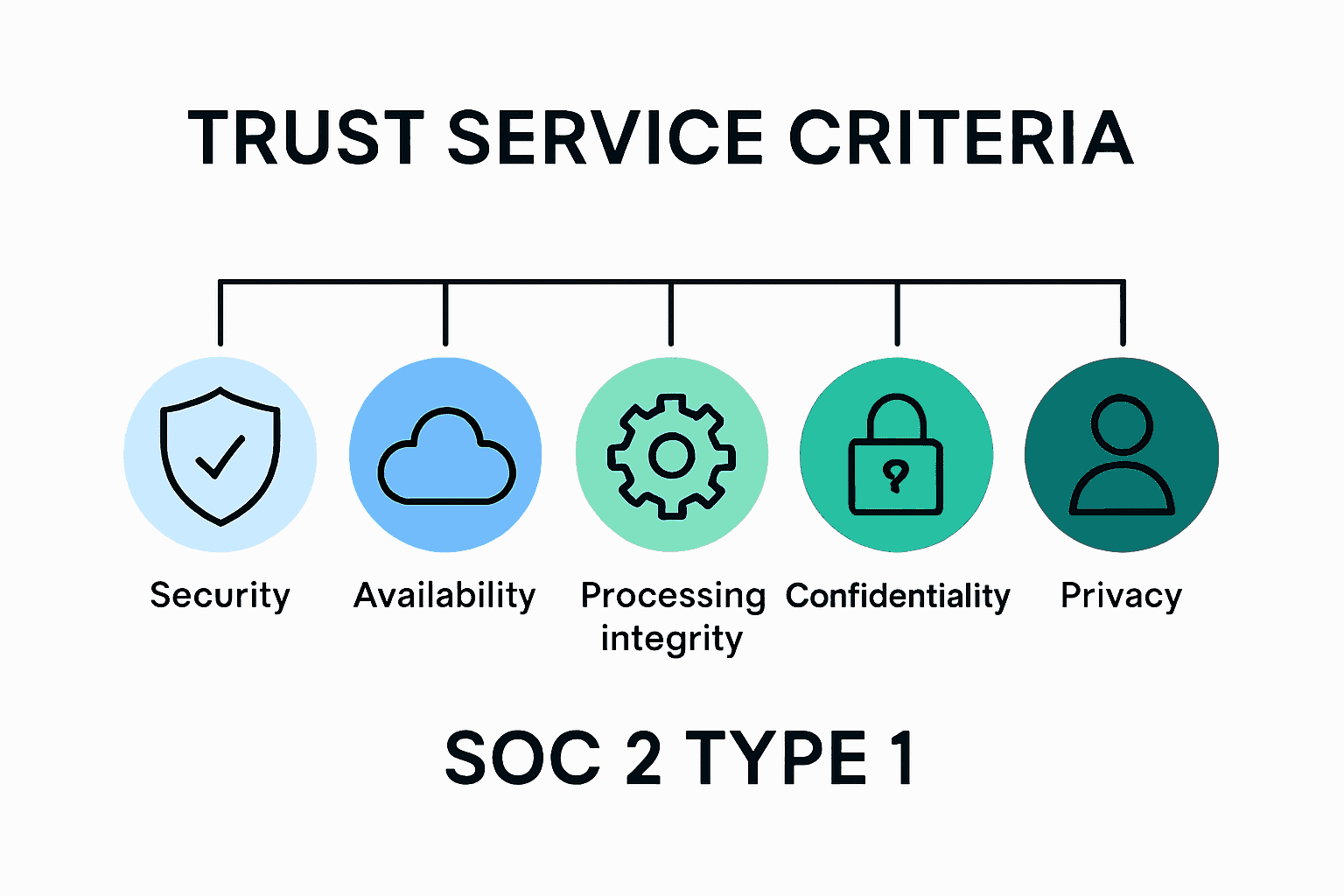
- Security: Protection against unauthorized system access
- Availability: System accessibility and operational reliability
- Processing Integrity: Ensuring accurate, timely, and authorized data processing
- Confidentiality: Protecting sensitive information from unauthorized disclosure
- Privacy: Managing personal information collection, use, retention, and disclosure
Each criterion undergoes rigorous evaluation to validate the design and implementation of specific control mechanisms.
 Auditors assess how well an organization's systems and processes align with these critical standards, providing a detailed snapshot of security infrastructure at a specific point in time.
The comprehensive nature of these assessments means businesses receive not just a compliance document, but a strategic tool for understanding and improving their security posture. By systematically examining each trust service criterion, organizations can identify potential vulnerabilities, strengthen their defensive strategies, and demonstrate a commitment to maintaining the highest standards of information protection.
How SOC II Type 1 Works in Practice
A SOC II Type 1 audit represents a complex, structured process that transforms abstract security principles into tangible, verifiable practices. Understanding its practical implementation helps organizations navigate the assessment with confidence and strategic insight.
Preparation and Readiness Assessment
Before the actual audit, organizations must meticulously prepare their security infrastructure.
Explore business security strategies to align your preparation effectively. According to AICPA's implementation guidelines, this phase involves:
- Conducting internal security control evaluations
- Documenting existing security policies and procedures
- Identifying potential gaps in current security frameworks
- Developing comprehensive control documentation
The preparation stage is crucial, as auditors will thoroughly examine an organization's documented security practices and their practical implementation. Companies must demonstrate not just the existence of security controls, but their systematic design and integration within organizational processes.
Audit Execution and Evaluation
During the SOC II Type 1 audit, independent certified public accountants conduct a comprehensive review of an organization's security controls. The process focuses exclusively on the design effectiveness of these controls at a specific point in time. Key evaluation components include:
-
Reviewing system documentation
-
Interviewing key organizational personnel
-
Testing security control mechanisms
-
Assessing alignment with trust service criteria
-
Validating control implementation strategies
Auditors perform detailed testing to verify that security controls are not just documented, but are logically designed to protect against potential vulnerabilities. They examine architectural frameworks, access management protocols, data protection mechanisms, and incident response strategies.
The practical nature of SOC II Type 1 means organizations receive more than a compliance document. They gain a sophisticated blueprint for understanding their current security posture, identifying potential improvements, and demonstrating a proactive approach to information protection. This assessment serves as a strategic tool for continuous security enhancement and stakeholder confidence.
Real-World Applications and Impact of SOC II Type 1
SOC II Type 1 certifications have transformed from a compliance checkbox to a strategic business instrument that significantly influences organizational credibility, market positioning, and operational security across multiple industries. Understanding its real-world applications provides insights into its profound impact on contemporary business ecosystems.
Industry-Specific Implementation Scenarios
Different sectors leverage SOC II Type 1 certifications uniquely to address their specific security challenges. Explore comprehensive business security strategies to understand nuanced implementation approaches. According to Gartner's cybersecurity research, industries demonstrate varied yet critical applications:
- Cloud service providers validating infrastructure security
- Financial technology platforms protecting sensitive transaction data
- Healthcare technology companies ensuring patient information confidentiality
- Software as a Service (SaaS) platforms demonstrating robust access controls
- Telecommunications networks protecting customer communication infrastructure
Competitive Advantage and Risk Mitigation
Beyond compliance, SOC II Type 1 certifications serve as powerful competitive differentiators. Organizations that successfully obtain these certifications signal advanced security maturity to potential clients, investors, and partners. The certification provides tangible evidence of an organization's commitment to:
- Proactive security risk management
- Systematic vulnerability identification
- Comprehensive data protection strategies
- Transparent operational practices
- Continuous improvement of security infrastructure
The certification's impact extends beyond immediate security improvements. By systematically addressing potential vulnerabilities and demonstrating rigorous control mechanisms, businesses can significantly reduce potential financial and reputational risks associated with data breaches and security incidents. This proactive approach not only protects organizational assets but also builds substantial trust with stakeholders, potentially accelerating business growth and market expansion.
Accelerate SOC II Type 1 Compliance and Streamline Security Reviews with Skypher
Navigating SOC II Type 1 audits can feel overwhelming for organizations that need to prove strong security controls and gain client trust quickly. The anxiety of compiling evidence, responding to countless security questionnaires, and maintaining up-to-date documentation is real, especially when each misstep could delay contracts or jeopardize stakeholder confidence. As highlighted in this article, your ability to demonstrate rigorous security practices is key to standing out in competitive tech and finance markets.
Let Skypher transform your approach to compliance and security reviews. With our AI Questionnaire Automation Tool, you can answer even the toughest vendor questionnaires or due diligence requests almost instantly and always with precision. Our seamless integrations and enterprise-grade collaboration tools bring your team together, reduce errors, and let your experts focus on improving your security—not on repetitive paperwork. Visit Skypher today to see how you can win client trust faster and painlessly prepare for your next SOC II Type 1 assessment. Start now and move one step ahead of your competitors.
Frequently Asked Questions
What is a SOC II Type 1 report?
A SOC II Type 1 report is an independent assessment that evaluates an organization's information security controls at a specific point in time, focusing on how sensitive customer data is managed and protected.
How does a SOC II Type 1 report differ from a SOC II Type 2 report?
A SOC II Type 1 report provides a snapshot of an organization's security infrastructure and control effectiveness at a specific moment, while a SOC II Type 2 report assesses the performance and effectiveness of those controls over a designated period.
Below is a comparison table highlighting the main differences between SOC II Type 1 and SOC II Type 2, summarizing details discussed in the article to clarify their scope and assessment periods.
| Feature | SOC II Type 1 | SOC II Type 2 |
|---|---|---|
| Assessment Period | Specific point in time | Over an extended period (typically several months) |
| Focus | Design and implementation of controls | Design, implementation, and operational effectiveness |
| Report Type | Snapshot of security infrastructure | Continuous performance review |
| Purpose | Verify controls are in place at audit date | Assess ongoing effectiveness of controls |
| Use Case | Initial compliance, faster certification | Long-term assurance, deeper client trust |
What are the key trust service criteria assessed in a SOC II Type 1 report?
The five core trust service criteria assessed are security, availability, processing integrity, confidentiality, and privacy, ensuring a comprehensive evaluation of an organization’s security practices.
Why is obtaining a SOC II Type 1 certification important for businesses?
Obtaining a SOC II Type 1 certification boosts customer confidence, meets regulatory compliance requirements, differentiates organizations in competitive markets, and establishes a foundation for ongoing security improvements.