

Companies are under constant pressure to prove their security practices measure up. Firms using comprehensive frameworks like SOCS can slash their breach risk by up to 60 percent. That might sound like another boring compliance rulebook. Actually, SOCS goes far beyond box-checking and turns security into a smart business advantage you probably were not expecting.
Table of Contents
- What are SOCS Requirements and Their Purpose?
- The Importance of SOCS Requirements in Software Security
- How SOCS Requirements Influence Risk and Compliance Strategies
- Key Concepts and Components of SOCS Requirements
- Real-World Applications of SOCS Requirements in B2B
Quick Summary
| Takeaway | Explanation |
|---|---|
| SOCS ensures proactive cybersecurity | Adopting SOCS requirements transforms security management from a reactive to a proactive approach, anticipating threats before they materialize. |
| SOCS promotes organizational trust | Implementing these requirements signals to clients and stakeholders that an organization prioritizes security and risk management. |
| Compliance drives strategic advantages | Viewing compliance under SOCS as a strategic capability can differentiate organizations and enhance stakeholder confidence. |
| Continuous monitoring is essential | SOCS emphasizes ongoing assessment and adaptation of security strategies to respond effectively to evolving challenges. |
| Tailor SOCS to industry needs | Different industries can customize SOCS requirements to address specific security challenges and regulatory demands efficiently. |
What are SOCS Requirements and Their Purpose?
SOCS requirements represent a comprehensive framework for organizations to manage, assess, and validate their information security controls and processes. These requirements serve as a critical mechanism for ensuring robust cybersecurity practices, particularly in business environments where data protection and risk management are paramount.
Understanding SOCS Framework
The SOCS (Security, Operational, Compliance, and Strategic) framework provides a structured approach for companies to evaluate their security infrastructure. Unlike traditional compliance models, SOCS requirements focus on holistic risk assessment and continuous improvement. Organizations leverage these requirements to:
- Identify potential security vulnerabilities
- Establish standardized control mechanisms
- Create transparent reporting processes
- Demonstrate commitment to robust cybersecurity practices
Specifically designed for B2B technology and financial sectors, SOCS requirements help companies systematically address complex security challenges. According to Gartner Research, organizations implementing comprehensive security frameworks can reduce potential breach risks by up to 60%.
Strategic Importance of SOCS Compliance
SOCS requirements are not merely a checkbox exercise but a strategic approach to risk management. They provide a comprehensive methodology for organizations to:
- Validate internal security protocols
- Build trust with clients and stakeholders
- Demonstrate regulatory adherence
- Create a proactive security culture
By implementing SOCS requirements, companies transform their security approach from reactive to proactive. This shift enables businesses to anticipate potential threats, implement robust preventative measures, and maintain a resilient cybersecurity posture.
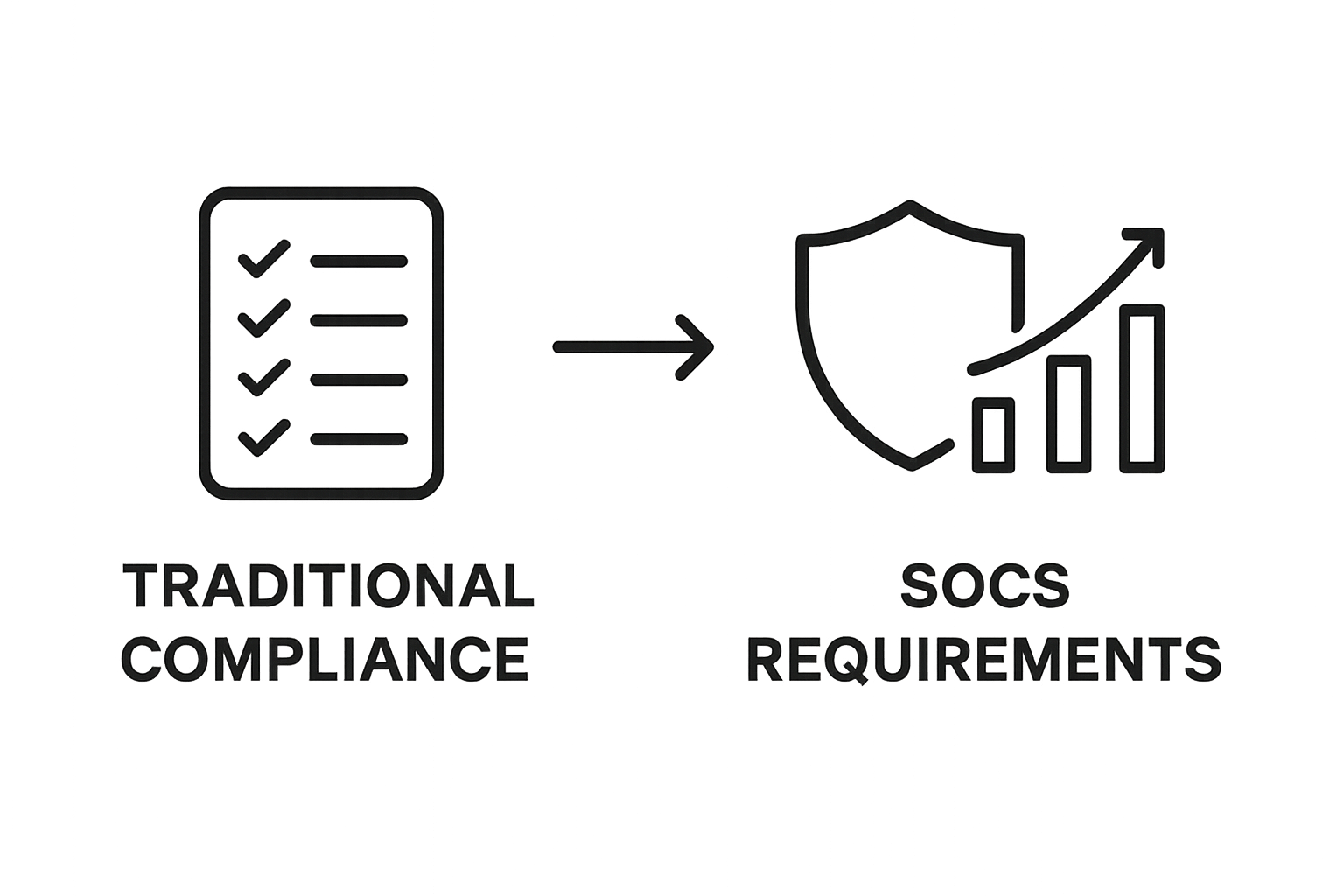
The table below compares traditional compliance frameworks with the SOCS approach, summarizing their key differences and strategic impacts.
| Approach | Focus | Security Mindset | Business Impact | Ongoing Process |
|---|---|---|---|---|
| Traditional Compliance | Regulatory checklist | Reactive | Meets minimum standards | Periodic reviews |
| SOCS Requirements | Holistic risk management | Proactive | Strategic business differentiator | Continuous improvement |
The Importance of SOCS Requirements in Software Security
SOCS requirements play a pivotal role in establishing comprehensive software security frameworks that protect organizations from evolving digital threats. By providing structured methodologies for identifying, assessing, and mitigating potential vulnerabilities, these requirements transform software security from a reactive to a proactive discipline.
Mitigating Software Security Risks
In the complex landscape of enterprise software, security risks are multifaceted and continuously changing. SOCS requirements offer a systematic approach to understanding and addressing these challenges. Companies utilizing robust SOCS frameworks can effectively:
- Identify potential security vulnerabilities before they become critical
- Implement comprehensive risk assessment protocols
- Develop strategic response mechanisms for emerging threats
- Establish clear accountability for security incidents
According to the National Institute of Standards and Technology, comprehensive security frameworks can reduce potential software vulnerability exposure by identifying critical control points and establishing rigorous monitoring processes.
Building Trust through Comprehensive Security Protocols
SOCS requirements extend beyond technical controls. They represent a holistic approach to demonstrating organizational commitment to security. By implementing these requirements, companies signal to clients, partners, and stakeholders that they:
- Prioritize data protection
- Maintain rigorous security standards
- Continuously improve their security infrastructure
- Proactively manage potential risks
Moreover, SOCS requirements help organizations create a culture of security awareness. They transform security from a technical necessity into a strategic organizational capability, ensuring that every team member understands their role in maintaining robust digital defenses.
How SOCS Requirements Influence Risk and Compliance Strategies
SOCS requirements are instrumental in transforming organizational risk and compliance strategies from reactive checklists to dynamic, proactive frameworks.
These comprehensive guidelines enable businesses to develop sophisticated approaches that anticipate potential vulnerabilities and create robust protective mechanisms.
Strategic Risk Management Transformation
In modern business environments, risk management goes beyond traditional defensive strategies. SOCS requirements provide organizations with a structured methodology to identify, assess, and mitigate potential risks systematically. By implementing these requirements, companies can:
- Create comprehensive risk assessment protocols
- Develop predictive threat modeling capabilities
- Establish clear escalation and response procedures
- Implement continuous monitoring mechanisms
According to ISACA Research, organizations with well-defined security operations frameworks can significantly reduce potential financial losses and reputational damage associated with cybersecurity incidents.
Compliance as a Strategic Advantage
SOCS requirements transcend traditional compliance frameworks by positioning regulatory adherence as a strategic business capability. Rather than viewing compliance as a burdensome obligation, forward-thinking organizations recognize it as an opportunity to:
- Demonstrate organizational maturity
- Build stakeholder confidence
- Differentiate from competitors
- Minimize potential legal and financial risks
By integrating SOCS requirements into their core strategic planning, companies transform compliance from a reactive process into a proactive business strategy.
 This approach enables organizations to not just meet minimum regulatory standards but to establish themselves as industry leaders in risk management and security governance.
Key Concepts and Components of SOCS Requirements
SOCS requirements represent a comprehensive framework that integrates multiple dimensions of organizational security, risk management, and operational control. Understanding these key components is crucial for businesses seeking to develop robust and adaptive security strategies that protect their digital infrastructure and sensitive information.
This table organizes the core components of the SOCS framework, clarifying their roles within a comprehensive security strategy.
| Component | Purpose |
|---|---|
| Access control and authentication | Control user and system access |
| Continuous security monitoring | Ongoing detection of threats and issues |
| Incident response and management | Structured actions to resolve security events |
| Risk assessment and vulnerability tracking | Identify and prioritize potential risks |
| Data encryption and protection | Safeguard sensitive information |
Core Security Architecture Components
The fundamental architecture of SOCS requirements encompasses several critical elements that work together to create a holistic security approach. These components are designed to provide comprehensive protection and enable organizations to identify, assess, and mitigate potential risks systematically:
- Access control and authentication mechanisms
- Continuous security monitoring systems
- Incident response and management protocols
- Risk assessment and vulnerability tracking
- Data encryption and protection strategies
According to the National Institute of Standards and Technology, effective security frameworks must integrate technical controls with organizational policies to create a dynamic and responsive security ecosystem.
Operational and Strategic Alignment
SOCS requirements go beyond technical implementations by ensuring that security strategies are seamlessly integrated with broader organizational objectives. This approach transforms security from a standalone function to a strategic business capability that:
- Supports business continuity
- Enables informed decision making
- Promotes transparency and accountability
- Facilitates regulatory compliance
By aligning security requirements with organizational goals, companies can create a proactive approach that anticipates potential risks and develops adaptive strategies. This holistic perspective ensures that security is not viewed as a constraint but as an enabler of business innovation and growth.
Real-World Applications of SOCS Requirements in B2B
SOCS requirements are not theoretical constructs but practical frameworks that drive tangible security improvements across diverse business environments. By translating complex security principles into actionable strategies, these requirements enable organizations to develop robust, adaptive cybersecurity approaches that address real-world challenges.
Cybersecurity Transformation in Enterprise Environments
In complex B2B technology ecosystems, SOCS requirements provide a structured approach to managing multifaceted security challenges. Organizations leverage these frameworks to:
- Protect intricate network infrastructures
- Safeguard sensitive client and partner data
- Develop predictive threat detection mechanisms
- Create scalable security governance models
According to ISACA Research, successful implementation of comprehensive security operations centers can dramatically reduce potential vulnerability exposure and minimize financial risks associated with cybersecurity incidents.
Strategic Implementation across Industry Sectors
Different industries apply SOCS requirements uniquely, tailoring their approach to sector-specific challenges. Financial services, technology companies, healthcare providers, and manufacturing organizations all utilize these frameworks to:
- Establish industry-specific security benchmarks
- Develop customized risk management protocols
- Ensure regulatory compliance
- Maintain competitive technological advantage
The adaptability of SOCS requirements allows organizations to create security strategies that are not only comprehensive but also precisely aligned with their unique operational context, transforming cybersecurity from a defensive mechanism to a strategic business enabler.
Transform SOCS Compliance Into Effortless Efficiency With Skypher
SOCS requirements are about much more than checking boxes. They demand strong security, rapid risk assessments, and complete visibility for your team and stakeholders. Does managing security questionnaires keep your B2B company buried in manual work or repeated data entry? The pressure to prove compliance is real, but so is the risk of human error and wasted time if you rely on outdated methods.
Skypher can help you turn this challenge into a competitive advantage. Our AI Questionnaire Automation Tool lets you complete routine SOCS security assessments in record time, with greater accuracy and less back-and-forth. Unique features like our Custom Trust Center and integrations with over 40 leading risk management platforms also simplify collaboration and reporting. You can finally cut down on delays that stall sales and transform your compliance process from a vulnerability into a business strength.
Ready to save hours on every SOCS review and strengthen client trust today? Visit Skypher now to see how easy risk management can truly be.
Frequently Asked Questions
What are SOCS requirements?
SOCS requirements represent a structured framework that helps organizations evaluate their security infrastructure, manage risks, and validate their information security controls and processes.
How do SOCS requirements improve software security?
SOCS requirements help organizations systematically identify and mitigate security risks in software by establishing comprehensive risk assessment protocols, developing response mechanisms, and promoting accountability for security incidents.
Why is SOCS compliance important for B2B companies?
SOCS compliance is crucial for B2B companies as it builds trust with clients, demonstrates regulatory adherence, and transforms security from a reactive effort to a proactive strategy, ultimately enhancing overall risk management.
How do SOCS requirements align with business goals?
SOCS requirements ensure that security strategies are integrated with broader organizational objectives, allowing companies to support business continuity, make informed decisions, and facilitate regulatory compliance while minimizing risks.