
Vendor reviews might seem like nothing more than checklists and paperwork. Think again. Organizations that use structured vendor reviews can reduce supplier risk by up to 60 percent compared to those with informal assessments. Most assume these evaluations are just about compliance, but true value comes from turning vendor reviews into continuous, data-driven tools for strategic growth.
Table of Contents
- Understanding the Vendor Review Process
- Key Criteria for Effective Vendor Reviews
- Best Practices for Conducting Vendor Reviews
- How to Use Vendor Reviews for Better Decisions
Quick Summary
| Takeaway | Explanation |
|---|---|
| Comprehensive Vendor Assessment | Vendor reviews must evaluate financial stability, technical competence, compliance, and strategic alignment to ensure effective partnerships. |
| Ongoing Performance Monitoring | Continuous vendor reviews and monitoring are critical for adapting to changes and ensuring sustained performance throughout the vendor relationship lifecycle. |
| Stakeholder Engagement is Key | Involving multiple departments in the vendor evaluation process leads to a more holistic and representative assessment, enhancing decision-making. |
| Advanced Analytical Methods | Utilize quantitative scoring, qualitative analysis, and comparative benchmarking for deeper insights that support risk-aware decision-making. |
| Strategic Framework for Utilization | Vendor reviews should be viewed as dynamic tools for strategic partnership development, requiring an adaptive and continuous feedback-driven approach. |
Understanding the Vendor Review Process
A vendor review represents a comprehensive evaluation process designed to assess potential business partners across multiple critical dimensions. This systematic approach enables organizations to make informed decisions about which vendors can effectively support their operational requirements while minimizing potential risks.
Key Components of Comprehensive Vendor Assessment
Vendor reviews require a multifaceted examination that goes beyond surface-level considerations. According to the U.S. Department of Labor, organizations must prioritize vendors who demonstrate human-centered design principles and operational agility. This means evaluating potential partners not just on cost, but on their ability to adapt and truly understand user needs.
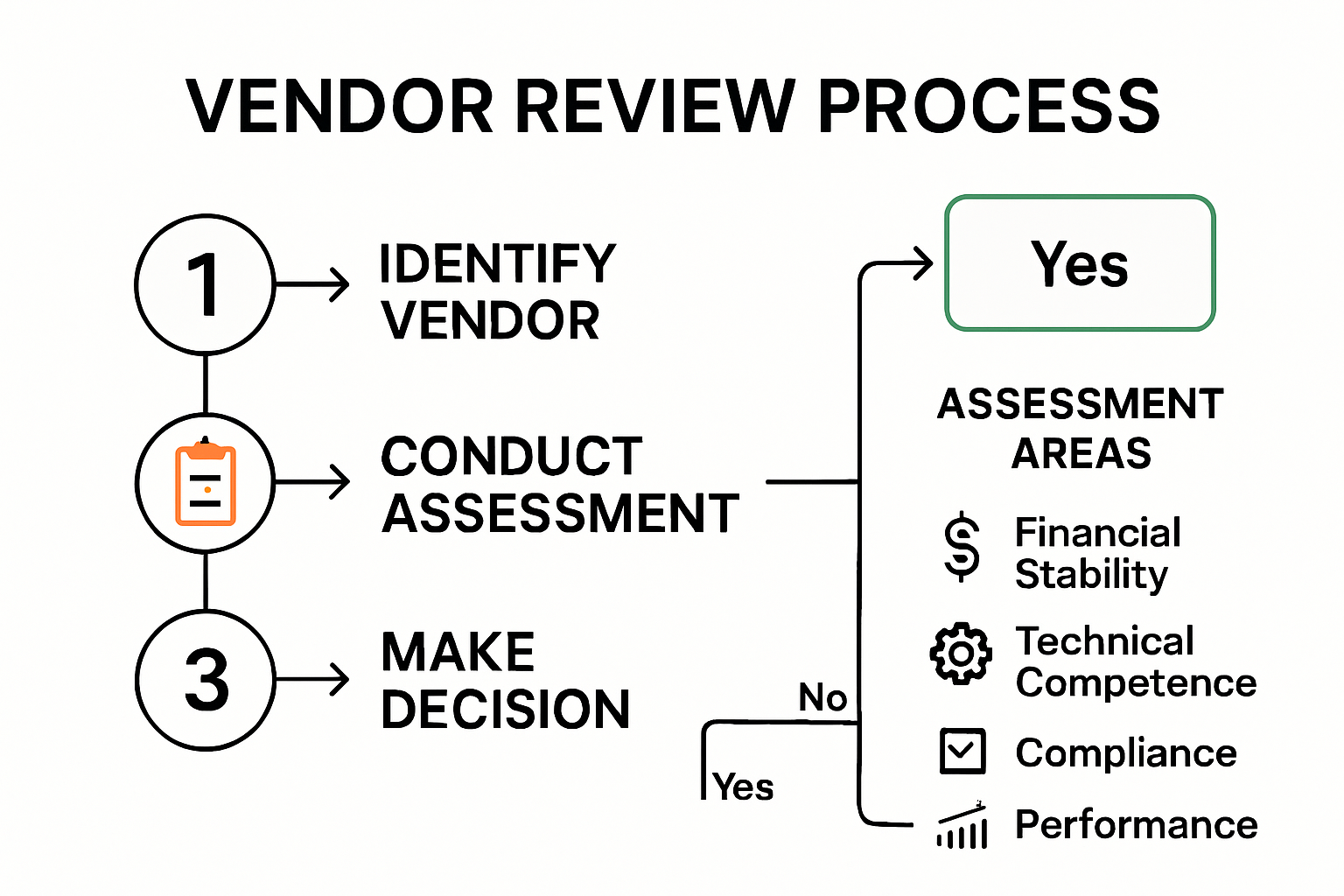
The assessment typically encompasses several critical evaluation areas:
- Financial Stability Analyzing the vendor's financial health through detailed balance sheets, revenue trends, and long-term sustainability indicators
- Technical Competence Examining the vendor's technological capabilities, innovation potential, and alignment with organizational infrastructure
- Compliance and Security Verifying the vendor's adherence to industry regulations and data protection standards
Risk Management and Performance Metrics
Effective vendor reviews demand rigorous risk management strategies. The University of Virginia's security guidelines recommend mandatory Service Organization Control 2 (SOC 2) Type II reports for vendors handling sensitive data. These reports provide independent verification of a vendor's security controls and operational effectiveness.
Performance metrics play a crucial role in this process. Organizations should establish clear, measurable criteria that go beyond traditional evaluation parameters. These might include:
- Responsiveness to communication
- Quality of delivered services
- Speed of problem resolution
- Alignment with organizational culture and values

Strategic Vendor Relationship Development
The vendor review is not merely a transactional assessment but a strategic approach to building long-term partnerships. As highlighted by the Office of the Procurement Ombudsman, successful vendor management requires an established framework aligned with corporate strategic objectives.
This approach transforms vendor reviews from a checklist exercise into a dynamic, collaborative process. Organizations should view potential vendors as strategic allies capable of driving mutual growth and innovation. By implementing a comprehensive, nuanced vendor review process, businesses can mitigate risks, optimize operational efficiency, and create value-driven partnerships that extend far beyond traditional procurement models.
Key takeaway: A robust vendor review process is not about elimination but about strategic selection and ongoing relationship management.
To help clarify the main components assessed during a comprehensive vendor review, the following table summarizes the key evaluation areas and their primary focus:
| Evaluation Area | What is Assessed |
|---|---|
| Financial Stability | Financial health, balance sheets, revenue trends, sustainability |
| Technical Competence | Technology capabilities, innovation, infrastructure alignment |
| Compliance and Security | Adherence to regulations, data protection, security standards |
| Performance Metrics | Responsiveness, quality, problem resolution, culture alignment |
| Strategic Alignment | Support for corporate objectives, potential for partnership development |
Key Criteria for Effective Vendor Reviews
Effective vendor reviews transcend basic compliance checks and demand a strategic, comprehensive approach to evaluating potential business partners. These reviews require a nuanced understanding of multiple interconnected assessment dimensions that collectively determine a vendor's suitability and potential long-term value.
Financial and Operational Stability Assessment
Financial stability stands as a foundational criterion in vendor evaluation. According to Singapore Institute of Purchasing and Materials Management, organizations must conduct thorough financial health assessments that extend beyond surface-level metrics.
Key financial evaluation components include:
- Credit Ratings Detailed analysis of independent credit assessments
- Balance Sheet Strength Comprehensive review of assets, liabilities, and equity
- Revenue Consistency Examination of financial performance trends and predictability
Beyond monetary metrics, operational stability requires assessing a vendor's infrastructure, technological capabilities, and organizational resilience. This involves evaluating their:
- Technology stack and infrastructure robustness
- Disaster recovery and business continuity plans
- Scalability of operational processes
Compliance and Risk Management Frameworks
Robust vendor reviews mandate a rigorous compliance and risk management approach. Gartner Research emphasizes that modern vendor assessments must integrate comprehensive risk evaluation methodologies.
Critical compliance assessment areas include:
- Regulatory Adherence Verification of industry-specific legal requirements
- Data Protection Standards Assessment of cybersecurity protocols
- Ethical Business Practices Evaluation of corporate governance standards
Performance and Innovation Potential
The most sophisticated vendor reviews move beyond traditional risk mitigation to assess potential strategic value. Harvard Business Review suggests that forward-thinking organizations evaluate vendors based on their innovation potential and ability to drive mutual growth.
Performance evaluation metrics should encompass:
- Track record of technological innovation
- Demonstrated ability to solve complex business challenges
- Alignment with organizational strategic objectives
- Potential for collaborative product or service development
Successful vendor reviews represent a holistic, forward-looking process. They transform vendor selection from a transactional exercise into a strategic partnership development mechanism. By implementing comprehensive, multi-dimensional assessment criteria, organizations can identify vendors who are not just service providers but potential catalysts for sustainable competitive advantage.
Key takeaway: Effective vendor reviews require a sophisticated, multi-layered approach that balances risk management with strategic opportunity identification.
To summarize the key assessment criteria for effective vendor reviews, the following table organizes primary criteria alongside what is typically evaluated within each:
| Assessment Criterion | Example Areas Evaluated |
|---|---|
| Financial Stability | Credit ratings, balance sheet, revenue consistency |
| Operational Stability | Technology stack, disaster recovery, scalability |
| Compliance & Risk Management | Regulatory adherence, cybersecurity, ethics |
| Performance Metrics | Innovation, challenge resolution, strategic alignment |
Best Practices for Conducting Vendor Reviews
Conducting effective vendor reviews requires a strategic, systematic approach that goes beyond traditional evaluation methods. Organizations must develop a comprehensive framework that ensures thorough, objective, and continuous assessment of potential and existing vendor relationships.
Establishing a Robust Evaluation Framework
A successful vendor review process begins with creating a structured and repeatable methodology. According to the Office of the Procurement Ombudsman, establishing a comprehensive vendor performance program is crucial for aligning vendor management with organizational strategic goals.
Key elements of an effective evaluation framework include:
- Clear Assessment Criteria Developing standardized evaluation metrics
- Consistent Scoring Mechanisms Creating objective scoring systems
- Regular Review Schedules Implementing periodic performance assessments
Organizations should design a flexible yet rigorous process that allows for comprehensive vendor evaluation while remaining adaptable to changing business needs. This approach ensures that the review process remains relevant and valuable over time.
Stakeholder Engagement and Comprehensive Assessment
Simplified VMS Insights emphasizes the critical importance of involving key stakeholders from multiple departments in the vendor evaluation process. This multidisciplinary approach ensures a holistic assessment that considers various organizational perspectives.
Effective stakeholder engagement involves:
- Collecting input from departments directly impacted by vendor services
- Creating cross-functional review teams
- Developing collaborative assessment methodologies
- Ensuring diverse perspectives are considered in vendor evaluations
Continuous Monitoring and Performance Optimization
Vendor reviews are not one-time events but ongoing processes of performance management. New Zealand Government Procurement recommends regular performance reviews that extend throughout the entire vendor relationship lifecycle.
Continuous monitoring strategies should include:
- Real-time performance tracking
- Regular formal performance reviews
- Mechanism for immediate feedback and correction
- Adaptive assessment approaches that evolve with vendor relationships
Successful vendor reviews transform from simple compliance checks into strategic partnership development tools. By implementing a comprehensive, dynamic approach, organizations can create value-driven vendor relationships that contribute directly to operational excellence and strategic objectives.
Key takeaway: Effective vendor reviews are iterative, collaborative processes that require ongoing commitment, strategic thinking, and a holistic approach to vendor relationship management.
How to Use Vendor Reviews for Better Decisions
Vendor reviews represent more than simple evaluation tools. They are strategic decision-making instruments that can transform organizational procurement processes and drive intelligent business choices. By systematically analyzing vendor performance data, organizations can develop nuanced insights that support more informed, risk-aware decision-making.
Advanced Analytical Approaches to Vendor Review Data
Modern organizations require sophisticated methods for extracting meaningful insights from vendor reviews. According to research published in ArXiv, implementing structured evaluation processes like the Analytical Hierarchy Process (AHP) enables comprehensive assessment of both qualitative and quantitative criteria.
Key analytical strategies include:
- Quantitative Scoring Developing numerical frameworks for objective vendor assessment
- Qualitative Analysis Interpreting narrative feedback and contextual performance indicators
- Comparative Benchmarking Evaluating vendors against industry standards and peer performance
These approaches transform raw vendor review data into actionable intelligence, supporting more strategic procurement decisions. By moving beyond simplistic evaluation metrics, organizations can develop a more nuanced understanding of vendor capabilities and potential risks.
Sentiment and Interaction-Driven Review Analysis
Advanced research in review analysis demonstrates the power of feature-level sentiment examination. This approach allows organizations to dive deeper than surface-level evaluations, uncovering granular insights about vendor performance.
Critical components of advanced review analysis include:
- Identifying specific product or service attributes
- Mapping sentiment across different performance dimensions
- Detecting potential bias in review data
- Developing more comprehensive vendor profiles
Strategic Decision-Making Framework
Interaction-driven research suggests that effective vendor review utilization requires a holistic decision-making framework. This approach goes beyond traditional evaluation methods, incorporating sophisticated analysis techniques that provide more balanced and confident insights.
Key strategic decision-making principles include:
- Integrating multiple data sources
- Developing dynamic evaluation criteria
- Creating adaptive vendor assessment models
- Establishing continuous feedback mechanisms
Successful vendor review utilization transforms these assessments from passive documentation into active strategic tools. Organizations that master this approach can turn vendor reviews into powerful mechanisms for risk management, performance optimization, and strategic partnership development.
Key takeaway: Vendor reviews are not static documents but dynamic intelligence tools that require sophisticated, multidimensional analysis to unlock their full strategic potential.
Frequently Asked Questions
What is a vendor review?
A vendor review is a systematic evaluation process designed to assess potential business partners across financial stability, technical competence, compliance, and strategic alignment to minimize risks and foster effective partnerships.
Why are vendor reviews important?
Vendor reviews are essential because they can reduce supplier risk by up to 60% by providing a structured framework for evaluating vendor performance and ensuring long-term strategic alignment.
What key criteria should be included in a vendor review?
Key criteria for effective vendor reviews should include financial stability, operational capabilities, compliance with regulations, and the vendor's potential for innovation and strategic partnership.
How often should vendor reviews be conducted?
Vendor reviews should be conducted regularly as part of an ongoing performance management strategy to adapt to changes in vendor relationships and to ensure sustained performance throughout the vendor lifecycle.
Transform Your Vendor Review Process with Skypher
Struggling to turn complex vendor reviews into a streamlined, risk-reducing engine for growth? The "Vendor Review Guide 2025" highlights how manual questionnaire responses, siloed collaboration, and compliance bottlenecks drain your time and increase risk. Skypher was built for decision-makers who want more accuracy and less busywork when it comes to financial stability checks, compliance audits, and tracking performance metrics.
Ready to eliminate hours of manual review and build more secure, reliable partnerships? Discover how the AI Questionnaire Automation Tool can help you complete security questionnaires—and vendor assessments—faster, smarter, and with audit-worthy accuracy. Experience real-time collaboration, integrations with over 40 top risk management platforms, and a customizable Trust Center. Visit Skypher now to make every vendor review count and secure your advantage before your next audit cycle.