

More than 60 percent of major security incidents involve third-party vendors, putting even the most advanced American technology firms at risk. For compliance managers facing the pressure of maintaining tight cybersecurity controls, vendor risk assessment is no longer a simple checklist task. This article unpacks the real expectations of the Vendor Risk Manager role and dispels common myths, giving you tools and insights to transform your compliance approach with greater clarity and confidence.
Table of Contents
- Defining Vendor Risk Manager Roles and Myths
- Types of Vendor Risk Management Solutions
- How Automation Transforms Questionnaire Handling
- Key Features for Tech and Finance Organizations
- Compliance Requirements and Legal Exposure Risks
- Mistakes to Avoid in Vendor Risk Management
Key Takeaways
| Point | Details |
|---|---|
| Vendor Risk Managers are Strategic Guardians | They balance commercial interests with security protocols, assessing risks across various dimensions beyond simple compliance. |
| Automation Enhances Efficiency | Automated tools streamline vendor questionnaire processes, reducing manual errors and enabling real-time monitoring of risks. |
| Continuous Monitoring is Essential | Organizations must implement ongoing vendor assessments to identify emerging risks and ensure compliance effectively. |
| Develop Robust Contracts | Clear, comprehensive contracts help define responsibilities and mitigate potential legal challenges in vendor relationships. |
Defining Vendor Risk Manager Roles and Myths
The Vendor Risk Manager plays a critical role in protecting organizations from potential third-party vulnerabilities. This professional is responsible for systematically assessing vendor security risks across multiple complex dimensions. Far from being a simple checklist administrator, the role requires sophisticated strategic thinking and comprehensive risk evaluation skills.
Traditionally misunderstood, Vendor Risk Managers are not just compliance officers but strategic guardians who balance commercial interests with robust security protocols. They analyze potential risks in areas such as information security, financial stability, regulatory compliance, and business continuity. These professionals serve as critical liaisons between internal stakeholders, vendors, and management teams, developing nuanced risk mitigation strategies that protect organizational integrity.
The role demands a unique blend of technical knowledge and interpersonal skills. Successful Vendor Risk Managers must understand complex regulatory landscapes, possess advanced analytical capabilities, and communicate risk assessments effectively across different organizational levels. They leverage sophisticated risk assessment frameworks, advanced technological tools, and deep industry knowledge to create comprehensive vendor management strategies that minimize potential vulnerabilities.
Pro tip: Develop a standardized vendor risk assessment template that includes weighted scoring for different risk categories, enabling more consistent and objective evaluations across potential partnerships.
Types of Vendor Risk Management Solutions
Vendor Risk Management (VRM) solutions encompass a diverse range of strategic approaches designed to mitigate comprehensive organizational risks across multiple domains. These sophisticated solutions are not one-size-fits-all but rather tailored frameworks that address unique organizational vulnerabilities through systematic risk assessment and continuous monitoring.
The primary types of VRM solutions typically include strategic, operational, financial, compliance, business continuity, and cybersecurity risk management approaches. Strategic solutions focus on alignment with organizational goals, while operational solutions analyze vendor performance and operational efficiency. Financial risk management solutions evaluate vendor financial health, examining factors like creditworthiness, financial stability, and potential economic impacts. Compliance-oriented solutions ensure vendors meet regulatory requirements and industry standards, critically examining legal and regulatory adherence.
Advanced VRM solutions integrate multiple risk assessment methodologies, utilizing technological platforms that enable real-time monitoring, automated risk scoring, and comprehensive vendor lifecycle management. These solutions often incorporate advanced analytics, machine learning algorithms, and integrated dashboards that provide holistic visibility into vendor risk profiles. By combining due diligence, contract management, continuous monitoring, and proactive risk mitigation strategies, organizations can develop robust vendor risk management ecosystems that protect against potential vulnerabilities.
Here's a concise summary comparing key vendor risk management solution types and their core focus areas:
| Solution Type | Core Focus | Tools Used |
|---|---|---|
| Strategic | Align vendor with goals | Policy review, alignment maps |
| Operational | Evaluate efficiency | Performance dashboards |
| Financial | Assess financial health | Credit checks, financial reports |
| Compliance | Ensure regulations met | Audit trails, compliance software |
| Cybersecurity | Safeguard information | Threat detection platforms |
Pro tip: Develop a weighted risk assessment matrix that assigns different scoring levels to various risk categories, enabling more nuanced and objective vendor evaluation processes.
How Automation Transforms Questionnaire Handling
Automation is revolutionizing vendor risk management by fundamentally transforming how organizations handle security questionnaire processes. Traditional manual approaches that consumed countless hours of administrative work are being replaced by intelligent systems that dramatically reduce time, minimize human error, and provide more comprehensive risk insights.

The core advantages of automated questionnaire handling include standardized assessment frameworks, real-time response tracking, and integrated risk scoring mechanisms. Automated tools can rapidly process structured surveys like SIG Lite, seamlessly integrate responses into comprehensive risk profiles, and enable evidence-based decision-making. These systems leverage advanced technologies such as machine learning and natural language processing to extract relevant information, cross-reference vendor responses, and generate nuanced risk assessments with unprecedented speed and accuracy.
Beyond basic efficiency gains, automation supports continuous vendor monitoring and compliance enforcement. Advanced platforms can automatically flag inconsistencies, trigger follow-up investigations, and maintain dynamic risk dashboards that provide real-time visibility into vendor performance. By eliminating manual data entry, reducing administrative overhead, and creating standardized evaluation processes, automation empowers vendor risk managers to focus on strategic risk mitigation rather than getting bogged down in repetitive administrative tasks.
Pro tip: Implement a phased automation strategy that begins with low-complexity questionnaires, allowing your team to gradually build confidence and expertise in automated risk assessment tools.
Key Features for Tech and Finance Organizations
Tech and finance organizations require sophisticated vendor risk management solutions that go far beyond traditional compliance tracking. These advanced platforms must provide comprehensive risk intelligence, enabling organizations to proactively identify, assess, and mitigate potential vulnerabilities across their entire vendor ecosystem.
The most critical features for these sectors include continuous risk monitoring, real-time cybersecurity intelligence integration, and dynamic risk scoring mechanisms. Advanced vendor risk management platforms now offer granular assessment capabilities that track vendor performance across multiple dimensions, including financial stability, operational resilience, regulatory compliance, and information security posture. Sophisticated tools can automatically analyze vendor responses, cross-reference multiple data sources, and generate comprehensive risk profiles that provide actionable insights for strategic decision making.
Complex organizations require robust reporting capabilities and incident escalation workflows that can seamlessly integrate with existing governance, risk, and compliance frameworks. These solutions must support comprehensive documentation, enable rapid response to emerging risks, and provide transparent audit trails that demonstrate due diligence. By leveraging advanced technologies like artificial intelligence and machine learning, modern vendor risk management platforms can deliver predictive risk assessments that help tech and finance organizations stay ahead of potential third-party vulnerabilities.
Pro tip: Implement a tiered vendor risk assessment approach that applies different evaluation criteria based on the vendor's criticality and potential impact on your organization.
Compliance Requirements and Legal Exposure Risks
Organizations face increasingly complex legal challenges when managing third-party vendor relationships, with vendor risk management processes becoming critical to preventing regulatory and financial vulnerabilities. The landscape of compliance has transformed dramatically, requiring sophisticated approaches that go beyond traditional checklist-based assessments and demand comprehensive, dynamic risk evaluation strategies.
Complex legal exposure risks emerge from multiple interconnected domains, including regulatory compliance, data privacy, cybersecurity, and financial accountability. Different industries face unique challenges: healthcare organizations must navigate HIPAA regulations, financial institutions must comply with stringent banking oversight, while technology companies must address evolving international data protection standards. These compliance requirements demand meticulous vendor assessment processes that can identify potential legal vulnerabilities before they escalate into significant financial or reputational risks.
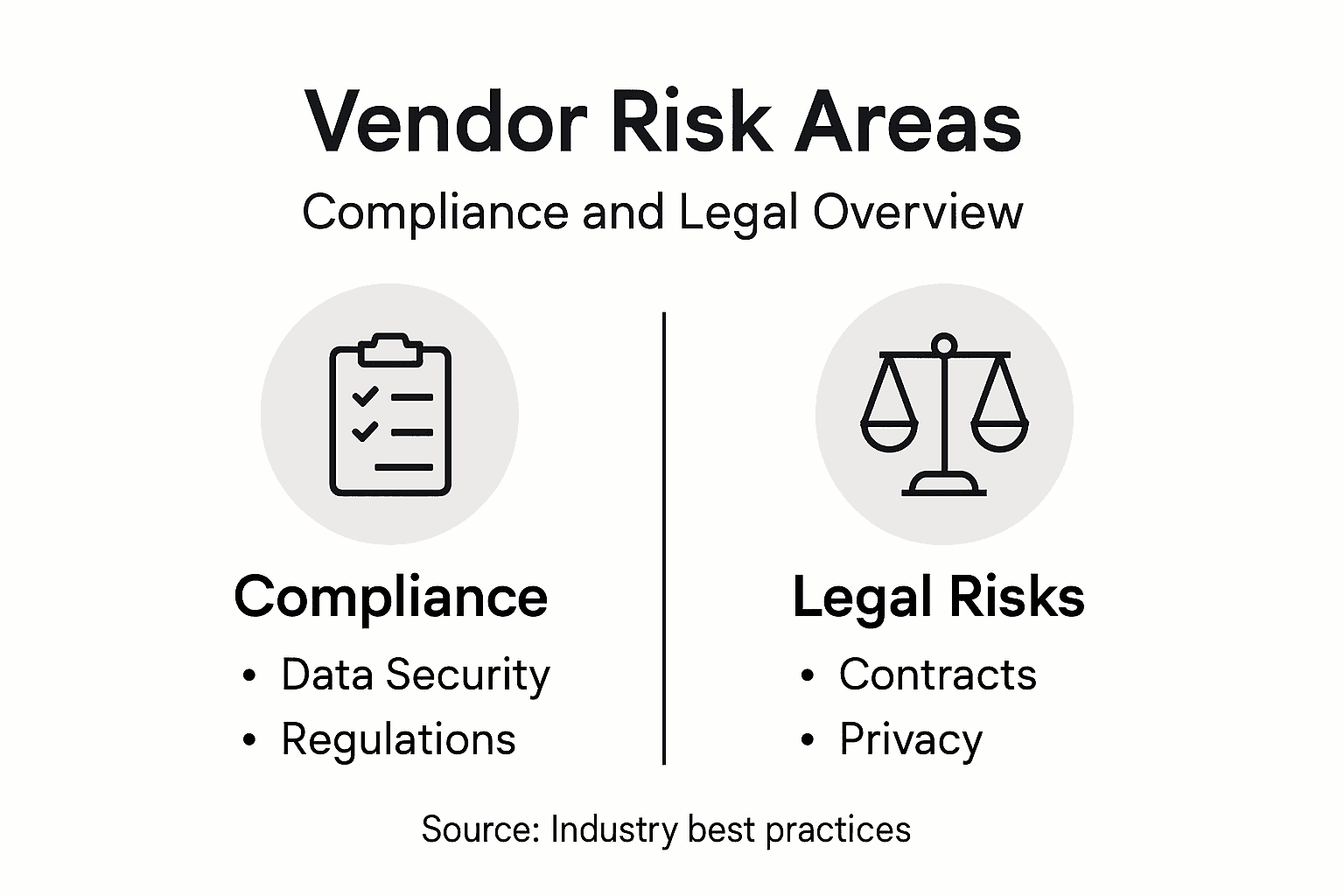
Successful risk management requires a proactive, multilayered approach that integrates continuous monitoring, robust documentation, and adaptive compliance frameworks. Organizations must develop comprehensive vendor selection criteria, implement ongoing performance evaluations, and establish clear contractual safeguards that explicitly define compliance expectations. Advanced risk management strategies now incorporate sophisticated technologies like artificial intelligence and machine learning to provide predictive insights, enabling organizations to anticipate and mitigate potential legal challenges before they emerge.
Pro tip: Create a standardized vendor compliance scorecard that includes weighted risk factors, enabling consistent and objective assessment across different vendor categories and relationship types.
Mistakes to Avoid in Vendor Risk Management
Vendor risk management demands precision, and organizations frequently stumble into critical errors that can compromise their entire risk mitigation strategy. Common vendor management mistakes often stem from oversimplified approaches that fail to recognize the complex, dynamic nature of third-party relationships. These missteps can expose organizations to significant financial, operational, and reputational risks.
One of the most prevalent mistakes is conducting superficial initial due diligence without establishing robust continuous monitoring mechanisms. Organizations frequently perform comprehensive vendor assessments during onboarding but then fail to implement ongoing risk tracking. This approach creates dangerous blind spots, allowing potential vulnerabilities to develop unnoticed. Successful vendor risk management requires a dynamic, adaptive framework that continuously evaluates vendor performance, compliance, and potential emerging risks across multiple dimensions including cybersecurity, financial stability, operational resilience, and regulatory adherence.
Another critical error involves inadequate communication and poorly defined contractual expectations. Many organizations neglect to establish clear, comprehensive risk management protocols that explicitly outline vendor responsibilities, performance standards, and compliance requirements. Without precise documentation and transparent communication channels, organizations leave themselves vulnerable to misunderstandings, compliance gaps, and potential legal challenges. Effective vendor risk management demands creating detailed contracts that include specific risk mitigation clauses, performance metrics, audit rights, and comprehensive escalation procedures for addressing potential issues.
The table below highlights common mistakes in vendor risk management and how to address them:
| Mistake | Impact | Prevention Strategy |
|---|---|---|
| Superficial due diligence | Missed warning signs | Continuous performance monitoring |
| Poor contract documentation | Legal/reputational risk | Detailed contracts with clear terms |
| Inadequate communication | Compliance gaps | Set defined channels and protocols |
Pro tip: Develop a standardized vendor risk assessment template with clearly defined, weighted evaluation criteria that can be consistently applied across different vendor categories and relationship types.
Streamline Vendor Risk Management with AI-Powered Automation
Managing vendor risk and security compliance is complex and demanding. The article highlights challenges such as handling extensive security questionnaires, continuous risk monitoring, and avoiding common mistakes that expose organizations to vulnerabilities. Skypher understands these pain points and offers a powerful solution designed specifically for tech and finance sectors to accelerate and simplify security questionnaire processes while improving accuracy and collaboration.
Skypher's AI Questionnaire Automation Tool transforms how Vendor Risk Managers handle multiple complex assessments by automating answers, supporting every format, and integrating with over 40 third-party risk management platforms. This means you can complete even hundreds of questions in under a minute without sacrificing quality or compliance. Leveraging real-time collaboration, customizable Trust Center features, and seamless API integrations with tools like ServiceNow and Slack, the platform enables continuous, dynamic risk evaluation to help you stay ahead of legal exposure risks and operational mistakes.
Interested in elevating your vendor risk management and reducing administrative burdens? Experience firsthand how Skypher can empower your security compliance workflows today.

Explore the benefits of our AI Questionnaire Automation Tool and learn how you can automate complex security reviews with unmatched speed and precision. Visit Skypher now and take the first step toward smarter, faster, and more reliable vendor risk management.
Frequently Asked Questions
What is the role of a Vendor Risk Manager?
A Vendor Risk Manager is responsible for assessing and mitigating third-party security risks, ensuring the organization maintains compliance with regulatory standards while balancing commercial interests.
What types of risks do Vendor Risk Managers evaluate?
Vendor Risk Managers evaluate a variety of risks, including information security, financial stability, regulatory compliance, and business continuity, to protect organizational integrity.
How can automation improve vendor risk management processes?
Automation streamlines vendor risk management by standardizing assessment frameworks, reducing administrative workload, and providing real-time monitoring and comprehensive insights for better decision-making.
What common mistakes should organizations avoid in vendor risk management?
Organizations should avoid conducting superficial initial due diligence, neglecting continuous monitoring, inadequate communication, and poorly defined contractual expectations to prevent significant financial and legal risks.