

Vendor risk is shaping up to be one of the biggest concerns for companies heading into 2025. Almost 60 percent of organizations admit they have experienced a critical vendor failure in the past year—that number is only expected to rise. Most people assume tighter contracts or more rules solve the problem. But new threats like cyberattacks and AI-driven fraud are making yesterday’s solutions useless. The real danger is ignoring how fast these risks are evolving and missing the chance to turn vendor relationships into real business resilience.
Table of Contents
- Understanding the Most Common Vendor Risks
- How Vendor Risks Impact Your Business
- Effective Ways to Manage Vendor Risks in 2025
Quick Summary
| Takeaway | Explanation |
|---|---|
| Assess Vendor Financial Stability | Conduct thorough financial evaluations to ensure vendors can support your operations and avoid disruptions. |
| Implement Continuous Monitoring Systems | Establish real-time performance tracking to quickly identify and respond to risk factors in vendor relationships. |
| Prioritize Cybersecurity Assessments | Regularly evaluate vendors' cybersecurity measures to protect against potential breaches and data losses. |
| Utilize Advanced Technologies for Risk Management | Leverage innovations like blockchain and AI to enhance transparency and efficiency in vendor assessment processes. |
| View Vendors as Strategic Partners | Approach vendor relationships with a focus on collaboration and long-term evaluation to foster operational resilience. |
Understanding the Most Common Vendor Risks
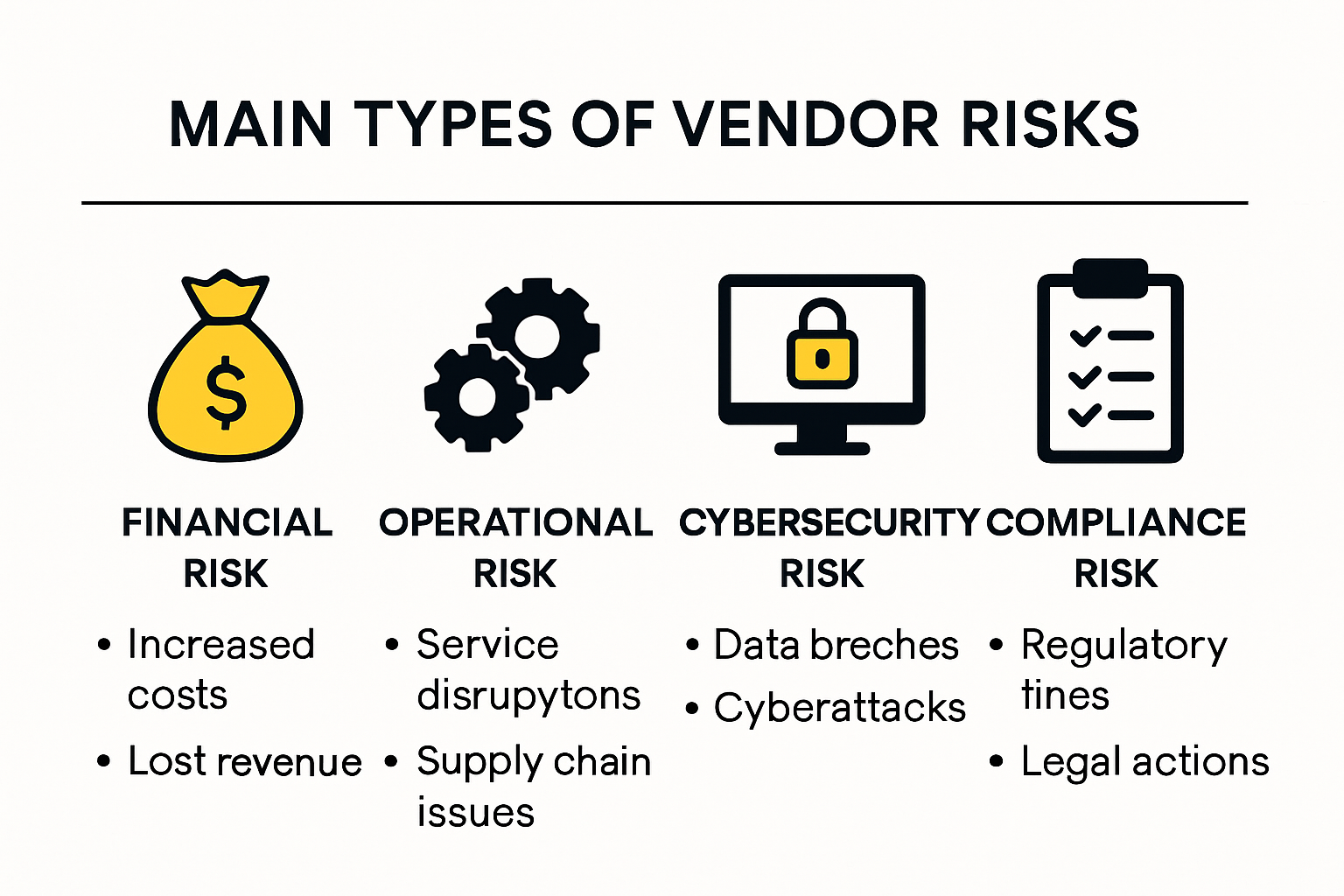
Vendor risks represent a complex landscape of potential challenges that organizations must carefully navigate to protect their operational integrity and strategic objectives. These risks extend far beyond simple contractual considerations, encompassing a wide range of potential vulnerabilities that can significantly impact an organization's performance and reputation.
Financial and Operational Vulnerability
Financial risks remain at the forefront of vendor risk management. Bright Defense highlights that organizations must conduct comprehensive financial assessments of potential vendors to understand their fiscal stability. This involves examining key financial indicators such as liquidity, debt levels, revenue trends, and overall financial health. A vendor experiencing financial instability could potentially disrupt your supply chain, fail to deliver critical services, or unexpectedly cease operations.
Operational risks are equally critical. These risks emerge from potential inefficiencies, process failures, or operational disruptions within a vendor's organization. CashFlo notes that operational risks can manifest through inconsistent service delivery, technological limitations, or inadequate quality control mechanisms. Organizations must develop robust evaluation frameworks that assess a vendor's operational capabilities, including their technology infrastructure, process maturity, and ability to consistently meet performance standards.
Cybersecurity and Compliance Challenges
Cybersecurity represents a paramount concern in vendor risk management. Vendors with weak security protocols can become potential entry points for cyber threats, potentially exposing your organization to data breaches, intellectual property theft, and significant reputational damage. Oliver Wyman emphasizes the critical need for comprehensive cybersecurity assessments that go beyond surface-level evaluations.
Comprehensive vendor risk assessments should include detailed examinations of:
- Cybersecurity Infrastructure: Evaluation of security protocols, encryption standards, and incident response capabilities.
- Regulatory Compliance: Verification of adherence to industry-specific regulations and standards.
- Data Protection Mechanisms: Assessment of data handling practices and privacy protection strategies.
Successful vendor risk management requires a proactive, holistic approach that integrates continuous monitoring, rigorous assessment protocols, and adaptive risk mitigation strategies. Organizations must view vendor relationships as dynamic partnerships that demand ongoing scrutiny and strategic alignment.
By developing a sophisticated understanding of potential vendor risks and implementing comprehensive evaluation frameworks, organizations can transform potential vulnerabilities into strategic opportunities for enhanced operational resilience and performance.
How Vendor Risks Impact Your Business
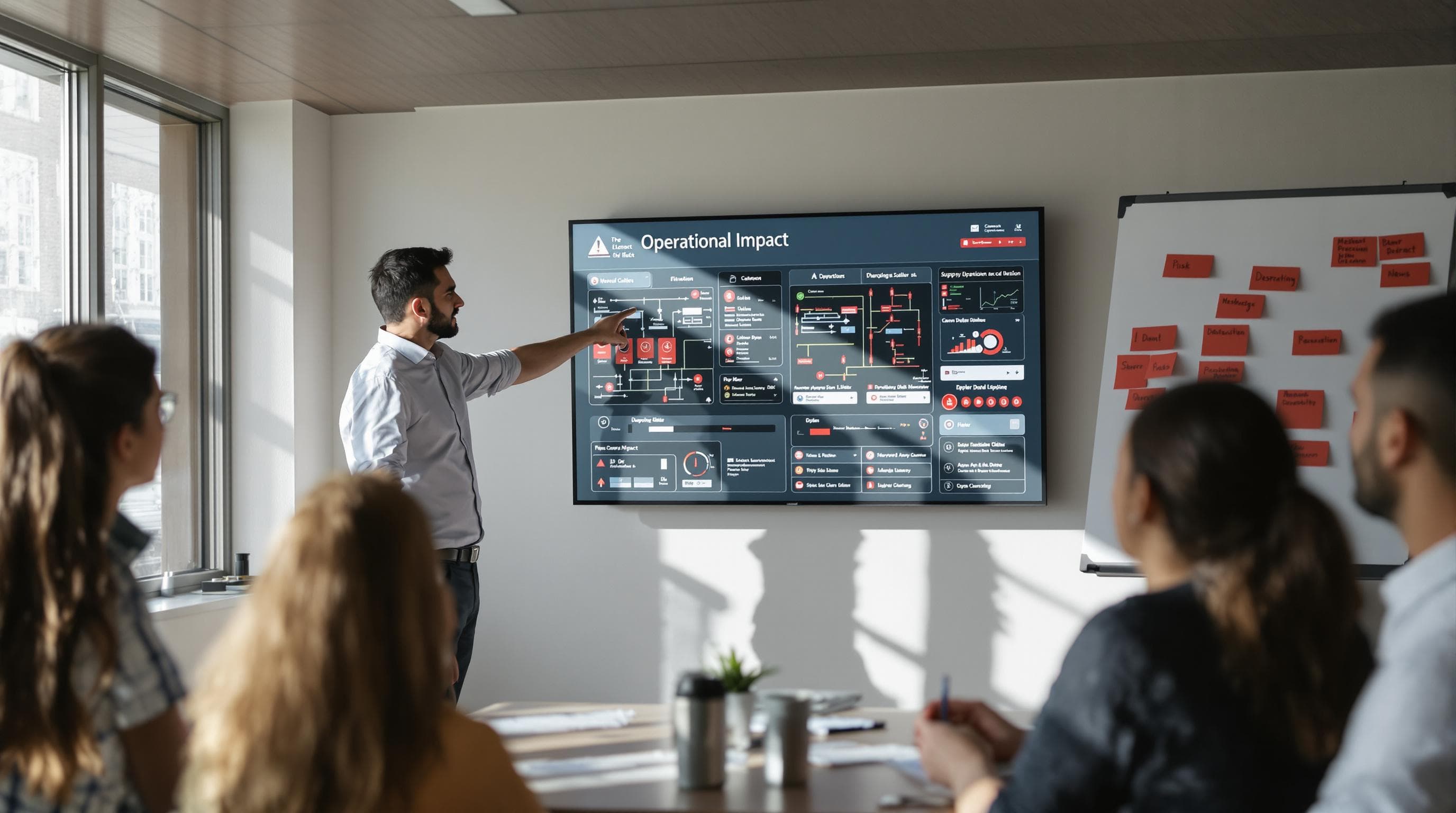
Vendor risks are not mere theoretical concerns but tangible challenges that can profoundly disrupt business operations, financial stability, and organizational reputation. Understanding the multifaceted ways these risks manifest is crucial for developing proactive mitigation strategies.
Financial and Operational Disruption Risks
Cincinnati Insurance reveals that vendor risks can create significant financial vulnerabilities for organizations. A single vendor's financial instability or operational failure can trigger cascading consequences that extend far beyond immediate service interruptions. These risks might include sudden supply chain breakdowns, unexpected service discontinuations, or compliance failures that result in substantial monetary penalties.
For instance, when a critical vendor experiences financial distress, your organization could face immediate challenges such as:
- Sudden Service Interruptions: Critical services or product deliveries might halt without warning
- Emergency Replacement Costs: Rapid vendor replacement can incur substantial unexpected expenses
- Contractual Penalties: Breach of agreements due to vendor failures can lead to legal and financial repercussions
Cybersecurity and Data Protection Implications
CIO Index emphasizes that data security represents a critical dimension of vendor risks. Vendors with inadequate cybersecurity protocols can become potential entry points for sophisticated cyber threats, potentially exposing your organization to significant data breaches, intellectual property theft, and regulatory non-compliance.
Modern vendor risk management requires comprehensive assessments that evaluate:
- Cybersecurity infrastructure and protocols
- Data handling and protection mechanisms
- Compliance with industry-specific security standards
Technological Innovation and Risk Mitigation
Emerging research proposes innovative approaches to vendor risk management, highlighting the potential of blockchain technology in creating more transparent, traceable vendor assessment frameworks. By integrating advanced technological solutions, organizations can develop more robust risk management strategies that adapt to evolving business landscapes.
Successful vendor risk management is not about eliminating all risks but about creating resilient systems that can effectively identify, assess, and mitigate potential vulnerabilities. This requires a dynamic, proactive approach that views vendor relationships as strategic partnerships requiring continuous monitoring and collaborative risk management.
Ultimately, understanding and addressing vendor risks is not just a defensive strategy but an opportunity to enhance organizational agility, build more robust operational frameworks, and create competitive advantages through strategic vendor relationship management.
Effective Ways to Manage Vendor Risks in 2025
As vendor ecosystems become increasingly complex, organizations must adopt sophisticated and proactive approaches to effectively manage and mitigate potential risks. The year 2025 demands a strategic, technology-driven methodology that goes beyond traditional risk management techniques.
Comprehensive Vendor Assessment and Due Diligence
Shared Assessments emphasizes the critical importance of thorough vendor due diligence as the foundational step in risk management. This process involves more than surface-level evaluations. Organizations must develop robust frameworks that conduct deep, multidimensional assessments of potential vendors.
Key components of comprehensive vendor assessments include:
- Financial Health Evaluation: Detailed analysis of vendor financial statements
- Operational Capability Assessment: Examination of technological infrastructure and process maturity
- Security Control Verification: Rigorous assessment of cybersecurity protocols and data protection mechanisms
Here is a summary table outlining the key components of comprehensive vendor assessments and what each involves:
| Assessment Component | What It Involves |
|---|---|
| Financial Health Evaluation | Analyze vendor financial statements, liquidity, debt, and revenue trends |
| Operational Capability Assessment | Review technology infrastructure, process maturity, and service consistency |
| Security Control Verification | Assess cybersecurity protocols and data protection mechanisms |
Continuous Monitoring and Performance Tracking
ISACA recommends establishing clear key performance indicators (KPIs) to objectively monitor vendor performance. This approach transforms vendor management from a static, periodic review process to a dynamic, real-time evaluation system.
Effective continuous monitoring strategies should include:
- Regular security audits
- Performance benchmarking
- Compliance verification
- Real-time risk assessment mechanisms
Technological Innovation in Risk Management
Emerging blockchain research presents groundbreaking approaches to vendor risk management. By leveraging blockchain technology, organizations can create more transparent, immutable, and traceable vendor assessment frameworks. Smart contracts enable real-time monitoring of compliance and security controls, significantly reducing human error and enhancing risk detection capabilities.
Innovative technological approaches to vendor risk management include:
- Blockchain-Enhanced Tracking: Ensuring transparency and immutability of vendor interactions
- AI-Powered Risk Detection: Using machine learning algorithms to predict potential vendor vulnerabilities
- Automated Compliance Monitoring: Implementing systems that provide instant alerts on potential risk deviations
The following table compares traditional vendor risk management methods with innovative, technology-driven approaches, helping readers visualize the shift happening in 2025:
| Approach | Traditional Methods | Innovative Methods (2025) |
|---|---|---|
| Risk Monitoring | Periodic reviews, manual audits | Real-time monitoring, AI & blockchain |
| Vendor Assessment | Paper-based checklists, annual review | Multidimensional, continuous, tech-driven |
| Compliance Tracking | Manual tracking, spreadsheets | Automated monitoring, instant alerts |
| Data Transparency | Limited visibility | Full traceability (blockchain) |
Successful vendor risk management in 2025 requires a holistic, proactive approach that integrates comprehensive assessments, continuous monitoring, and cutting-edge technological solutions. Organizations must view vendor relationships as dynamic partnerships that demand ongoing scrutiny, strategic alignment, and adaptive risk mitigation strategies.
By embracing these advanced methodologies, businesses can transform vendor risk management from a defensive mechanism into a strategic advantage, creating more resilient, secure, and efficient operational ecosystems.
Frequently Asked Questions
What are the most common vendor risks to watch in 2025?
Vendor risks in 2025 include financial and operational vulnerabilities, cybersecurity challenges, and compliance issues. Organizations must assess these risks to protect their operations effectively.
How can vendor risks impact my business?
Vendor risks can lead to financial disruption, operational inefficiencies, and data breaches. Understanding these impacts allows organizations to develop proactive strategies to mitigate potential threats.
What strategies can I implement to manage vendor risks effectively?
To manage vendor risks, conduct comprehensive assessments, implement continuous monitoring systems, and leverage technological innovations such as AI and blockchain for enhanced transparency and efficiency.
Why is cybersecurity a significant concern in vendor risk management?
Cybersecurity is critical because vendors with weak security protocols can become entry points for cyber threats, resulting in significant data breaches and reputational damage for organizations.
Take Control of Vendor Risks with Skypher’s Automation
Struggling to keep up with the rapidly evolving vendor risks highlighted in this guide? Relying on outdated processes for security questionnaires leaves your organization exposed to financial disruption, compliance gaps, and cybersecurity threats. It is time to close the risk gap and turn every security review into a strength.
Skypher streamlines security questionnaire responses, automating the most time-consuming parts while ensuring your data is always accurate and up to date. Use real-time collaboration, connect instantly with over 40 third-party risk management platforms, and show your partners you take every risk seriously. Do not let a slow or manual process undermine your operational resilience. Visit Skypher’s main platform now to explore our AI Questionnaire Automation Tool and discover how you can build a more secure vendor ecosystem today.