

The Health Insurance Portability and Accountability Act has significant implications for organizations handling sensitive medical information. More than 60% of healthcare entities are unaware of their compliance responsibilities under this federal regulation. But here's the kicker: understanding these obligations is not just essential; it’s legally required. Because failing to comply can lead to hefty fines that reach into the millions, jeopardizing not only finances but also trust with patients.
Defining HIPAA Covered Entities

The Health Insurance Portability and Accountability Act (HIPAA) establishes crucial privacy and security regulations for certain organizations that handle sensitive medical information. At the core of understanding HIPAA compliance is knowing what constitutes a covered entity—the organizations directly regulated by these federal standards.
What Exactly Is a HIPAA Covered Entity?
A covered entity for HIPAA purposes refers to specific types of organizations that handle protected health information (PHI) and must comply with HIPAA regulations. The exact definition is established in the HIPAA regulations under § 160.103, which identifies three distinct categories of organizations that qualify as covered entities.
According to the Centers for Medicare & Medicaid Services, a HIPAA covered entity falls into one of these three categories:
-
Health Plans: Organizations that provide or pay for medical care. These include health insurance companies, HMOs, Medicare, Medicaid, and employer-sponsored health plans.
-
Health Care Clearinghouses: Entities that process nonstandard health information they receive from another entity into a standard format, or vice versa. Examples include billing services and community health management information systems.
-
Health Care Providers: Doctors, clinics, psychologists, dentists, chiropractors, nursing homes, and pharmacies that transmit any health information electronically in connection with transactions for which HHS has adopted standards.
It's important to understand that the third category—healthcare providers—carries a specific qualifier. A healthcare provider only becomes a covered entity when they transmit protected health information electronically in connection with certain transactions. This includes activities like claims, benefit eligibility inquiries, referral authorization requests, or other transactions for which HHS has established standards.
The Significance of Covered Entity Status
Being classified as a HIPAA covered entity carries substantial legal implications. These organizations must:
- Implement safeguards to protect health information
- Limit uses and disclosures of protected health information
- Provide individuals with rights regarding their health information
- Develop clear privacy procedures and train staff accordingly
- Designate a privacy official responsible for implementing privacy procedures
Failing to meet these obligations can result in severe penalties, including substantial fines and corrective action plans. The designation as a covered entity is not optional—if an organization meets the definition, compliance is mandatory regardless of size, profit status, or other factors.
Beyond Direct Covered Entities
The reach of HIPAA extends beyond just the covered entities themselves. Organizations that perform certain functions or services for covered entities that involve access to PHI are known as business associates. These entities must also comply with many HIPAA requirements through formal contracts called Business Associate Agreements (BAAs).
Understanding whether your organization qualifies as a covered entity for HIPAA is the first critical step in determining your compliance obligations. This classification serves as the foundation for all other HIPAA-related requirements that may apply to your organization.
Key Takeaways
| Takeaway | Explanation |
|---|---|
| Understanding Covered Entities is Crucial for Compliance | Organizations must clearly identify whether they fall into one of the three HIPAA covered entity categories: health plans, health care clearinghouses, or health care providers, to determine their compliance obligations. |
| Health Care Providers Must Transmit Electronically | Health care providers only qualify as covered entities if they transmit protected health information electronically in connection with HIPAA-covered transactions, making this a key factor in compliance. |
| Compliance Obligations Carry Legal Implications | Covered entities must implement safeguards, limit disclosures, and uphold patient rights regarding their health information, with non-compliance leading to significant penalties. |
| Ongoing Compliance is a Necessity | HIPAA compliance is an ongoing process requiring regular risk assessments, policy updates, and employee training to adapt to evolving risks and regulations. |
| Business Associates Also Have Compliance Responsibilities | Organizations providing services for covered entities that access PHI must have Business Associate Agreements in place and comply with HIPAA regulations, expanding the scope of responsibility beyond direct covered entities. |
Determining Covered Entity Eligibility

Determining whether your organization qualifies as a covered entity under HIPAA is a critical first step in understanding your compliance obligations. While the definition seems straightforward, applying it to real-world scenarios often requires careful analysis of your organization's activities and operations.
Health Plans: Identifying Coverage
Health plans are perhaps the most straightforward category to identify. Your organization qualifies as a covered entity under this classification if it provides or pays for the cost of medical care. This includes:
- Health insurance companies
- Health maintenance organizations (HMOs)
- Employer-sponsored group health plans
- Government programs like Medicare and Medicaid
- Military health programs like TRICARE
- Prescription drug insurers
- Dental insurers
The key determining factor is whether your organization functions primarily to finance or reimburse healthcare services. Even if your organization outsources certain administrative functions, it remains a covered entity if it meets this fundamental criteria.
Health Care Clearinghouses: Processing Functions
Health care clearinghouses serve as intermediaries that process nonstandard health information from other entities into standard formats. Your organization may qualify as a clearinghouse if it:
- Converts nonstandard health data into standard electronic formats
- Processes raw health data into standardized billing codes
- Provides billing services that involve processing health information
- Operates as a community health management information system
Importantly, if your organization primarily performs these processing functions, it likely qualifies as a covered entity regardless of its size or whether it interacts directly with patients.
Health Care Providers: The Electronic Transmission Test
The provider category contains the most nuance when determining covered entity status. Not all healthcare providers are automatically covered entities. According to the Centers for Medicare & Medicaid Services, a healthcare provider only becomes a covered entity when they transmit health information electronically in connection with covered transactions.
To determine if your organization meets this criterion, ask the following questions:
- Does your organization provide healthcare services or supplies?
- Does your organization transmit any health information electronically?
- Is this electronic transmission related to transactions for which HHS has adopted standards?
If you answered yes to all three questions, your organization likely qualifies as a covered entity. Examples of covered transactions include claims submissions, benefit eligibility inquiries, referral authorizations, and coordination of benefits.
It's worth noting that indirect electronic transmissions also count. If your organization uses a billing service or other third party to conduct electronic transactions on your behalf, you're still considered a covered entity. This provision prevents organizations from circumventing compliance by simply outsourcing electronic transactions.
Special Considerations for Complex Organizations
Many healthcare organizations perform multiple functions that may cross these categories. For example, a hospital might function as both a healthcare provider and operate a health plan for its employees. In these cases, the organization is subject to HIPAA regulations for all covered functions it performs.
The determination process becomes more complex for research institutions, universities with medical centers, or government agencies with healthcare components. In these scenarios, organizations often implement what's called 'hybrid entity' status, where they designate which components are covered by HIPAA and which are not.
If your organization's status remains unclear after reviewing these criteria, consulting with a healthcare attorney specializing in HIPAA compliance is advisable. Correctly determining your covered entity status establishes the foundation for all your subsequent HIPAA compliance efforts.
HIPAA Compliance and Responsibilities
Once an organization determines it is a covered entity under HIPAA, a comprehensive set of compliance responsibilities comes into effect. These obligations are not optional—they represent legal requirements that carry significant penalties for non-compliance. Understanding these responsibilities is essential for any covered entity seeking to protect patient information while meeting federal standards.
Core Compliance Requirements
HIPAA compliance for covered entities centers around three primary rules that work together to create a comprehensive framework for protecting health information:
-
Privacy Rule: This foundational component governs the use and disclosure of Protected Health Information (PHI). Covered entities must implement policies that limit how PHI is used, establish procedures for obtaining necessary authorizations, and recognize patients' rights to access their own health information. The Privacy Rule establishes the principle that PHI should only be shared on a 'minimum necessary' basis—providing only what is required for a particular purpose, nothing more.
-
Security Rule: While the Privacy Rule covers all PHI in any format, the Security Rule specifically addresses electronic PHI (ePHI). Covered entities must implement appropriate administrative, physical, and technical safeguards to ensure the confidentiality, integrity, and availability of all ePHI they create, receive, maintain, or transmit. This includes conducting risk assessments, implementing access controls, and establishing contingency plans.
-
Breach Notification Rule: In the event that PHI is improperly disclosed or accessed, covered entities have specific obligations to notify affected individuals, the Department of Health and Human Services (HHS), and in some cases, the media. These notifications must occur within strict timeframes and include specific information about the breach.
Organizational Implementation Requirements
To satisfy these rules, covered entities must take concrete steps within their organizations:
-
Appoint a Privacy Officer: Every covered entity must designate an individual responsible for developing and implementing privacy policies and procedures and serving as the contact person for privacy-related questions and complaints.
-
Develop Written Policies and Procedures: Comprehensive documentation of privacy and security practices is required, covering everything from patient access requests to security incident responses.
-
Conduct Staff Training: All workforce members must receive training on HIPAA requirements relevant to their job functions. This training should be documented and provided regularly, not just once upon hiring.
-
Implement Technical Safeguards: Covered entities must adopt technology solutions that protect ePHI, including encryption, access controls, audit controls, integrity controls, and transmission security.
-
Establish Business Associate Agreements: When sharing PHI with vendors or service providers (business associates), covered entities must obtain written assurances that these partners will appropriately safeguard the information.
Patient Rights Management
HIPAA establishes specific rights for individuals regarding their health information, and covered entities must honor these rights:
- Right to access and obtain copies of their health records
- Right to request corrections to inaccurate information
- Right to receive an accounting of certain disclosures of their information
- Right to request restrictions on certain uses and disclosures
- Right to request confidential communications
- Right to receive a Notice of Privacy Practices explaining how their information may be used
Establishing clear procedures for responding to these requests is an essential part of HIPAA compliance.
Ongoing Compliance Activities
HIPAA compliance isn't a one-time achievement but rather an ongoing process. According to research published in the International Journal of Civil Engineering and Technology, maintaining HIPAA compliance remains challenging for healthcare organizations due to evolving cyber threats and technological advancements. Covered entities must:
- Conduct regular risk assessments to identify potential vulnerabilities
- Update policies and procedures to address changing circumstances
- Perform periodic technical and non-technical evaluations
- Document compliance efforts and maintain records for at least six years
- Stay informed about regulatory changes and guidance from HHS
The consequences of failing to meet these responsibilities can be severe, ranging from corrective action plans to civil monetary penalties that can reach into the millions of dollars for willful neglect. Beyond financial penalties, HIPAA violations can damage patient trust, harm an organization's reputation, and in some cases, result in criminal charges against responsible individuals.
By systematically addressing these compliance requirements, covered entities can protect both their patients and themselves while fulfilling the important trust placed in them as stewards of sensitive health information.
Examples of Covered Entities
Understanding HIPAA covered entities becomes clearer when examining specific examples across the three main categories. These real-world examples demonstrate how the definition applies to various organizations in the healthcare ecosystem.
Health Plan Examples
Health plans constitute a broad category of covered entities that finance or administer the cost of healthcare. Common examples include:
- Commercial health insurance providers such as Aetna, UnitedHealthcare, and Blue Cross Blue Shield
- Federal healthcare programs including Medicare, Medicaid, and TRICARE (military healthcare)
- Employer-sponsored health plans that provide or pay for medical care for employees and their dependents
- Health maintenance organizations (HMOs) like Kaiser Permanente that both insure and provide care
- Dental insurance plans that cover dental procedures and services
- Vision insurance plans covering eye examinations and corrective lenses
- Prescription drug plans such as Medicare Part D plans or standalone pharmacy benefit managers
- Long-term care insurers providing coverage for nursing home care and assisted living services
It's important to note that certain types of insurance are explicitly excluded from HIPAA's definition of health plans. These include workers' compensation insurance, automobile insurance plans (even those covering medical payments), and life insurance policies.
Healthcare Clearinghouse Examples
Healthcare clearinghouses serve as intermediaries that process nonstandard health information into standard formats. Examples include:
- Billing services that convert provider-supplied information into standard claim formats
- Repricing companies that convert standard transactions into proprietary formats for payers
- Community health management information systems that process health information from multiple sources
- Value-added networks (VANs) that facilitate the exchange of healthcare transactions between providers and payers
- Switching companies that route electronic claims from providers to appropriate insurance carriers
These entities typically operate behind the scenes in healthcare transactions, but their role in processing protected health information makes them subject to HIPAA regulations.
Healthcare Provider Examples
Healthcare providers become covered entities when they transmit health information electronically in connection with HIPAA-covered transactions. Common examples include:
- Hospitals and health systems of all sizes, from small community hospitals to large academic medical centers
- Physicians and physician group practices across all specialties
- Dentists and dental practices
- Chiropractors, optometrists, and podiatrists
- Psychologists, psychiatrists, and other mental health professionals
- Nursing homes and extended care facilities
- Home health agencies providing care in patients' homes
- Pharmacies that transmit prescription information electronically
- Laboratories conducting medical tests and electronically sharing results
- Ambulance companies and emergency medical service providers
- Physical, occupational, and speech therapists
- Durable medical equipment suppliers that bill health plans
It's worth emphasizing that size doesn't matter—a solo practitioner who electronically transmits health information for billing purposes is just as much a covered entity as a large hospital system.
Complex Organizational Examples
Some organizations have complex structures that span multiple covered entity categories or include both covered and non-covered components:
- Integrated healthcare systems that function as both providers and health plans
- Universities with medical schools and hospitals that designate their healthcare components as covered entities while excluding academic departments
- Government agencies that administer health plans or provide healthcare services
- Retail pharmacies that operate both as healthcare providers and as retail establishments
In these cases, organizations may implement hybrid entity status, formally documenting which organizational components are subject to HIPAA requirements and which are not.
Understanding these examples helps organizations recognize their responsibilities under HIPAA and illustrates the broad scope of entities required to protect health information under federal law. If your organization resembles any of these examples, a deeper evaluation of your covered entity status may be warranted.
Frequently Asked Questions
What is a covered entity under HIPAA?
A covered entity under HIPAA refers to organizations that handle protected health information (PHI) and must comply with HIPAA regulations. This includes health plans, health care clearinghouses, and health care providers who transmit health information electronically.
Who qualifies as a health care provider covered entity?
A health care provider qualifies as a covered entity if they electronically transmit health information related to transactions covered by HIPAA, such as claims submissions or benefit inquiries. This includes doctors, clinics, and pharmacies.
What compliance responsibilities do covered entities have?
Covered entities must implement safeguards to protect PHI, limit disclosures, provide patients with rights regarding their information, train staff, and designate a privacy official responsible for compliance. Non-compliance can result in significant penalties.
What is a business associate in relation to HIPAA?
A business associate is an organization that performs functions or services on behalf of a covered entity, involving access to PHI. They must also comply with HIPAA regulations and typically do so through formal contracts known as Business Associate Agreements.
Elevate Your HIPAA Compliance with Skypher's Solutions
Navigating HIPAA compliance can feel daunting for many organizations, especially with the stringent regulations affecting covered entities. With over 60% of healthcare entities unaware of their obligations, your organization can't afford to be one of them. Whether you're a healthcare provider, a healthcare clearinghouse, or a health plan, having a robust compliance strategy is essential to safeguard your patients' sensitive information and avoid costly penalties.
But what if you could simplify this process? At Skypher, we understand the complexities you face. Our AI-driven Questionnaire Automation Tool is designed specifically for organizations like yours, providing a streamlined solution for handling security questionnaires efficiently. Imagine completing compliance reviews significantly faster and with higher accuracy—our platform allows for real-time collaboration and integrates with over 40 third-party risk management platforms, keeping you ahead of the compliance curve.
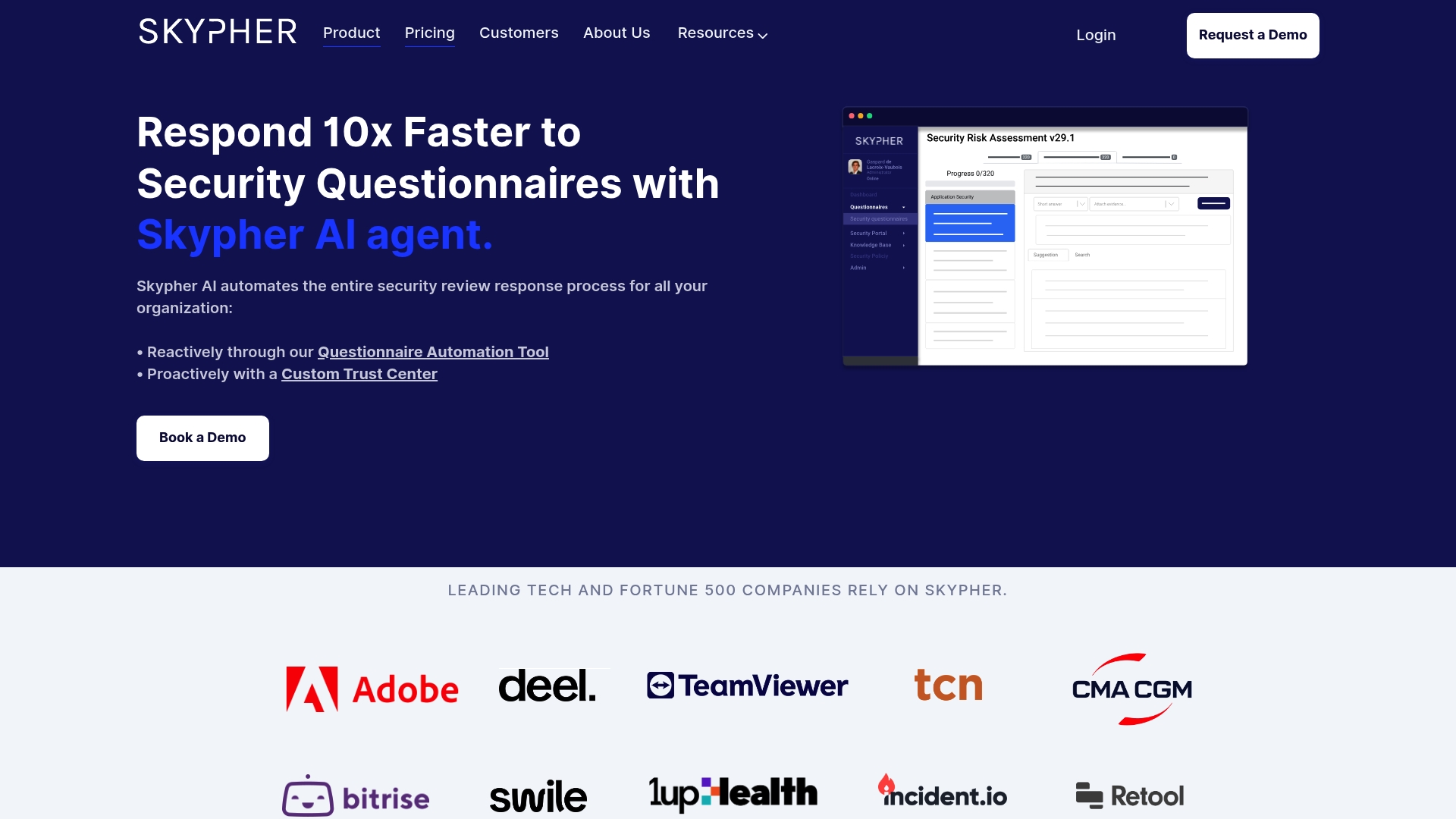
Ready to transform your HIPAA compliance process? Discover how Skypher can enhance your operational productivity while ensuring your organization meets its compliance obligations. Don’t wait until it’s too late; act now to secure your sensitive health information and build trust with your patients. Visit us at https://skypher.co and start your journey towards seamless compliance today!