

Managing security questionnaires manually wastes weeks of valuable time. AI-powered automation can answer 200 questions in under a minute, transforming how IT teams handle vendor risk assessments. This shift from manual processes to intelligent automation eliminates bottlenecks, reduces burnout, and accelerates vendor onboarding while maintaining accuracy. If your team still manually completes questionnaires, you're leaving efficiency on the table.
Table of Contents
- Introduction To Cybersecurity Questionnaires
- Common Challenges In Managing Cybersecurity Questionnaires
- Automation Technologies Transforming Questionnaire Management
- Integration With Third-Party Risk Management Platforms
- Common Misconceptions About Cybersecurity Questionnaires
- Practical Applications And Case Studies
- Best Practices For Effective Cybersecurity Questionnaire Management
- Summary And Future Outlook
- Accelerate Your Cybersecurity Questionnaire Management With Skypher
- Frequently Asked Questions
Key takeaways
| Point | Details |
|---|---|
| Cybersecurity questionnaires assess vendor security risks | These structured assessments are critical for third-party risk management in tech and finance sectors |
| Manual processes cause delays and burnout | Traditional handling takes 7 to 14 days per questionnaire, increasing staff burnout by 20% |
| AI automation delivers rapid responses | Automated tools complete 200 questions in under a minute with improved accuracy |
| Integration with TPRM platforms streamlines workflows | Connecting with 40+ risk management systems eliminates duplicate work and centralizes vendor data |
| Common myths hinder automation adoption | Misconceptions about quality and compliance roles prevent teams from realizing automation benefits |
Introduction to cybersecurity questionnaires
Cybersecurity questionnaires are structured assessments sent to vendors and third-party providers to evaluate their security posture. These documents help organizations verify whether external partners meet security standards before granting access to sensitive data or systems. For medium and large enterprises, especially in tech and finance, these questionnaires are not optional extras but regulatory and operational necessities.
The primary purpose is risk management. When you onboard a new vendor, you need assurance they won't introduce vulnerabilities into your environment. Questionnaires systematically probe security controls, compliance certifications, incident response capabilities, and data handling practices. They transform abstract security claims into documented evidence you can audit and verify.
Two main types exist:
- Standardized assessments: Industry frameworks like SIG, CAIQ, or VSA that use consistent question sets across vendors
- Custom vendor-specific forms: Tailored questionnaires addressing unique organizational requirements or compliance mandates
Both types share a common challenge. They require detailed, accurate responses that demonstrate security competence while consuming significant staff time to complete properly.
Common challenges in managing cybersecurity questionnaires
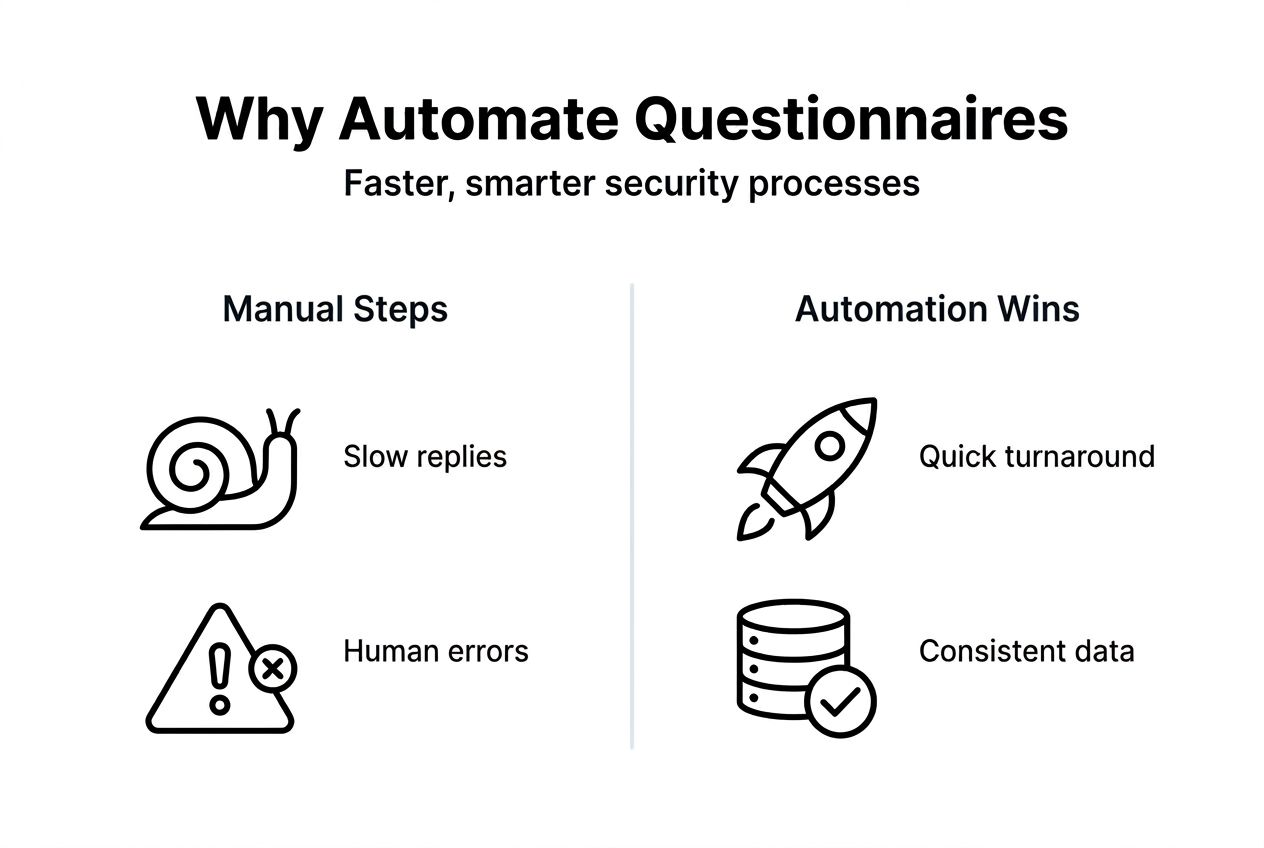
Manual questionnaire management creates operational bottlenecks that ripple across security and sales teams. Manual response times average 7 to 14 days, delaying vendor approvals and extending sales cycles. This lag increases security exposure windows and frustrates potential clients waiting for onboarding clearance.

The repetitive nature of this work drives burnout. When security professionals spend hours answering the same questions across multiple questionnaires, IT staff burnout increases by about 20%. Talented team members exit for roles with more strategic work, creating knowledge gaps and turnover costs.
Key pain points include:
- Inconsistent answers: Fatigue and manual copying introduce errors that undermine credibility during audits
- Fragmented tools: Switching between spreadsheets, documents, and email chains wastes time and duplicates effort
- Format chaos: Vendors submit questionnaires in Word, Excel, PDFs, and proprietary portals requiring different handling approaches
- Version control nightmares: Tracking which answers are current across multiple simultaneous questionnaires becomes unmanageable
"The manual process is not just slow. It actively damages team morale and creates compliance risks through inconsistent documentation."
These security questionnaires challenges compound as organizations scale vendor relationships. What starts as manageable for 10 vendors becomes overwhelming at 100.
Automation technologies transforming questionnaire management
AI-powered platforms eliminate manual bottlenecks by intelligently parsing questionnaires and generating accurate responses at machine speed. AI technologies answer up to 200 questions in under one minute, reducing response times by 90%. This dramatic acceleration comes from sophisticated natural language processing that understands question intent across varied phrasings.
Modern security questionnaires automation handles multiple formats seamlessly. Whether vendors send Word documents, Excel spreadsheets, PDFs, or submit through online portals like OneTrust, the system extracts questions and matches them to your documented security controls. No more manual copying or reformatting.
Multilingual support expands this efficiency globally. Enterprise teams operating across regions no longer translate questionnaires manually. The platform processes Spanish, French, German, and other languages automatically, maintaining consistent answers regardless of submission language.
Key automation benefits:
- Real-time collaboration: Multiple team members review and refine answers simultaneously, catching errors before submission
- Content management: Centralized knowledge base stores approved answers with version control and audit trails
- Consistency enforcement: The system flags conflicting responses across questionnaires, ensuring your security story stays coherent
- Integration ready: API connections to third-party risk management platforms eliminate data silos
Statistic spotlight: Organizations adopting AI automation report 90% faster questionnaire completion while maintaining higher accuracy than manual processes.
The technology learns from your previous responses. As you complete more questionnaires, the AI refines its understanding of your security environment and delivers increasingly precise initial drafts that require minimal human review.
Integration with third-party risk management platforms
Standalone questionnaire tools create new silos. Smart automation platforms connect directly with your existing TPRM infrastructure, creating unified workflows. Supporting integrations with 40+ platforms including OneTrust, ServiceNow, Archer, and others means vendor data flows seamlessly without duplicate entry.
These connections transform how you manage vendor lifecycles. When a vendor submits a questionnaire through OneTrust, the automation platform pulls it automatically, generates responses based on your knowledge base, and pushes completed answers back into the TPRM system. Your risk team sees updated vendor profiles without touching the questionnaire directly.
Integration delivers multiple advantages:
- Centralized visibility: View all vendor assessments in one dashboard regardless of submission method
- Automated workflows: Trigger reviews, approvals, and follow-ups based on questionnaire completion status
- Audit trail preservation: Every answer, edit, and approval syncs to your TPRM system with timestamps
- Risk scoring updates: Completed questionnaires automatically refresh vendor risk ratings in your master database
The table below shows how integrated platforms compare to fragmented tools:
| Feature | Integrated Platform | Fragmented Tools |
|---|---|---|
| Data entry | Single source of truth | Manual copying between systems |
| Vendor updates | Automatic sync | Manual reconciliation |
| Audit trails | Unified across systems | Scattered across tools |
| Team visibility | Real-time shared view | Email chains and spreadsheets |
Automating security questionnaire responses with proper integration means your security documentation becomes a strategic asset rather than a repetitive burden.
Common misconceptions about cybersecurity questionnaires
Misunderstandings about questionnaires and automation prevent teams from adopting better approaches. Clearing these myths helps decision makers evaluate tools objectively.
Myth 1: Questionnaires are just compliance checklists. Many view these assessments as box-checking exercises with no strategic value. In reality, questionnaires are risk management tools that inform vendor selection, contract terms, and ongoing monitoring priorities. They identify specific vulnerabilities before they become incidents.
Myth 2: Automation reduces answer quality. Some fear AI-generated responses will be generic or inaccurate compared to human-crafted answers. Evidence contradicts this concern. Real-time collaboration features improve accuracy by 25% because automation provides consistent baseline answers that experts then review and refine. The combination outperforms purely manual processes.
Myth 3: Manual processes can match automated efficiency. Even experienced teams cannot compete with machine speed while maintaining accuracy. Manual approaches introduce transcription errors, version conflicts, and delays that automation eliminates. Surveys indicate 40% of security professionals still underestimate the efficiency gap.
Additional misconceptions:
- "Only large enterprises benefit": Mid-sized companies gain proportionally more time savings because they lack dedicated questionnaire staff
- "Automation requires extensive training": Modern platforms offer intuitive interfaces that teams adopt within days, not months
- "Custom questions break automation": Advanced systems handle both standard and unique questions through machine learning
"The fear that automation sacrifices quality for speed is backwards. Speed enables quality by giving experts time to focus on nuanced questions instead of repetitive copying."
Understanding these realities helps teams make informed decisions about security questionnaire automation rather than clinging to outdated manual methods.
Practical applications and case studies
Real-world implementations demonstrate concrete benefits beyond theoretical claims. These examples from medium to large tech and finance companies show measurable impacts.
-
Global tech company with 500+ vendors: This organization previously spent 10 days per questionnaire using manual processes. After implementing AI automation, response time dropped to under 2 hours for typical 200-question assessments. The security team redirected 30 hours per week from questionnaire filling to threat analysis and architecture reviews. Annual vendor onboarding capacity increased from 50 to over 400 without adding headcount.
-
Regional financial services firm: Manual questionnaire management created sales bottlenecks because security reviews delayed customer onboarding by weeks. Automation cut review time by 85%, reducing average sales cycle length by 30%. The firm closed 40% more deals in the first year post-implementation. Customer satisfaction scores improved as prospects experienced faster, more responsive security vetting.
-
Enterprise software provider: This company struggled with inconsistent answers across questionnaires, creating audit concerns. Automation centralized their security documentation and enforced consistency. Post-audit findings dropped from 12 inconsistencies to zero. The compliance team reported 50% operational efficiency gains as they stopped manually cross-checking questionnaire responses.
-
Multinational corporation with regional security teams: Language barriers previously required translators for questionnaires from European and Asian clients. Multilingual automation eliminated translation delays and costs. Cross-team collaboration features let regional experts contribute local compliance details while maintaining global consistency.
User testimonials consistently highlight improved team morale. Security professionals report feeling more valued when automation handles repetitive work, letting them focus on strategic initiatives. Turnover in questionnaire-handling roles decreased as the work became less tedious.
Best practices for effective cybersecurity questionnaire management
Selecting and implementing automation requires strategic thinking beyond just purchasing software. These practices maximize your return on investment.
Prioritize real-time collaboration. Choose platforms where multiple team members can simultaneously review, edit, and approve answers. This reduces errors and improves accuracy by 25% compared to serial review processes. Legal, compliance, and technical teams should contribute expertise without version control headaches.
Demand multi-format and multilingual support. Your vendors will send questionnaires in every imaginable format. Platforms that handle Word, Excel, PDF, and direct portal integrations prevent format conversion busywork. For global operations, automatic language processing ensures consistent responses regardless of submission language.
Integrate with existing TPRM systems. Standalone tools create new silos that defeat the purpose of automation. Verify the platform connects with OneTrust, ServiceNow, or whatever risk management system you currently use. Seamless data flow between systems eliminates duplicate entry and keeps vendor profiles current.
Build a customizable Trust Center. Proactive transparency reduces questionnaire volume. When prospects can self-serve security documentation through your Trust Center, they often skip formal questionnaires entirely. This accelerates sales while demonstrating security maturity.
Key implementation steps:
- Centralize your knowledge base: Document security controls, policies, and compliance certifications in one authoritative source
- Establish review workflows: Define who approves different answer types before automation submits responses
- Monitor accuracy metrics: Track answer acceptance rates and audit feedback to continuously improve your knowledge base
- Train across teams: Sales, legal, and compliance should understand how to access and use the system
Pro Tip: Include human expert review for high-stakes or unusually complex questions even when automation provides initial answers. This hybrid approach combines machine speed with human judgment for optimal results.
The comparison table below contrasts traditional versus automated approaches:
| Aspect | Manual Process | Automated Process |
|---|---|---|
| Response time | 7 to 14 days | Under 1 hour for 200 questions |
| Accuracy | Prone to copy/paste errors | 25% more accurate with collaboration |
| Staff burnout | 20% increase documented | Significant reduction reported |
| Integration | Email and spreadsheets | Direct API connections to TPRM |
| Scalability | Requires proportional headcount | Handles 10x volume without new hires |
Following automating security questionnaires best practices and questionnaire response best practices ensures your implementation delivers maximum value. Additional guidance on security questionnaire management tips helps teams avoid common pitfalls.
Summary and future outlook
Cybersecurity questionnaire automation represents a fundamental shift from manual document processing to intelligent workflow orchestration. The evidence is clear: AI-powered platforms deliver 90% faster responses, improve accuracy by 25%, and reduce staff burnout by eliminating repetitive work. For medium to large enterprises managing dozens or hundreds of vendor relationships, these improvements directly impact competitive positioning.
Integration with risk management platforms creates unified vendor lifecycle management. When questionnaire data flows automatically into TPRM systems, security teams gain holistic visibility without manual reconciliation. This integration will only deepen as platforms add more sophisticated risk scoring and continuous monitoring capabilities.
Key trends shaping the future:
- Fully collaborative ecosystems: Vendors, customers, and third-party auditors will share real-time access to security documentation, eliminating questionnaire exchanges entirely
- Predictive risk analysis: AI will proactively flag potential vendor risks based on questionnaire patterns before incidents occur
- Blockchain-verified credentials: Cryptographic proof of security controls will supplement traditional questionnaire responses
- Continuous assessment models: Static annual questionnaires will evolve into ongoing automated monitoring
IT and security professionals who embrace automation now position their organizations for this collaborative future. Those clinging to manual processes will face widening efficiency gaps and talent retention challenges as competitors demonstrate faster, more reliable vendor onboarding.
The question is not whether to automate but how quickly you can implement it. Every week of delay represents continued inefficiency, frustrated staff, and delayed business opportunities.
Accelerate your cybersecurity questionnaire management with Skypher
Your security team deserves better than manual questionnaire drudgery. Skypher's AI security questionnaire automation delivers the speed, accuracy, and integration your enterprise needs. Answer 200 questions in under a minute while maintaining consistency across all vendor assessments.

Seamless connections to 40+ third-party risk management platforms mean Skypher fits into your existing workflows without disruption. Real-time collaboration features let your team review and refine answers together, catching issues before submission. Customizable Trust Centers provide prospects with instant security documentation access, reducing questionnaire volume while demonstrating transparency.
The AI powered recommendation engine learns from your responses, delivering increasingly accurate initial drafts that require minimal review. Multilingual support handles global vendor relationships without translation overhead. Visit Skypher to see how automation transforms questionnaire management from bottleneck to competitive advantage.
Frequently asked questions
What is a cybersecurity questionnaire?
A cybersecurity questionnaire is a structured assessment that evaluates a vendor's security controls, compliance status, and risk management practices. Organizations send these questionnaires to third-party providers before granting access to systems or data. They serve as both due diligence tools and ongoing monitoring mechanisms, documenting security posture for audit and compliance purposes.
How does automation improve cybersecurity questionnaire response times?
AI automation parses questions instantly and matches them to your documented security controls, generating accurate responses in minutes rather than days. Security questionnaires automation handles hundreds of questions simultaneously while manual processes require sequential answering. Integrated collaboration features and centralized content management further accelerate reviews by eliminating version control delays and redundant work.
What are common misconceptions about cybersecurity questionnaires?
Many view questionnaires as mere compliance checklists rather than strategic risk management tools that inform vendor selection and monitoring priorities. Another widespread myth claims automation reduces answer quality, but evidence shows it improves accuracy by 25% through consistent baseline responses and expert review. Security questionnaire automation actually enhances quality while delivering speed benefits manual processes cannot match.
How do cybersecurity questionnaire automation tools integrate with risk management platforms?
Automation platforms connect via API to systems like OneTrust and ServiceNow, enabling bidirectional data flow without manual entry. When vendors submit questionnaires through your TPRM portal, the automation tool pulls them automatically, generates responses, and pushes completed assessments back into the risk platform. This integration maintains centralized vendor profiles and preserves complete audit trails across systems. Explore automating security questionnaire responses for implementation guidance.