

Defining SOC 1 Type 2 Reports: Scope, Objectives, and Key Concepts
A SOC 1 Type 2 report is a comprehensive audit document that evaluates the effectiveness of a service organization's internal controls related to financial reporting over a specified period, typically 6-12 months. Unlike its counterpart, the Type 1 report (which examines controls at a single point in time), a Type 2 SOC 1 report provides historical validation of control effectiveness.
SOC 1 Type 2 reports are specifically designed for service organizations whose activities may impact their clients' financial statements. According to the American Institute of CPAs (AICPA), these reports follow the Statement on Standards for Attestation Engagements (SSAE) No. 18.

The key components of a SOC 1 Type 2 report include:
- Management's assertion about control effectiveness throughout the review period
- Detailed system description including the services provided
- Control objectives and the specific controls implemented to meet them
- Testing procedures performed by the auditor to validate controls
- Results of testing with any exceptions or deviations noted
- The independent auditor's opinion on the fair presentation and operational effectiveness
What distinguishes a SOC 1 Type 2 from a Type 1 assessment is the temporal dimension—Type 2 demonstrates sustained compliance rather than a snapshot. For example, a payroll processing company that underwent a Type 2 audit would need to show that access controls and transaction validation processes functioned correctly consistently for the entire examination period, not just during initial implementation.
Key Takeaways
| Takeaway | Explanation |
|---|---|
| SOC 1 Type 2 reports validate historical effectiveness | They assess the effectiveness of internal controls over a specified review period, typically 6-12 months, showing sustained performance rather than a one-time evaluation. |
| Key components include management assertions and auditor opinions | The reports contain management's assertions about control effectiveness, details of the audited system, control objectives, testing results, and the independent auditor's opinion. |
| Type 2 is more rigorous than Type 1 | SOC 1 Type 2 reports involve extensive testing over time, demonstrating that controls not only exist but operate effectively consistently, unlike Type 1 reports. |
| Essential for organizations impacting financial statements | These reports are specifically designed for service organizations that affect clients' financial reporting, making them critical for compliance and risk management. |
SOC 1 Reporting Spectrum: Distinguishing Type 1 from Type 2
Understanding the difference between SOC 1 Type 1 and Type 2 reports is essential for organizations seeking appropriate compliance verification. The primary distinction lies in the assessment timeframe and depth of testing.
SOC 1 Type 1 vs. Type 2 reports differ fundamentally in their temporal focus:
- Type 1 Reports: Provide a snapshot assessment of control design at a specific point in time, essentially answering "Are appropriate controls in place?"
- Type 2 Reports: Evaluate control effectiveness over an extended period (typically 6-12 months), answering both "Are appropriate controls in place?" and "Did they work consistently throughout the period?"
According to I.S. Partners, Type 2 reports include more extensive testing procedures and results, making them considerably more rigorous than their Type 1 counterparts.
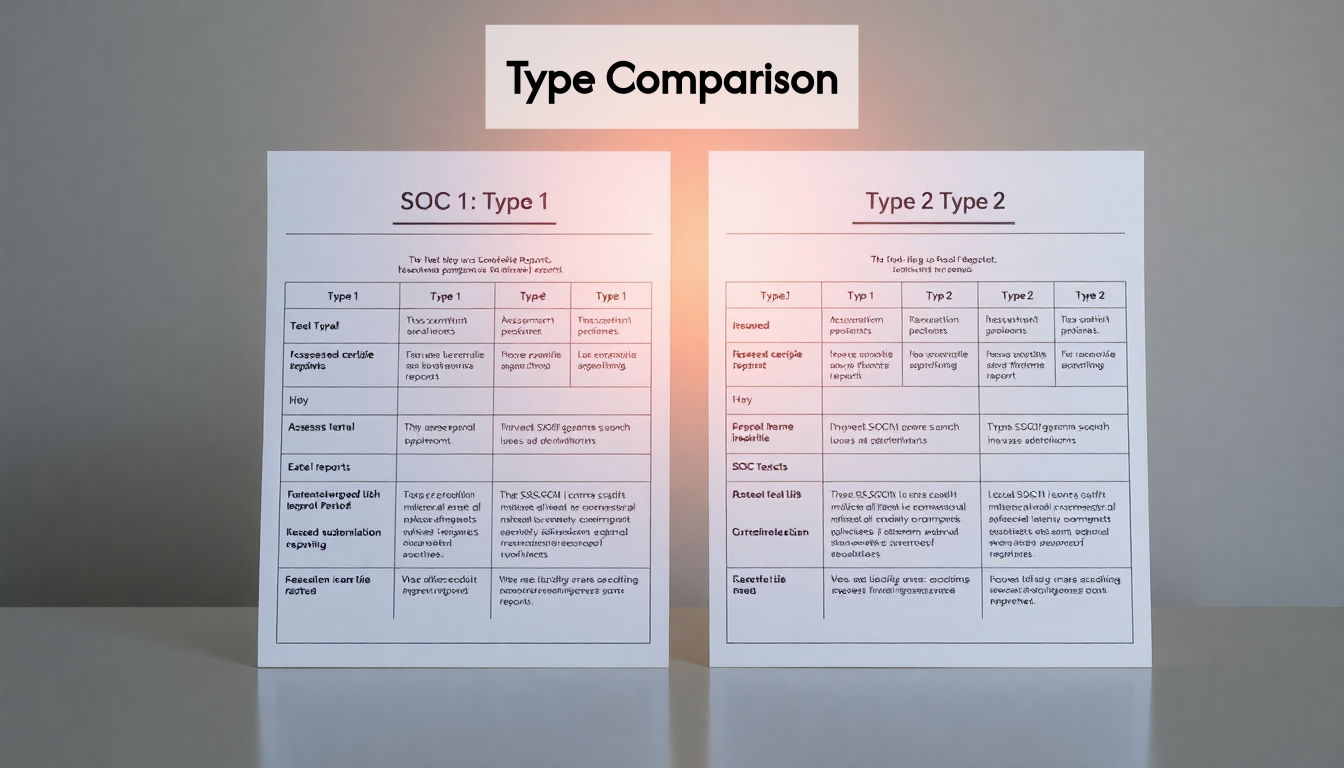
Consider this practical comparison: A payroll processing company with a Type 1 report demonstrates they have implemented controls for accurate calculation of withholding taxes. The same company with a Type 2 report proves these controls functioned correctly throughout the assessment period, with auditors sampling multiple payroll cycles to verify consistent performance.
While Type 1 reports serve as a valuable first step toward compliance, Type 2 reports provide the comprehensive assurance most clients and regulators ultimately require. Organizations typically begin with Type 1 assessment before progressing to Type 2, building a mature control environment through this phased approach.
Inside the Audit: Process and Methodology of SOC 1 Type 2 Evaluations
A SOC 1 Type 2 audit follows a structured methodology designed to thoroughly assess control effectiveness over time. The process typically unfolds across several distinct phases, with each building upon the previous to create a comprehensive evaluation.
The SOC 1 Type 2 audit journey encompasses these key stages:
- Planning and Scoping: Defining the audit boundaries, identifying critical systems, and determining which control objectives to include
- Control Definition: Documenting existing controls and mapping them to specific financial reporting risks
- Testing Period Selection: Establishing the timeframe (typically 6-12 months) for continuous control evaluation
- Evidence Collection: Gathering documentation, system logs, and other artifacts demonstrating control performance
- Control Testing: Auditors examining samples across the entire period to verify consistent control operation
- Findings Documentation: Recording test results, exceptions, and management responses
- Report Compilation: Assembling all components into the final attestation report
According to Sprinto, the auditors employ various testing methodologies including inquiry, observation, inspection, and reperformance to thoroughly evaluate controls. For example, when assessing a payment processing service's transaction validation controls, auditors might select random samples from each month of the testing period, tracing them through the entire workflow to confirm consistent application of authorization limits.
Modern SOC 1 Type 2 audits increasingly leverage automated evidence collection tools that continuously monitor control performance. This approach not only streamlines the audit process but also provides organizations with real-time visibility into compliance status, enabling proactive remediation of potential issues before they become audit findings.
Driving Compliance and Mitigating Risk with SOC 1 Type 2 Reports
SOC 1 Type 2 reports serve as powerful risk management tools that extend far beyond mere compliance checkboxes. These comprehensive assessments deliver tangible benefits by identifying control deficiencies before they impact financial reporting integrity.
The strategic value of SOC 1 Type 2 reports manifests through multiple dimensions:
- Proactive risk identification: Revealing control weaknesses through rigorous testing across the evaluation period
- Standardized assessment framework: Providing consistent methodology for evaluating financial reporting controls
- Independent verification: Offering objective third-party validation of control effectiveness
- Continuous improvement catalyst: Establishing a feedback loop for ongoing control enhancement
- Stakeholder confidence: Building trust with clients, regulators, and other interested parties
Organizations using SOC 1 Type 2 reports experience measurable risk reduction. According to BitSight Technologies, companies with robust compliance programs demonstrate stronger cybersecurity postures and operational resilience. In a practical application, a financial services provider that implemented controls identified during SOC 1 preparation reduced transaction processing errors by 37% within the first year.
Beyond direct financial reporting benefits, SOC 1 Type 2 reports foster a culture of control consciousness throughout the organization. This heightened awareness extends beyond the specific controls being tested to improve overall operational discipline. For service organizations, this translates to fewer client impacts, reduced remediation costs, and enhanced competitive positioning in the marketplace.
Best Practices for Implementing and Maintaining SOC 1 Type 2 Compliance
Successful SOC 1 Type 2 compliance requires strategic planning and consistent execution. Organizations that achieve and maintain compliance typically follow these proven approaches to streamline the process and maximize value.
Key strategies for effective SOC 1 Type 2 implementation include:
- Early scoping and planning: Define precise boundaries of systems and controls to be included
- Cross-functional team formation: Involve stakeholders from IT, finance, operations, and compliance
- Control rationalization: Optimize control framework to address risks without unnecessary duplication
- Continuous monitoring: Implement tools to verify control performance throughout the year
- Evidence collection automation: Deploy systems that capture and preserve control evidence in real-time
- Regular testing cycles: Conduct internal assessments quarterly to identify issues before formal audits
- Documentation discipline: Maintain clear, current documentation for all control activities
According to Thoropass, implementing robust change management processes is particularly crucial for maintaining compliance. This includes systematically tracking all system modifications, requiring appropriate authorizations, and conducting impact assessments before implementing changes.
A financial services provider preparing for their SOC 1 Type 2 audit reduced their evidence collection time by 62% by implementing automated control monitoring tools. These systems generated real-time alerts when controls operated outside defined parameters, allowing immediate remediation rather than discovering issues during the audit.
Mature SOC 1 Type 2 compliance programs also emphasize regular communication between the audit team and control owners throughout the assessment period. This ongoing dialogue prevents surprises during testing and creates opportunities for continuous improvement in control design and execution.
Frequently Asked Questions
What is a SOC 1 Type 2 report?
A SOC 1 Type 2 report is an audit document that assesses the effectiveness of a service organization's internal controls related to financial reporting over a specified period, typically 6-12 months.
How does a SOC 1 Type 2 report differ from a Type 1 report?
While a Type 1 report provides a snapshot of control design at a single point in time, a Type 2 report evaluates control effectiveness over an extended period, demonstrating consistent operational effectiveness.
Why are SOC 1 Type 2 reports important for organizations?
SOC 1 Type 2 reports are crucial for service organizations that affect clients' financial statements, as they provide independent verification of control effectiveness and help mitigate risks related to financial reporting.
What is the process of a SOC 1 Type 2 audit?
The SOC 1 Type 2 audit process includes planning and scoping, control definition, testing period selection, evidence collection, control testing, findings documentation, and final report compilation.
Elevate Your Compliance Journey with Skypher
Navigating the complexities of SOC 1 Type 2 reports can be daunting, especially when you’re striving for sustained control effectiveness over extended periods. With the need for thorough testing and independent verification hanging over your organization, managing security questionnaires can feel like an overwhelming task. Enter Skypher—your strategic partner in conquering compliance challenges.
Skypher’s AI Questionnaire Automation Tool simplifies the response process, enabling your team to complete security reviews faster and with higher accuracy. Imagine transforming laborious security questionnaire processes into efficient workflows that not only boost collaboration across teams but also foster stakeholder confidence. With integrations across over 40 third-party risk management platforms and real-time collaboration features, Skypher empowers you to take control of your compliance journey before your next audit.
Don’t let cumbersome questionnaires hold you back—visit Skypher today and experience how our solutions can enhance your cybersecurity posture and streamline your operations. Act now to transform your compliance approach and ensure you’re always audit-ready!