

The rapid rise of cloud computing has transformed how businesses operate, making cloud security assessment a top priority. A staggering 45% of data breaches now occur in the cloud, leaving organizations scrambling to vet potential providers. But here's the kicker—many still overlook a vital resource in the assessment process. The Consensus Assessment Initiative Questionnaire, or CAIQ, offers a standardized and systematic way to evaluate security controls across cloud services, helping organizations identify risks before they escalate. With this powerful tool in hand, securing your cloud journey becomes not just a possibility but a strategic victory.
Understanding the CAIQ Fundamentals
Cloud security assessment remains one of the most critical challenges for organizations adopting cloud services. Vetting potential cloud providers requires a systematic approach to evaluate security controls, and this is where the Consensus Assessment Initiative Questionnaire (CAIQ) becomes invaluable.
What Exactly Is CAIQ?
CAIQ, pronounced "cake," stands for Consensus Assessment Initiative Questionnaire. Developed by the Cloud Security Alliance (CSA), it serves as a standardized tool for documenting security controls in Infrastructure as a Service (IaaS), Platform as a Service (PaaS), and Software as a Service (SaaS) offerings. According to Sprinto, CAIQ enables organizations to methodically assess the security capabilities of cloud service providers through a comprehensive set of questions.
The primary purpose of CAIQ is to provide:
- A standardized way to evaluate cloud provider security controls
- A framework for comparing security capabilities across different providers
- Documentation for compliance requirements
- Risk assessment guidelines for cloud adoption
CAIQ Versions and Structure
CAIQ has evolved over time to address emerging security challenges. Currently, it's available in two main formats:
| Version | Number of Questions | Best For | Time to Complete |
|---|---|---|---|
| CAIQ v4 (Full) | 261 | Comprehensive security assessment | 3-4 weeks |
| CAIQ Lite | 124 | Initial or rapid assessments | 1-2 weeks |
| The questionnaire is structured around key security domains aligned with the Cloud Security Alliance's Cloud Controls Matrix (CCM). These domains include: |
- Application & Interface Security
- Audit Assurance & Compliance
- Business Continuity Management
- Change Control & Configuration Management
- Data Security & Information Lifecycle Management
- Datacenter Security
- Encryption & Key Management
- Governance & Risk Management
- Human Resources
- Identity & Access Management
- Infrastructure & Virtualization Security
- Interoperability & Portability
- Mobile Security
- Security Incident Management
- Supply Chain Management
- Threat & Vulnerability Management

Why CAIQ Matters in Today's Cloud Environment
The significance of CAIQ has grown proportionally with cloud adoption. With 45% of data breaches now being cloud-based, organizations need reliable methods to assess security controls before entrusting sensitive data to third-party providers.
CAIQ offers several key benefits:
- Risk Reduction: Identifies potential security gaps before they lead to breaches
- Standardization: Provides a common language for security discussions between customers and providers
- Efficiency: Eliminates the need to create custom security questionnaires
- Comparability: Enables side-by-side comparison of cloud providers' security capabilities
- Documentation: Creates a record of due diligence for compliance purposes
Who Should Use CAIQ?
CAIQ benefits multiple stakeholders in the cloud ecosystem:
- Cloud Customers: Organizations evaluating potential cloud service providers
- Cloud Providers: Vendors documenting their security controls for potential clients
- Security Teams: Professionals conducting security assessments
- Compliance Officers: Personnel validating adherence to regulations
- Risk Managers: Individuals quantifying and mitigating cloud adoption risks
While CAIQ does not replace a comprehensive security audit, it serves as an excellent first-line tool for cloud security assessment. By providing a standardized framework for evaluation, CAIQ helps organizations make informed decisions about cloud adoption while minimizing security risks. The questionnaire's alignment with industry best practices ensures that critical security domains are thoroughly evaluated before any cloud migration begins.
Key Takeaways
| Takeaway | Explanation |
|---|---|
| CAIQ is Essential for Cloud Security Assessments | The Consensus Assessment Initiative Questionnaire (CAIQ) provides a standardized method to evaluate cloud service providers, helping organizations assess security controls effectively. |
| Two Versions Offer Flexibility | CAIQ is available in a full version with 261 questions for comprehensive assessments and a Lite version with 124 questions for quicker evaluations, catering to various assessment needs. |
| Integration with Other Frameworks Enhances Security | CAIQ complements frameworks like ISO 27001 and SOC 2 by providing cloud-specific insights, making it a valuable tool within a broader security compliance strategy. |
| Clear Communication is Key for Effective Implementation | Organizations should establish clear expectations and assessments to ensure both vendors and internal teams understand the CAIQ process, enhancing response quality. |
| Utilize CAIQ as a Risk Management Tool | Moving beyond compliance, organizations can leverage CAIQ for ongoing vendor evaluations, security performance metrics, and fostering security discussions with cloud providers. |
CAIQ's Role in Cloud Security
Cloud computing has revolutionized how organizations operate, but this transformation comes with significant security challenges. The Consensus Assessment Initiative Questionnaire (CAIQ) plays a pivotal role in addressing these challenges by providing a structured approach to cloud security assessment.
Bridging the Security Gap Between Providers and Customers
Cloud computing creates a shared responsibility model where both providers and customers must understand their security obligations. CAIQ serves as a communication bridge, helping both parties clearly articulate and understand security controls.
The questionnaire addresses a fundamental challenge in cloud adoption: how can organizations verify that a provider's security measures meet their requirements without direct access to the provider's infrastructure? CAIQ solves this by standardizing security inquiries across crucial domains.
According to Vanta, with 45% of data breaches being cloud-based, tools like CAIQ have become essential in the security assessment toolkit. This standardized approach ensures that no critical security aspects are overlooked during provider evaluation.
The CAIQ Assessment Process
The CAIQ implementation typically follows this proven process:
-
Preparation Phase
- Define assessment scope and objectives
- Identify stakeholders and responsibilities
- Select appropriate CAIQ version (full or lite)
-
Questionnaire Distribution
- Send the CAIQ to cloud service providers
- Establish reasonable timeframes for completion
- Provide clarification on questions as needed
-
Response Analysis
- Review provider responses for completeness
- Identify potential security gaps or concerns
- Compare responses against organizational requirements
-
Risk Assessment
- Evaluate identified gaps against business impact
- Determine acceptable risk thresholds
- Document findings for decision-making

Integration with Broader Security Frameworks
CAIQ doesn't exist in isolation. Its true strength lies in how it complements other security frameworks and standards:
| Framework/Standard | How CAIQ Complements It |
|---|---|
| ISO 27001/27017 | Provides detailed cloud-specific controls aligned with ISO requirements |
| SOC 2 | Offers additional cloud security questions that enhance SOC 2 trust criteria |
| NIST CSF | Maps to NIST cybersecurity framework components with cloud-specific context |
| GDPR | Addresses data protection requirements specific to cloud environments |
| HIPAA | Covers security controls relevant to protected health information in the cloud |
This integration allows organizations to leverage CAIQ as part of their comprehensive compliance strategy rather than treating it as a standalone assessment.
Beyond Simple Compliance: CAIQ as a Strategic Tool
While many organizations initially approach CAIQ as a compliance checkbox, its value extends far beyond regulatory requirements:
- Vendor Selection: CAIQ provides objective criteria for comparing cloud providers during procurement
- Contract Negotiations: Identified gaps can inform specific security requirements in service agreements
- Continuous Monitoring: Periodic CAIQ assessments track security posture changes over time
- Security Architecture: CAIQ responses can inform internal security control design
- Risk Management: Systematic identification of potential cloud security weaknesses
Overcoming CAIQ Implementation Challenges
Despite its benefits, organizations often face several challenges when implementing CAIQ:
- Resource Intensity: The comprehensive questionnaire requires significant time to complete and analyze
- Technical Knowledge: Properly evaluating responses requires cloud security expertise
- Response Validation: Verifying the accuracy of provider claims can be difficult
- Contextual Relevance: Not all questions apply equally to every organization
Successful organizations address these challenges by:
- Starting with CAIQ Lite for initial assessments
- Focusing on high-risk areas first
- Building in-house expertise through training
- Requesting supporting evidence for critical control claims
- Adapting the questionnaire to focus on business-specific risks
CAIQ has evolved from a simple security checklist to an essential component of cloud risk management. By providing a standardized framework for evaluating cloud provider security, it enables organizations to make informed decisions, mitigate risks, and build more secure cloud environments.
Using CAIQ for Vendor Risk
Cloud service providers have become critical business partners for most organizations. Their security posture directly impacts your risk exposure, making vendor risk assessment an essential component of cloud adoption. CAIQ offers a structured approach to evaluating these risks, enabling more informed decisions about cloud partnerships.
Where CAIQ Fits in Vendor Risk Management
Vendor risk management encompasses multiple dimensions - financial stability, operational reliability, compliance status, and security capabilities. CAIQ specifically addresses the security component, providing in-depth visibility into a provider's controls.
According to UpGuard, the CAIQ addresses the historical lack of transparency in cloud provider security practices by offering a standardized set of questions aligned with the CSA Cloud Controls Matrix. This standardization enables efficient assessment without compromising thoroughness.
The questionnaire serves several critical functions in the vendor risk management process:
- Pre-engagement screening - Evaluating potential providers before formal engagement
- Due diligence documentation - Creating audit trails of security assessment
- Contractual baseline - Establishing security expectations in agreements
- Ongoing monitoring - Periodically reassessing provider security posture
Comparing CAIQ with Other Vendor Assessment Tools
CAIQ is one of several assessment frameworks available to organizations. Understanding how it compares to alternatives helps determine when to use each tool:
| Assessment Tool | Primary Focus | Best For | Limitation |
|---|---|---|---|
| CAIQ | Cloud security controls | Cloud service providers | Limited scope beyond cloud security |
| SIG | Comprehensive vendor risk | Broad vendor assessment | Resource-intensive to complete |
| VSA | General security practices | Initial screening | Less cloud-specific detail |
| Custom Questionnaires | Organization-specific concerns | Unique requirements | Lack of standardization |
Implementing CAIQ in Your Vendor Assessment Process
Integrating CAIQ into your existing vendor assessment workflow requires thoughtful implementation:
-
Establish Risk Thresholds
- Define acceptable answers for critical security controls
- Identify deal-breaker responses that would disqualify a vendor
- Set remediation expectations for identified gaps
-
Develop a Scoring Methodology
- Weight questions based on your security priorities
- Create a scoring system to compare multiple vendors
- Document evaluation criteria for consistency
-
Create an Assessment Timeline
- Initial assessment during vendor selection
- Follow-up assessment after remediation of identified gaps
- Periodic reassessment (typically annual) to identify changes
-
Prepare for Response Analysis
- Train evaluators on interpreting CAIQ responses
- Document analysis procedures for consistency
- Establish escalation paths for concerning findings
Enhancing CAIQ Assessments with Additional Evidence
While CAIQ provides valuable self-reported information, supplementing these responses with additional evidence strengthens your assessment:
- Documentation Review: Request supporting policies, procedures, and technical documentation
- Certification Verification: Validate claimed certifications (ISO 27001, SOC 2, etc.)
- Independent Security Ratings: Incorporate third-party security ratings where available
- On-site Assessments: For critical providers, conduct on-site validation of controls
- Penetration Test Results: Review recent penetration testing reports
Common Challenges and Solutions
Organizations implementing CAIQ often encounter several challenges:
- Incomplete Responses: Provide clear instructions and establish minimum completion requirements upfront
- Technical Complexity: Involve technical staff in response evaluation
- Resource Constraints: Begin with CAIQ-Lite for initial assessments and focus on critical controls
- Resistance from Vendors: Explain the value proposition and offer flexibility in response formats
- Assessment Frequency: Establish risk-based reassessment schedules rather than one-size-fits-all
Moving Beyond Checkbox Compliance
The true value of CAIQ emerges when organizations move beyond treating it as a compliance checkbox. Forward-thinking companies use CAIQ to:
- Initiate meaningful security discussions with vendors
- Identify opportunities for security collaboration
- Build shared security responsibility models
- Establish security performance metrics
- Drive continuous improvement in cloud security
By approaching CAIQ as a communication tool rather than just an assessment instrument, organizations can build stronger, more secure relationships with their cloud service providers. This perspective transforms vendor risk management from a point-in-time activity to an ongoing partnership focused on mutual security improvement.
Incorporating CAIQ into your vendor risk management program provides structure, consistency, and depth to cloud provider assessments. When implemented thoughtfully, it becomes a powerful tool for reducing risk while enabling the business benefits of cloud adoption.
CAIQ Best Practices and Tips
Implementing the Consensus Assessment Initiative Questionnaire effectively requires more than just distributing forms to vendors. Organizations that derive maximum value from CAIQ follow established best practices that enhance the quality of responses and the overall assessment process.
For Organizations Administering CAIQ
When using CAIQ to assess cloud service providers, these proven strategies will help streamline the process and improve outcomes:
1. Customize Your Approach
Not all questions in the CAIQ carry equal weight for every organization. Tailor your approach based on your specific security requirements:
- Risk-Based Prioritization: Identify high-risk areas based on your data sensitivity and compliance requirements
- Industry-Specific Focus: Emphasize controls particularly relevant to your industry (healthcare, finance, etc.)
- Incremental Assessment: Begin with CAIQ-Lite for initial screening, then progress to the full questionnaire for final candidates
2. Establish Clear Expectations
Set vendors up for success by communicating clearly about your CAIQ process:
| Communication Element | Best Practice |
|---|---|
| Timeline | Provide reasonable deadlines with clear milestones |
| Response Format | Specify preferred format (spreadsheet, online form, etc.) |
| Supporting Evidence | Clarify what documentation should accompany responses |
| Follow-up Process | Explain how you'll handle incomplete or concerning answers |
| Point of Contact | Designate a specific person to address vendors' questions |
3. Develop a Consistent Evaluation Methodology
Establish a structured approach to analyzing CAIQ responses:
- Create evaluation rubrics with clear criteria for acceptable answers
- Train multiple evaluators to ensure consistent interpretation
- Document the reasoning behind risk determinations
- Establish a formal process for handling exceptions
- Implement a governance structure for final approval
4. Integrate with Your Broader Risk Management Framework
CAIQ is most effective when integrated with other security and risk management activities:
- Link CAIQ findings to your organization's risk register
- Incorporate results into vendor management systems
- Align CAIQ assessments with contract renewal cycles
- Coordinate CAIQ with other compliance activities to reduce duplication
According to Sprinto, organizations that effectively integrate CAIQ into their broader risk management framework can significantly reduce the likelihood of security incidents like the Toyota data breach that affected 260,000 customers due to cloud misconfiguration.
For Cloud Service Providers Responding to CAIQ
If you're a cloud provider frequently receiving CAIQ requests, these practices will help you respond efficiently while showcasing your security strengths:
1. Prepare Standard Responses
Develop a library of standard, pre-approved responses to common CAIQ questions:
- Maintain version-specific responses for different CAIQ versions
- Document the rationale behind each response
- Review and update standard responses quarterly
- Ensure technical accuracy while maintaining readability
2. Provide Appropriate Supporting Evidence
Enhance credibility by including relevant documentation:
- Certification Reports: Include relevant summaries of SOC 2, ISO 27001, etc.
- Architecture Diagrams: Provide simplified security architecture overviews
- Policy Excerpts: Share relevant portions of security policies
- Control Descriptions: Detail how specific controls are implemented
3. Explain Compensating Controls
When you don't implement a control exactly as described in CAIQ:
- Acknowledge the variation from the standard approach
- Describe your alternative method in detail
- Explain how your approach achieves equivalent security outcomes
- Provide evidence of the effectiveness of your approach
4. Be Transparent About Limitations
Honesty about limitations builds trust more effectively than overstating capabilities:
- Clearly identify controls that are customer responsibilities
- Acknowledge areas where improvements are planned
- Specify service tiers that include different security capabilities
- Differentiate between standard and premium security features
Advanced CAIQ Implementation Strategies
Organizations with mature security programs can enhance their CAIQ implementation through these advanced approaches:
Automating the CAIQ Process
Reduce manual effort through automation:
- Implement dedicated vendor risk management platforms
- Develop APIs for integrating CAIQ data with security dashboards
- Create automated scoring and reporting tools
- Establish continuous monitoring to supplement point-in-time assessments
Building a Collaborative Approach
Transform CAIQ from an assessment tool to a collaboration framework:
- Conduct joint workshops to review critical control areas
- Establish regular security discussion forums with key providers
- Share threat intelligence relevant to cloud environments
- Develop mutual security improvement roadmaps
Leveraging Industry Partnerships
Expand your capabilities through industry collaboration:
- Participate in industry-specific security working groups
- Share anonymized CAIQ findings to establish benchmarks
- Contribute to evolving CAIQ standards
- Develop shared assessment frameworks for common providers
Common CAIQ Pitfalls to Avoid
Beware of these common mistakes that diminish CAIQ effectiveness:
- Checkbox Mentality: Treating CAIQ as a compliance exercise rather than a risk management tool
- Insufficient Validation: Accepting responses without adequate verification
- Static Assessment: Failing to reassess as cloud environments evolve
- Isolated Implementation: Not integrating CAIQ with other security processes
- Lack of Context: Evaluating responses without considering your specific risk context
By following these best practices, organizations can transform CAIQ from a simple questionnaire into a powerful tool for cloud risk management. The key is approaching CAIQ as a framework for meaningful security dialogue rather than just a compliance checkbox. When implemented properly, CAIQ facilitates deeper understanding of cloud security controls and enables more informed risk decisions.
CAIQ vs Other Security Frameworks
The cloud security landscape features numerous frameworks, standards, and assessment tools. Understanding how CAIQ compares to these alternatives helps organizations determine when to use each approach and how to integrate them effectively. Rather than viewing these frameworks as competing options, security professionals benefit from seeing them as complementary tools addressing different aspects of cloud security.
CAIQ vs SIG
The Standardized Information Gathering (SIG) questionnaire is another widely used assessment tool that frequently draws comparisons to CAIQ. According to BitSight, while both serve vendor assessment purposes, they differ significantly in focus and scope:
| Feature | CAIQ | SIG |
|---|---|---|
| Focus | Cloud-specific security | Comprehensive vendor risk |
| Question Count | 261 (Full), 124 (Lite) | 1200+ (Core), <200 (Lite) |
| Risk Domains | Cloud security specifically | 18 domains across security, privacy, business continuity |
| Best For | Cloud service providers | Broader vendor ecosystem |
| Standards Alignment | Cloud Controls Matrix | Multiple frameworks (NIST, ISO, HIPAA, etc.) |
Many organizations use both frameworks—CAIQ for cloud-specific providers and SIG for broader vendor assessments—to ensure comprehensive coverage of their third-party ecosystem.
CAIQ vs ISO 27001
ISO 27001 represents the international standard for information security management systems. While CAIQ is an assessment tool, ISO 27001 defines a management system approach. Key differences include:
- Purpose: CAIQ assesses specific controls; ISO 27001 establishes a management system
- Verification: CAIQ relies on self-attestation; ISO 27001 requires formal certification
- Scope: CAIQ focuses on cloud security; ISO 27001 covers general information security
- Process vs Controls: ISO 27001 emphasizes processes; CAIQ examines specific controls
- Recognition: ISO 27001 offers global recognition; CAIQ provides detailed cloud insights
Many cloud providers maintain ISO 27001 certification while also completing CAIQ to demonstrate both systematic management and specific control implementation.
CAIQ vs SOC 2
System and Organization Controls (SOC) 2 reports provide detailed assessments of service providers' controls relevant to security, availability, processing integrity, confidentiality, and privacy. Comparing CAIQ and SOC 2:
- Assessment Type: CAIQ is a questionnaire; SOC 2 is an attestation report
- Verification: CAIQ typically involves self-reporting; SOC 2 requires independent auditor validation
- Time Dimension: CAIQ represents a point-in-time assessment; SOC 2 Type II covers operations over a period
- Depth: SOC 2 includes testing of control effectiveness; CAIQ documents control existence
- Customization: SOC 2 can be tailored to specific trust services criteria; CAIQ maintains standard questions
Many organizations request both CAIQ responses and SOC 2 reports, using CAIQ for initial assessment and SOC 2 for deeper validation.
CAIQ vs NIST Cybersecurity Framework
The NIST Cybersecurity Framework (CSF) provides a policy framework for private sector organizations to assess and improve their ability to prevent, detect, and respond to cyber attacks. Key differences from CAIQ include:
- Orientation: NIST CSF offers guidance for implementing security; CAIQ assesses existing controls
- Audience: NIST CSF primarily targets implementing organizations; CAIQ facilitates provider assessment
- Structure: NIST CSF uses functional areas (Identify, Protect, Detect, Respond, Recover); CAIQ aligns with the Cloud Controls Matrix
- Adaptability: NIST CSF provides flexible implementation; CAIQ uses standardized questions
- Purpose: NIST CSF builds security programs; CAIQ evaluates them
CAIQ vs Cloud Controls Matrix (CCM)
The Cloud Controls Matrix and CAIQ are both CSA products designed to work together:
- CCM defines the control objectives and implementation guidance
- CAIQ provides assessment questions to evaluate implementation
This relationship makes them highly complementary rather than alternatives. CCM answers "what controls should be implemented," while CAIQ helps determine "how to assess those controls."
Creating an Integrated Assessment Approach
Rather than selecting a single framework, effective organizations integrate multiple approaches:
Tiered Assessment Model:
- Initial Screening: Use CAIQ-Lite for preliminary vendor evaluation
- Detailed Assessment: Request full CAIQ for promising candidates
- Verification: Review SOC 2 reports to validate control effectiveness
- Ongoing Monitoring: Implement continuous monitoring for critical providers
Framework Mapping Strategy:
Many organizations create mapping matrices to connect requirements across frameworks, reducing duplication and ensuring comprehensive coverage. This approach aligns with modern compliance trends, where almost 70% of service organizations need to demonstrate compliance with at least six security and data privacy frameworks.
Risk-Based Selection:
The most effective approach selects assessment methods based on risk factors:
- High-Risk Providers: Comprehensive assessment using multiple frameworks
- Medium-Risk Providers: CAIQ plus selected additional verification
- Low-Risk Providers: Simplified assessment using CAIQ-Lite
Future of Security Framework Integration
The security industry continues to move toward greater integration of frameworks. Emerging trends include:
- Automated mapping between frameworks
- Shared assessment repositories
- Real-time compliance monitoring
- AI-assisted control evaluation
- Common control taxonomy across frameworks
By understanding the strengths and limitations of each framework, organizations can build comprehensive assessment programs that leverage the best aspects of each approach. CAIQ provides excellent cloud-specific control assessment, while other frameworks offer complementary benefits in areas like management systems, independent verification, and broader risk coverage.
The optimal approach treats these frameworks not as competing alternatives but as complementary tools in a comprehensive security ecosystem.
Frequently Asked Questions
What is CAIQ?
CAIQ stands for Consensus Assessment Initiative Questionnaire. It is a standardized tool developed by the Cloud Security Alliance (CSA) for assessing the security controls of cloud service providers across various service models like IaaS, PaaS, and SaaS.
Why is CAIQ important for cloud security assessments?
CAIQ is crucial because it provides a systematic approach to evaluate the security practices of cloud service providers, helping organizations identify risks before engaging with them. With the prevalence of cloud-based data breaches, CAIQ enables informed decision-making regarding security capabilities.
What are the different versions of CAIQ available?
CAIQ is available in two main versions: CAIQ v4 (Full), which consists of 261 questions for comprehensive assessments, and CAIQ Lite, which contains 124 questions suitable for rapid evaluations. Organizations can choose the version that best fits their assessment needs.
Who should use CAIQ?
CAIQ is beneficial for various stakeholders, including cloud customers evaluating service providers, cloud vendors documenting security practices, compliance officers validating adherence to regulations, and security teams conducting assessments. It serves as a foundational tool for cloud security evaluations.
Secure Your Cloud Journey with Smart Automation!
In a world where 45% of data breaches now occur in the cloud, ensuring your cloud provider's security controls are top-notch is critical. The Consensus Assessment Initiative Questionnaire (CAIQ) serves as a vital resource for organizations to systematically evaluate security measures. But let's face it—conducting these assessments can be a resource-intensive process, leaving your teams overwhelmed.
Imagine a streamlined solution where you can automate security reviews with precision, enhance collaboration, and cut down the time spent on tedious tasks. Meet Skypher! Our AI-driven Questionnaire Automation Tool empowers organizations like yours to respond to security assessments faster and with greater accuracy:
- Integrates seamlessly with over 40 third-party risk management platforms
- Offers real-time collaboration to unify your team’s effort
- Create a customizable Trust Center that improves client relations and builds trust
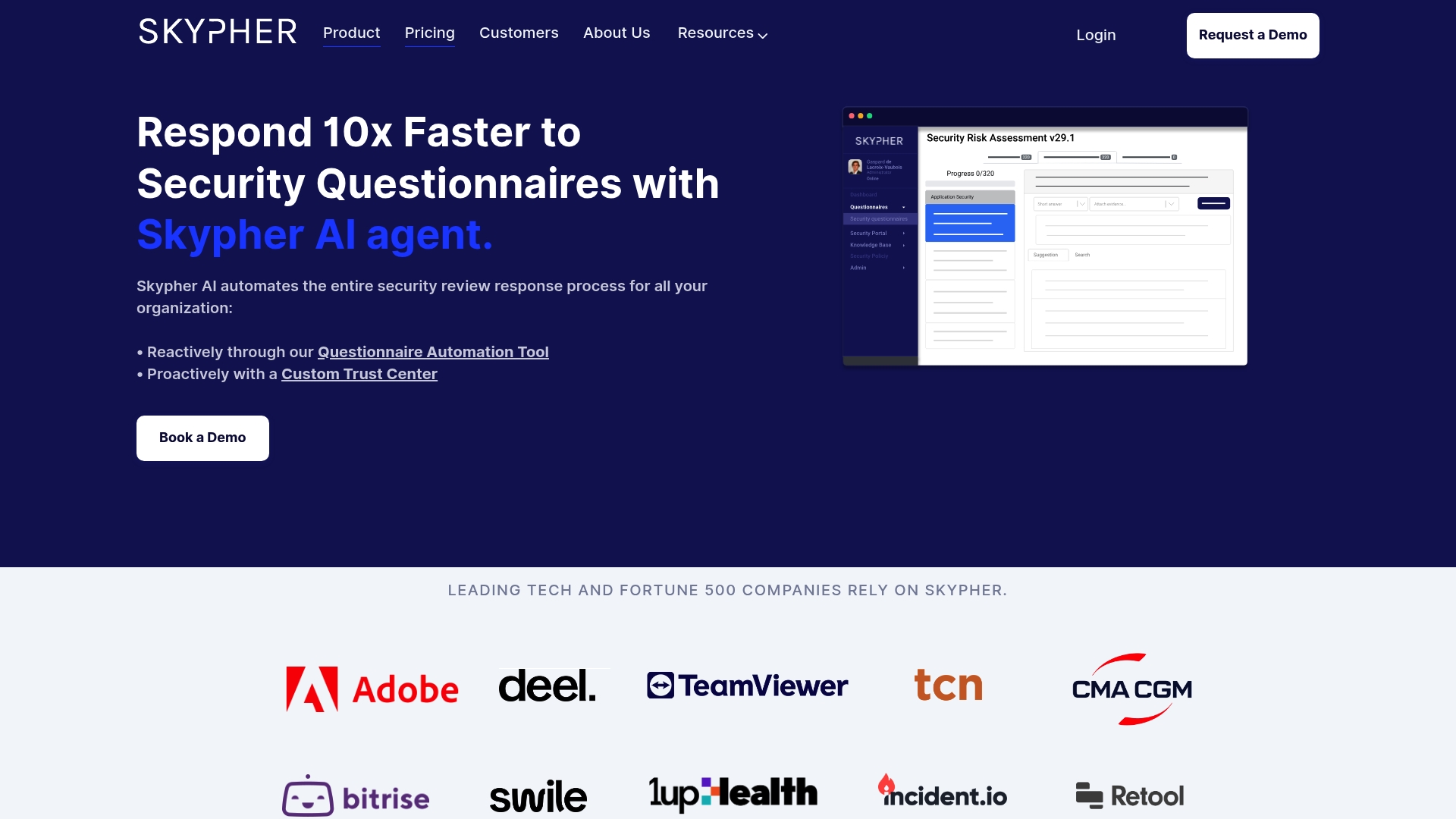
Don’t let lengthy security assessments slow down your cloud adoption journey. Enhance your cybersecurity posture with Skypher—your partner in turning rigorous assessments into strategic victories! Act NOW and discover how our platform can revolutionize your approach to security questionnaires. Visit Skypher today!