

Over 60% of compliance failures in large organizations result in penalties exceeding $1 million annually, yet many leaders still view compliance risk as purely a legal concern. This narrow perspective ignores the operational disruptions, reputational damage, and strategic setbacks that accompany regulatory missteps. For compliance officers and risk managers in tech and finance, understanding the full scope of compliance risk is essential to protecting your organization's bottom line and market position. This guide breaks down what compliance risk truly means, identifies its root causes, and shows how to build effective mitigation strategies including modern automation approaches.
Table of Contents
- Understanding Compliance Risk: Definition and Scope
- Causes and Triggers of Compliance Risk
- Impact of Compliance Risk on Security Questionnaire Processes
- Frameworks and Best Practices for Managing Compliance Risk
- Leveraging Automation to Mitigate Compliance Risk
- Common Misconceptions About Compliance Risk
- Conclusion: Enhancing Compliance and Operational Efficiency
- Discover Skypher's AI Security Questionnaire Automation
Key Takeaways
| Point | Details |
|---|---|
| Compliance risk encompasses legal, financial, and reputational dimensions beyond just regulatory fines | It affects operational trust, customer relationships, and strategic market positioning across the organization |
| Regulatory change drives 70% of compliance complexity according to compliance officers | Rapid shifts in regulations create gaps between current controls and emerging requirements |
| Manual security questionnaire processes significantly amplify compliance risk exposure | Human errors, inconsistent responses, and delayed reviews create vulnerabilities during audits and vendor assessments |
| AI automation reduces questionnaire response times by 70% and errors by 60% | Technology enhances speed and accuracy but requires human oversight for nuanced compliance judgment |
| Continuous monitoring and training sustain long term compliance effectiveness | Static compliance programs fail as regulations, technologies, and business models evolve |
Understanding Compliance Risk: Definition and Scope
Compliance risk arises from legal, financial, and reputational factors in regulated industries like finance and technology. The definition of compliance risk extends beyond violating laws to include failing internal policies, missing audit requirements, and submitting incomplete security questionnaire responses. Each dimension carries distinct consequences that compound over time.
For tech and finance organizations, compliance risk manifests in several critical scenarios. Failed audits trigger regulatory investigations and potential sanctions. Policy breaches expose sensitive data and erode customer trust. Incomplete or inaccurate security questionnaire responses delay vendor approvals, stall client onboarding, and signal weak controls to partners evaluating your risk posture.
The scope of compliance risk covers both external regulatory obligations and internal governance standards. External requirements include industry specific frameworks like SOC 2, ISO 27001, GDPR, and financial services regulations. Internal policies encompass data handling procedures, access controls, incident response protocols, and documentation standards. Organizations must integrate compliance controls across all operational levels, from frontline staff executing daily processes to executive leadership setting strategic direction.
Key compliance risk dimensions include:
- Legal violations resulting in fines, sanctions, or operational restrictions
- Financial penalties including direct fines, remediation costs, and lost revenue from delayed deals
- Reputational damage affecting customer retention, partner relationships, and competitive positioning
- Operational disruptions from remediation activities, system changes, and resource reallocation
- Strategic constraints limiting market expansion or product development options
Understanding this comprehensive scope allows you to assess compliance risk holistically rather than treating it as isolated legal checkboxes. Your organization's regulatory standing and operational trust depend on managing all these interconnected dimensions effectively.
Causes and Triggers of Compliance Risk
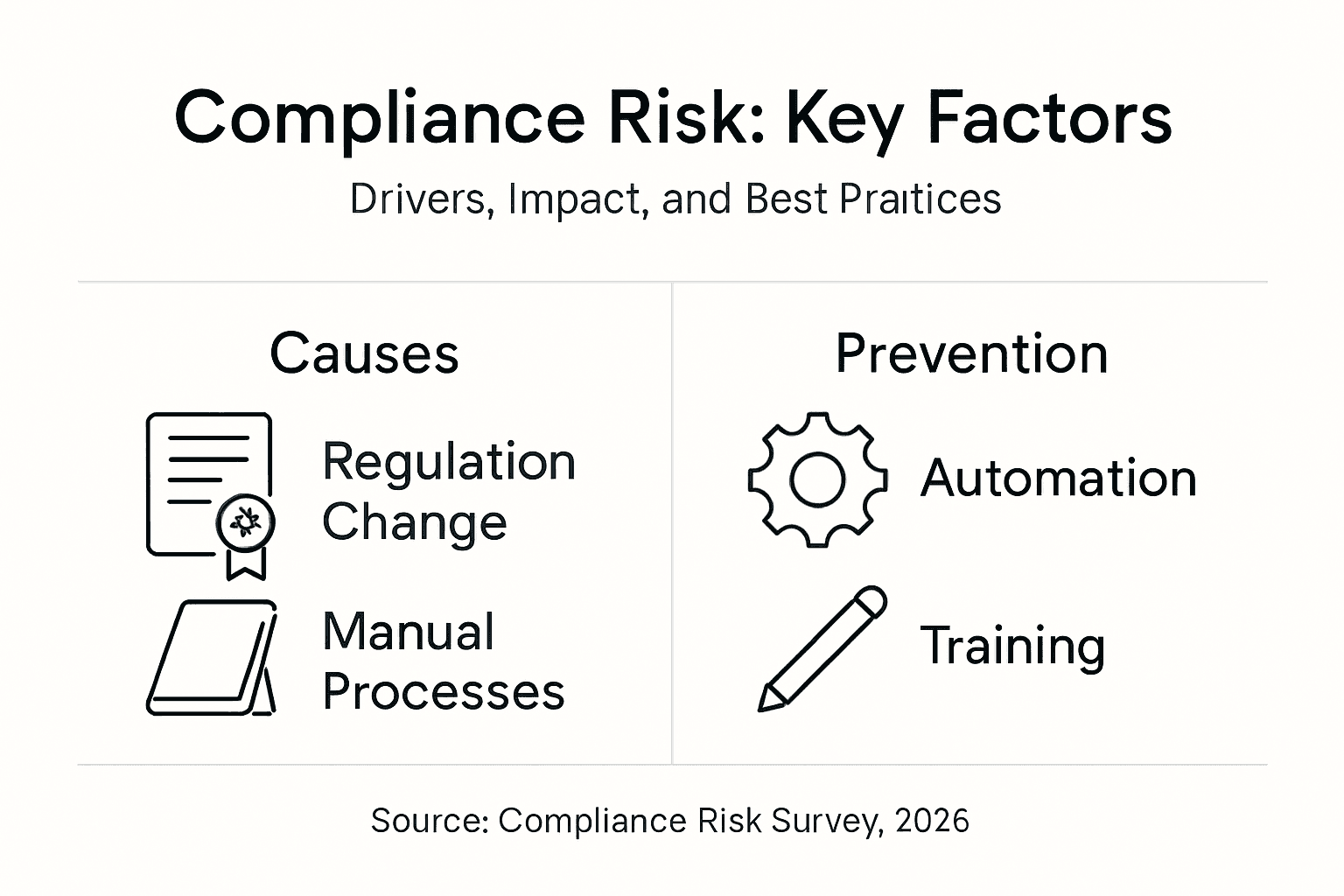
70% of compliance officers report regulatory change as the top cause of compliance risk complexity. Regulatory complexity intensifies as governments introduce new data privacy laws, cybersecurity mandates, and industry standards at accelerating rates. Organizations struggle to track changes across multiple jurisdictions, interpret ambiguous requirements, and implement controls before enforcement deadlines.
Manual security questionnaire processes represent a critical trigger for compliance risk. When your team relies on spreadsheets, email threads, and disparate document repositories to respond to vendor assessments, errors multiply. Inconsistent answers across similar questionnaires create audit red flags. Outdated responses fail to reflect current controls. Delayed submissions frustrate clients and partners who need timely assurance of your security posture. These operational weaknesses expose regulatory causes of compliance risk that auditors and regulators scrutinize during reviews.
Cross border operations amplify compliance challenges significantly. A tech company serving European, American, and Asian markets must navigate conflicting data localization requirements, varying breach notification timelines, and incompatible consent frameworks. Finance organizations face overlapping anti money laundering rules, capital requirements, and consumer protection standards that differ by jurisdiction. Reconciling these conflicts without creating compliance gaps demands sophisticated risk assessment and continuous monitoring.
"The velocity of regulatory change has outpaced traditional compliance approaches. Organizations that treat compliance as static documentation rather than dynamic risk management consistently fall behind."
Human factors further elevate compliance risk exposure. Staff turnover disrupts institutional knowledge about control procedures. Insufficient training leaves employees unaware of policy updates. Competing priorities cause teams to deprioritize compliance tasks until audit deadlines loom. Communication breakdowns between legal, IT, and business units create control gaps that persist undetected.
Primary compliance risk triggers include:
- Regulatory updates introducing new obligations or changing existing requirements
- Technology changes creating security gaps or data handling uncertainties
- Business model shifts entering new markets or customer segments with distinct compliance needs
- Organizational restructuring disrupting established control frameworks and accountability chains
- Third party relationships introducing inherited risks from vendor or partner compliance failures
Managing these triggers requires continuous adaptation. Static compliance programs that rely on annual reviews and outdated documentation fail when regulations evolve monthly and business contexts shift rapidly.
Impact of Compliance Risk on Security Questionnaire Processes
Security questionnaire workflows concentrate multiple compliance risks in high visibility interactions with clients, partners, and auditors. Manual questionnaire management creates error prone, slow processes that directly impact on security questionnaires and organizational credibility. Audit reports consistently link questionnaire mismanagement to broader compliance control weaknesses, making these assessments critical indicators of overall compliance health.

When compliance officers manually track hundreds of questions across dozens of formats, inconsistencies emerge. Your team provides different answers to identical questions across separate assessments. Response accuracy deteriorates as staff rush to meet deadlines without proper review cycles. Documentation references become outdated when policies update but questionnaire templates remain static. Each inconsistency raises doubts about your control environment and triggers follow up inquiries that further delay approvals.
Delayed questionnaire responses create cascading business impacts. Sales cycles extend when prospects await security reviews before signing contracts. Partnership agreements stall pending vendor assessments. Regulatory examinations intensify when auditors interpret slow responses as control deficiencies. These delays directly affect revenue, market opportunities, and competitive positioning.
Poor questionnaire compliance damages organizational reputation in measurable ways. Prospects question your security maturity when responses lack detail or contain contradictions. Partners reduce trust levels and impose additional oversight requirements. Industry peers notice patterns of delayed or incomplete assessments that signal operational weaknesses. Rebuilding credibility after compliance failures requires years of consistent performance.
Security questionnaire compliance challenges compound when organizations lack centralized knowledge management. Teams waste hours searching for evidence documents, recreating answers already provided elsewhere, and coordinating reviews across departments. This inefficiency not only slows responses but increases the likelihood of errors as contributors work from incomplete information.
Key questionnaire process impacts include:
- Error rates exceeding 30% in manually managed assessments
- Response times averaging 2 to 4 weeks versus days with automation
- Client dissatisfaction scores rising with each delayed or incomplete submission
- Audit findings citing questionnaire inconsistencies as evidence of control gaps
- Revenue loss from deals delayed or lost due to prolonged security reviews
Addressing security questionnaire vulnerabilities requires rethinking how your organization approaches these critical compliance touchpoints. Efficiency and accuracy improvements directly reduce compliance risk exposure while enhancing business outcomes.
Frameworks and Best Practices for Managing Compliance Risk
Structured frameworks provide proven approaches to identify, assess, and mitigate compliance risk systematically. The COSO Enterprise Risk Management framework emphasizes integrating risk management into strategic planning and operational execution. ISO 31000 offers principles based guidance for establishing risk management processes that adapt to organizational context and evolving threats. Both frameworks share core elements that compliance officers can apply to strengthen their programs.
Effective compliance risk management steps follow a logical sequence that builds comprehensive coverage:
- Identify all applicable regulatory obligations and internal policy requirements across jurisdictions and business units
- Assess current controls against those obligations to determine gaps and weaknesses
- Prioritize risks based on likelihood, potential impact, and strategic importance
- Implement remediation activities including new controls, process updates, and technology solutions
- Monitor control effectiveness through continuous testing, metrics tracking, and incident analysis
- Review and update the compliance program regularly as regulations and business contexts change
Formal policies document expectations and accountability structures that sustain compliance over time. Well designed policies clarify roles, define escalation procedures, and establish performance standards that employees can follow consistently. Policy effectiveness depends on accessibility, regular updates reflecting regulatory changes, and alignment with actual operational workflows.
Staff training transforms policies from documents into practiced behaviors. Effective training programs go beyond annual checkbox exercises to provide role specific guidance, scenario based learning, and regular refreshers as regulations evolve. Training metrics should track comprehension and application, not just completion rates.
| Framework Component | Purpose | Implementation Approach |
|---|---|---|
| Risk Identification | Catalog all compliance obligations and threat scenarios | Regulatory mapping, policy inventory, stakeholder interviews |
| Control Assessment | Evaluate existing safeguards and identify gaps | Control testing, audit reviews, self assessments |
| Monitoring Systems | Track control performance and detect emerging risks | Automated dashboards, periodic testing, incident tracking |
| Governance Structure | Establish accountability and decision authority | Compliance committees, clear RACI matrices, executive oversight |
Continuous monitoring adapts your compliance program to evolving risks. Automated control testing detects failures faster than periodic audits. Real time regulatory tracking alerts you to new obligations before enforcement begins. Incident analysis identifies patterns that reveal systemic weaknesses requiring broader remediation.
Pro Tip: Integrate risk assessment routinely into security questionnaire workflows by flagging questions that reveal control gaps or policy updates needed. Each questionnaire becomes both a compliance deliverable and a diagnostic tool for improving your program.
Compliance risk best practices emphasize cross functional collaboration. Compliance officers cannot manage risk alone when controls span IT systems, business processes, and employee behaviors across departments. Regular communication between legal, technology, operations, and business leadership ensures compliance considerations inform strategic decisions before commitments create obligations you cannot meet.
Leveraging Automation to Mitigate Compliance Risk
AI powered automation can reduce security questionnaire response times by 70% and reduce errors by 60%. This transformation occurs through intelligent content management, automated response generation, and seamless integration with collaboration platforms. AI automation in compliance addresses the manual process limitations that create compliance vulnerabilities while freeing your team to focus on higher value risk management activities.
Manual versus automated security questionnaire processes show stark differences in performance and risk profiles. Manual approaches require staff to search documents, draft responses from scratch, coordinate reviews via email, and track versions across spreadsheets. Each step introduces delay and error potential. Automated systems vectorize your compliance documentation, match questions to relevant evidence, generate consistent responses, and route reviews through integrated workflows.
| Process Aspect | Manual Approach | AI Automated Approach |
|---|---|---|
| Response Time | 2 to 4 weeks average | 1 to 3 days typical |
| Error Rate | 25% to 35% inconsistencies | Under 10% with human review |
| Knowledge Access | Fragmented across files and emails | Centralized, searchable repository |
| Version Control | Spreadsheet tracking, manual updates | Automated tracking with audit trails |
| Collaboration | Email threads, meeting scheduling | Real time platform integration |
Security questionnaire automation benefits extend beyond speed improvements to enhance compliance quality. Automated systems enforce consistent terminology across responses, apply approved language for sensitive topics, and flag questions requiring legal or technical review. These capabilities reduce the inconsistencies that auditors interpret as control weaknesses.
Integration with third party risk management platforms amplifies automation value. Modern solutions connect with OneTrust, ServiceNow, and 30+ other TPRM systems through APIs that synchronize questionnaire data bidirectionally. This connectivity eliminates duplicate data entry, maintains single sources of truth, and provides stakeholders real time visibility into assessment status.
Automation requires complementing technology with human judgment for nuanced compliance decisions. AI excels at matching questions to existing documentation and generating draft responses based on approved content. Compliance officers provide essential oversight by validating technical accuracy, assessing risk context, and determining appropriate disclosure levels. This hybrid approach combines automation efficiency with human expertise.
Pro Tip: Ensure your automation tool supports multilingual formats and collaboration integration with platforms like Slack and Microsoft Teams. Global operations require responses in multiple languages, and seamless team communication accelerates review cycles without email bottlenecks.
Automation partnerships with specialized providers deliver implementation support, ongoing optimization, and integration services that maximize your investment. Successful automation deployments align tools with existing workflows rather than forcing process changes that staff resist. Change management, training, and executive sponsorship determine whether automation achieves its full compliance risk reduction potential.
Common Misconceptions About Compliance Risk
Many organizations underestimate compliance risk by focusing exclusively on regulatory fines while ignoring broader operational and reputational impacts. Financial penalties represent only direct costs. Indirect consequences including lost customers, damaged partner relationships, reduced market valuation, and executive departures often exceed fines by orders of magnitude. Viewing compliance risk through this narrow lens leads to under investment in controls and inadequate risk mitigation strategies.
Another widespread misconception holds that automation can fully replace human oversight in compliance management. While AI tools dramatically improve efficiency and accuracy, they cannot replace the contextual judgment, ethical reasoning, and strategic thinking that experienced compliance officers provide. Automated systems generate responses based on existing documentation but cannot assess whether current policies adequately address emerging risks or determine appropriate disclosure levels for sensitive information.
Some leaders treat compliance as a static achievement rather than a continuous process. They believe passing an audit or achieving certification means compliance obligations are satisfied indefinitely. This mindset fails when regulations update, business models evolve, or technology changes create new risk exposures. Compliance risk requires ongoing vigilance through regular control testing, policy updates, staff training, and regulatory monitoring.
Neglecting these realities creates dangerous compliance gaps:
- Organizations invest minimally in compliance programs until a violation forces reactive spending
- Teams deploy automation without maintaining human review processes for complex assessments
- Compliance programs stagnate between audits while regulations and threats evolve
- Leadership dismisses compliance concerns that lack immediate regulatory deadlines
- Training programs focus on checkbox completion rather than comprehension and behavior change
Educating stakeholders on compliance risk realities improves organizational culture and resource allocation. When executives understand that compliance failures threaten strategic objectives and market position, they prioritize programs appropriately. When teams recognize automation as a tool requiring oversight rather than a replacement for expertise, they use technology effectively. When everyone acknowledges compliance as continuous rather than episodic, they embed risk management into daily operations.
Clarifying these misconceptions prepares your organization for realistic, effective compliance risk management. You build programs that address actual threats rather than checking boxes, leverage technology appropriately, and sustain performance through changing conditions.
Conclusion: Enhancing Compliance and Operational Efficiency
Structured compliance risk management reduces costly failures by transforming reactive checkbox exercises into proactive, strategic programs. Organizations that identify obligations comprehensively, assess controls honestly, and remediate gaps systematically avoid the penalties, reputation damage, and operational disruptions that plague peers with weaker programs. The financial and competitive advantages justify investment in robust frameworks, continuous monitoring, and skilled staff.
Leveraging AI driven automation streamlines security questionnaire processes that concentrate compliance risks in high visibility assessments. Reducing response times by 70% and errors by 60% through intelligent systems transforms questionnaires from compliance burdens into business enablers. Faster, more accurate responses accelerate sales cycles, strengthen partner confidence, and demonstrate control maturity to auditors.
Continuous monitoring and training sustain compliance effectiveness as regulations evolve and business contexts shift. Automated dashboards detect control failures early. Regular policy updates maintain alignment with new requirements. Ongoing education ensures staff apply current standards rather than outdated practices. These activities prevent compliance drift that creates vulnerabilities during examinations.
Combining human oversight with automation produces optimal outcomes. Technology handles repetitive tasks, enforces consistency, and provides real time insights. Compliance officers contribute contextual judgment, risk assessment expertise, and strategic guidance. This partnership maximizes both efficiency and quality.
Proactive adaptation to regulatory changes positions your organization ahead of competitors struggling with reactive compliance. Monitoring regulatory developments, participating in industry forums, and planning implementation before enforcement deadlines transforms compliance from obstacle into competitive advantage. You enter new markets faster, onboard clients more smoothly, and demonstrate risk management maturity that differentiates your brand.
Discover Skypher's AI Security Questionnaire Automation
Transform your compliance risk management by implementing AI powered tools that streamline security questionnaire workflows. Skypher's platform addresses the manual process vulnerabilities that create compliance exposure while accelerating response times and improving accuracy. Our proprietary AI models parse every questionnaire format reliably, far exceeding generic solutions in handling complex assessments.

The AI Security Questionnaire Automation & Response Tool integrates with over 30 third party risk management platforms including OneTrust and ServiceNow. Answer 200 questions in under one minute using AI powered content management and document vectorization. Real time collaboration through Slack and Microsoft Teams integrations keeps your team aligned without email bottlenecks. Multilingual support handles global assessments seamlessly.
Explore best practices for automating security questionnaires to maximize your implementation success. Learn how leading organizations combine automation with human expertise to achieve compliance excellence. Review The Case for Security Questionnaire Automation to understand the strategic and operational benefits driving adoption across tech and finance sectors.
What Is Compliance Risk? Frequently Asked Questions
What distinguishes compliance risk from general operational risk?
Compliance risk specifically involves failing to meet legal, regulatory, or policy obligations that govern your industry and operations. General operational risk encompasses broader threats including technology failures, supply chain disruptions, and market changes. Compliance risk creates legal liability and regulatory consequences beyond typical operational setbacks.
How can automation tools fit with existing compliance frameworks?
Automation tools implement framework requirements more efficiently by centralizing documentation, enforcing consistent controls, and providing continuous monitoring capabilities. They support COSO and ISO 31000 principles through automated risk assessments, control testing, and reporting. Integration with your existing TPRM platforms maintains workflow continuity while enhancing performance.
What are the key indicators that compliance risk is increasing?
Rising questionnaire response times, increasing error rates in assessments, and growing backlogs of pending reviews signal mounting compliance risk. Regulatory updates in your industry, failed control tests, and audit findings indicating gaps also warn of elevated risk. Staff turnover in compliance roles and budget cuts to compliance programs further increase exposure.
Does AI automation eliminate the need for compliance officers?
No, automation enhances compliance officer effectiveness rather than replacing their expertise. AI handles repetitive tasks like matching questions to documentation and generating draft responses. Compliance officers provide essential judgment on risk context, appropriate disclosure levels, and strategic compliance decisions that technology cannot replicate. The most effective programs combine both.
How often should organizations update their compliance risk assessments?
Continuous monitoring with formal quarterly reviews provides appropriate frequency for most organizations. Regulations change frequently enough that annual assessments miss critical updates. Quarterly cycles allow you to track regulatory developments, test controls, analyze incidents, and adjust programs before risks materialize into violations. Trigger additional assessments when entering new markets, launching new products, or experiencing significant organizational changes.