

HIPAA training is crucial in healthcare, ensuring privacy and security for patient information, but did you know that nearly 60% of healthcare employees don't fully understand their responsibilities? Surprising, right? The truth is, many healthcare teams view HIPAA as just another regulation, rather than a vital framework that enhances patient trust and care. This misconception can lead to significant compliance risks, but the good news is that effective training can transform this perception, equipping staff with the knowledge they need to protect sensitive information and foster a culture of privacy.
Understanding HIPAA Training Basics
HIPAA training forms the cornerstone of healthcare privacy compliance in the United States. But what exactly does this training entail? Let's break down the fundamentals to help you navigate these crucial requirements with confidence.
What HIPAA Training Covers
At its core, HIPAA training educates healthcare workers and business associates about their legal obligations when handling protected health information (PHI). This training isn't just a bureaucratic checkbox—it's a practical framework for safeguarding patient privacy in everyday operations.
Comprehensive HIPAA training typically covers several key areas:
- Privacy Rule fundamentals: Guidelines for using and disclosing patient information
- Security Rule protocols: Measures to protect electronic PHI from unauthorized access
- Breach notification procedures: Steps to take when data breaches occur
- Patient rights: Understanding what rights patients have regarding their health information
According to training experts at TeachPrivacy, both covered entities and their business associates must train all employees who handle Protected Health Information, regardless of their role. This includes doctors, nurses, administrative staff, and even IT personnel who might encounter patient data.
Who Needs HIPAA Training?
The short answer: virtually everyone in healthcare organizations who might encounter patient information.
The U.S. Department of Health and Human Services mandates HIPAA training for all employees within covered entities (healthcare providers, health plans, and healthcare clearinghouses) and their business associates. This includes full-time staff, part-time workers, volunteers, and contractors who access, use, or disclose protected health information.
What surprises many organizations is the breadth of staff requiring training. It's not limited to clinical staff—receptionists scheduling appointments, billing specialists processing claims, and IT staff maintaining systems containing patient data all need appropriate HIPAA training.
When and How Often Training Is Required
HIPAA training isn't a one-and-done obligation. The regulations establish clear timing requirements:
- New employees must receive training within a reasonable period after joining the organization
- Existing employees need refresher training when there are material changes to policies or procedures
- Annual training is widely considered a best practice and is often required by many compliance programs
While HIPAA doesn't specifically mandate annual training, yearly refreshers have become the industry standard. This regular cadence helps ensure that privacy and security awareness remains top of mind for all staff members.
The typical HIPAA training session lasts between 20-40 minutes, focusing on both privacy and security aspects. Interestingly, longer training doesn't necessarily yield better results—concise, engaging training often proves more effective at maintaining attention and improving information retention.
Understanding these HIPAA training basics helps organizations build a culture of compliance where patient privacy protection becomes second nature rather than a regulatory burden.
Key Takeaways
| Takeaway | Explanation |
|---|---|
| Comprehensive Training is Essential | All employees in healthcare who handle protected health information (PHI) require HIPAA training, including clinical and non-clinical staff, to ensure compliance and protect patient privacy. |
| Regular Training Updates are Recommended | Training should occur for new employees promptly, with refresher courses for existing staff whenever policies change or annually, to maintain awareness of evolving regulations. |
| Customize Training for Different Roles | Tailoring HIPAA training content to specific roles within the organization enhances relevance and effectiveness, ensuring individuals receive practical guidance applicable to their responsibilities. |
| Monitor and Measure Training Effectiveness | Using key performance indicators (KPIs) and real-world simulations helps assess training impact, guiding continuous improvement and ensuring the program remains effective in promoting compliance. |
| Fostering a Culture of Privacy Awareness | Encouraging an organizational culture that prioritizes privacy protection helps staff feel empowered and accountable in safeguarding sensitive patient information. |
Regulatory Compliance and Privacy Rules
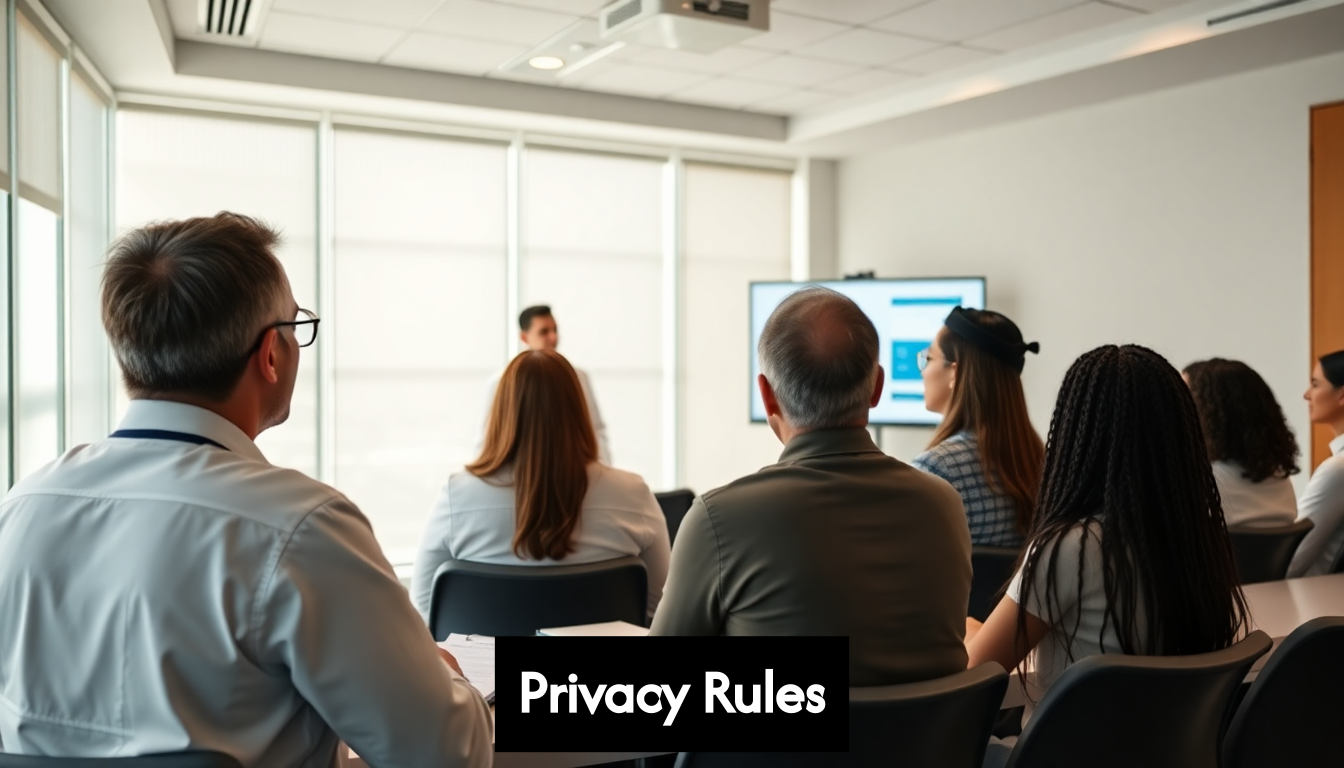
HIPAA training isn't just about checking boxes—it's fundamentally about understanding and implementing critical privacy protections that safeguard sensitive patient information. Let's explore the regulatory landscape that shapes HIPAA compliance requirements and why these rules matter in healthcare settings.
The Core HIPAA Privacy and Security Rules
At the heart of HIPAA compliance training are two fundamental components: the Privacy Rule and the Security Rule. These regulations work in tandem to establish comprehensive protection for patient information.
The Privacy Rule establishes national standards for protecting individually identifiable health information. It sets boundaries on medical record use and disclosure, establishes safeguards organizations must implement, and holds violators accountable through civil and criminal penalties. Your HIPAA privacy training should thoroughly cover when and how PHI can be used, patient rights regarding their information, and proper authorization procedures.
The Security Rule complements the Privacy Rule by specifically addressing electronic protected health information (ePHI). It outlines administrative, physical, and technical safeguards that covered entities must implement. These include access controls, encryption requirements, audit controls, and integrity verifications that help prevent unauthorized access to digital health records.
According to experts at Linford & Company, organizations must start with thorough risk assessments to identify their specific compliance needs under regulations like HIPAA. This assessment process helps determine where patient data exists within your systems and what specific protections are required.
HITECH Act and Omnibus Rule Updates
HIPAA training requirements didn't remain static after the original legislation. The Health Information Technology for Economic and Clinical Health (HITECH) Act of 2009 and the subsequent Omnibus Rule of 2013 significantly strengthened and expanded HIPAA's scope.
The HITECH Act increased penalties for HIPAA violations, expanded patients' rights to access their information, and created the Breach Notification Rule. This rule requires covered entities to notify affected individuals, the Secretary of Health and Human Services, and in some cases, the media following a breach of unsecured PHI.
The Omnibus Rule further enhanced HIPAA by:
- Extending direct compliance obligations to business associates
- Strengthening limitations on the use of health information for marketing
- Prohibiting the sale of protected health information without authorization
- Expanding individuals' rights to receive electronic copies of their health information
Your HIPAA compliance training must incorporate these updates to remain current and effective.
Consequences of Non-Compliance
Understanding the potential consequences of HIPAA violations reinforces why proper training is essential. The Office for Civil Rights (OCR) can impose civil monetary penalties ranging from $100 to $50,000 per violation, with annual maximums of $1.5 million for identical violations. These penalties vary based on the level of negligence, from unknown violations to willful neglect.
Beyond financial penalties, HIPAA violations can result in:
- Mandatory corrective action plans
- Reputational damage to healthcare organizations
- Loss of patient trust
- Criminal charges in cases of deliberate violations
Effective HIPAA staff training represents your first line of defense against these serious consequences. By ensuring your team understands both the letter and spirit of these regulations, you create a culture of compliance that protects both your patients and your organization.
Regular training on these regulatory requirements helps transform abstract legal concepts into practical daily behaviors that safeguard privacy and security across your healthcare operations.
HIPAA Training Benefits for Staff
While compliance is mandatory, effective HIPAA training delivers benefits that extend far beyond simply avoiding penalties. When properly implemented, HIPAA education empowers healthcare staff with valuable knowledge and skills that enhance both their professional capabilities and patient care outcomes.
Creating a Culture of Privacy Awareness
Well-designed HIPAA training transforms abstract regulations into practical understanding that staff carry into their daily work. Rather than viewing privacy requirements as burdensome rules, properly trained employees develop an intuitive sense for protecting sensitive information.
This cultural shift happens when training helps staff understand not just what the rules are, but why they matter. According to HIPAA security experts, many violations stem from healthcare professionals' natural helpfulness and caring nature—attributes that can inadvertently lead to oversharing patient information. Effective training acknowledges these good intentions while redirecting them toward privacy-conscious behaviors.
When privacy awareness becomes part of your organizational culture, staff members begin to:
- Proactively identify potential privacy risks in workflows
- Comfortably discuss privacy concerns with colleagues
- Take ownership of privacy protection rather than seeing it as "someone else's job"
- Apply privacy principles consistently across different situations
Reducing Workplace Stress and Uncertainty
Healthcare environments are inherently stressful, and uncertainty about compliance requirements only adds to this burden. Comprehensive HIPAA training alleviates this stress by providing clear guidelines for handling protected health information.
When staff know exactly what actions are permitted and prohibited, they can work with confidence rather than hesitation. This certainty is particularly valuable in high-pressure situations where decisions about information sharing must be made quickly.
For new employees, thorough HIPAA training establishes a foundation of competence that eases the transition into healthcare roles. For experienced staff, regular refresher training clarifies evolving requirements and reinforces best practices.
Enhancing Professional Development and Career Advancement
HIPAA training contributes significantly to healthcare professionals' career development. The knowledge gained through this training represents a valuable credential that demonstrates regulatory competence—an increasingly important skill in today's healthcare environment.
For individual staff members, documented HIPAA training:
- Enhances resumes and professional portfolios
- Demonstrates commitment to ethical practice
- Provides transferable knowledge applicable across healthcare settings
- Builds confidence in handling complex privacy scenarios
From a practical perspective, staff with strong HIPAA training are better positioned to take on roles with greater responsibility, particularly positions involving access to sensitive information or oversight of privacy practices.
Improving Patient Relationships and Trust
Perhaps the most meaningful benefit of HIPAA training is its impact on patient relationships. Patients are increasingly aware of their privacy rights and concerned about the security of their health information. Staff who demonstrate knowledgeable, confident handling of sensitive information build greater trust with those in their care.
This trust manifests in several ways:
- Patients become more willing to share complete health information
- Communication improves when patients feel their privacy is respected
- The perception of care quality increases when privacy practices are visible
- Patient satisfaction scores tend to rise when privacy concerns are addressed
By emphasizing these benefits during training sessions, healthcare organizations can increase staff engagement and motivation to apply HIPAA principles consistently. When employees recognize that privacy protection enhances both patient care and their own professional development, compliance becomes a natural extension of quality healthcare rather than a regulatory burden.
How to Implement HIPAA Training
Implementing effective HIPAA training requires thoughtful planning and execution. Whether you're establishing a program from scratch or enhancing existing training, following these best practices will help ensure your staff receives meaningful education that translates into compliant behaviors.
Developing a Comprehensive Training Plan
A well-structured HIPAA training plan serves as your roadmap for implementation. Start by assessing your organization's specific needs, considering factors like staff roles, access to PHI, and any previous compliance issues.
Your training plan should include:
- Clear learning objectives that align with HIPAA requirements
- Training frequency schedule (initial onboarding and refreshers)
- Content customized to different staff roles and responsibilities
- Documentation procedures to track completion and comprehension
- Evaluation methods to measure effectiveness
According to medical compliance experts at HIPAA Exams, one-time training is insufficient for maintaining compliance. They recommend implementing annual or bi-annual refresher courses to address evolving regulations and emerging security threats. This regular cadence helps counter the natural decay of knowledge over time.
Customizing Training for Different Roles
One of the most common mistakes in HIPAA training is the "one-size-fits-all" approach. Different staff members have varying levels of PHI access and distinct responsibilities in maintaining compliance. Role-specific training acknowledges these differences and provides relevant instruction.
Consider these role-based customizations:
Clinical Staff (doctors, nurses, therapists):
- Focus on practical privacy scenarios encountered during patient care
- Patient rights regarding their health information
- Proper documentation practices and chart security
Administrative Staff (front desk, scheduling, billing):
- Secure communication protocols for patient information
- Privacy practices in waiting areas and public spaces
- Proper handling of authorization forms and release requests
IT and Technical Staff:
- Technical safeguards for electronic PHI
- Access controls and authentication requirements
- Security incident response procedures
Management and Leadership:
- Oversight responsibilities and compliance monitoring
- Risk assessment processes
- Breach notification procedures and timeline requirements
This targeted approach ensures everyone receives training directly applicable to their daily responsibilities, making compliance more intuitive and practical.
Selecting Effective Training Methods
The delivery method of your HIPAA training significantly impacts its effectiveness. Modern training programs typically utilize a blend of approaches to enhance engagement and retention.
Consider these training delivery options:
Interactive Online Modules:
- Provide consistent information to all employees
- Allow flexible completion at convenient times
- Include knowledge checks throughout to verify understanding
- Track completion automatically for documentation purposes
In-Person Workshops:
- Facilitate discussion of complex scenarios
- Address specific questions from staff members
- Build a collective understanding of organization-specific protocols
- Create opportunities for role-playing privacy situations
Microlearning Opportunities:
- Brief, focused training segments on specific topics
- Regular privacy reminders through email or staff communications
- Quick case studies highlighting real-world examples
- "Just-in-time" learning for immediate application
The most effective HIPAA training programs employ multiple methods, recognizing that different people learn differently and various topics may be better suited to specific formats.
Measuring Training Effectiveness
Implementing HIPAA training is only valuable if it achieves the desired result: improved compliance. Measuring effectiveness helps validate your program and identify areas for improvement.
Establish success metrics such as:
- Completion rates for all required training
- Knowledge assessment scores to gauge comprehension
- Reduction in privacy incidents or near-misses
- Staff confidence levels when handling PHI
- Results from compliance audits and assessments
Regularly review these metrics to identify trends and make necessary adjustments to your training approach. Remember that the ultimate goal isn't just completion of training but actual behavior change that enhances privacy protection throughout your organization.
By thoughtfully implementing HIPAA training with these best practices, you create a program that goes beyond basic compliance to build a privacy-conscious culture that benefits your staff, your organization, and most importantly, your patients.
Measuring HIPAA Training Effectiveness
Implementing HIPAA training isn't the finish line—it's just the beginning of your compliance journey. To ensure your training program actually improves privacy practices and protects sensitive information, you need concrete methods to measure its effectiveness. Let's explore practical approaches for evaluating your HIPAA training program and using those insights to drive continuous improvement.
Key Performance Indicators for HIPAA Training
Effective measurement starts with identifying the right metrics. While completion rates provide basic accountability, they don't tell you whether the training changed behaviors or improved understanding. A more comprehensive approach includes multiple KPIs that collectively paint a clearer picture.
Consider tracking these performance indicators:
Knowledge Retention Metrics:
- Pre and post-training assessment scores
- Improvement percentages across different training modules
- Long-term knowledge retention through follow-up quizzes
- Ability to correctly identify PHI in practical scenarios
Behavioral Change Indicators:
- Reduction in privacy incidents and near-misses
- Increased reporting of potential security concerns
- Proper handling of authorization requests
- Appropriate responses during simulated privacy scenarios
According to security training experts, organizations should focus on measuring specific security behaviors rather than just training completion. For example, tracking how quickly staff report suspicious emails or monitoring proper workstation logout practices provides tangible evidence of training effectiveness.
Using Simulations and Real-World Testing
One of the most revealing ways to measure HIPAA training effectiveness is through simulated scenarios that test how employees apply their knowledge in realistic situations. These practical assessments provide insights that multiple-choice quizzes simply cannot capture.
Effective simulation techniques include:
Phishing Simulations: Send benign but realistic-looking phishing emails that request protected health information. Track who clicks suspicious links, who reports the emails to security, and who inappropriately shares information.
Social Engineering Tests: Conduct controlled tests where authorized testers attempt to gain verbal PHI through social engineering techniques. This reveals how well staff adhere to verification procedures before disclosing information.
Physical Security Audits: Perform surprise checks for unlocked screens, visible patient information, or unattended documents containing PHI. These audits reveal whether training about physical safeguards translated into actual practice.
These simulations should never be used punitively but rather as learning opportunities that identify training gaps and reinforce proper procedures.
Analyzing Incident Patterns and Trends
Privacy incidents, even minor ones, provide valuable data about your training program's effectiveness. By systematically analyzing these events, you can identify patterns that point to specific training deficiencies.
When reviewing incidents, look for:
- Common violation types that might indicate unclear training
- Departments or roles with higher incident rates that may need specialized training
- Timing patterns (such as increases after staff changes) that suggest onboarding training gaps
- Recurring issues that weren't addressed by previous training efforts
This analysis helps you refine your training content to address actual rather than assumed vulnerabilities. If you're consistently seeing incidents related to email security, for instance, that area clearly needs enhanced training focus regardless of how well staff performed on related assessments.
Gathering Feedback from Staff and Patients
Sometimes the most valuable insights come directly from the people involved. Structured feedback mechanisms can reveal training strengths and weaknesses from multiple perspectives.
Consider implementing:
- Anonymous staff surveys about training relevance and clarity
- Focus groups to discuss privacy challenges in daily workflows
- Patient feedback about their perception of privacy practices
- Manager observations about practical application of training concepts
This qualitative feedback complements your quantitative metrics by explaining the "why" behind the numbers and often highlights practical barriers to implementing training concepts.
Continuous Improvement Cycle
The ultimate measure of training effectiveness is how well it adapts and improves over time. Establish a continuous improvement cycle that uses measurement data to refine your approach:
- Collect performance data from multiple sources
- Analyze trends and identify specific improvement areas
- Adjust training content, delivery methods, or frequency
- Implement changes and communicate the rationale
- Measure results of modifications and repeat the cycle
This iterative approach ensures your HIPAA training program remains relevant, addresses actual needs, and continues to strengthen your privacy protection efforts over time.
By implementing comprehensive measurement strategies, you transform HIPAA training from a compliance checkbox into a dynamic tool that demonstrably improves patient privacy protection throughout your organization.
Frequently Asked Questions
What is HIPAA training?
HIPAA training educates healthcare workers about their legal obligations regarding the handling of protected health information (PHI). It covers essential aspects such as the Privacy Rule, Security Rule, and breach notification procedures.
Who is required to take HIPAA training?
All employees who work for healthcare organizations handling PHI are required to take HIPAA training. This includes full-time, part-time employees, contractors, and volunteers across all roles, including administrative and IT staff.
How often should HIPAA training be conducted?
New employees must receive HIPAA training shortly after joining, and existing employees should undergo refresher training when policies change or at least annually to reinforce compliance and awareness.
What are the consequences of not complying with HIPAA training requirements?
Failure to comply with HIPAA training can result in severe penalties, including fines that range from $100 to $50,000 per violation. Non-compliance can also lead to reputational damage and loss of patient trust.
Elevate Your HIPAA Compliance with Skypher's Solutions
Understanding the intricacies of HIPAA training is essential for any healthcare organization committed to patient privacy and regulatory compliance. Yet, as highlighted in our article, many healthcare teams struggle with the complexities of the training process and the sheer volume of required documentation, leading to compliance risks and potential patient trust issues.
What if you could streamline this crucial training process while enhancing your overall compliance framework? With Skypher's AI-driven Questionnaire Automation Tool, you can significantly reduce the time and effort required to manage HIPAA-related security questionnaires. This tool not only simplifies evaluations but also integrates seamlessly with over 40 third-party risk management platforms, ensuring that your organization remains compliant without the usual headaches.
Take action NOW: Don’t let compliance concerns hinder your ability to focus on what matters: quality patient care. Experience the benefits of our custom Trust Center and real-time collaboration features that empower your team to tackle HIPAA compliance effectively, improving operational productivity and enhancing patient trust.
Visit Skypher and elevate your compliance process today!