

Organizations that implement an ISMS reduce security incidents by about 30% within the first year. If you lead IT or security teams in tech or finance, understanding what an ISMS is and how it works can transform your compliance posture and operational resilience. This guide explains the core components, standards, benefits, and practical steps to build an effective information security management system tailored to your organization's risk landscape.
Table of Contents
- Introduction to information security management systems (ISMS)
- Key components and processes of an ISMS
- Relevant standards and regulatory frameworks
- Benefits and operational impact of implementing an ISMS
- Common misconceptions and pitfalls in ISMS adoption
- Implementing an ISMS: strategies and tools for success
- Conclusion and next steps for security leaders
- Enhance your ISMS with Skypher's AI-driven automation
- Frequently asked questions
Key takeaways
| Point | Details |
|---|---|
| ISMS definition | A structured framework aligning policies, processes, and controls to protect data confidentiality, integrity, and availability. |
| ISO/IEC 27001 standard | Guides ISMS adoption worldwide with a focus on continuous improvement via the Plan-Do-Check-Act cycle. |
| Measurable benefits | Implementing an ISMS leads to 30% reduction in security incidents and 40% faster audit preparation. |
| Organization-wide effort | Successful ISMS requires involvement beyond IT, including legal, HR, and leadership, with ongoing monitoring. |
| Automation advantage | Tools like Skypher improve ISMS efficiency, accelerating compliance in dynamic environments. |
Introduction to information security management systems (ISMS)
An ISMS is a systematic approach encompassing policies, procedures, and controls designed to manage information security risks and ensure confidentiality, integrity, and availability of data. It serves as the backbone for organizations navigating complex regulatory landscapes and evolving cyber threats. For tech and finance sectors, where data breaches carry massive financial and reputational costs, an IT security management system is not optional. It is a strategic necessity.
The primary goals of an ISMS center on three core security objectives:
- Confidentiality: Ensuring sensitive information is accessible only to authorized individuals.
- Integrity: Maintaining accuracy and completeness of data throughout its lifecycle.
- Availability: Guaranteeing timely and reliable access to information when needed.
These objectives form the foundation of all ISMS activities, from risk assessment to control deployment. The ISO/IEC 27001 standard defines ISMS requirements and provides a certifiable framework for organizations to prove their commitment to information security.
"An information security management system preserves the confidentiality, integrity and availability of information by applying a risk management process and gives confidence to interested parties that risks are adequately managed." — ISO/IEC 27001:2013
By adopting an ISMS, you create a living framework that adapts to new threats, regulatory changes, and business growth. It moves security from reactive firefighting to proactive risk management, positioning your organization to meet stakeholder expectations and compliance mandates with confidence.
Key components and processes of an ISMS
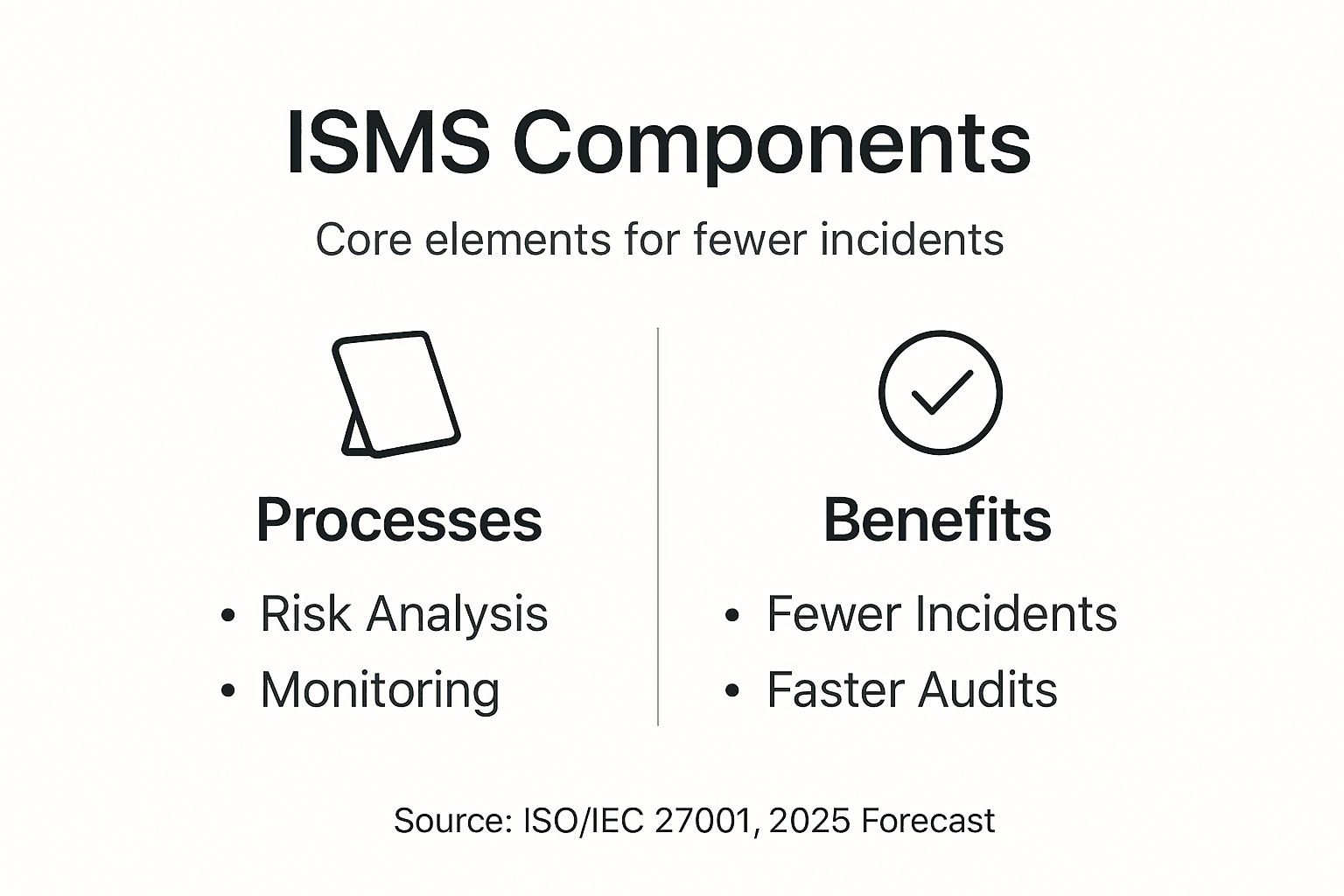
An effective ISMS operates through interconnected components and cyclical processes that ensure continuous risk management. Risk assessment in ISMS involves continuous identification, evaluation, and treatment of risks tailored to your business context. This is not a one-time exercise. It is an ongoing discipline that keeps your security posture aligned with your threat landscape.
The key ISMS processes follow a logical sequence:
- Risk assessment: Identify assets, threats, vulnerabilities, and potential impacts to prioritize security investments.
- Control implementation: Deploy technical, administrative, and physical safeguards based on risk analysis and appetite.
- Monitoring and measurement: Track control effectiveness, detect anomalies, and gather metrics for informed decision making.
- Continuous improvement: Review performance data, update controls, and refine processes to address emerging risks.
Each process feeds into the next, creating a feedback loop that strengthens your security posture over time. Cross-department collaboration is essential. IT teams cannot build an effective ISMS in isolation. Legal ensures compliance alignment, HR manages personnel security, and business units define acceptable risk levels. This collective ownership turns ISMS from a compliance checkbox into a strategic asset.
Pro Tip: Conduct risk assessments on a quarterly cycle rather than annually. Threat landscapes shift rapidly, and frequent reviews let you spot emerging vulnerabilities before they become incidents. This agility is especially critical in tech and finance, where new attack vectors appear constantly.
Monitoring does not stop at technical controls. You also track policy adherence, training completion, incident response effectiveness, and third-party risk. These risk management tips help you build a holistic view of your security posture and identify gaps before auditors or attackers do.
Relevant standards and regulatory frameworks
The ISO/IEC 27001 standard remains the globally recognized benchmark for ISMS, requiring organizations to identify risks, implement controls, and continuously improve their security posture through a Plan-Do-Check-Act (PDCA) cycle. This iterative model ensures your ISMS evolves with your business and threat environment.
The PDCA cycle consists of four phases:
- Plan: Establish ISMS scope, policies, objectives, and risk treatment plans.
- Do: Implement controls, train staff, and operationalize security processes.
- Check: Monitor performance, conduct audits, and measure control effectiveness.
- Act: Address nonconformities, update controls, and drive continuous improvement.
This cycle repeats indefinitely, creating a culture of ongoing enhancement rather than static compliance. While ISO/IEC 27001 dominates global ISMS certification, other frameworks play important roles. NIST SP 800-53 provides detailed control catalogs favored by US government agencies and contractors. Understanding how these frameworks compare helps you choose the right approach for your organization.
| Framework | Scope | Focus | Certification |
|---|---|---|---|
| ISO/IEC 27001 | Global | Risk-based ISMS with PDCA cycle | Yes, third-party audited |
| NIST SP 800-53 | US-focused | Prescriptive control catalog | No formal certification |
ISO/IEC 27001 offers the advantage of international recognition and a certifiable standard that demonstrates commitment to stakeholders. Many ISO 27001 consulting guide resources can help you navigate the certification process. For organizations pursuing ISO 27001 certification, the journey typically takes 6 to 12 months depending on existing maturity and resource allocation.
Regulatory frameworks like GDPR, SOC 2, and PCI-DSS often reference ISO 27001 controls, making ISMS certification a force multiplier for compliance. By aligning your ISMS with ISO certification data, you streamline multiple audit processes and reduce redundant documentation efforts.
Benefits and operational impact of implementing an ISMS
Implementing ISMS leads to an average 30% reduction in security incidents and 40% decrease in manual audit preparation time. These are not marginal gains. They represent fundamental improvements in how your organization manages risk and demonstrates compliance.

The 30% incident reduction stems from proactive risk identification and control deployment. Instead of waiting for breaches to reveal weaknesses, you discover and remediate vulnerabilities during routine risk assessments. This shift from reactive to proactive security cuts incident response costs and minimizes business disruption.
Audit preparation becomes dramatically faster because ISMS creates a single source of truth for security evidence. When auditors request documentation, you pull from centralized policy repositories, automated control monitoring, and structured risk registers. The 40% time savings translate directly to reduced consulting fees, less staff overtime, and faster time to certification or contract approval.
Contract negotiations accelerate by approximately 25% when you maintain an active ISMS certification. Prospects and partners trust certified organizations more readily, reducing back-and-forth questionnaire cycles and security assessments. This velocity advantage is particularly valuable in competitive sales situations where speed to signature matters.
Operational impacts extend beyond metrics:
- Improved risk visibility: Centralized risk registers and dashboards give leadership real-time insight into security posture.
- Compliance efficiency: One ISMS framework satisfies multiple regulatory requirements, reducing audit fatigue.
- Enhanced stakeholder confidence: Customers, investors, and partners view ISMS certification as proof of security maturity.
- Better resource allocation: Data-driven risk assessments help you invest security budgets where they deliver the most protection.
Pro Tip: Maximize ISMS benefits by integrating automated tools for evidence collection and control monitoring. Manual spreadsheet tracking consumes resources and introduces errors. Information security tool benefits include real-time dashboards, automated evidence gathering, and streamlined audit workflows that free your team to focus on strategic security initiatives.
The compound effect of these benefits creates a virtuous cycle. Reduced incidents mean fewer disruptions and lower remediation costs. Faster audits mean quicker certifications and contract approvals. Enhanced confidence means stronger customer relationships and easier partner integrations. Together, they position your organization as a security leader in your market.
Common misconceptions and pitfalls in ISMS adoption
Three persistent myths undermine ISMS success. Recognizing and correcting them improves your implementation outcomes.
- Myth 1: ISMS is IT-only. Reality: Effective ISMS requires cross-departmental commitment. Legal ensures regulatory alignment, HR manages personnel security and training, leadership allocates resources and sets tone, and business units define acceptable risk levels. Treating ISMS as an IT project guarantees incomplete coverage and poor adoption.
- Myth 2: ISMS guarantees total security. Reality: No framework eliminates all risk. ISMS reduces likelihood and impact of incidents through systematic controls, but determined attackers, insider threats, and zero-day vulnerabilities still pose challenges. The goal is managed risk, not absolute security.
- Myth 3: ISMS is a one-time project. Reality: ISMS demands ongoing monitoring, assessment, and improvement. Threats evolve, regulations change, and business contexts shift. A static ISMS quickly becomes obsolete and ineffective.
"Over 60% of ISMS initiatives fail to deliver expected benefits due to lack of organization-wide involvement and executive sponsorship."
This statistic highlights the importance of treating ISMS as a strategic program, not a compliance task. When leadership does not champion security, middle management deprioritizes it, and frontline staff ignore policies. The result is a paper ISMS that exists in documents but not in daily operations.
Another common pitfall is underestimating the cultural change required. ISMS shifts responsibility from a central security team to every employee. This democratization of security requires training, communication, and accountability mechanisms. Organizations that invest in automated compliance tools reduce the burden on individual contributors while maintaining control effectiveness.
Scope creep also derails ISMS projects. Starting with an organization-wide scope before building foundational capabilities overwhelms teams and delays progress. Begin with a limited scope like a single product or business unit, achieve certification, then expand. This phased approach delivers early wins that build momentum and secure continued investment.
Implementing an ISMS: strategies and tools for success
Successful ISMS implementation follows a structured approach that balances rigor with pragmatism. Use these steps to build or enhance your framework.
- Secure executive sponsorship and define scope. Leadership commitment ensures resource allocation and signals organizational priority. Start with a manageable scope that aligns with business objectives.
- Conduct baseline risk assessment. Identify critical assets, likely threats, existing vulnerabilities, and potential impacts. This assessment informs your control selection and prioritization.
- Implement controls and document policies. Deploy technical safeguards, establish administrative procedures, and create clear policies that staff can understand and follow.
- Establish continuous review processes. Schedule recurring risk assessments, control testing, policy reviews, and management briefings to maintain ISMS effectiveness.
- Integrate automation and collaboration tools. Adopt platforms that streamline evidence collection, questionnaire responses, and cross-team coordination to maximize efficiency.
Risk assessment cycles ideally are conducted quarterly or bi-annually for effective ISMS management. More frequent cycles benefit dynamic environments with rapid technological change or evolving threat landscapes. Finance and tech organizations typically fall into this category, making quarterly reviews the preferred cadence.
Cross-department collaboration requires dedicated communication channels and shared accountability. Tools that integrate with Slack, Microsoft Teams, and project management platforms keep security top of mind without creating separate workflows. When security becomes part of existing work patterns, adoption improves and friction decreases.
AI-powered automation tools like Skypher accelerate compliance by reducing manual questionnaire completion time from days to minutes. These platforms maintain centralized evidence repositories, auto-populate responses based on current controls, and flag inconsistencies for review. The result is faster ISO 27001 compliance with higher accuracy and less staff burnout.
Pro Tip: Secure executive sponsorship early by framing ISMS as a business enabler, not a cost center. Show how faster contract cycles, reduced incident costs, and improved customer confidence translate to revenue growth and competitive advantage. When leadership views security as strategic, you get the budget and attention needed for success.
Training is another critical success factor. Security awareness trainings tailored to role-specific risks improve policy adherence and reduce human error. Generic annual compliance training does little to change behavior. Targeted, scenario-based education that connects to daily work creates lasting impact.
For additional implementation guidance, consult resources like this IT support guide 2026 that covers technical infrastructure considerations alongside ISMS frameworks.
Conclusion and next steps for security leaders
An ISMS is not a destination. It is an ongoing risk management framework essential for compliance and operational efficiency in tech and finance sectors. The 30% reduction in security incidents and 40% faster audit preparation demonstrate measurable value that justifies investment.
Prioritize continuous improvement and organization-wide alignment to sustain ISMS benefits over time. Security cannot be delegated solely to IT. It requires collective ownership from leadership, legal, HR, and every business unit. This cultural shift takes time but delivers lasting resilience.
Technology is a force multiplier. Automation tools reduce manual workload, improve accuracy, and free your team to focus on strategic initiatives rather than administrative tasks. As threat complexity increases, leveraging AI-powered platforms becomes essential to maintaining effective ISMS without expanding headcount proportionally.
For security leaders ready to take action, start by evaluating your current ISMS maturity. Identify gaps in risk assessment frequency, control documentation, or cross-department collaboration. Then plan iterative enhancements that address high-priority weaknesses first. Small, consistent improvements compound into significant capability gains.
Enhance your ISMS with Skypher's AI-driven automation
Building and maintaining an effective ISMS demands significant effort, but the right tools make the process dramatically more efficient. Skypher's AI-powered platform reduces audit preparation time by 40% through automated evidence management and intelligent questionnaire responses.

Our AI security automation integrates seamlessly with ISMS processes, maintaining centralized documentation repositories and auto-populating security questionnaires based on your current controls. This means faster responses to customer due diligence, reduced manual workload for your team, and higher accuracy in compliance reporting. Discover how to answer security questionnaires effectively and automate your security questionnaires response process to accelerate contract cycles and enhance stakeholder confidence. Contact us for a demo and see how Skypher transforms ISMS compliance from a burden into a competitive advantage.
Frequently asked questions
What are the main goals of an ISMS?
The primary goals are to ensure confidentiality, integrity, and availability of information assets through systematic risk management. An ISMS also supports organizational compliance with regulatory requirements and builds operational resilience against security threats.
How does ISO/IEC 27001 influence ISMS adoption?
ISO/IEC 27001 remains the key international standard setting ISMS requirements and certification criteria. It provides a certifiable framework that organizations follow to systematically manage information security risks and mandates continuous improvement through the Plan-Do-Check-Act cycle. Many organizations pursue ISO 27001 consulting to navigate the certification process efficiently.
Can ISMS guarantee 100% security?
No, ISMS significantly reduces risks but cannot guarantee absolute security. It provides a systematic approach to identifying, assessing, and treating information security risks, but determined attackers and unforeseen vulnerabilities still pose challenges. The framework requires ongoing updates and improvements to adapt to evolving threats.
How often should risk assessments be conducted in an ISMS?
Risk assessment cycles ideally are conducted quarterly or bi-annually for maintaining an effective ISMS. More frequent reviews may be needed in highly dynamic risk environments like tech and finance sectors. Regular risk management frequency ensures your controls remain aligned with current threats and business context.
What role does automation play in effective ISMS management?
Automation reduces manual workload, speeds audit preparation by up to 40%, and improves response accuracy through centralized evidence repositories and intelligent questionnaire completion. AI-powered automated compliance tools integrate with ISMS processes to enhance collaboration, reporting, and control monitoring without expanding team size proportionally.
Recommended
- IT Security Management System: Enhancing Trust and Efficiency
- ISO 27001: Impact on Tech Security Compliance
- Cybersecurity GRC: Essential Strategies for 2025 Success
- ISO 27001 Certification Company: Streamlining SaaS Security
- IT support services guide 2026: Cut breaches by 50% & boost uptime
- Business Resilience Strategies for Beginners 2025 Guide | siift