

Risk assessment in IT security is more crucial than ever—cyber threats have surged 41% in the last year alone.
But here’s the twist: many businesses remain unprepared to tackle these growing risks.
The unexpected truth? A solid risk assessment can be your strongest defense, transforming vulnerabilities into a strategic advantage.
Understanding IT Security Risk Assessment
Risk assessment in IT security is the systematic process of identifying, analyzing, and evaluating potential threats and vulnerabilities that could compromise your organization's information assets. It forms the cornerstone of any effective security strategy, helping businesses allocate resources efficiently to address the most significant threats.
Key Components of IT Security Risk Assessment
- Threat Identification - Recognizing potential dangers to your systems, including malware, ransomware, phishing attacks, insider threats, and supply chain vulnerabilities.
- Vulnerability Analysis - Examining weaknesses in your IT infrastructure, applications, and processes that could be exploited by threats.
- Impact Evaluation - Determining the potential business consequences if a security incident occurs, including financial losses, operational disruption, and reputational damage.
- Probability Assessment - Estimating the likelihood of identified risks materializing based on current security controls and historical data.
- Risk Prioritization - Ranking identified risks based on their potential impact and probability to focus mitigation efforts effectively.
According to LMG Security, organizations should tailor their security risk assessment scope rather than assuming a comprehensive approach is always best. Focusing on high-value assets or "crown jewels" can provide more efficient and valuable results, especially when working with limited resources.
Key Takeaways
| Takeaway | Explanation |
|---|---|
| Systematic Risk Assessment is Essential | Regular risk assessments help identify and mitigate vulnerabilities in your IT environment, ensuring a comprehensive security strategy. |
| Focus on High-Value Assets | Tailoring the assessment towards critical assets increases efficiency and effectiveness, especially when resources are limited. |
| Ongoing Process | Risk assessment should be an ongoing cycle, revisited periodically to adapt to the evolving threat landscape. |
| Data-Driven Decisions | Risk assessments provide the foundation for informed security investments and strategic planning through prioritization of risks. |
| Regulatory Compliance | Regular assessments help meet compliance requirements, safeguarding against legal and financial repercussions. |
Benefits of Regular Risk Assessments
- Provides a clear picture of your organization's security posture
- Helps meet regulatory compliance requirements
- Enables data-driven decisions about security investments
- Reduces the likelihood and impact of security incidents
- Creates a framework for continuous security improvement
The risk assessment process in information security isn't a one-time activity but rather an ongoing cycle that should be revisited periodically as your technology environment, threat landscape, and business priorities evolve.
Core Steps in Risk Analysis
Performing a comprehensive security risk assessment follows a structured approach that helps identify, evaluate, and address potential threats to your IT infrastructure. Let's break down the essential steps in the risk assessment process information security professionals follow:
1. Asset Identification and Valuation
Before you can protect your business, you need to know what you're protecting. This step involves:
- Cataloging all information assets (hardware, software, data, network components)
- Determining the business value of each asset
- Identifying critical systems that require the highest protection
Prioritizing your "crown jewels" ensures your risk assessment focuses on what matters most to your business operations.
2. Threat Identification
This step involves recognizing potential dangers that could exploit vulnerabilities in your systems:
- External threats: Hackers, malware, ransomware, social engineering
- Internal threats: Employee errors, insider abuse, inadequate security awareness
- Environmental threats: Power outages, natural disasters, hardware failures
3. Vulnerability Assessment
Vulnerabilities are weaknesses that threats can exploit. This step includes:
- Conducting security scans and penetration testing
- Reviewing system configurations and security controls
- Examining policies, procedures, and security awareness
According to DataGuard, effective risk assessment identifies vulnerabilities and threats to provide a clear overview of risks to information assets, enabling strategic protection measures.
4. Risk Evaluation and Prioritization
Not all risks are created equal. This step involves:
- Impact analysis: Determining the potential damage if a risk materializes
- Likelihood assessment: Estimating the probability of each risk occurring
- Risk calculation: Combining impact and likelihood to determine risk levels
| Risk Level | Impact | Likelihood | Action Required |
|---|---|---|---|
| High | Severe | Likely | Immediate mitigation |
| Medium | Moderate | Possible | Planned response |
| Low | Minor | Unlikely | Monitoring |
5. Risk Response Planning
Once risks are identified and prioritized, determine how to address each one:
- Risk mitigation: Implementing controls to reduce risk
- Risk avoidance: Eliminating activities that create risk
- Risk transfer: Shifting risk to third parties (insurance, outsourcing)
- Risk acceptance: Acknowledging and accepting minor risks
The IT security risk assessment process isn't complete without documenting your findings, implementing your response plan, and establishing ongoing monitoring procedures to address evolving threats in your security environment.
Identifying IT Security Threats
Understanding the specific threats your organization faces is a crucial component of any risk assessment in IT security. Threats are constantly evolving, so staying informed about current and emerging dangers is essential for protecting your business assets.
Common External Threats
- Malware: Including viruses, worms, trojans, and ransomware that can infiltrate your systems
- Phishing and Social Engineering: Deceptive tactics that manipulate users into revealing sensitive information
- DDoS Attacks: Overwhelming your systems with traffic to cause disruption
- Advanced Persistent Threats (APTs): Sophisticated, long-term targeted attacks
- Zero-day Exploits: Attacks that target previously unknown vulnerabilities
Internal Threat Factors
According to usecure.io, over 70% of cybersecurity breaches in 2023 were attributed to human error. Internal threats often stem from:
- Employee Negligence: Accidental mishandling of data or falling victim to scams
- Credential Misuse: Sharing passwords or using weak authentication
- Insider Attacks: Deliberate acts by disgruntled employees or contractors
- Physical Security Breaches: Unauthorized access to equipment or facilities
- Shadow IT: Unapproved software or services that bypass security controls
Industry-Specific Threat Considerations
Different sectors face unique security challenges that should be identified during risk assessment:
| Industry | Primary Threat Concerns | Typical Targets |
|---|---|---|
| Healthcare | Patient data theft, ransomware | Medical records, billing systems |
| Financial | Fraud, account takeovers | Payment systems, customer data |
| Manufacturing | Intellectual property theft, sabotage | Design documents, control systems |
| Retail | Payment card skimming, inventory fraud | POS systems, customer databases |
Threat Intelligence Sources
To effectively identify relevant threats during your risk assessment process in information security, utilize these resources:
- Industry security reports and threat feeds
- Government security advisories (CISA, NIST, etc.)
- Security vendor research and updates
- Information sharing groups specific to your industry
- Internal incident data and security logs
The threat identification phase of your security risk assessment should be comprehensive but focused on threats that are most relevant to your specific business context, industry, and technology environment. This targeted approach ensures your risk assessment remains practical and actionable rather than overwhelming.
Risk Assessment Tools and Techniques
Effective risk assessment in computer security requires appropriate methodologies and tools. Selecting the right approach ensures you identify, analyze, and evaluate risks accurately based on your organization's specific needs and context.
Common Risk Assessment Methodologies
1. Qualitative Risk Assessment
This approach uses descriptive categories (high, medium, low) to evaluate risks based on their likelihood and potential impact. Benefits include:
- Simplicity and ease of communication with non-technical stakeholders
- Less reliance on precise numerical data
- Faster implementation than quantitative methods
2. Quantitative Risk Assessment
This method assigns specific numerical values to risks, typically expressed in monetary terms or probability percentages. Advantages include:
- More precise risk calculations for better prioritization
- Clearer cost-benefit analysis for security investments
- Better support for complex decision-making
3. Semi-quantitative Assessment
This hybrid approach combines elements of both qualitative and quantitative methods, using numerical scales (like 1-5) to represent risk likelihood and impact.
According to Secureframe, semi-quantitative risk assessment is particularly useful when complete quantitative data is unavailable but more precision than purely qualitative assessment is desired.
Practical Risk Assessment Tools
Risk Matrix
A visual tool that plots risks based on their likelihood and impact, helping prioritize mitigation efforts.
| Likelihood/Impact | Low Impact | Medium Impact | High Impact |
|---|---|---|---|
| High Likelihood | Medium Risk | High Risk | Critical Risk |
| Medium Likelihood | Low Risk | Medium Risk | High Risk |
| Low Likelihood | Minimal Risk | Low Risk | Medium Risk |
FMEA (Failure Mode and Effects Analysis)
This structured approach:
- Identifies potential failure points in systems or processes
- Assesses the severity, occurrence likelihood, and detection difficulty
- Calculates Risk Priority Numbers (RPNs) to prioritize actions
Scenario Analysis
This technique examines various "what-if" scenarios to understand potential risk outcomes and develop appropriate response strategies.
Choosing the Right Approach
When selecting risk assessment tools for IT security, consider:
- Your organization's size and complexity
- Available resources and expertise
- Regulatory requirements specific to your industry
- The maturity of your existing security program
- The types of assets you need to protect
The most effective risk assessment in information security often employs multiple complementary tools rather than relying on a single methodology. This multi-faceted approach provides a more comprehensive view of your organization's security risk profile.
Best Practices for Risk Management
Once you've completed your risk assessment, implementing effective risk management practices ensures your organization can systematically address identified vulnerabilities. The following best practices will help you build a robust risk management program as part of your overall security strategy.
Establish a Consistent Risk Framework
Create a standardized approach to risk management across your organization:
- Define clear risk categories and terminology that all stakeholders understand
- Develop consistent evaluation criteria for likelihood and impact
- Document your risk management methodology in easily accessible policies
- Align your framework with recognized standards like NIST, ISO 27001, or FAIR
According to Riskonnect, standardizing risk language and methodology across departments significantly improves risk understanding and cross-functional collaboration.
Prioritize Based on Business Impact
Not all risks require the same level of attention:
- Focus resources on risks that threaten critical business functions
- Consider both direct costs (financial losses) and indirect impacts (reputational damage)
- Establish risk treatment thresholds that align with your risk tolerance
- Document your risk acceptance criteria for lower-priority risks
Assign Clear Ownership and Accountability
Risk management requires defined responsibilities:
- Designate specific owners for each identified risk
- Ensure risk owners have authority to implement necessary controls
- Create accountability mechanisms through regular reporting
- Involve executive leadership in high-impact risk decisions
Implement Layered Security Controls
Develop defense-in-depth strategies:
- Apply multiple, overlapping controls rather than single-point solutions
- Balance preventive, detective, and corrective controls
- Consider administrative, technical, and physical measures
- Document control effectiveness and interdependencies
Continuously Monitor and Reassess
Risk management is an ongoing process, not a one-time activity:
- Establish key risk indicators (KRIs) to monitor changing threat levels
- Schedule regular reassessments of your risk landscape
- Update your risk register when new threats emerge or business changes occur
- Review control effectiveness through testing and validation
Foster a Risk-Aware Culture
Engage your entire organization in risk management:
- Provide regular security awareness training for all employees
- Encourage reporting of potential security issues without fear of reprisal
- Celebrate proactive risk identification and mitigation
- Make security considerations part of everyday decision-making
Document and Communicate
Maintain comprehensive records of your risk management activities:
- Create and maintain a detailed risk register
- Document all risk decisions, including accepted risks
- Provide regular risk reports to stakeholders in appropriate detail
- Use visual dashboards to communicate risk status effectively
Effective risk management in IT security requires balancing thorough analysis with practical implementation. By following these best practices, you can transform your risk assessment findings into a proactive security program that protects your organization's most valuable assets.
Frequently Asked Questions
What is a risk assessment in IT security?
Risk assessment in IT security is the systematic process of identifying, analyzing, and evaluating potential threats and vulnerabilities that could jeopardize an organization's information assets. It helps businesses allocate resources efficiently to address significant risks.
Why is risk assessment important for businesses?
Risk assessment is crucial for businesses as it provides a clear picture of the organization's security posture, helps in compliance with regulations, enables data-driven decision-making, reduces the likelihood of security incidents, and creates a framework for continuous improvement.
What are the key components of IT security risk assessment?
The key components include threat identification, vulnerability analysis, impact evaluation, probability assessment, and risk prioritization. Each component helps understand and address potential risks effectively.
How often should organizations conduct risk assessments?
Organizations should conduct risk assessments regularly and treat it as an ongoing process. This ensures adaptation to the evolving threat landscape, changes in technology, and shifts in business priorities.
Transform Your Risk Assessment Process with Skypher
In today's fast-paced environment, conducting comprehensive risk assessments can be daunting, especially for tech and finance organizations overwhelmed by security questionnaires and compliance demands. With cyber threats on the rise and the increasing complexity of vulnerabilities, you need a solution that not only streamlines your risk management but also enhances your cybersecurity posture. Enter Skypher’s AI-driven Questionnaire Automation Tool!
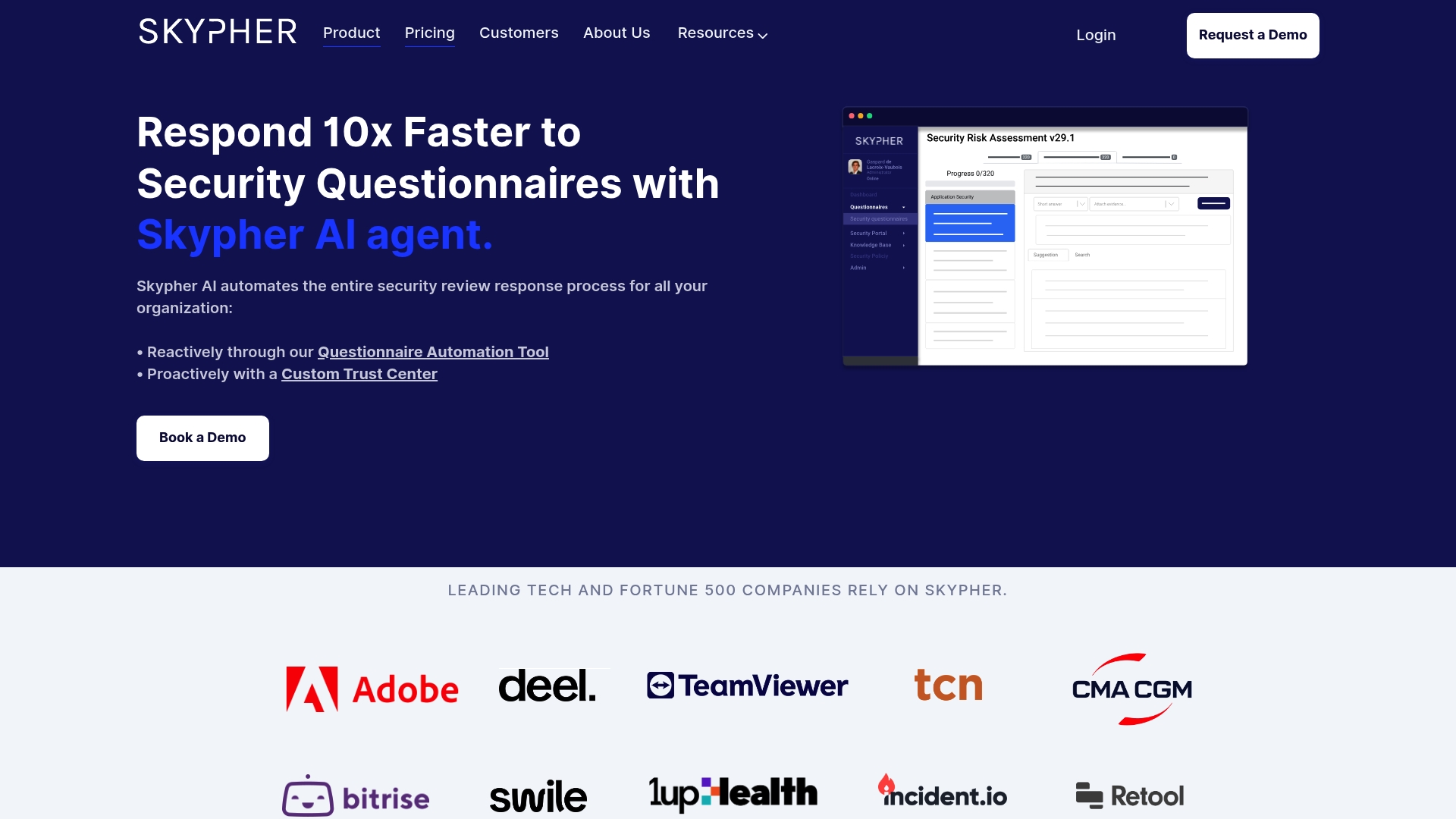
Imagine reducing the time spent on tedious security reviews while increasing accuracy and team collaboration—Skypher can make that vision a reality.
- Automate your responses to security questionnaires,
- Integrate seamlessly with over 40 third-party risk management platforms,
- Collaborate in real-time with your teams,
- Showcase your security posture with a customizable Trust Center.
Why wait? Start transforming your cyber risk assessment process today! Visit Skypher to discover how our innovative solutions can empower your organization to thrive in a landscape of evolving threats.