

Navigating the world of payment security can feel overwhelming, especially with the complexity surrounding PCI compliance. The Self-Assessment Questionnaire (SAQ) might sound like just another bureaucratic hurdle for businesses. But here's the surprise: completing an SAQ is actually your key to not only safeguarding cardholder data but also enhancing your overall business operations. Surprisingly, a straightforward process can unlock significant benefits, securing your reputation and building customer trust in a security-conscious marketplace.
Understanding SAQ and PCI DSS
The Self-Assessment Questionnaire (SAQ) serves as a cornerstone tool in the Payment Card Industry Data Security Standard (PCI DSS) compliance framework. If you've been asked to complete an SAQ or demonstrate PCI compliance, understanding what these terms mean and how they relate to your business is essential.
What is an SAQ?
An SAQ, or Self-Assessment Questionnaire, is a validation tool designed to help merchants and service providers assess their compliance with the PCI DSS requirements. Essentially, it's a set of questions that helps determine whether your business adequately protects cardholder data according to industry standards.
The SAQ functions as a self-evaluation mechanism, allowing businesses to document their security practices without necessarily requiring an on-site assessment by a Qualified Security Assessor (QSA). This makes compliance more accessible, especially for smaller businesses with limited resources.
According to the PCI Security Standards Council, SAQs have been updated for PCI DSS v4.0, with some requirements effective immediately while others are considered best practices until March 31, 2025, after which full compliance becomes mandatory.
Types of SAQs
Not all businesses handle payment card data in the same way, which is why multiple SAQ types exist. Each questionnaire is tailored to specific business models and payment processing environments:
- SAQ A: For merchants who have fully outsourced all cardholder data functions to PCI DSS compliant third-party service providers
- SAQ A-EP: For e-commerce merchants using a third-party website for payment processing
- SAQ B: For merchants using only imprint machines or standalone dial-out terminals
- SAQ B-IP: For merchants using only standalone, PTS-approved payment terminals
- SAQ C: For merchants with payment application systems connected to the internet
- SAQ C-VT: For merchants who manually enter transactions via web-based virtual terminals
- SAQ D: The most comprehensive questionnaire for merchants and service providers not qualifying for other SAQ types
- SAQ P2PE: For merchants using approved Point-to-Point Encryption solutions
Selecting the correct SAQ type is crucial as it directly impacts the scope and complexity of your compliance process. Using an inappropriate SAQ could leave security gaps or unnecessarily increase your compliance burden.
The Relationship Between SAQs and PCI DSS
PCI DSS (Payment Card Industry Data Security Standard) provides the framework of security standards that all entities handling cardholder data must follow. The SAQ serves as the practical implementation tool for this framework, helping businesses demonstrate their adherence to these standards.
While PCI DSS outlines what security measures are required, the SAQ helps businesses document how they've implemented these requirements. The questionnaire format breaks down complex security concepts into actionable items that businesses can address systematically.
Completing an SAQ typically involves:
- Determining which SAQ type applies to your business model
- Answering all questions truthfully about your security practices
- Implementing remediation measures for any identified gaps
- Having the completed SAQ signed by an authorized company officer
- Submitting the SAQ along with any required supporting documentation to your acquiring bank or payment brand
By understanding the purpose and structure of SAQs within the broader PCI DSS framework, businesses can approach compliance more strategically and efficiently, ensuring that cardholder data remains secure while meeting industry requirements.
Key Takeaways
| Takeaway | Explanation |
|---|---|
| Understanding SAQs is Vital | Knowing the purpose and structure of Self-Assessment Questionnaires (SAQs) helps businesses navigate PCI DSS compliance effectively. |
| Selecting the Right SAQ Type | Choosing the appropriate SAQ is crucial, as it impacts the complexity of the compliance process and helps identify specific security needs based on business operations. |
| Structured Completion Process | A systematic approach to completing the SAQ, including preparation, documentation, and internal validation, ensures thoroughness and accuracy in compliance efforts. |
| Maintaining Ongoing Compliance | PCI DSS compliance requires continuous monitoring and updates to security practices to avoid slippage between assessments, emphasizing the need for a proactive compliance culture. |
| Recognizing Business Benefits | SAQ compliance not only meets regulatory requirements but also enhances security posture, fosters customer trust, and provides a competitive edge in the marketplace. |
SAQ Eligibility and Types
Navigating PCI DSS compliance begins with determining which Self-Assessment Questionnaire (SAQ) applies to your business. Each SAQ type has specific eligibility criteria designed to match different payment processing environments and risk profiles.
Determining Your SAQ Eligibility
Your eligibility for a particular SAQ depends primarily on how your business handles cardholder data and payment processing. The key factors that determine which SAQ you should complete include:
- Payment acceptance channels (in-person, online, mail order, etc.)
- Storage practices for cardholder data
- Processing systems and their connectivity
- Use of third-party service providers
- Volume of transactions processed annually
It's crucial to accurately assess these factors, as using an inappropriate SAQ could either leave security gaps or impose unnecessary compliance burdens on your organization. When in doubt, consult with your acquiring bank or a qualified security assessor.
According to the PCI Security Standards Council, while they provide tools to facilitate compliance, they don't define specific compliance requirements. You must consult with your compliance enforcing entity (payment brands, acquirers, etc.) for your specific validation requirements.

Comprehensive Guide to SAQ Types
Let's explore the different SAQ types in greater detail to help you identify which one aligns with your business operations:
SAQ A: The simplest questionnaire, with approximately 24 questions. This applies to merchants who have fully outsourced all payment processing to PCI DSS validated third-party service providers. Your business must not electronically store, process, or transmit cardholder data. Typically suitable for e-commerce merchants using iframe or redirect methods.
SAQ A-EP: For e-commerce merchants who outsource payment processing but have websites that could impact the security of the payment transaction. Contains about 190 questions and requires more extensive security controls than SAQ A.
SAQ B: Designed for merchants using only standalone, dial-out terminals (not connected to the internet) or imprint machines. These merchants don't store cardholder data electronically. Includes approximately 41 questions.
SAQ B-IP: For merchants using only standalone, PTS-approved payment terminals with an IP connection to the payment processor. These terminals must not be connected to any other systems within the merchant environment. Contains roughly 82 questions.
SAQ C-VT: Applicable to merchants who manually enter transactions via a virtual terminal provided by a PCI DSS compliant third-party service provider. No electronic cardholder data storage is permitted. Includes about 83 questions.
SAQ C: For merchants with payment application systems connected to the internet, but who do not store cardholder data electronically. Typically applies to point-of-sale systems connected to the internet. Contains approximately 160 questions.
SAQ P2PE: For merchants using validated point-to-point encryption solutions listed by the PCI SSC. These merchants do not have access to decrypted cardholder data. Includes about 35 questions.
SAQ D for Merchants: The most comprehensive questionnaire for merchants. Required for those who don't qualify for other SAQs, including all merchants that store cardholder data electronically or those who process cardholder data on systems connected to the internet. Includes all PCI DSS requirements, resulting in approximately 329 questions.
SAQ D for Service Providers: Similar to SAQ D for Merchants but specifically designed for service providers that are eligible for SAQ validation. Contains about 347 questions covering all PCI DSS requirements.
Evolution of SAQ Requirements
The requirements within each SAQ type evolve as the PCI DSS standard itself is updated. With the release of PCI DSS v4.0, several SAQs have seen updates to their requirements and eligibility criteria. Most notably, SAQ A has undergone significant revisions regarding eligibility for e-commerce merchants.
These updates reflect the changing landscape of payment security threats and technologies. What qualified for a simpler SAQ type in the past may now require a more comprehensive assessment due to emerging security concerns.
If you're already familiar with a previous version of an SAQ, be sure to review the current requirements carefully, as they may have changed substantially. Working with your acquiring bank or a qualified security professional can help ensure you're completing the appropriate SAQ for your current business operations and technology environment.
Step-by-Step SAQ Completion Process
Completing a PCI DSS Self-Assessment Questionnaire might seem daunting at first, but breaking it down into manageable steps makes the process more approachable. This systematic approach ensures thorough compliance documentation while minimizing the stress typically associated with regulatory requirements.
Preparation Phase
Before diving into the questionnaire itself, proper preparation sets the foundation for a successful SAQ completion:
-
Determine the correct SAQ type: Based on your payment processing methods and business model, identify which SAQ applies to your organization. Consult with your acquiring bank if you're uncertain.
-
Define your cardholder data environment (CDE): Map out exactly where cardholder data is stored, processed, or transmitted within your organization. This critical step helps establish the scope of your assessment.
-
Gather relevant documentation: Assemble your security policies, network diagrams, inventory lists, and evidence of security controls. Having these documents readily available streamlines the assessment process.
-
Assemble your compliance team: Identify key stakeholders from IT, security, operations, and management who will contribute to completing the SAQ. Clearly define roles and responsibilities.
According to OneTrust, only organizations processing fewer than 6 million transactions annually (for merchants) or fewer than 300,000 transactions (for service providers) are eligible to use an SAQ. Higher-volume organizations require a more comprehensive Report on Compliance (ROC).
Completion Process
With preparation complete, you can proceed to the actual questionnaire completion:
-
Download the current SAQ version: Always use the most recent version of your applicable SAQ from the PCI Security Standards Council website. Using outdated forms could result in compliance gaps.
-
Complete the questionnaire section by section: Work through each question methodically, answering honestly about your security practices. The SAQ uses a yes/no format, with "not applicable" options available for certain scenarios.
-
Document compensating controls: If you cannot meet a requirement as specifically stated but have alternative security measures in place, document these as compensating controls. These must address the same risk the original requirement was designed to mitigate.
-
Address non-compliant items: For any "no" responses, develop and document remediation plans. These should include specific actions, responsible parties, and target completion dates.
-
Conduct internal validation: Before finalizing, have someone not directly involved in the completion process review the SAQ for accuracy and completeness. This provides a valuable quality check.
Finalization and Submission
The final phase involves formalizing your compliance status and submitting documentation:
-
Complete the Attestation of Compliance (AOC): This document serves as your formal declaration of PCI DSS compliance status. It must be signed by an officer of your company, typically a C-level executive or equivalent.
-
Submit documentation to required parties: Provide your completed SAQ and AOC to your acquiring bank and/or the payment brands as required. Some may require additional supporting evidence.
-
Maintain compliance records: Keep copies of all compliance documentation, including the completed SAQ, AOC, and supporting evidence. These records prove valuable during future assessments and audits.
-
Implement continuous monitoring: Establish processes to maintain compliance between formal assessments. This includes regular vulnerability scanning, policy reviews, and security awareness training.
Common Challenges and Solutions
Many organizations encounter similar obstacles during the SAQ process:
-
Scope uncertainty: When in doubt about what systems fall within scope, consult with a QSA (Qualified Security Assessor) for professional guidance.
-
Technical jargon: If you encounter unfamiliar terminology, refer to the PCI DSS glossary or seek clarification from your acquiring bank.
-
Resource constraints: For smaller organizations with limited resources, consider prioritizing remediation efforts based on risk and potential impact.
-
Documentation gaps: If you lack formal documentation for existing controls, this is an opportunity to develop these important security artifacts.
Remember that PCI DSS compliance is not merely a checkbox exercise but a continuous commitment to payment card security. The SAQ process should prompt ongoing improvements to your security posture rather than being viewed as a one-time hurdle to overcome.
By following this structured approach, you'll not only satisfy compliance requirements but also strengthen your overall security program, protecting both your customers' sensitive data and your business reputation.
Key Benefits of SAQ Compliance
Complying with PCI DSS requirements through the appropriate Self-Assessment Questionnaire delivers significant advantages beyond merely checking a regulatory box. Understanding these benefits can help transform your perspective on SAQ completion from a burdensome obligation to a valuable business investment.
Enhanced Security Posture
The primary purpose of PCI DSS compliance is to protect sensitive cardholder data, and completing an SAQ helps achieve this fundamental goal. By systematically addressing each requirement, you'll implement robust security controls that significantly reduce your vulnerability to data breaches and other security incidents.
Each section of an SAQ addresses specific security domains crucial to protecting payment card information:
- Network security and firewall configurations
- Secure password policies and access controls
- Encryption of transmitted cardholder data
- Anti-virus implementation and maintenance
- Secure systems and application development
- Restricted physical access to cardholder data
- Network monitoring and security testing
- Regular policy maintenance and review
Implementing these controls creates multiple layers of defense against both external and internal threats. Even if one security measure fails, others remain to protect your customers' sensitive information.
Risk Reduction and Financial Protection
The financial implications of PCI DSS non-compliance can be severe. By maintaining SAQ compliance, you protect your business from potentially devastating costs:
-
Avoided breach costs: The average cost of a data breach continues to rise each year, with significant expenses for forensic investigation, customer notification, credit monitoring services, and legal fees.
-
Protection from penalties: Non-compliant merchants face substantial fines from payment card brands and acquiring banks, ranging from thousands to hundreds of thousands of dollars depending on transaction volume and breach severity.
-
Reduced fraud losses: Properly implemented security controls directly reduce fraudulent transactions, saving your business from chargebacks and related processing fees.
-
Insurance benefits: Many cyber insurance policies require PCI DSS compliance as a prerequisite for coverage or offer reduced premiums for compliant businesses.
According to Network Assured, Self-Assessment Questionnaires are simplified versions of the comprehensive PCI Report on Compliance (ROC), making them particularly valuable for small and medium-sized businesses looking to achieve compliance without overwhelming resources.
Competitive Advantage and Customer Trust
In today's privacy-conscious marketplace, demonstrating a commitment to data security provides tangible business advantages:
-
Enhanced brand reputation: Customers increasingly factor security and privacy practices into their purchasing decisions. PCI compliance signals your dedication to protecting their financial information.
-
Business partnership opportunities: Many organizations require their vendors and partners to demonstrate PCI DSS compliance before establishing business relationships, particularly when cardholder data is involved.
-
Customer confidence: The ability to assure customers that your payment processes meet industry security standards builds trust and encourages repeat business.
-
Differentiation from competitors: In competitive markets, PCI compliance can serve as a distinguishing factor that sets your business apart from less security-conscious alternatives.
Operational Improvements
The SAQ process often catalyzes broader operational enhancements beyond security:
-
Business process clarification: Mapping data flows for your SAQ often reveals inefficiencies or redundancies in business processes that can be streamlined.
-
Technology optimization: Evaluating systems for compliance frequently identifies outdated technologies or unnecessary complexity that can be addressed.
-
Staff awareness: Completing an SAQ raises security awareness throughout your organization, creating a more security-conscious culture.
-
Documentation improvements: The documentation required for SAQ compliance provides valuable reference materials that improve operational consistency and knowledge transfer.
Simplified Compliance Framework
The structured nature of SAQs provides a clear framework that simplifies the compliance process:
-
Scope limitation: By properly defining your cardholder data environment, you can potentially limit the scope of your assessment, focusing resources on truly critical systems.
-
Clear expectations: SAQs provide explicit requirements, eliminating guesswork about what constitutes appropriate security.
-
Progressive improvement: For businesses new to compliance, SAQs offer a roadmap for incrementally improving security practices over time.
-
Alignment with other standards: Many PCI DSS requirements overlap with other security frameworks like ISO 27001 or NIST, creating efficiencies when pursuing multiple certifications.
By fully appreciating these benefits, organizations can approach SAQ compliance not merely as a regulatory requirement but as a strategic advantage that strengthens their security posture, enhances customer relationships, and protects financial interests. The investment in proper compliance pays dividends across multiple aspects of your business operations and reputation.
Common SAQ Challenges and Tips
While Self-Assessment Questionnaires provide a structured approach to PCI DSS compliance, organizations frequently encounter obstacles during the process. Understanding these common challenges and implementing proven strategies can significantly streamline your compliance journey.
Scope Determination Difficulties
One of the most pervasive challenges organizations face is accurately defining the scope of their cardholder data environment (CDE).
Challenge: Many businesses struggle to identify all systems that store, process, or transmit cardholder data, or that could impact the security of those systems. This often leads to either an unnecessarily broad scope (increasing compliance costs) or a dangerously narrow scope (creating security gaps).
Solutions:
- Create detailed data flow diagrams that track cardholder data from entry to exit points
- Implement clear network segmentation with proper validation testing
- Consider scope-reduction technologies like point-to-point encryption (P2PE) or tokenization
- Consult with a Qualified Security Assessor (QSA) for complex environments
- Document your scoping decisions and rationale for future reference
Resource Constraints
Completing an SAQ requires dedicated time, expertise, and often financial resources that may strain smaller organizations.
Challenge: Limited staff with security expertise, competing priorities, and budget constraints can make thorough SAQ completion seem overwhelming.
Solutions:
- Break the SAQ process into smaller, manageable tasks assigned across departments
- Create a realistic timeline that accounts for your organization's resource limitations
- Focus first on high-risk requirements that protect cardholder data
- Consider outsourcing specific technical requirements (like vulnerability scanning)
- Leverage free or low-cost resources provided by the PCI Security Standards Council
Technical Complexity
Some PCI DSS requirements involve sophisticated security controls that may exceed your team's current technical capabilities.
Challenge: Requirements around secure coding practices, encryption implementation, or penetration testing often require specialized knowledge.
Solutions:
- Prioritize training for your IT team on key security concepts
- Consider managed security service providers for complex requirements
- Implement compensating controls when appropriate (with proper documentation)
- Start with simpler requirements while developing capabilities for more complex ones
- Join industry forums where you can ask questions and learn from peers
Ongoing Compliance Maintenance
PCI DSS compliance is not a one-time achievement but requires continuous effort to maintain.
Challenge: Organizations often struggle to maintain compliance between annual assessments, allowing security controls to drift or deteriorate over time.
Solutions:
- Implement a compliance calendar with recurring tasks and responsibilities
- Conduct quarterly mini-assessments focused on critical requirements
- Incorporate compliance requirements into regular business processes
- Establish key performance indicators (KPIs) for security and compliance
- Automate compliance checks and monitoring where possible
Documentation Gaps
Even when security controls are in place, inadequate documentation can derail your compliance efforts.
Challenge: Organizations frequently implement security measures without properly documenting policies, procedures, evidence gathering processes, or control effectiveness.
Solutions:
- Create templates for consistent documentation across all requirements
- Establish a central repository for compliance evidence
- Implement automated logging and reporting where possible
- Assign specific documentation responsibilities to team members
- Schedule regular reviews of documentation to ensure it remains current
Third-Party Service Provider Management
Many organizations rely on third-party service providers who may impact their PCI DSS compliance status.
Challenge: Ensuring vendor compliance and clearly defining responsibility boundaries presents significant challenges, particularly with the increased scrutiny on service provider relationships in PCI DSS v4.0.
Solutions:
- Maintain an inventory of all service providers who handle cardholder data
- Include specific PCI DSS compliance requirements in contracts
- Regularly review vendors' compliance documentation
- Clearly document responsibility matrices for shared compliance requirements
- Implement a formal vendor risk management program
Expert Tips for SAQ Success
Beyond addressing specific challenges, these general strategies can help ensure a successful SAQ process:
-
Start early: Begin the assessment process at least 3-4 months before your deadline to allow time for remediation.
-
Involve leadership: Ensure executive support for the compliance program, including necessary resources and authority.
-
Take a risk-based approach: Focus your most intensive efforts on the requirements that address the greatest risks to cardholder data.
-
Build a cross-functional team: Include representatives from IT, security, operations, legal, and business units for comprehensive coverage.
-
Leverage technology: Consider governance, risk, and compliance (GRC) tools to streamline documentation and evidence collection.
-
Learn from assessments: Use each compliance cycle to improve your security program rather than treating it as a mere checkbox exercise.
By anticipating these common challenges and implementing strategic solutions, you can transform the SAQ process from a frustrating obligation into a valuable opportunity to enhance your overall security posture. Remember that compliance is ultimately about protecting your customers' sensitive information and your business reputation, not just satisfying a regulatory requirement.
Frequently Asked Questions
What is a Self-Assessment Questionnaire (SAQ)?
An SAQ is a validation tool designed for merchants and service providers to assess their compliance with the Payment Card Industry Data Security Standard (PCI DSS) requirements, helping them ensure they adequately protect cardholder data.
How do I determine which SAQ type applies to my business?
Your SAQ type depends on factors such as how you accept payments, whether you store cardholder data, and the systems involved in processing transactions. Consulting your acquiring bank can help clarify which SAQ is appropriate for your specific business model.
What are the key steps in completing an SAQ?
The key steps include determining the correct SAQ type, mapping your cardholder data environment, completing the questionnaire section by section, addressing any non-compliant items, and submitting your completed SAQ along with the Attestation of Compliance (AOC) to your acquiring bank.
Why is PCI DSS compliance important for my business?
PCI DSS compliance protects your business from data breaches, helps you avoid hefty fines, and builds customer trust by assuring them their payment information is secure. Compliance enhances your overall security posture and can provide a competitive advantage in a security-conscious marketplace.
Elevate Your PCI Compliance Efforts with Skypher
Navigating the complexities of PCI DSS compliance, especially while completing the Self-Assessment Questionnaire (SAQ), can be overwhelming. The intricate details of determining the correct SAQ type and accurately documenting your security controls often lead to confusion and frustration—especially for organizations striving to protect sensitive cardholder data.
But what if you could simplify this entire process? With Skypher’s AI Questionnaire Automation Tool, you'll transform your compliance journey into a streamlined, efficient experience. Say goodbye to endless hours of paperwork and hello to:
- Faster Compliance: Complete your SAQ with precision and speed, reducing your compliance burden significantly.
- Real-Time Collaboration: Enhance communication within your teams as you tackle the complexities of security assessments.
- Seamless Integrations: Connect to over 40 third-party risk management platforms, allowing you to consolidate your security efforts into one powerful tool.
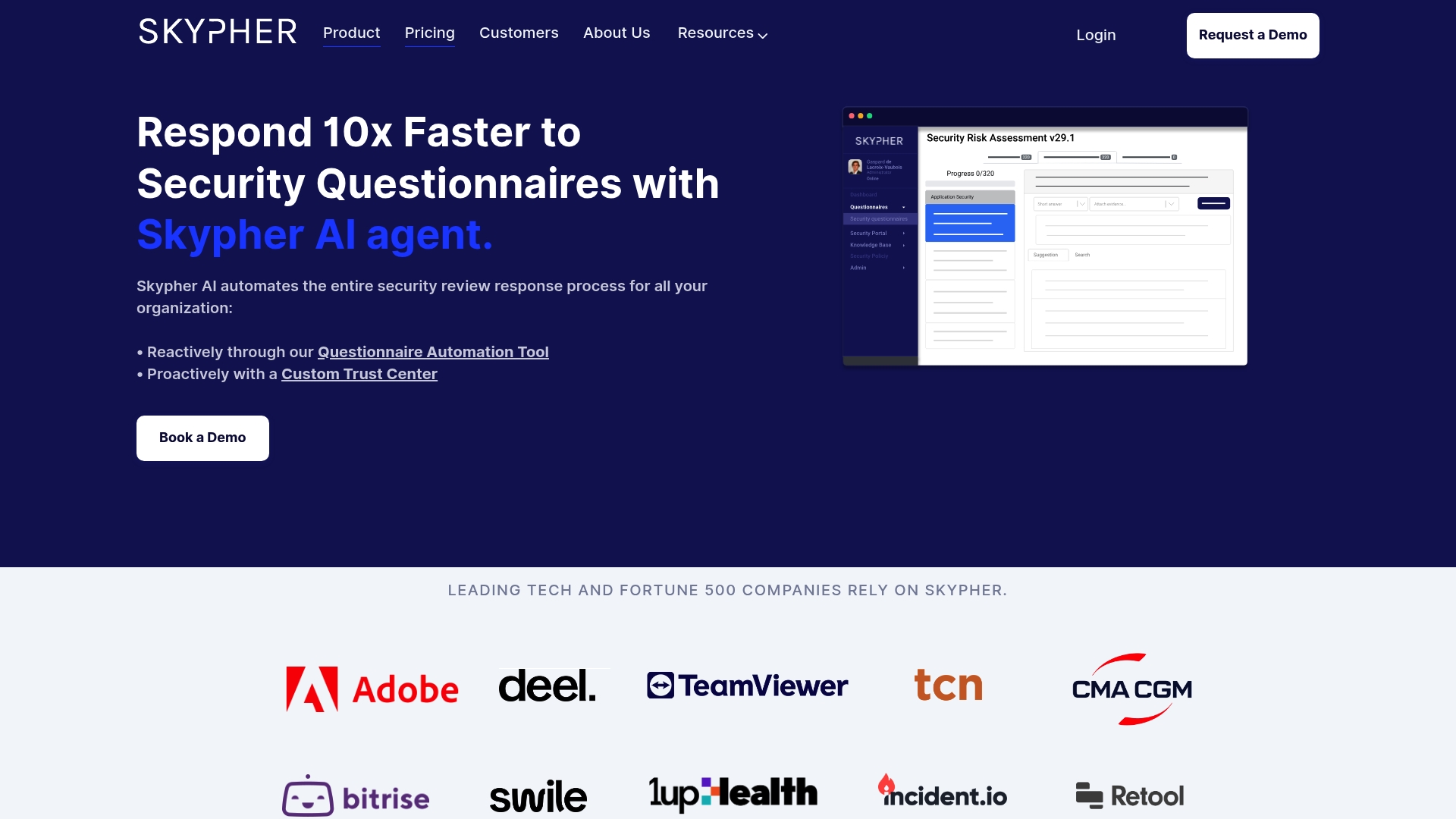
Don’t let compliance challenges hinder your business’s growth. Take control of your PCI DSS obligations and enhance your cybersecurity posture today! Visit https://skypher.co to discover how our platform can revolutionize your approach to security questionnaires and elevate your operational productivity. Start your journey towards effortless compliance now!