

Understanding the Basics: What Is SOC1 and SOC2?
SOC1 and SOC2 are service organization control reports developed by the American Institute of Certified Public Accountants (AICPA). These frameworks evaluate and validate a company's internal controls related to financial reporting and data security.
SOC1 (Service Organization Control 1) specifically addresses internal controls relevant to a client's financial reporting. Designed to evaluate financial controls, SOC1 ensures that service organizations handling financial data maintain appropriate safeguards. For example, a payroll processing company would obtain a SOC1 report to demonstrate to its clients that their financial data processing maintains integrity.
In contrast, SOC2 (Service Organization Control 2) focuses on non-financial controls related to security, availability, processing integrity, confidentiality, and privacy of data. Cloud service providers like AWS and Microsoft Azure typically pursue SOC2 compliance to prove their systems protect sensitive customer information.
The difference between SOC1 and SOC2 reports primarily concerns their focus:
- SOC1 - Evaluates controls relevant to financial reporting
- SOC2 - Assesses controls related to the five Trust Services Criteria
- SOC1 requires accounting expertise for auditing
- SOC2 demands specialized IT security knowledge
A 2022 survey by Compliance Week found that 79% of businesses request SOC reports from their vendors, highlighting their critical importance in business relationships and risk management.
Key Takeaways
| Key Point | Details |
|---|---|
| SOC1 vs SOC2 Focus | SOC1 evaluates financial controls, while SOC2 assesses non-financial data security controls. |
| Trust Services Criteria | SOC2 reports are built around five criteria: Security, Availability, Processing Integrity, Confidentiality, and Privacy, unlike SOC1. |
| Report Types | Both SOC1 and SOC2 offer Type I and Type II reports, with Type II providing greater assurance through a longer evaluation period. |
| Importance for Vendors | 79% of businesses request SOC reports from vendors, emphasizing the value of compliance in business relationships. |
Key Differences Unpacked: SOC1 vs SOC2 Compliance and Focus
Understanding the difference between SOC1 and SOC2 compliance is essential for organizations to determine which framework best suits their needs and obligations to customers.
Primary Purpose and Scope

The fundamental difference between SOC1 and SOC2 lies in their intended focus. SOC1 reports evaluate controls relevant to financial reporting, while SOC2 examines controls related to information security and data privacy. This distinction makes SOC1 more relevant for service providers that impact their clients' financial statements, such as payment processors or loan servicing companies.
A Fortune 500 manufacturing company recently required SOC1 compliance from its inventory management software provider to ensure accurate financial reporting for its $2 billion in annual inventory.
Trust Services Criteria
SOC2 reports are built around five Trust Services Criteria:
- Security - Protection against unauthorized access
- Availability - System accessibility for operation and use
- Processing Integrity - Complete, accurate, and timely processing
- Confidentiality - Protection of confidential information
- Privacy - Collection, use, retention, and disposal of personal information
In contrast, SOC1 focuses solely on financial controls without these specific criteria categories.
Report Types
Both SOC1 and SOC2 offer Type I and Type II reports. Type I assesses the design suitability of controls at a specific point in time, while Type II evaluates both design and operational effectiveness over a period (usually 6-12 months). According to AICPA data, 72% of organizations opt for Type II reports due to their comprehensive nature and greater assurance value.
The difference between SOC1 and SOC2 reports ultimately determines which compliance path an organization should prioritize based on the services they provide and customer requirements.
Benefits and Business Impact: How SOC Reports Build Trust
SOC1 and SOC2 compliance delivers substantial business advantages beyond mere regulatory adherence. These frameworks provide tangible benefits that directly impact an organization's reputation, client relationships, and operational efficiency.
Competitive Differentiation stands as perhaps the most significant benefit of SOC compliance. In markets where customers increasingly scrutinize vendor security practices, having SOC1 or SOC2 certification provides a measurable advantage. A 2023 Ponemon Institute study revealed that 84% of enterprises consider security certifications a decisive factor when selecting service providers.
The difference between SOC1 and SOC2 reports also influences their specific benefits:
- SOC1 compliance demonstrates financial control integrity, reducing audit costs for clients
- SOC2 certification signals robust data security practices, building customer confidence
- Both frameworks streamline risk management by identifying control weaknesses
- SOC reports reduce the burden of responding to multiple security questionnaires
- Compliance often leads to preferential cyber insurance rates
Financial impact is measurable as well. SaaS companies with SOC2 compliance close enterprise deals 40% faster on average than non-compliant competitors, according to data from Vanta's compliance benchmark report.
The interconnection between SOC1 and SOC2 compliance often creates efficiency opportunities. Organizations handling both financial data and sensitive customer information can develop integrated control environments addressing requirements for both frameworks simultaneously, reducing compliance overhead while maximizing trust signals to potential clients.
Choosing the Right SOC Report: Common Questions and Decision-Making Guidance
Determining whether your organization needs SOC1 or SOC2 compliance depends on several key factors related to your services and customer base.
Does your service affect customer financial statements?
This question represents the primary decision point when choosing between SOC1 and SOC2. If your organization processes transactions, handles accounting data, or provides services that directly impact your clients' financial statements, then SOC1 is likely appropriate. Examples include:
- Payroll processing companies
- Financial transaction processors
- Claims processing services
- Loan servicing organizations
- Investment management services
Do you handle sensitive customer data?
If your service manages confidential information or personal data without directly impacting financial reporting, SOC2 is typically the better choice. A recent survey by Deloitte found that 91% of SaaS companies ultimately pursued SOC2 over SOC1 due to their focus on data security rather than financial controls.
Do you need both?
Some organizations require both SOC1 and SOC2 compliance. For instance, a cloud-based accounting platform would need SOC1 to address financial reporting controls and SOC2 to demonstrate proper security measures for customer data protection. According to AICPA data, approximately 23% of service organizations maintain both types of reports.
Evaluating business requirements
When deciding between SOC1 vs SOC2 compliance, consider:
- Customer requirements and expectations
- Regulatory environment in your industry
- Types of data you process and store
- Competitive landscape and market differentiation needs
- Resource availability for compliance efforts
The difference between a SOC1 and SOC2 report ultimately comes down to whether financial reporting controls or information security controls are most relevant to your business operations and customer needs.
Best Practices for Implementing SOC Compliance Successfully
Achieving and maintaining SOC compliance requires strategic planning and execution. Organizations seeking SOC1 or SOC2 compliance can optimize their approach with these proven practices.
Pre-Audit Preparation
Preparing thoroughly before engaging an auditor saves time and reduces costs. Begin with a readiness assessment to identify gaps between your current controls and SOC requirements. A well-executed gap analysis typically reduces audit costs by 30-40% according to compliance advisory firm A-LIGN.
Establish clear ownership of the compliance process by appointing a dedicated compliance manager or team responsible for coordinating efforts across departments. This prevents the common pitfall of fragmented responsibility that derails many compliance initiatives.
Documentation and Control Implementation
Whether pursuing SOC1 or SOC2 compliance, comprehensive documentation is essential. Key documentation requirements include:
- Detailed control descriptions and objectives
- Information security policies and procedures
- Risk assessment frameworks
- Evidence of control operation
- Incident response protocols
- Vendor management procedures
Implement automated evidence collection wherever possible. Organizations using compliance automation tools complete SOC2 audits 50% faster than those relying on manual processes, according to Vanta's 2023 compliance benchmark study.
Sustainability Planning
SOC compliance isn't a one-time achievement but an ongoing commitment. Successful organizations integrate compliance activities into regular business operations rather than treating them as separate initiatives.
The difference between SOC1 and SOC2 reports means distinct operational approaches may be needed. SOC1 compliance requires ongoing monitoring of financial control effectiveness, while SOC2 demands continuous security control evaluation across the five Trust Services Criteria.
Consider starting with Type I certification before advancing to more rigorous Type II assessment, particularly for first-time compliance efforts. This staged approach allows organizations to address design effectiveness before tackling operational consistency.
Frequently Asked Questions
What is the main difference between SOC1 and SOC2?
SOC1 focuses on evaluating internal controls relevant to financial reporting, while SOC2 assesses controls related to security, availability, processing integrity, confidentiality, and privacy of data.
Who needs SOC1 compliance?
Organizations that handle financial data affecting their clients' financial statements, such as payroll processors or loan servicing companies, typically require SOC1 compliance.
Who should pursue SOC2 compliance?
Companies that manage sensitive customer data without directly impacting financial reporting, like cloud service providers and SaaS companies, should pursue SOC2 compliance.
What are the types of SOC reports available?
Both SOC1 and SOC2 offer Type I and Type II reports. Type I assesses the design of controls at a specific point in time, while Type II evaluates both design and operational effectiveness over a period, usually 6-12 months.
Elevate Your Compliance Game with Skypher
Navigating the complexities of SOC1 and SOC2 compliance can feel overwhelming. Many organizations struggle with the time-consuming process of responding to security questionnaires, often bogged down by the need to provide substantial proof of financial and data security controls. Don't let these compliance challenges hinder your growth and client relations.
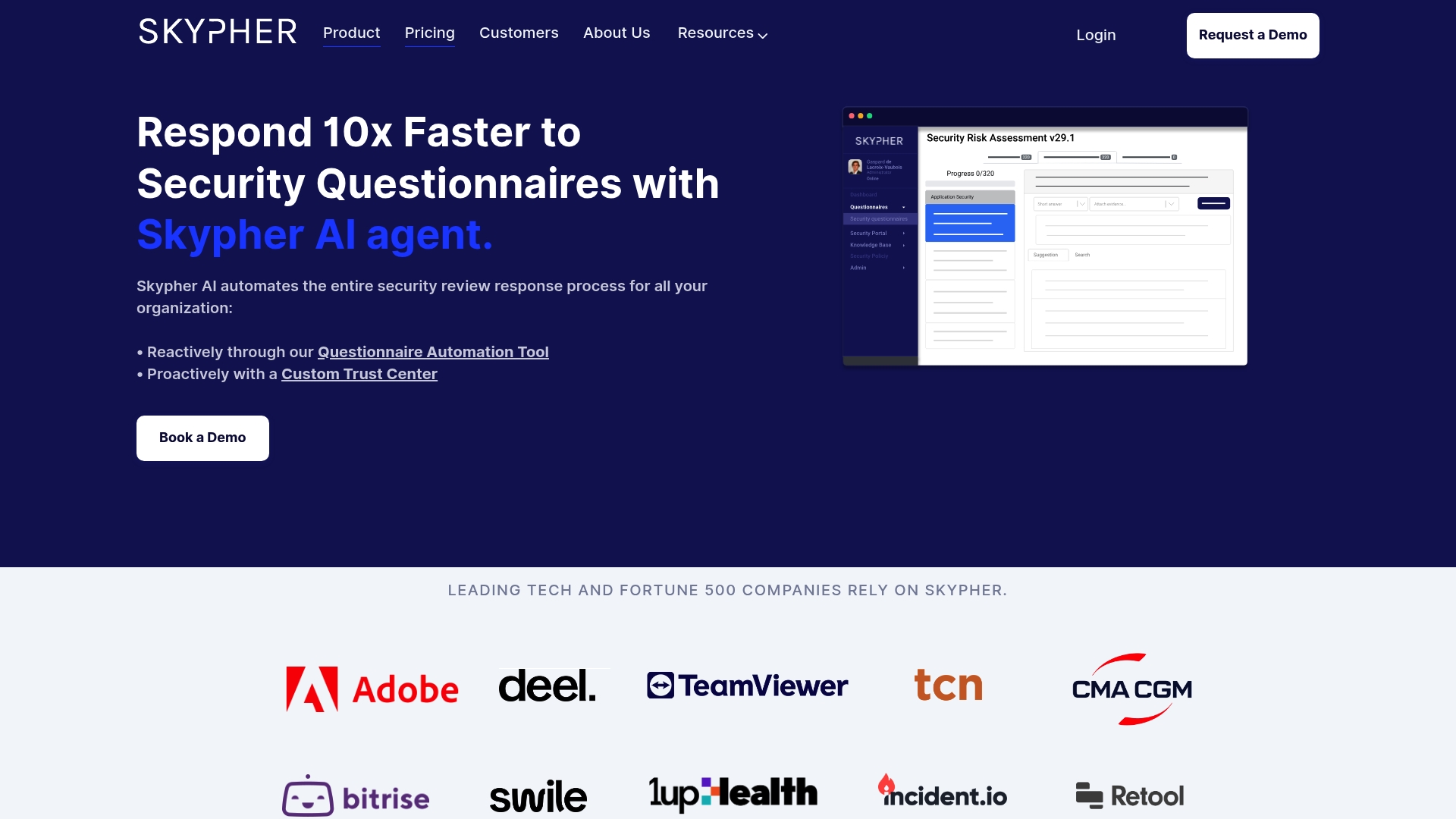
At Skypher, we offer a seamless solution to streamline your response process, enabling you to tackle security reviews with AI-driven efficiency. Our Questionnaire Automation Tool reduces the hours spent completing security questionnaires, allowing your teams to focus on what matters—building strong client relationships and enhancing your cybersecurity posture. Imagine cutting your questionnaire response time in half and boosting your compliance confidence!
Ready to transform your compliance process? Experience Skypher today at https://skypher.co and discover how our real-time collaboration and custom Trust Center can take your organizational efficiency to new heights. Don’t wait—make compliance a breeze now!