

Navigating the complexities of healthcare regulations can feel overwhelming. The HIPAA Omnibus Rule introduced significant compliance requirements for business associates and healthcare providers alike, yet many are still unaware of its full impact. Surprisingly, while most people think of regulations as hindrances, this rule actually empowers patients with enhanced rights over their health information. Understanding its nuances not only helps organizations stay compliant but can also foster stronger patient relationships in the long run.
HIPAA Omnibus Rule Overview
The HIPAA Omnibus Rule represents one of the most significant overhauls to healthcare privacy and security regulations since the original Health Insurance Portability and Accountability Act (HIPAA) was enacted in 1996. Implemented in 2013, this comprehensive set of regulations strengthened and modernized the existing HIPAA framework to address evolving challenges in protecting patient information in an increasingly digital healthcare environment.
Evolution and Implementation
The HIPAA Omnibus Rule, formally known as the "Final Omnibus Rule," was published by the Department of Health and Human Services (HHS) on January 25, 2013, and became effective on March 26, 2013. Healthcare organizations were required to comply with these new regulations by September 23, 2013. This rule wasn't created in isolation—it emerged as a direct response to the Health Information Technology for Economic and Clinical Health (HITECH) Act of 2009, which aimed to promote the adoption of electronic health records while strengthening privacy and security protections.
The rule didn't replace HIPAA but instead modified and enhanced existing regulations, consolidating several proposed rules into a single, comprehensive framework. This consolidation is actually what gives the rule its name—"omnibus" refers to legislation that packages together several diverse measures into one document.
Core Components and Changes
The HIPAA Omnibus Rule introduced several crucial modifications to existing regulations:
-
Expanded Scope of Compliance: Perhaps most significantly, the rule directly extended HIPAA compliance requirements to business associates and their subcontractors. Before the Omnibus Rule, only covered entities (healthcare providers, health plans, and healthcare clearinghouses) were directly liable for HIPAA compliance. Under the new regulations, business associates became directly liable for compliance with the HIPAA Security Rule and certain provisions of the Privacy Rule.
-
Enhanced Patient Rights: The Omnibus Rule strengthened individuals' privacy protections and access to their health information. It gave patients new rights to receive electronic copies of their health information and restricted disclosures to health plans when patients paid out-of-pocket in full.
-
Modified Breach Notification: The rule revised the Breach Notification Rule by implementing a more objective standard for determining when notification is required following a data breach. It replaced the "significant risk of harm" standard with a presumption that all unauthorized uses or disclosures of protected health information (PHI) constitute a breach unless a covered entity or business associate demonstrates a low probability that the PHI was compromised.
-
Increased Penalties: The Omnibus Rule also implemented the HITECH Act's tiered penalty structure for HIPAA violations, significantly increasing the maximum penalties for noncompliance. This reflected a more serious approach to enforcement of privacy and security regulations.
According to Compliancy Group, the rule also addressed privacy issues concerning PHI use and disclosure in marketing communications, payment exchanges, and disclosures to individuals involved in patient care—necessitating updates to notices of privacy practices, research authorizations, internal policies, and training programs.

Impact on Healthcare Organizations
The implementation of the HIPAA Omnibus Rule created significant compliance challenges for healthcare organizations and their business partners. Covered entities had to revise their policies and procedures, update their Notice of Privacy Practices, and renegotiate business associate agreements. Business associates, now directly liable for HIPAA compliance, had to implement comprehensive security programs, often for the first time.
Despite these challenges, the Omnibus Rule has played a crucial role in modernizing healthcare privacy and security regulations to address the realities of 21st-century healthcare delivery and information management. It represents an important step in the ongoing evolution of healthcare privacy protections in the United States.
Key Takeaways
| Takeaway | Explanation |
|---|---|
| Expanded Liability for Business Associates | The Omnibus Rule made business associates directly liable for HIPAA compliance, requiring them to implement comprehensive security programs and policies to protect PHI. |
| Modified Breach Notification Standards | Organizations must now treat most unauthorized disclosures of PHI as breaches unless they can demonstrate a low probability of compromise, requiring rigorous risk assessments for incident evaluations. |
| Enhanced Patient Rights | The Omnibus Rule strengthened patient rights to access their health information, including the right to receive electronic copies, necessitating revisions to organizations' policies and technology infrastructure. |
| Financial and Operational Impact | Compliance with the Omnibus Rule imposed significant costs and operational changes, particularly for smaller providers, often leading them to seek larger partnerships for effective compliance management. |
| Importance of Regular Risk Assessments | Conducting regular risk assessments is essential for compliance, helping organizations identify vulnerabilities related to PHI management and security. |
Key Regulatory Changes Impacting Compliance
The HIPAA Omnibus Rule brought sweeping changes to healthcare compliance requirements, significantly altering how organizations handle protected health information (PHI). Understanding these regulatory modifications is essential for healthcare providers, business associates, and any organization that handles patient data to remain compliant and avoid potentially severe penalties.
Expanded Liability for Business Associates
One of the most profound changes introduced by the HIPAA Omnibus Rule was the direct application of HIPAA requirements to business associates and their subcontractors. Prior to the 2013 Omnibus Rule, business associates were contractually obligated to protect PHI through business associate agreements, but they weren't directly liable under HIPAA regulations.
The Omnibus Rule fundamentally changed this relationship. Business associates became directly responsible for complying with the HIPAA Security Rule and portions of the Privacy Rule. This expansion meant that service providers like IT vendors, cloud storage companies, billing services, and consultants who handle PHI now face direct regulatory scrutiny and potential penalties for violations.
This change required business associates to implement comprehensive compliance programs, including risk assessments, security policies and procedures, employee training, and breach response plans—tasks that many weren't equipped to handle without significant investment.
Modified Breach Notification Requirements
The Omnibus Rule transformed how organizations determine whether a security incident constitutes a reportable breach. Previously, the standard hinged on whether an incident posed a "significant risk of harm" to affected individuals—a subjective assessment that often led to inconsistent reporting practices.
Under the new regulations, any unauthorized acquisition, access, use, or disclosure of PHI is presumed to be a breach requiring notification unless the covered entity or business associate can demonstrate a low probability that the PHI was compromised. This assessment must be based on a four-factor risk assessment that considers:
- The nature and extent of PHI involved
- The unauthorized person who used the PHI or to whom it was disclosed
- Whether the PHI was actually acquired or viewed
- The extent to which risk has been mitigated
This shift placed the burden of proof on organizations to demonstrate why notification isn't necessary, rather than justifying why it is—effectively lowering the threshold for what constitutes a reportable breach.
Enhanced Individual Rights
The Omnibus Rule substantially strengthened patient rights regarding their health information. Notable changes included:
- The right to receive electronic copies of electronic health records
- The ability to restrict disclosures to health plans when paying out-of-pocket in full for services
- The right to request an accounting of disclosures made through an electronic health record
- Streamlined authorization requirements for research purposes
These enhanced individual rights required healthcare organizations to modify their policies, procedures, and technology infrastructure to accommodate these new patient privileges.
Genetic Information Protection
The Omnibus Rule formally incorporated provisions from the Genetic Information Nondiscrimination Act (GINA), prohibiting health plans from using genetic information for underwriting purposes. This change required health plans to revise their policies and practices regarding the collection and use of genetic information.
Marketing and Fundraising Restrictions
The rule tightened restrictions on using PHI for marketing purposes, requiring patient authorization in most cases where the covered entity receives financial remuneration for communications. It also modified fundraising requirements, mandating that each fundraising communication include a clear opportunity to opt-out of future solicitations.
These regulatory changes represented a significant shift in compliance obligations, requiring extensive policy revisions, operational adjustments, and new investments in security infrastructure. For healthcare organizations and their business partners, these changes necessitated a thorough reassessment of their HIPAA compliance programs to address these expanded requirements and minimize exposure to the heightened penalties established by the Omnibus Rule.

Effects on Healthcare Service Providers
The HIPAA Omnibus Rule created substantial operational, administrative, and financial impacts on healthcare service providers across the United States. These organizations faced the challenge of implementing complex new requirements while maintaining quality patient care and operational efficiency. The effects of these regulatory changes continue to influence how healthcare providers operate today.
Operational and Administrative Changes
Healthcare service providers had to implement extensive operational changes to comply with the Omnibus Rule. These modifications affected virtually every aspect of their information management processes and patient interactions.
Notice of Privacy Practices (NPP) documents required comprehensive revisions to reflect the new patient rights and privacy protections. This seemingly simple document change cascaded into multiple operational tasks—reprinting materials, training staff on new provisions, and implementing processes to obtain acknowledgment from patients. Many providers had to redesign their patient intake procedures to accommodate these updated requirements.
The rule also necessitated updated authorization forms for specific uses of patient information and new processes for handling patient requests to restrict disclosures to health plans when they paid out-of-pocket. This required modifications to billing systems and staff training to identify and properly handle these special cases.
Perhaps most significantly, the Omnibus Rule's modified breach notification standard required providers to develop more robust incident response capabilities. Healthcare organizations needed to implement the four-factor risk assessment process and develop clear protocols for determining when notification was necessary. This often meant creating new positions or teams dedicated to privacy and security incident management.
Technology and Security Infrastructure Investments
Compliance with the Omnibus Rule's enhanced security provisions often required substantial technology investments. Many healthcare providers needed to upgrade their electronic health record systems to accommodate new patient rights, such as providing electronic copies of records upon request.
Security infrastructure improvements frequently became necessary as the stakes for data breaches increased under the new regulations. This included investments in encryption technologies, access controls, audit capabilities, and security monitoring systems. Smaller practices, which often had limited IT resources, found these requirements particularly challenging to implement.
Healthcare providers also needed to review and often revise their disaster recovery and business continuity plans to ensure they could maintain the availability of patient information even during disruptions—a component of the Security Rule that took on increased importance with the Omnibus Rule's heightened enforcement provisions.
Financial Impact and Resource Allocation
The financial implications of the Omnibus Rule were substantial. Direct compliance costs included technology investments, legal fees for updating contracts and policies, consulting services for risk assessments, and staff training. Larger healthcare organizations often created dedicated compliance teams or departments to manage these ongoing requirements.
Beyond these direct expenses, providers faced indirect costs in terms of staff time diverted to compliance activities. Clinicians and administrative staff required training on new privacy and security procedures, taking time away from patient care activities.
Smaller healthcare providers felt these financial pressures most acutely. Without dedicated compliance departments or substantial IT resources, small practices often struggled to implement the complex requirements without significant outside assistance. This contributed to the ongoing trend of consolidation in healthcare, as many smaller practices found partnership with larger organizations a more viable path to compliance.
Patient Relationship Changes
The Omnibus Rule also affected how healthcare providers interacted with patients regarding their information. New rights for patients, including enhanced access to electronic records and restrictions on certain disclosures, required providers to modify their communication approaches.
Many providers had to enhance their patient portals and other electronic communication channels to support these rights, accelerating the adoption of digital patient engagement tools. While creating initial implementation challenges, these changes ultimately contributed to greater transparency in healthcare and increased patient engagement in their care.
Providers also needed to adapt their marketing and fundraising practices to comply with stricter requirements for patient authorization, particularly when financial remuneration was involved. This necessitated more careful management of communications and more explicit patient consent processes.
These sweeping changes required healthcare providers to fundamentally rethink their approach to information privacy and security, transforming it from a compliance checkbox to an essential component of quality healthcare delivery. While challenging, this shift ultimately strengthened patient trust and helped prepare providers for an increasingly digital healthcare environment.
Best Practices for HIPAA Compliance
Complying with the HIPAA Omnibus Rule requires a comprehensive approach that addresses not only technical safeguards but also administrative and physical controls. Organizations handling protected health information (PHI) need to implement robust practices to maintain compliance and protect sensitive patient data effectively.
Conduct Regular Risk Assessments
A thorough risk assessment forms the foundation of any effective HIPAA compliance program. These assessments should identify where PHI is stored, processed, or transmitted; evaluate potential threats and vulnerabilities; and determine the likelihood and potential impact of these risks. Risk assessments should be conducted regularly—not just as a one-time activity—and whenever significant changes occur in your organization's operations or IT environment.
Risk assessments should examine all aspects of data security, including:
- Network and system security measures
- Physical security controls
- Administrative procedures and policies
- Staff awareness and training effectiveness
- Business associate relationships and agreements
Documenting your risk assessment process and findings is crucial, as this documentation serves as evidence of your compliance efforts in case of an audit and provides a roadmap for addressing identified vulnerabilities.
Implement Comprehensive Policies and Procedures
Developing and maintaining detailed policies and procedures that address all aspects of the HIPAA Privacy, Security, and Breach Notification Rules is essential. These documents should be tailored to your organization's specific operations and risks rather than using generic templates.
Key policies should address:
- Patient rights to access and amend their health information
- Minimum necessary standards for using and disclosing PHI
- Authorization requirements for uses and disclosures not permitted by the Privacy Rule
- Security incident response procedures
- Business associate management
- Workforce security and privacy training
Policies must be regularly reviewed and updated to reflect changes in regulations, technology, or organizational practices. Importantly, these policies must be operationalized—not just documented but actually implemented in day-to-day operations.
Provide Ongoing Staff Training
Employee errors remain one of the leading causes of privacy and security breaches. Regular training ensures that all workforce members understand their responsibilities regarding patient privacy and information security. Research on healthcare cybersecurity suggests that robust employee training is a critical component in preventing data breaches.
Effective training programs should:
- Be role-based, providing staff with information relevant to their specific job functions
- Include both initial training for new employees and periodic refresher courses
- Cover practical scenarios that employees might encounter
- Address recent incidents or near-misses to create learning opportunities
- Incorporate testing to verify understanding
Training should extend beyond formal sessions to include ongoing awareness efforts such as newsletters, posters, and reminders about privacy and security best practices.
Implement Technical Safeguards
The HIPAA Security Rule requires implementing technical safeguards to protect electronic PHI (ePHI). These safeguards have become increasingly important as healthcare operations become more digitized.
According to research on cybersecurity in healthcare, essential technical safeguards include:
-
Access Controls: Implement strong authentication mechanisms (such as multi-factor authentication) and role-based access controls to ensure that only authorized individuals can access ePHI.
-
Encryption: Encrypt ePHI both at rest and in transit. This provides an additional layer of protection if data is compromised and may qualify for safe harbor under the Breach Notification Rule.
-
Audit Controls: Implement systems that record and examine activity in information systems containing ePHI, allowing you to detect suspicious activities.
-
Integrity Controls: Use mechanisms to verify that ePHI has not been altered or destroyed in an unauthorized manner.
-
Transmission Security: Implement technical security measures to guard against unauthorized access to ePHI being transmitted over electronic networks.
Manage Business Associate Relationships
The Omnibus Rule significantly expanded requirements for business associate relationships. Organizations should:
- Maintain an inventory of all business associates
- Ensure compliant business associate agreements are in place
- Perform due diligence before engaging new business associates
- Periodically assess business associate compliance
- Have processes for promptly addressing business associate incidents
This area requires particular attention since many organizations fail to properly identify all of their business associates or maintain appropriate agreements with them.
Develop and Test Incident Response Plans
Preparing for potential security incidents and breaches before they occur is essential. A well-documented and tested incident response plan helps organizations respond quickly and effectively when incidents occur.
An effective incident response plan should include:
- Clear roles and responsibilities during an incident
- Processes for detecting and analyzing security incidents
- Procedures for containing and mitigating the impact
- Methods for preserving evidence
- Breach determination process using the four-factor assessment
- Notification procedures if a breach is determined to have occurred
- Post-incident analysis to prevent similar incidents
Regularly testing these plans through tabletop exercises or simulations helps identify gaps and ensures team members understand their responsibilities during an actual incident.
By implementing these best practices, organizations can build a robust HIPAA compliance program that not only meets regulatory requirements but also effectively protects patient information. This comprehensive approach requires ongoing attention and resources but is essential for maintaining patient trust and avoiding potentially significant penalties.
Frequently Asked Questions
What is the HIPAA Omnibus Rule?
The HIPAA Omnibus Rule is a set of regulations that expanded HIPAA's privacy and security protections. It was implemented in 2013 to ensure compliance among business associates and healthcare providers, modernizing the existing HIPAA framework.
How does the HIPAA Omnibus Rule affect business associates?
The Omnibus Rule made business associates directly responsible for HIPAA compliance, requiring them to implement comprehensive security programs and ensure the protection of protected health information (PHI).
What are the new patient rights introduced by the HIPAA Omnibus Rule?
The rule enhances patients' rights to access their health information by allowing them to obtain electronic copies of their health records and restricting disclosure to health plans when they pay out-of-pocket in full for services.
What are the penalties for non-compliance with the HIPAA Omnibus Rule?
The Omnibus Rule implemented a tiered penalty structure for HIPAA violations, significantly increasing the maximum penalties for non-compliance, reflecting a more stringent enforcement approach to privacy and security regulations.
Transform Your Compliance Journey with Skypher
Navigating the complexities of the HIPAA Omnibus Rule can be daunting, especially as healthcare organizations face increased compliance demands and expanded liability. Are your security questionnaires consuming too much time and resources? In a landscape where breaches carry significant penalties, ensuring your organization is prepared and compliant is crucial. That's where Skypher comes in.
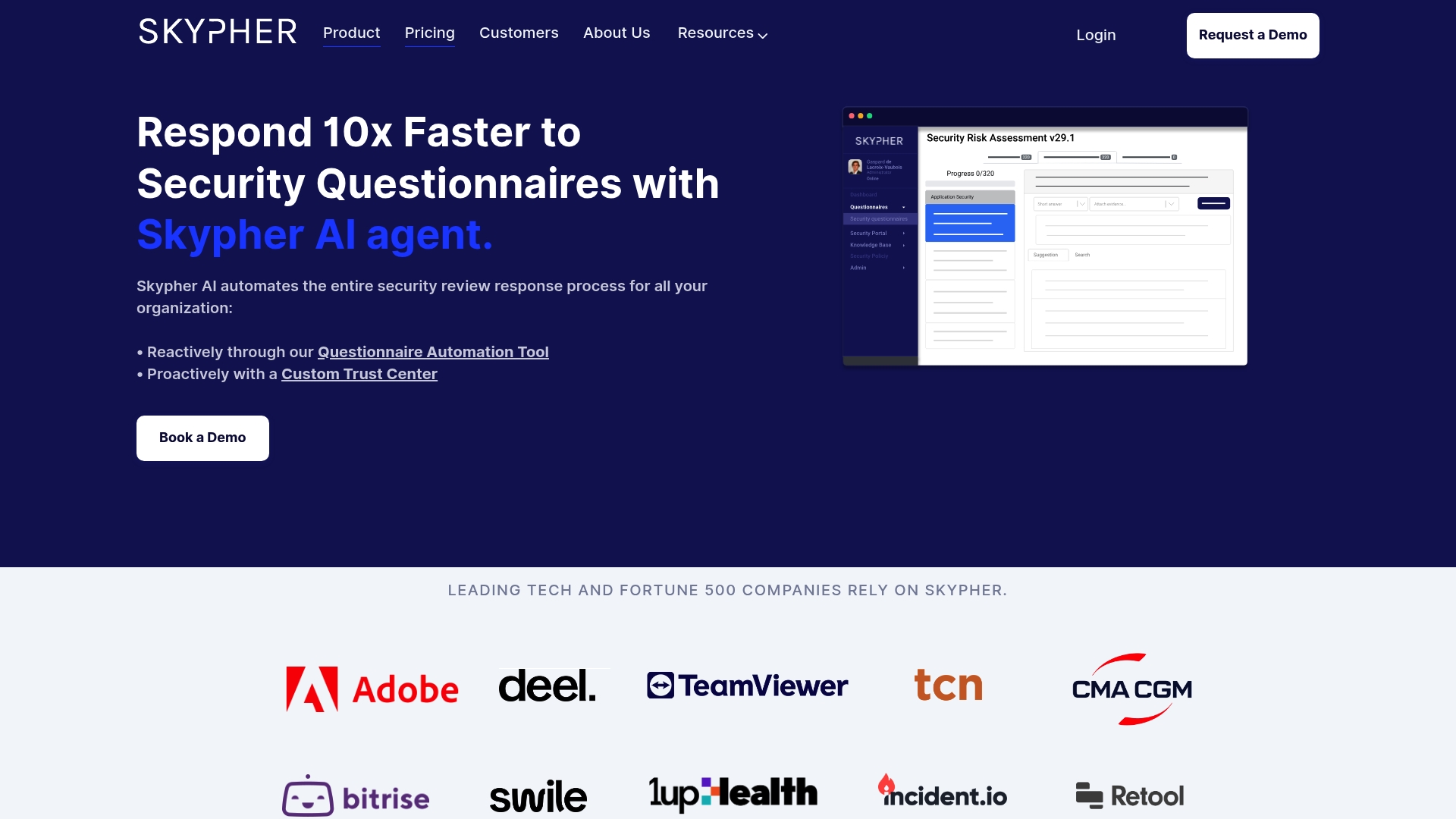
Our AI Questionnaire Automation Tool helps you tackle the intricacies of compliance head-on. With features like real-time collaboration and API integrations with over 40 third-party risk management platforms, you can streamline your responses, enhance accuracy, and foster robust patient relationships—all while significantly reducing your operational burden. Why navigate this process alone when you can accelerate your compliance efforts today?
Don’t let the complexities of HIPAA compliance slow you down. Visit https://skypher.co now to discover how our solutions can boost your efficiency and ensure you meet the demands of today’s healthcare environment!