

Managing dozens of vendors while answering endless security questionnaires can overwhelm even the best compliance teams. Effective third-party risk management is more than ticking boxes—it is your shield against compliance gaps, operational failures, and reputational harm. By understanding the essentials of evaluating and overseeing vendor risk, you empower your organization to respond confidently to client demands, protect sensitive data, and support ongoing efficiency in a fast-paced tech environment. A structured third-party risk management program transforms vendor relationships into measurable, managed partnerships.
Table of Contents
- Defining Third Party Risk Management Essentials
- Types of Third Party Risks Explained
- Core Components and Lifecycle Processes
- Key Obligations and Compliance Requirements
- Pitfalls, Challenges, and Best Practices
Key Takeaways
| Point | Details |
|---|---|
| Importance of Third-Party Risk Management | Organizations must actively manage vendor risks to protect data, ensure compliance, and maintain operational stability. |
| Lifecycle Approach | Implement a continuous cycle of vendor assessment through sourcing, monitoring, and offboarding to effectively manage risks. |
| Governance and Compliance Obligations | Clear governance structures and documented compliance processes are essential to meet regulatory requirements and manage third-party risks. |
| Common Pitfalls and Best Practices | Avoid fragmented oversight and resource constraints by establishing a centralized framework and automating processes to streamline vendor management. |
Defining Third Party Risk Management Essentials
Third-party risk management is a structured approach to identifying, evaluating, and controlling risks that arise from external vendors, suppliers, and partners. Your organization depends on these external relationships, but they also introduce potential security, compliance, and operational vulnerabilities.
Core Definition
Third-party risk management refers to the practice of evaluating and mitigating risks introduced by vendors before, during, and after engagement. It's not just a compliance checkbox. It's a continuous process that protects your data, systems, and reputation.
Why This Matters to Your Organization
Your vendors and partners have access to sensitive information and critical systems. A single breach at a vendor can cascade directly into your environment. Inadequate third-party risk oversight has led to major security incidents affecting thousands of organizations.
Key reasons third-party risk management matters:
- Reduces breach likelihood and data exposure from external partners
- Ensures regulatory compliance across vendor relationships
- Prevents operational failures caused by vendor downtime or performance issues
- Strengthens your overall security posture and client trust
- Identifies weaknesses before they become costly incidents
Essential Components of a TPRM Program
A comprehensive third-party risk management program includes multiple interconnected elements:
- Risk assessment procedures that evaluate vendor security controls and practices
- Vendor selection criteria that prioritize security and compliance standards
- Ongoing monitoring and periodic reassessment of third-party risk levels
- Clear governance frameworks defining roles and accountability
- Incident response protocols specific to third-party breaches
The Reality for Compliance Teams
As a compliance officer managing multiple vendor relationships, you face a critical challenge: responding to security questionnaires from clients demanding proof of your vendor management practices. These assessments are repetitive, time-consuming, and require coordination across teams. Your vendors ask similar questions, creating a cycle of overlapping requests.
Understanding vendor risk assessment methodologies helps you build stronger evaluation processes and respond more efficiently to client demands.
A robust third-party risk management program transforms vendor relationships from potential liabilities into managed, measurable partnerships that strengthen rather than threaten your organization.
Pro tip: Start documenting your vendor risk assessment criteria and monitoring activities now. When clients request proof of your third-party oversight, you'll have concrete evidence ready rather than scrambling to gather information from multiple teams.
Types of Third Party Risks Explained
Third-party risks come in many forms. Your vendors and partners can expose you to security breaches, regulatory violations, operational failures, and reputational damage. Understanding these distinct risk categories helps you prioritize your oversight efforts and allocate resources where they matter most.
Cyber and Security Risks
Cyber risks are perhaps the most visible threat. A vendor's data breach can become your data breach. If a vendor storing your customer information gets hacked, you face notification requirements, regulatory fines, and damaged client relationships.
Cyber risks include:
- Unauthorized access to systems or data
- Malware and ransomware infections transmitted through vendor networks
- Weak encryption or outdated security controls at third parties
- Insufficient authentication and access management practices
Compliance and Regulatory Risks
Vendors must operate within regulatory frameworks that affect your organization. If a vendor violates HIPAA, PCI-DSS, or SOC 2 requirements, you share the liability and regulatory consequences.

Compliance risks encompass regulatory violations, audit failures, and standards breaches. Your vendor's non-compliance becomes your compliance problem.
Operational and Concentration Risks
Operational risks occur when vendors fail to deliver services or experience downtime. If your critical payment processor goes down, your business grinds to a halt. Concentration risks emerge when you depend too heavily on single vendors for essential functions—losing that vendor creates catastrophic operational gaps.
Financial and Reputational Risks
Financial risks include cost overruns, contract disputes, and unexpected expenses from vendor failures. Reputational risks damage your brand when vendors behave unethically or experience public security incidents that reflect poorly on your organization.
Your clients associate vendor failures with your judgment. A vendor's public scandal affects your credibility and client trust.
Systemic and Contagion Risks
When multiple organizations depend on the same vendor, a single vendor failure creates industry-wide contagion. This systemic risk affects not just your organization but the broader financial ecosystem.
Different risk types require different monitoring strategies. Cyber risks need security assessments; compliance risks need audit documentation; operational risks need service-level tracking.
Pro tip: Map your vendors against these risk categories. Which vendors pose cyber risks? Which handle regulated data? Which are mission-critical? This classification guides your assessment priority and response intensity for each vendor relationship.
Here's a comparison of common third-party risk types and effective management strategies for each:
| Risk Type | Typical Impact | Effective Monitoring Approach |
|---|---|---|
| Cyber/Security | Data breaches, service outages | Security assessments, penetration tests |
| Compliance/Regulatory | Legal penalties, audits | Regular compliance reviews, audits |
| Operational/Concentration | Service interruption, business halt | Performance tracking, vendor tiering |
| Financial/Reputational | Cost overruns, brand damage | Financial checks, media monitoring |
| Systemic/Contagion | Industry-wide disruption | Industry risk alerts, scenario analysis |
Core Components and Lifecycle Processes
An effective third-party risk management program isn't a one-time assessment. It's a continuous cycle that covers every phase of a vendor relationship, from initial selection through contract termination. This lifecycle approach ensures risks are identified early and managed throughout the engagement.
The TPRM Lifecycle Framework
The lifecycle spans five critical phases. Each phase requires specific activities, documentation, and oversight to keep vendor risks under control. Understanding this flow helps you structure your own vendor management program.
The core phases include:
- Sourcing and due diligence
- Risk assessment and tiering
- Contracting and governance setup
- Ongoing monitoring and compliance
- Offboarding and relationship closure
Sourcing and Initial Due Diligence
Before you sign a contract, conduct thorough due diligence. This phase determines whether a vendor meets your baseline security, compliance, and operational standards. Initial due diligence includes reviewing vendor credentials, security certifications, financial stability, and regulatory compliance status.
Don't skip this step. Catching red flags upfront prevents problems later.
Risk Assessment and Vendor Tiering
Not all vendors pose equal risk. Tier vendors based on criticality, access to sensitive data, and regulatory exposure. Mission-critical vendors handling regulated data require intensive oversight. Lower-risk vendors get lighter-touch monitoring.
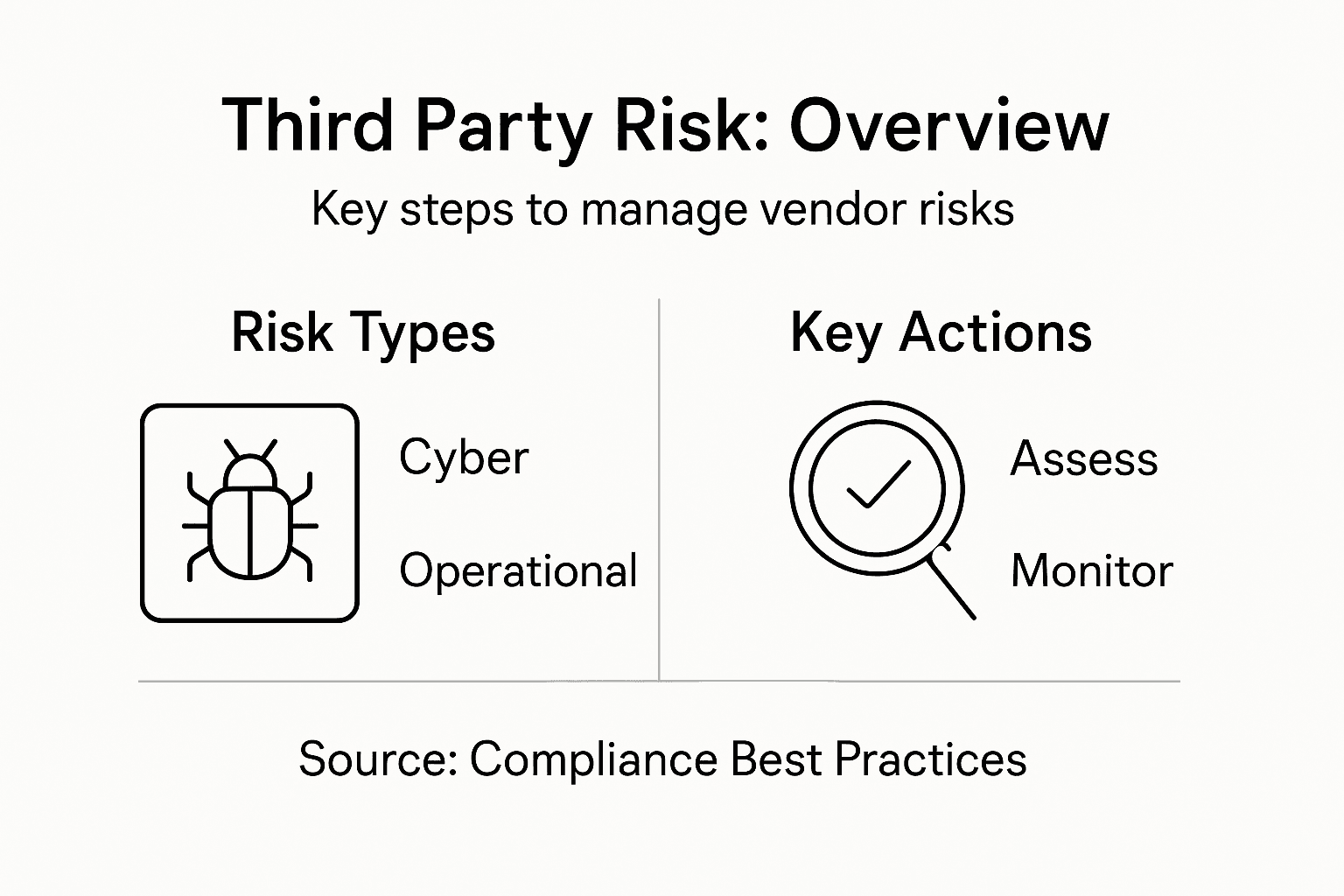
Tiering helps allocate your compliance resources efficiently. High-risk vendors get comprehensive annual assessments. Low-risk vendors might need quarterly questionnaires instead.
Contracting and Governance
Contracts establish accountability and define expectations. Your contracts should include service-level agreements, security requirements, audit rights, incident notification clauses, and termination provisions. Governance structures clarify roles, responsibilities, and escalation paths for managing vendor relationships.
Clear contracts prevent disputes when issues arise.
Ongoing Monitoring and Continuous Compliance
Monitoring never stops. Conduct regular security assessments, review audit reports, verify compliance certifications, track service-level performance, and maintain incident logs. Use questionnaires, security reviews, and third-party certifications to stay informed.
This phase consumes significant compliance resources and time.
Offboarding and Termination
When vendor relationships end, manage data return, access revocation, and final audits. Offboarding ensures no data remains with departed vendors and no lingering access threats persist.
A structured lifecycle approach transforms vendor management from reactive firefighting into proactive risk control, reducing incidents and compliance violations throughout each phase.
Pro tip: Document your lifecycle procedures in a standardized vendor management policy. When security questionnaires ask how you manage vendor relationships, you'll have a documented framework ready rather than explaining processes ad hoc.
The five phases of the TPRM lifecycle focus on different objectives:
| Lifecycle Phase | Main Objective | Key Outcome |
|---|---|---|
| Sourcing & Due Diligence | Choose vendors who meet baseline standards | Reduced initial risk |
| Risk Assessment & Tiering | Categorize vendors by risk level | Resource allocation efficiency |
| Contracting & Governance | Define roles, responsibilities, SLAs | Clear accountability |
| Ongoing Monitoring | Continuously track performance and compliance | Early issue detection |
| Offboarding & Termination | Securely end relationships | Data/control protection |
Key Obligations and Compliance Requirements
Third-party risk management isn't optional. Regulators, industry standards, and contractual obligations require you to actively manage vendor risks. Your compliance obligations span data protection, operational resilience, incident reporting, and regulatory alignment across multiple frameworks.
Regulatory Compliance Obligations
Regulators expect documented third-party risk management programs. Financial institutions face requirements from banking supervisors. Healthcare organizations must comply with HIPAA vendor rules. Technology companies handle state data protection laws. Each framework imposes specific obligations on how you vet, monitor, and manage vendors.
Regulatory frameworks require prudential compliance, data protection adherence, and operational resilience standards that directly govern your vendor management practices.
Data Protection and Security Obligations
Vendors accessing customer data must meet your data protection standards. This means verifying their security controls, encryption practices, access management, and incident response capabilities. Your organization remains liable if a vendor breaches customer data.
Key data protection obligations include:
- Verifying vendor data security certifications and controls
- Requiring encryption for data in transit and at rest
- Ensuring vendors implement access restrictions and authentication
- Establishing incident notification requirements and breach protocols
Contract Compliance and Audit Rights
Your contracts establish legal obligations vendors must meet. These include service-level agreements, security standards, audit rights, and compliance verification clauses. Without clear contractual language, you lack enforceable obligations when vendors underperform.
Contracts should define expectations, establish audit rights, and specify remedies for violations.
Periodic Assessment and Reporting Requirements
Compliance obligations require periodic risk assessments, security reviews, and vendor performance reporting to demonstrate ongoing oversight and risk mitigation. Many organizations must report vendor security incidents to regulators or boards within specified timeframes.
Failure to assess vendors exposes you to regulatory findings and penalties.
Incident Notification and Response Obligations
When vendors experience security incidents affecting your organization, you must notify affected parties, report to regulators, and document your response. These obligations exist whether the incident originated internally or with a vendor.
Incident notification deadlines vary by jurisdiction. Some require notification within 30 days; others demand immediate disclosure.
Documentation and Governance Requirements
Regulators expect documented vendor management policies, assessment procedures, and monitoring processes. Your documentation proves you're managing risks proactively, not reactively.
Compliance isn't a checklist item. It's proof that your vendor management program actually works and protects organizational assets.
Pro tip: Build a compliance obligation tracker mapping each vendor type to relevant regulations, contractual requirements, and assessment frequencies. When auditors ask how you meet specific compliance obligations, you'll have documented proof rather than scrambling to explain your process.
Pitfalls, Challenges, and Best Practices
Third-party risk management programs fail when organizations skip foundational steps or treat it as a compliance checkbox. Common pitfalls create gaps that regulators catch during audits. Understanding what goes wrong helps you build a stronger program that actually protects your organization.
Common Pitfalls Organizations Face
Many organizations underestimate third-party risks or treat vendors as low-priority. Others lack governance structures defining who manages vendor relationships. Fragmented programs scatter vendor oversight across departments without coordination.
Inconsistent risk identification, ineffective governance, and failure in continuous monitoring plague organizations that lack enterprise-wide frameworks.
Common mistakes include:
- Skipping thorough initial due diligence before vendor engagement
- Treating all vendors as equal risk rather than tiering by criticality
- Abandoning monitoring after vendor onboarding
- Failing to assess vendors when their services or access scope changes
- Not communicating vendor requirements across teams
Challenges Compliance Officers Actually Face
You face resource constraints. Vendors are numerous and questionnaires are repetitive. Multiple clients request similar security assessments. Your team responds to questionnaires ad hoc rather than systematically, creating inconsistent answers.
Timeline pressure is real. Clients demand responses quickly. Your vendors ask similar questions you've answered before. Manual questionnaire response consumes weeks of compliance team time.
Best Practices That Actually Work
Risk-based tiering, continual monitoring, strong governance, and communication mechanisms create effective programs that reduce vendor-related incidents.
Establish best practices that scale:
- Build an enterprise-wide TPRM framework with clear governance
- Implement risk-based tiering aligned to vendor criticality and access
- Document standardized assessment procedures and questionnaires
- Automate repetitive questionnaire responses and monitoring workflows
- Establish centralized documentation of vendor assessments and incidents
- Create clear escalation paths for compliance and security issues
Reducing Questionnaire Response Burden
You'll answer security questionnaire formats and common mistakes repeatedly. Standardizing your responses across clients and vendors eliminates rework. Document your vendor management practices once, then reference them in every questionnaire response.
Automation reduces manual questionnaire response time from weeks to hours. Centralized documentation means you're not rebuilding answers for every client request.
Organizations with documented frameworks, tiered approaches, and automation respond to security questionnaires 5 times faster while maintaining higher accuracy and compliance rigor.
Pro tip: Create a standardized vendor security questionnaire template based on common client requests. When clients ask security questions about your vendors, respond with consistent language from your documented vendor management framework rather than writing new answers each time.
Streamline Your Third-Party Risk Management with Skypher
Managing third-party risk is complex and time-consuming. The article highlights how compliance teams face repetitive security questionnaires, extensive vendor assessments, and the need for clear governance to reduce breach risks and ensure regulatory compliance. If you are struggling with manual processes, overlapping questionnaire requests, and the challenge of documentation and ongoing monitoring, Skypher is designed to solve exactly these pain points.

Skypher’s AI Questionnaire Automation Tool helps you answer even hundreds of security questions in minutes with unmatched accuracy. Automate your vendor risk assessments, centralize documentation in a customizable Trust Center, and integrate effortlessly with over 40 TPRM platforms like ServiceNow and OneTrust. Reduce operational burden, accelerate sales cycles, and enhance your compliance posture with real-time collaboration across teams. Discover how to transform your risk management lifecycle and respond to client security demands with confidence by visiting Skypher. Start automating your third-party risk management today and turn cumbersome compliance tasks into strategic advantages.
Learn more about how Skypher supports AI Questionnaire Automation Tool and Collaboration and Real-Time Integration.
Frequently Asked Questions
What is third-party risk management?
Third-party risk management is a systematic approach to identifying, evaluating, and mitigating risks that arise from using external vendors, suppliers, and partners. It involves ongoing processes to protect an organization’s data, systems, and reputation.
Why is third-party risk management important for organizations?
Third-party risk management is crucial as it helps reduce the likelihood of data breaches, ensures compliance with regulations, prevents operational failures, strengthens overall security, and builds client trust by proactively identifying vulnerabilities within vendor relationships.
What are the key components of a third-party risk management program?
Essential components include risk assessment procedures, vendor selection criteria, ongoing monitoring, clear governance frameworks, and incident response protocols specific to third-party breaches.
How do organizations identify and categorize third-party risks?
Organizations identify and categorize third-party risks by evaluating vendors based on various factors such as cyber risks, compliance obligations, operational reliability, and potential financial or reputational impacts. This prioritization helps allocate resources effectively during the risk management process.
Recommended
- Comprehensive Guide to Third Party Vendor Risk Assessment
- What is Vendor Risk Management? Understanding Its Importance and Implementation
- 7 Essential Risk Management Tips for Tech Leaders
- Compliance Risk Meaning: Impact on Security Reviews
- Technology Security Risks Every Business Owner Should Know About
- What Is IT Consulting and Why It Matters | Ailerons IT Consulting