

TL;DR:
- Due diligence is a continuous, structured process of identifying, verifying, and monitoring risks before entering business relationships or transactions. It safeguards organizations against liabilities, fraud, regulatory penalties, and reputational damage by ensuring comprehensive risk assessment and documentation. Effective implementation relies on assigned ownership, proportional scope, technological automation, ongoing reviews, and integration into governance frameworks.
Due diligence is defined as the systematic process of identifying, verifying, and monitoring risks before entering a business relationship, transaction, or strategic decision. Trustees are legally required to carry out proper checks on organizations they contract with or receive funds from, which illustrates how deeply this obligation runs across sectors. The process spans legal, financial, operational, and reputational risk categories, making it a foundational discipline for any organization that values accountability. Frameworks from the OECD Responsible Business Conduct guidelines and UK public sector governance standards have codified due diligence as a core organizational duty, not an optional precaution.
Why is due diligence important in business decisions?
Due diligence protects organizations from hidden liabilities, fraud, regulatory penalties, and reputational damage that surface only after a commitment has been made. The cost of skipping it is almost always higher than the cost of conducting it.
The direct benefits fall into four categories:
- Risk identification before commitment. Legal due diligence searches, including UCC filings, tax lien checks, judgment lien searches, and bankruptcy records, verify borrower risk and expose asset encumbrances that would otherwise remain invisible until a deal closes. Discovering a $4 million tax lien after signing a purchase agreement is a recoverable problem before signing and a catastrophic one after.
- Fraud prevention through structured assessment. Full fraud risk assessments convert abstract concerns into prioritized residual risk decisions, helping risk owners target resources where exposure is highest. Organizations that treat fraud risk as a structured cycle rather than a checklist connect control measures directly to governance decisions.
- Compliance assurance and value for money. Government commercial assurance reviews incorporate risk allocations and conditions to strengthen commercial cases and prevent public funds from being misallocated. The same logic applies in private sector procurement: due diligence is the mechanism that confirms a vendor or partner actually delivers what they claim.
- Stakeholder trust and reputational protection. Investors, regulators, and customers increasingly expect documented evidence of due diligence. Organizations that cannot produce it face scrutiny that goes beyond the immediate transaction.
Pro Tip: Document every due diligence step as you go, not after the fact. Regulators and auditors evaluate the quality of your process, not just your conclusions. Retroactive documentation is immediately visible and undermines credibility.
How is due diligence conducted across different contexts?

The core principles of due diligence are consistent: identify risks, verify claims, and monitor outcomes. The methods vary significantly by sector and risk type.
Legal and financial due diligence
Legal due diligence focuses on verifying the legal standing of an entity, checking for encumbrances, and confirming that representations in a contract are accurate. Financial due diligence examines cash flow, debt obligations, revenue quality, and accounting practices. Both disciplines rely on document review, third-party searches, and direct interviews with management.
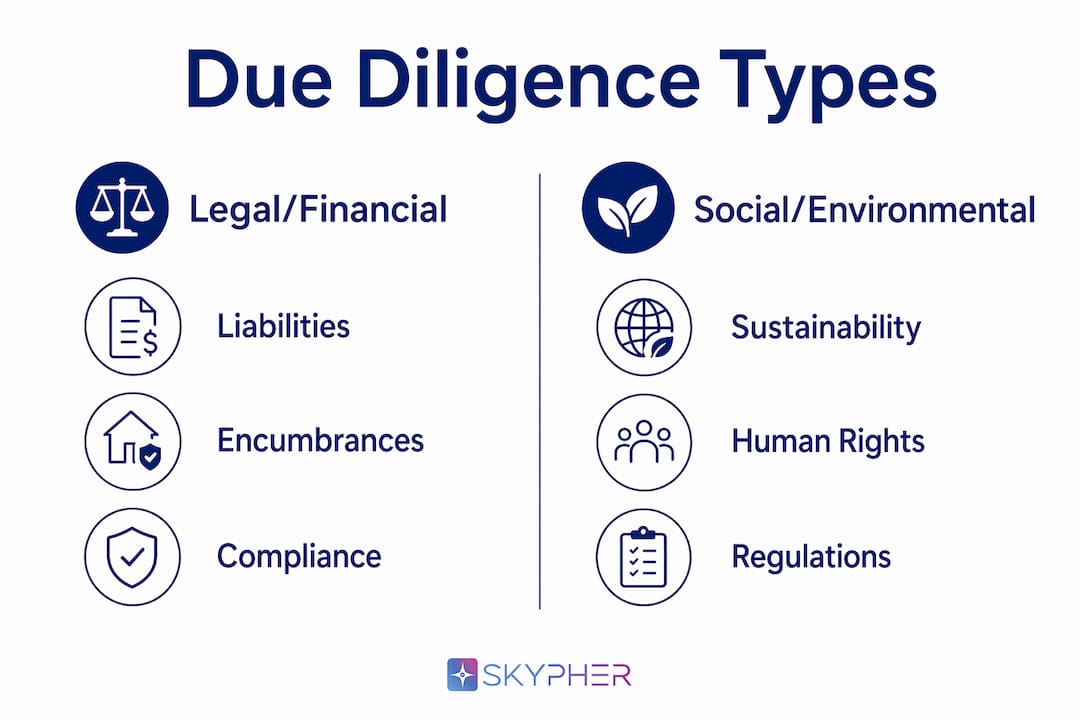
Social and environmental due diligence
The EU Corporate Sustainability Due Diligence Directive and analogous legislation have made social and environmental due diligence a legal obligation for large companies operating in or supplying to European markets. The OECD's mapping of due diligence legislation shows that governments now enforce risk analysis, prioritization, auditing, and disclosure across corporate operations and supply chains. This is not voluntary best practice. It is enforceable law with reporting deadlines.
AI and technology due diligence
The OECD's Due Diligence Guidance for Responsible AI establishes a stepwise roadmap for managing adverse impacts when developing or deploying AI systems. The framework emphasizes stakeholder engagement, risk-based prioritization, and remediation planning. For technology companies, this means due diligence now extends to the models and data pipelines embedded in their products, not just their vendors and partners. Understanding AI advantages in risk management is increasingly relevant for finance and tech decision-makers navigating this space.
The table below compares the four primary due diligence types by risk focus and typical methods:
| Due diligence type | Primary risk focus | Typical methods |
|---|---|---|
| Legal | Liabilities, encumbrances, entity standing | UCC searches, lien checks, contract review |
| Financial | Cash flow, debt, revenue quality | Audited financials, management interviews |
| Social and environmental | Supply chain conduct, labor practices | Audits, supplier questionnaires, site visits |
| AI and technology | Model bias, data integrity, system risk | Risk assessments, stakeholder reviews, testing |
Pro Tip: Match the depth of your due diligence to the size and reversibility of the decision. A $500,000 vendor contract warrants a different scope than a $50 million acquisition. Proportionality is a recognized principle in both UK public sector guidance and OECD frameworks.
What challenges make due diligence difficult to execute well?
Knowing why due diligence matters is straightforward. Executing it consistently across an organization is where most programs break down.
The most common failure points include:
- Operational overload. Audit fatigue and capacity constraints, particularly for small and mid-sized enterprises, create gaps in due diligence programs that regulators and auditors later identify. Large organizations face the same problem at scale: the volume of third-party relationships often exceeds the bandwidth of compliance teams.
- Fragmented supplier data. Operational overload and inconsistent supplier data are the most frequent failure points under social and environmental regulations. Simplistic templates do not substitute for genuine supply chain cooperation and data consistency. A questionnaire sent to 200 suppliers means nothing if 60% of responses are incomplete or unverified.
- Regulatory complexity. Companies must publish annual reports on due diligence activities and provide information to enforcement authorities across multiple jurisdictions. Tracking which requirements apply, in which markets, and on what timelines is itself a full-time compliance function.
- Superficial checklists masquerading as structured assessments. A checklist confirms that a task was completed. A structured risk assessment scores residual risks by likelihood and impact, documents the rationale for control effectiveness, and connects findings to governance decisions. The difference between the two is the difference between compliance theater and actual risk management.
- Continuous monitoring gaps. Due diligence is not a one-time check but a continuous, risk-based system requiring proportional monitoring and regular updates. Organizations that complete due diligence at onboarding and never revisit it are exposed to risks that emerge after the initial review.
The underlying problem in most cases is not a lack of intent. It is a lack of systems that make ongoing due diligence operationally feasible.
How can decision-makers apply due diligence best practices?
Embedding due diligence effectively requires moving from ad hoc reviews to a repeatable, documented process with clear ownership. The following steps reflect current best practice across governance frameworks:
- Assign risk ownership explicitly. Every due diligence workstream needs a named owner who is accountable for completion, documentation, and escalation. Cross-functional teams covering legal, finance, operations, and compliance reduce blind spots that single-function reviews miss.
- Prioritize by residual risk, not by effort. Residual risk scores guide resource allocation and help governance boards make informed decisions about control measures. Score risks by likelihood and impact, then concentrate resources on the highest-priority exposures.
- Use technology to scale the process. AI-driven tools can automate the collection, parsing, and analysis of due diligence data, particularly for security questionnaires and compliance documentation. Exploring AI in security questionnaires shows how automation reduces manual effort while improving accuracy and response times. For organizations managing dozens or hundreds of third-party relationships, automation is not a luxury. It is a prerequisite for consistent execution.
- Build trigger-event reviews into your process. Due diligence should be revisited when a supplier changes ownership, when a regulatory framework shifts, or when a material incident occurs. Waiting for the annual review cycle to catch these changes is a structural gap.
- Maintain documentation for auditability. Disclosure and documentation are central to modern due diligence laws because enforcement relies on verifiable records. Every decision, exception, and escalation should be recorded in a format that can be produced to regulators, auditors, or counterparties on request. For software-sector organizations, a software compliance guide provides a useful framework for structuring this documentation.
- Integrate due diligence into governance reporting. Boards and senior leadership should receive regular updates on due diligence status, open risks, and remediation progress. This connects operational risk management to strategic decision-making and signals to stakeholders that the organization takes its obligations seriously.
Pro Tip: Treat AI-generated cybersecurity risk assessments as a starting point, not a final answer. Human review of flagged risks remains necessary, particularly for high-stakes vendor relationships. Pairing AI tools with cybersecurity risk strategies gives decision-makers both speed and judgment.
Key takeaways
Due diligence is a continuous, documented risk management discipline that protects organizations from legal, financial, reputational, and operational harm across every stage of a business relationship.
| Point | Details |
|---|---|
| Due diligence is legally required | Trustees, procurement officers, and corporate leaders face enforceable obligations to verify partners and document findings. |
| Structured assessments outperform checklists | Scoring residual risks by likelihood and impact connects control measures to governance decisions and produces auditable evidence. |
| Continuous monitoring is non-negotiable | One-time reviews at onboarding leave organizations exposed to risks that emerge after the initial check. |
| Technology scales what manual processes cannot | AI-driven tools reduce the operational burden of managing due diligence across large third-party networks. |
| Documentation is the enforcement mechanism | Modern due diligence laws rely on verifiable records, making documentation a compliance requirement, not an administrative task. |
Due diligence in 2026: what I've learned from watching organizations get it wrong
Most organizations understand that due diligence matters. Where they consistently fail is in treating it as a project with a completion date rather than a permanent operating discipline. I have seen well-resourced compliance teams produce thorough onboarding assessments and then never look at a supplier again for three years. The risk profile of that supplier changed. The regulatory environment changed. The due diligence did not.
The other pattern I find consistently underappreciated is the gap between documentation and genuine analysis. Regulators do not just want to see that a form was completed. They want to see that someone thought carefully about the risks, made a reasoned judgment, and recorded why. That distinction separates organizations that survive regulatory scrutiny from those that do not.
The rise of AI in due diligence workflows is genuinely useful, but it introduces its own risks if decision-makers treat automated outputs as authoritative. AI tools are excellent at processing volume, flagging anomalies, and accelerating questionnaire responses. They are not substitutes for the judgment that comes from understanding a specific counterparty's context, history, and incentives.
My honest view is that due diligence is one of the few compliance disciplines where the investment compounds over time. Organizations that build strong processes early accumulate documented evidence of care and proportionality that becomes a genuine asset when things go wrong. And in business, things always eventually go wrong somewhere.
— Gaspard
How Skypher reduces the operational burden of due diligence

Security questionnaires are one of the most time-consuming components of third-party due diligence, particularly in tech and finance. Skypher's AI questionnaire automation tool processes questionnaires in virtually any format, connects to over 40 third-party risk management platforms including OneTrust and ServiceNow, and can answer 200 questions in under a minute. That is not a marginal efficiency gain. It is the difference between a compliance team that keeps pace with its third-party portfolio and one that is perpetually behind.
Skypher's Trust Center platform centralizes security and compliance documentation, giving counterparties and auditors a single source of verified information. For organizations that need to demonstrate due diligence to regulators, customers, or investors, that auditability is the point.
FAQ
What is due diligence in business?
Due diligence in business is the systematic process of verifying facts, identifying risks, and assessing the legal, financial, and operational standing of a counterparty before entering a transaction or relationship. It applies across mergers and acquisitions, vendor onboarding, lending, and regulatory compliance.
Why is due diligence important for risk management?
Due diligence is the primary mechanism for identifying hidden liabilities, fraud risks, and compliance gaps before they become organizational problems. Without it, decision-makers commit resources based on unverified assumptions, which increases exposure to financial loss, regulatory penalty, and reputational harm.
How often should due diligence be updated?
Due diligence should be treated as a continuous process, not a one-time review. Trigger events such as ownership changes, regulatory shifts, or material incidents should prompt immediate reassessment, with scheduled reviews at least annually for high-risk relationships.
What is the difference between due diligence and a compliance checklist?
A compliance checklist confirms that a task was completed. Due diligence is a structured risk assessment that scores residual risks by likelihood and impact, documents the rationale for control decisions, and connects findings to governance actions. The distinction matters because regulators evaluate the quality of reasoning, not just task completion.
How does AI improve the due diligence process?
AI tools automate the collection, parsing, and analysis of due diligence data, particularly for security questionnaires and compliance documentation. Platforms like Skypher reduce manual processing time significantly while maintaining accuracy, allowing compliance teams to manage larger third-party portfolios without proportional increases in headcount.
Recommended
- What Is a Due Diligence Questionnaire? A Comprehensive Guide to Informed Investment Decisions
- Understanding DDQS Meaning: A Comprehensive Guide to Due Diligence Questionnaires
- DDQ Automation for Private Equity and Credit: Moving from Text Drafting to Fiduciary Accuracy
- Your essential third-party risk checklist for effective assessment