

Compliance tech automates the repetitive work of proving an organization follows the rules. It collects evidence continuously, maps controls across regulatory frameworks like SOC 2 and GDPR, and keeps teams audit-ready year-round instead of scrambling every quarter. Skypher applies this same logic to one of the heaviest manual burdens in the category: security questionnaire responses.
TL;DR:
- Automatic evidence collection and expiry tracking help ensure proof stays current and reduces manual upload efforts.
- Control mapping across frameworks like SOC 2, ISO 27001, and GDPR minimizes duplicate work by using shared controls.
- Continuous monitoring provides a real-time audit readiness score, not just point-in-time snapshots, to track ongoing compliance health.
- Questionnaire automation with answer reuse and confidence scoring speeds up responses and highlights answers needing manual review.
- Effective implementation requires assessing integration coverage, evidence automation depth, and exporter quality, with some platforms promising SOC 2 readiness in two to four weeks.
Table of Contents
- What Falls Under the Compliance Technology Umbrella?
- What Features Actually Matter in a Compliance Platform
- How Does Compliance Tech Actually Generate Its Outputs?
- Where Compliance Tech Shows Up in Real Workflows
- How Do You Evaluate and Roll Out a Compliance Platform?
- How Skypher Applies This to Security Questionnaires
- Where This Category Is Actually Headed
- See How Skypher Handles Your Next Security Questionnaire
- Sources
- FAQ
What Falls Under the Compliance Technology Umbrella?
Compliance technology, often shortened to regtech or compliance tech, breaks into a few recognizable product families. Understanding where a given tool fits helps you avoid buying overlapping software or expecting one platform to do a job it was never built for.
Regulatory change management tools track legal and rule updates across jurisdictions and flag new obligations before they become violations. GRC (governance, risk, and compliance) platforms sit a layer above that, giving risk and audit teams a single system of record for policies, controls, and findings. Evidence-collection engines specialize in pulling proof (screenshots, logs, configuration snapshots) directly from cloud and SaaS environments. Questionnaire automation tools, Skypher's category, handle the incoming side: answering the security and privacy questionnaires that customers, auditors, and partners send you.
What ties these together is control mapping. A control built to satisfy SOC 2 usually satisfies a meaningful chunk of ISO 27001 or HIPAA requirements too, and mature platforms reuse that work automatically rather than starting from zero for each framework.
- Regulatory change management: tracks new laws and rule updates
- GRC platforms: centralize policies, controls, and audit findings
- Evidence-collection engines: pull proof directly from source systems
- Questionnaire automation: answers inbound security and vendor reviews
None of this replaces legal counsel or an accredited auditor. Compliance tech feeds them better, faster inputs; it doesn't sign off on your compliance posture for you.
What Features Actually Matter in a Compliance Platform
Feature lists in this space tend to blur together, but a handful of capabilities separate a real automation platform from a glorified spreadsheet.
- Automated evidence collection with expiry tracking. The system pulls proof on a schedule and flags it before it goes stale, not after an auditor notices.
- Control mapping across frameworks. One implemented control should visibly satisfy requirements in SOC 2, ISO 27001, HIPAA, and GDPR simultaneously, cutting duplicate work.
- Continuous monitoring and readiness scoring. Rather than a point-in-time snapshot, the platform gives you a running score of how audit-ready you are today.
- Questionnaire automation with answer reuse. Past answers are surfaced automatically for new questionnaires, with a confidence score attached to each suggestion so reviewers know what to double-check.
- Auditor-ready exports. Examiners get a clean, exportable package instead of a folder of loose documents.
Pro Tip: Ask any vendor to show you a live readiness score, not a demo screenshot. If the number doesn't update when you change an underlying control, it's a static report dressed up as a dashboard.
How Does Compliance Tech Actually Generate Its Outputs?
Most enterprise platforms follow a similar pipeline: ingestion, classification, control mapping, evidence storage, and auditor export. What varies is how much of that pipeline runs on AI versus human review, and that distinction matters more than most vendor pitches suggest.
Regulatory change management tools now monitor thousands of global sources in real time, using AI to extract new obligations, then routing anything ambiguous to a human specialist for verification before it reaches your team. That expert-in-the-loop pattern shows up again in questionnaire automation, where AI drafts an answer and a confidence score tells the reviewer whether to trust it or check it manually.
- Connectors to cloud providers, ticketing systems, and identity platforms feed evidence automatically
- Data isolation policies keep client information out of shared model training
- Confidence scoring flags low-certainty answers for human review before they ship
- Document stores retain versioned evidence so auditors see a clean history, not a single snapshot
Enterprise vendors typically isolate client models and keep in-house specialists reviewing AI output before anything gets actioned, which is the difference between a helpful assistant and a liability.
Where Compliance Tech Shows Up in Real Workflows
The taxonomy matters less than what these platforms actually solve day to day, and the use cases split cleanly by function.
Lender compliance is one of the clearest examples. Platforms in this space automate regulatory data submissions, flag fair lending risks, and generate examiner-ready reports, turning what used to be a manual reporting slog into a repeatable process. Security questionnaire automation solves a parallel problem on the vendor side: instead of a sales engineer manually answering the same 150 questions for the fifth time this quarter, the platform pulls from a verified answer bank.
- Lender compliance: regulatory reporting, fair lending flags, examiner-ready output
- Vendor and customer questionnaires: faster onboarding and RFP turnaround
- Regulated communications: email and data-delivery compliance for sensitive customer data
- Audit readiness: continuous evidence for both scheduled and surprise audits
Sales and procurement teams feel this most directly. Automating questionnaire responses and reusing an answer bank shortens security review cycles, which shortens the entire sales pipeline behind them.
How Do You Evaluate and Roll Out a Compliance Platform?
Buying compliance tech is less about finding the flashiest AI feature and more about matching a platform's depth to your actual workload. Start with an evaluation checklist, not a demo call.
- Integration coverage. Does it connect to the cloud services, ticketing systems, and identity providers you already run?
- Framework coverage. Does it map controls across the specific frameworks you're pursuing, not just the popular ones?
- Evidence automation depth. Is evidence pulled automatically, or does someone still upload PDFs by hand?
- Data handling policy. Is your data isolated from other customers' models, and is that documented?
- Auditor export quality. Can an external auditor use the export without back-and-forth clarification requests?
A short pilot beats a long procurement cycle. Scope it to one framework and one team, and measure time to a first real readiness score rather than feature checkboxes.
Deployment typically moves through discovery, connector setup, evidence seeding, first readiness score, and finally auditor export. Vendors claiming SOC 2 readiness in two to four weeks after onboarding are describing a best case with existing controls already in decent shape, not a universal timeline.
Pro Tip: Treat vague AI claims as a red flag. If a vendor can't explain what happens when the model is uncertain, ask what "uncertain" even means in their system.
How Skypher Applies This to Security Questionnaires
Security questionnaires are one of the most tedious, repetitive corners of compliance work, and it's where Skypher focuses entirely. The platform ingests questionnaires in any format and generates answers using a retrieval system built on your existing knowledge base, with a confidence score attached to each response so reviewers know what needs a second look before it goes out.
- Supports all major document formats, not just a handful of templates
- Answers up to 200 questions in under a minute using AI-powered recommendations
- Integrates with numerous third-party risk management platforms, including popular ones like OneTrust and ServiceNow
- Connects to common collaboration and document platforms such as Slack, MS Teams, Google Drive, and SharePoint for real-time team collaboration
- Offers a Trust Center feature that can be customized for customer access to security documentation
For sales teams stuck waiting on proof-of-concept sign-off, faster questionnaire turnaround directly shortens the deal cycle.
Where This Category Is Actually Headed
Compliance tech is quietly shifting from reactive gatekeeping to something closer to continuous governance. The old model waited for audit season; the newer one keeps controls monitored and evidence current all year, so the audit becomes a formality instead of a fire drill.
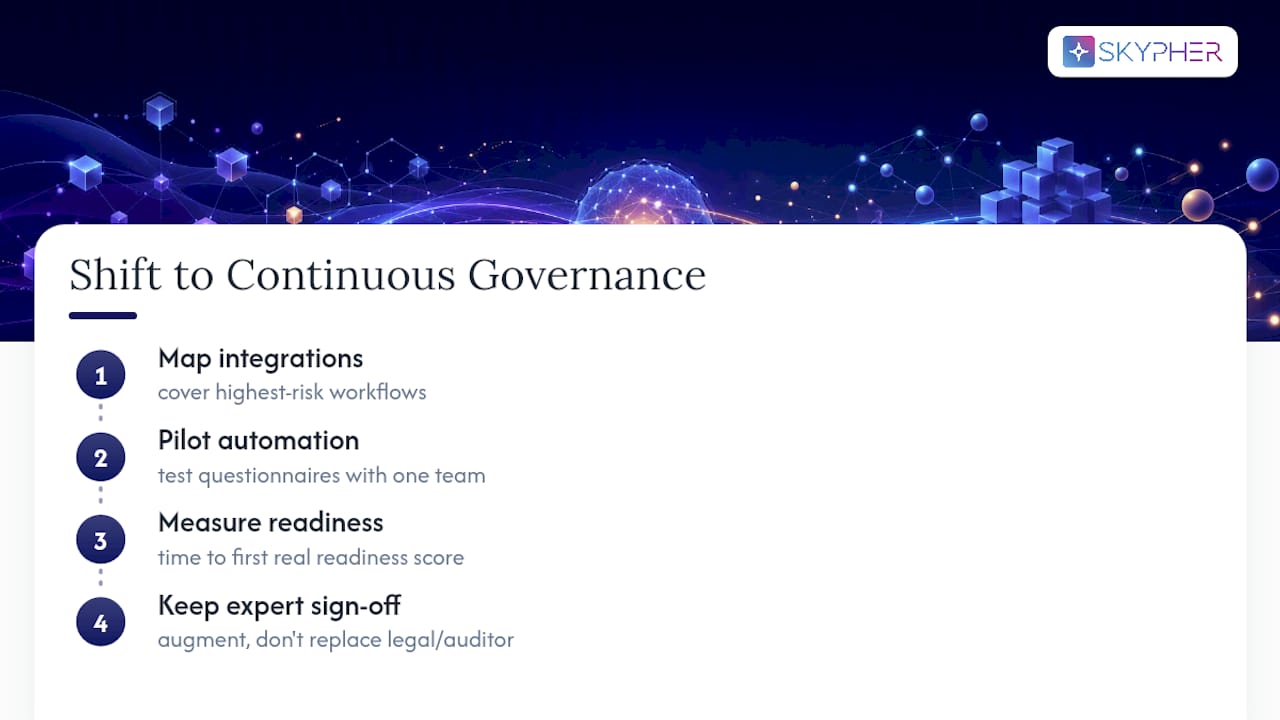
If you're evaluating tools right now, don't start with a feature bake-off. Start by mapping which integrations touch your highest-risk workflows, pilot questionnaire automation on one team, and measure how long it takes to hit a first real readiness score. That number tells you more than any sales deck will.
One caution worth repeating: these platforms make your compliance work faster and more consistent, but they don't replace legal judgment or an accredited auditor's sign-off. Treat the software as leverage, not a substitute for expertise.
— Gaspard
See How Skypher Handles Your Next Security Questionnaire
Skypher is built for exactly the teams described above: security, risk, and sales engineering groups at tech and finance companies buried in repeat questionnaires that eat weeks of skilled people's time. Instead of a manual answer hunt through old spreadsheets, the platform matches incoming questions to a verified knowledge base and flags anything it's unsure about.

If your team is fielding dozens of vendor security reviews or customer RFPs a quarter, it's worth running a pilot against real questionnaires rather than a sample deck. Explore the automated review cycle and duplicate detection features to see how repeat questions get handled without re-answering from scratch, then check the full security questionnaire automation platform to request a demo. A short security review of the platform itself is a reasonable first step before any pilot, and Skypher's team expects that conversation.
Sources
FAQ
What Is Compliance Tech?
Compliance tech is software that automates regulatory adherence, evidence collection, and audit preparation, typically by mapping controls across multiple frameworks and monitoring them continuously rather than only at audit time.
Which Technology Is Related to Compliance?
Related technologies include GRC platforms, regulatory change management tools, evidence-collection engines, and questionnaire automation tools like Skypher, which handles inbound security and vendor questionnaires specifically.
What Is Lender Compliance?
Lender compliance covers the regulatory reporting and risk-monitoring obligations specific to lending institutions, and lender compliance technology automates data submissions and fair lending risk detection while generating examiner-ready reports.
How Long Does It Take to Implement Compliance Tech?
Timelines vary by framework and existing control maturity, but some vendors cite SOC 2 readiness in two to four weeks after onboarding when core controls are already in place.
Does Compliance Tech Replace an Auditor or Legal Counsel?
No. Compliance platforms speed up evidence collection and control tracking, but final sign-off still requires an accredited auditor and, for regulatory interpretation, qualified legal counsel.