

Encryption in cyber security is the process of converting readable data, or plaintext, into scrambled data, or ciphertext, using a mathematical algorithm and a secret key. Its core purpose is simple: if someone steals your data, encryption makes it unreadable and useless without the matching key. We rely on it to protect information at rest, in transit, and increasingly while it's being processed, which makes it one of the few controls that still works even after other defenses have already failed.
TL;DR:
- Proper key management and regular rotation are the main vulnerabilities, not the encryption algorithms themselves, which are generally secure when properly implemented.
- Encrypted data in use, such as in secure enclaves, is far more complex to protect than data at rest or in transit, requiring specialized hardware or techniques like homomorphic encryption.
- Default or outdated cipher suites, predictable random number generators, and unprotected keys are common implementation flaws that significantly weaken encryption.
- Using AES-256 for data at rest and TLS 1.3 with AEAD cipher suites for data in transit offers strong, practical protection across most scenarios.
- A staged approach to encryption, including enabling TLS everywhere, encrypting backups, deploying centralized key management, and planning for quantum resistance, improves overall security posture.
Table of Contents
- How Encryption Actually Works Under the Hood
- Symmetric, Asymmetric, and the Algorithms That Actually Get Used
- Securing Data at Rest, in Transit, and in Use
- Key Management Is Where Most Encryption Programs Actually Fail
- Where Encryption Breaks Down in Practice
- A Practical Checklist for Adopting Encryption
- How Encryption Shows Up in Security Reviews and Trust Communication
- Standards and Guidance Worth Bookmarking
- Why Encryption Alone Won't Save You
- Sources
- FAQ
How Encryption Actually Works Under the Hood
Every encryption system runs on three moving parts: plaintext, an algorithm, and a key. The algorithm is a defined mathematical procedure. The key is the secret input that determines the exact output. Feed the same plaintext through the same algorithm with two different keys, and you get two completely different ciphertexts. That's the whole point. Cisco describes this process as a transformation that only someone holding the correct decryption key can reverse.
Decryption is just this process run backward. Whoever holds the right key applies the inverse operation to the ciphertext and recovers the original plaintext. Everyone else sees noise.
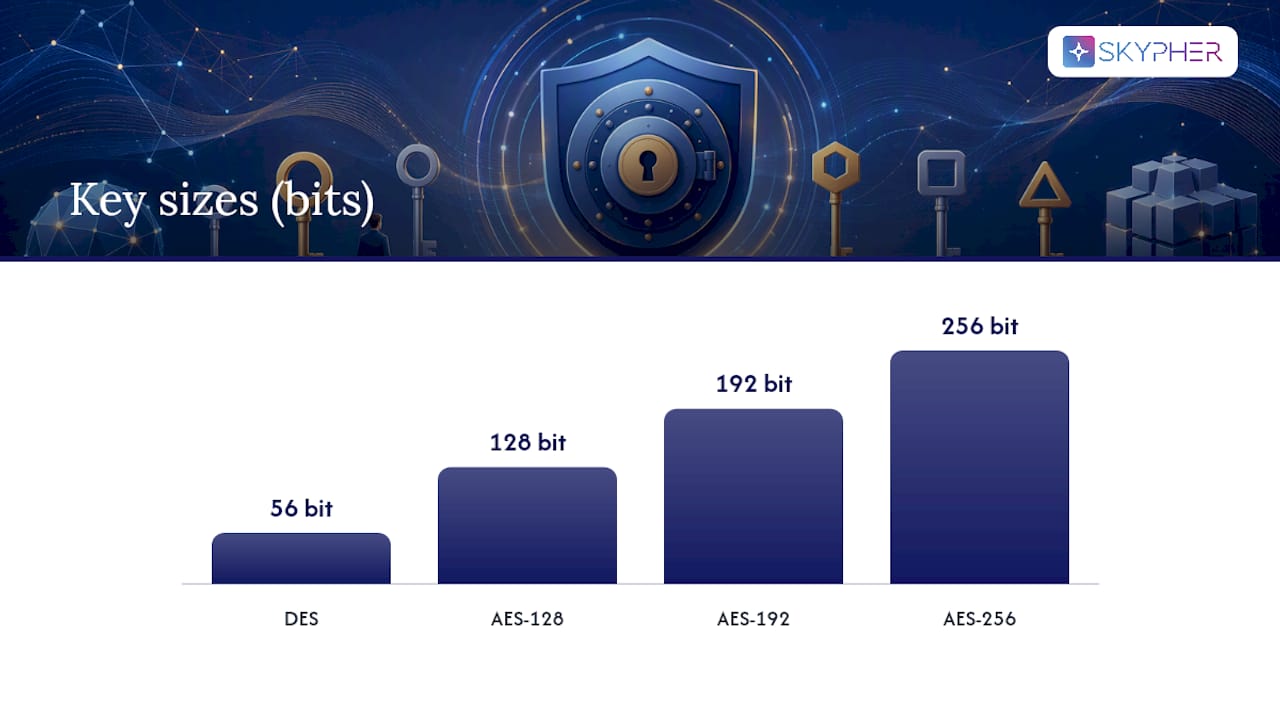
Key size and randomness matter more than most people assume. A 256-bit key isn't just "more secure" than a 128-bit key in some abstract sense. It has dramatically more possible combinations, which makes brute-force guessing computationally pointless with current hardware. But size alone doesn't help if the key generation process is predictable. Weak random number generators have quietly undermined otherwise solid cryptography for decades, because an attacker who can predict or narrow down the key space doesn't need to break the math at all.
It's worth drawing a clear line between encryption and two related but distinct tools:
- Encryption is reversible by design. You encrypt data specifically so an authorized party can decrypt it later.
- Hashing is one-way. You hash a password or a file to produce a fixed-length fingerprint that verifies integrity, but you're never meant to reverse it back to the original.
- Digital signing uses asymmetric key pairs to prove authenticity and origin, not to hide content, though it often works alongside encryption.
Mixing these up in a security architecture is a common and expensive mistake. Encrypting a password field instead of hashing it, for example, means a database compromise combined with a key leak exposes every password at once.
Symmetric, Asymmetric, and the Algorithms That Actually Get Used
Encryption splits into a few core categories, and picking the wrong one for the job is one of the more avoidable design errors in security architecture.
- Symmetric encryption uses one shared key for both encrypting and decrypting. AES, in its 128, 192, and 256-bit variants, is the dominant standard here. It's fast, efficient at scale, and ideal for encrypting large volumes of data like databases or backups. The tradeoff is key distribution: both parties need the same secret, which creates a logistics problem the moment more than two people are involved.
- Asymmetric encryption solves that distribution problem with a public and private key pair. RSA and elliptic curve cryptography (ECC) are the two workhorses. RSA is older and well understood; ECC delivers comparable security with much smaller keys, which is why it dominates mobile and IoT contexts where processing power is limited. Asymmetric encryption is slower than symmetric encryption, so it's typically used to exchange a symmetric key or to sign data rather than to encrypt bulk content directly.
- Authenticated encryption, often labeled AEAD (Authenticated Encryption with Associated Data), solves a problem older ciphers ignored: confidentiality without integrity is dangerous. AES-GCM and ChaCha20-Poly1305 encrypt data and simultaneously generate a tag that proves it hasn't been tampered with. Modern protocols, including current versions of TLS, default to AEAD constructions for exactly this reason.
Two ciphers deserve explicit avoidance: DES, with its 56-bit key, was cracked decades ago and has no place in current systems, and RC4 has known statistical biases that make it unsuitable for anything sensitive. If you find either in a legacy system, treat it as an active finding, not a historical curiosity.
Pro Tip: When in doubt, default to AES-256 for data at rest and TLS 1.3 with AEAD cipher suites for data in transit. That combination covers the overwhelming majority of practical use cases without requiring a cryptography specialist to sign off.
Securing Data at Rest, in Transit, and in Use
Data doesn't sit still, and neither should your encryption strategy. Security teams typically talk about three distinct states, and each one calls for different controls.
- Data at rest covers files sitting on a disk, a database, or a backup tape. Full-disk encryption, file-level encryption, and column-level database encryption all apply here, and encrypted backups close a gap that ransomware actors exploit constantly.
- Data in transit covers information moving across a network. TLS underneath HTTPS, VPN tunnels, and SSH sessions all rely on negotiated cipher suites and valid certificates. A misconfigured certificate or an outdated TLS version quietly downgrades protection even when the underlying algorithm is strong.
- Data in use is the newest and hardest frontier. Confidential computing and secure enclaves process encrypted data inside isolated hardware regions, keeping it encrypted even in active memory. Homomorphic encryption goes a step further, allowing computation directly on encrypted data, but it remains costly and specialized rather than a drop-in replacement for standard processing.
None of this matters if the endpoint itself is compromised. An attacker with control of the machine that holds the decryption key, or that briefly handles plaintext during processing, sidesteps the encryption entirely. Encryption protects data against interception and theft; it does not protect against a system that's already been taken over.
Key Management Is Where Most Encryption Programs Actually Fail
The algorithm you choose rarely causes a breach. The keys do. Practitioners consistently point to key handling, not cryptographic weakness, as the source of most real-world encryption failures.
Centralizing key management through a hardware security module (HSM) or a managed key management service (KMS) removes keys from application code and developer laptops, where they have no business living. Storing keys in HSMs or managed KMS platforms, combined with rotation and separation of duties, measurably reduces the blast radius when something does go wrong.
Operational best practices worth building into policy from day one:
- Rotate keys on a defined schedule, not indefinitely, and rotate immediately after any suspected exposure.
- Enforce strict access controls so the people who can approve key access aren't the same people who use the keys daily.
- Maintain secure, tested backups of key material, because a lost key can be just as damaging as a stolen one.
- Audit key access logs regularly rather than assuming the KMS is silently doing its job.
The failure pattern shows up again and again in incident reports: a key checked into a code repository, an unrotated key still active years after an employee's departure, or a key stored in plaintext configuration next to the ciphertext it protects.
Pro Tip: Run a simple audit this week: search your codebase and configuration files for hardcoded keys or credentials. It takes an afternoon and routinely turns up exposure that's been sitting unnoticed for months.

Where Encryption Breaks Down in Practice
Encryption fails in three broad ways, and none of them require breaking the math itself.
Cryptographic attacks target weaknesses in implementation rather than theory. Brute-force attacks try every possible key, which is why key length matters. Padding oracle attacks exploit how a system responds to malformed ciphertext to slowly extract information. Side-channel attacks measure timing, power consumption, or electromagnetic leakage from hardware to infer key material without touching the ciphertext at all.
Implementation and configuration mistakes cause more real damage than clever attacks do:
- Weak or predictable random number generation undermines otherwise strong keys.
- Outdated or mismatched cipher suites left enabled "for compatibility" quietly weaken TLS connections.
- Default credentials or test keys that never got replaced before a system went to production.
Quantum computing looms as the long-term risk. Sufficiently powerful quantum computers could eventually break widely used asymmetric algorithms like RSA and ECC. That's not an immediate crisis, but it's a planning problem today: organizations holding data that must stay confidential for a decade or more should start inventorying those long-lived secrets now, before post-quantum migration becomes urgent rather than optional.
A Practical Checklist for Adopting Encryption
Encryption adoption works best as a staged rollout, not a single sweeping project. Here's how we'd sequence it.
- Enable TLS everywhere, including internal services that "don't really need it," and verify certificate validity rather than assuming auto-renewal is working.
- Turn on full-disk encryption on every laptop, server, and mobile device that touches sensitive data, particularly given how often lost or stolen hardware, not network attacks, causes breaches.
- Verify backups are actually encrypted, not just assumed to be, since backup systems are a favorite ransomware target precisely because they're overlooked.
- Deploy a KMS or HSM to centralize key storage rather than letting keys scatter across application configs and developer environments.
- Audit active cipher suites across every TLS-terminating service and retire anything that still allows deprecated protocols.
- Enforce a documented key rotation policy with defined ownership, not an informal "someone will handle it" arrangement.
- Start post-quantum planning by inventorying data with long confidentiality requirements and tracking NIST's post-quantum standardization work as it matures.
- Pilot confidential computing only where the sensitivity of the workload justifies the added cost and complexity.
A detailed enterprise security checklist helps translate these steps into an ordered project plan rather than a scattered list of good intentions.
How Encryption Shows Up in Security Reviews and Trust Communication
Anyone who has filled out a security questionnaire knows encryption questions dominate the document. Reviewers ask about encryption algorithms in use, key management practices, TLS versions, and whether encryption applies at rest and in transit. Answering vaguely or inconsistently across questionnaires raises more red flags than it resolves.
We built Skypher's Questionnaire Automation Tool around exactly this pain point. It pulls consistent, accurate answers about your encryption posture from a centralized knowledge base instead of forcing a security team to retype the same AES-256 and TLS 1.3 details into every new vendor form.
A few ways this connects directly to encryption practices:
- Teams can maintain one authoritative source of truth for encryption standards, key management policies, and certification status.
- A customizable Trust Center lets you publish your encryption and data-protection posture publicly, cutting down repetitive one-off requests from prospects and auditors.
- Real-time collaboration features help ensure that security, sales, and compliance teams maintain consistent answers to encryption questions.
Getting this consistency right matters more the larger your questionnaire volume grows, and it's a direct extension of the same discipline behind good information security practices generally.
Standards and Guidance Worth Bookmarking
For anything beyond the basics, go to the primary sources. NIST's FIPS 140-2 standard defines how cryptographic modules get validated, which is the reference point auditors use to check whether a vendor's encryption claims hold up. CISA's encryption guidance focuses on practical, standards-based deployment for interoperable and secure communications, useful reading for anyone building policy rather than just implementing code.
Why Encryption Alone Won't Save You
Encryption is essential, but treating it as a finish line is a mistake we see constantly. It protects data that's already been stolen or intercepted; it does nothing for an attacker who simply logs in with valid, stolen credentials. That's why encryption has to sit inside a broader control set: identity and access management, multifactor authentication, and detailed logging all need to work alongside it. The organizations that get burned aren't usually the ones with weak algorithms. They're the ones that encrypted the data and then stopped asking questions about who could reach the keys.
— Gaspard
Sources
- What Is Encryption? Explanation and Types - Cisco
- What is encryption? - Google Cloud
- Encryption - CISA
- FIPS 140-2 - NIST
FAQ
What Is the Encryption Process in Cyber Security?
The encryption process takes readable plaintext and runs it through a cryptographic algorithm paired with a secret key, producing unreadable ciphertext. Decryption reverses this with the correct key, and Cisco notes this is what makes stolen data useless to anyone without that key.
What Are the Four Main Types of Encryption?
The four categories most commonly discussed are symmetric encryption (like AES, using one shared key), asymmetric encryption (like RSA and ECC, using public and private key pairs), hashing (a one-way fingerprint, not technically reversible encryption but often grouped alongside it), and authenticated encryption (AEAD constructions like AES-GCM that add integrity checking to confidentiality).
What Is an Example of Encryption?
A common example is your browser establishing an HTTPS connection with a bank's website: TLS negotiates a symmetric session key using asymmetric methods, then encrypts your session data with AES so anyone intercepting the traffic sees only ciphertext. Full-disk encryption on a stolen laptop is another everyday example, since it renders the drive's contents unreadable without the correct passphrase or key.
What Is the Difference Between Encryption and Decryption in Cyber Security?
Encryption converts plaintext into ciphertext to protect it from unauthorized access, while decryption reverses that process using the correct key to restore the original data. They're two halves of the same operation, and Google Cloud's overview frames this as the core mechanism protecting data across every state, at rest, in transit, and in use.
Why Does Key Management Matter More Than the Encryption Algorithm?
Strong algorithms like AES-256 are essentially unbreakable through brute force with current technology, so real-world failures almost always trace back to poor key handling rather than weak math. Storing keys in HSMs or a managed KMS, combined with rotation and access controls, addresses the actual point of failure.