

TL;DR:
- Data and cyber security protect the confidentiality, integrity, and availability of organizational data across all environments.
- Effective security relies on layered technical controls, governance, and continuous documentation updates to defend against threats.
What does data and cyber security actually protect?
Data and cyber security is the practice of maintaining the confidentiality, integrity, and availability of organizational data across every state it occupies: at rest, in transit, and in use. For medium and large tech and finance organizations, that definition carries real weight. Your data lives across cloud platforms, on-premises servers, mobile endpoints, and third-party applications simultaneously, and each layer is a potential entry point.
Modern frameworks address this by combining layered technical controls with organizational governance. The core components you need in place:
- Encryption of data at rest (AES-256 minimum) and in transit (TLS 1.3 preferred)
- Access controls including multifactor authentication (MFA), role-based access control (RBAC), and identity and access management (IAM)
- Real-time monitoring and anomaly detection across endpoints and network traffic
- Automated incident response to contain threats before they escalate
- Data loss prevention (DLP) tools that monitor and restrict unauthorized data transfers
- Firewalls and network segmentation to isolate systems by classification level
NIST's National Cybersecurity Center of Excellence and IBM's 2026 data security guidance both emphasize that no single control is sufficient. The organizations that weather attacks are the ones with defense in depth, not a single perimeter.
Table of Contents
- Core principles and governance frameworks every security team should follow
- How data protection and data security differ — and why both matter
- What weak security posture actually costs your organization
- Expert insights on integrating governance with security documentation
- How SIEM and intrusion detection systems strengthen threat detection
- Incident response planning: prepare, detect, respond, recover
- Encryption methods and secure data handling
- Compliance requirements for finance and tech organizations
- Security awareness training reduces your biggest attack surface
- How Skypher helps you communicate your security posture at scale
- Key Takeaways
Core principles and governance frameworks every security team should follow
The CIA triad sits at the foundation of every credible information security policy: confidentiality (restricting access to authorized users), integrity (ensuring data is not altered without authorization), and availability (keeping systems and data accessible when needed). These three principles drive every control decision, from firewall rules to backup schedules.
NIST SP 800-53 provides the most widely adopted control catalog for US organizations, mandating defined roles and formal review cycles. Governance responsibilities typically break down as follows:
- Board / Executive Committee: Approve the security policy, accept residual risk, and fund the program
- CISO: Maintain the policy, report security posture to the board, and direct day-to-day operations
- Information Asset Owners: Classify assets, approve access, and accept risk for their systems
- IT and Platform Engineering: Implement technical controls and respond to incidents
- All Staff: Comply with policy, report incidents, and complete security training
Annual policy reviews and control mapping to industry standards are required to meet federal and regulatory requirements. Without that cadence, your controls drift out of alignment with both the threat environment and your compliance obligations.
How data protection and data security differ — and why both matter
These terms get used interchangeably, but they describe distinct functions. Data security focuses on preventing unauthorized access and corruption. Data protection covers a broader lifecycle: security plus availability, backup, disaster recovery, and operational resilience.
The practical distinction matters when something goes wrong. A ransomware attack that encrypts your production database is a security failure. Your ability to restore operations within hours rather than days is a data protection outcome. Both functions must be integrated:
- Data security controls reduce the probability of an incident
- Data protection measures determine how quickly you recover when one occurs
- Together, they form the backbone of enterprise cyber risk management
Treating them as separate programs creates gaps. The organizations that recover fastest from incidents are the ones that integrated protection and security into a single strategy rather than running parallel, siloed programs.
What weak security posture actually costs your organization
The global average cost of a data breach reached USD 4.4 million in 2025. For finance and tech organizations, the number is typically higher given the sensitivity of the data involved and the density of regulatory obligations. Beyond the direct financial hit, the consequences compound:
- Regulatory penalties under GDPR, HIPAA, or PCI DSS
- Legal action from affected customers or partners
- Reputational damage that affects enterprise sales cycles for years
- Lost contracts when security questionnaire responses reveal gaps
That last point is where many organizations underestimate their exposure. Enterprise customers now vet security maturity before signing contracts, and outdated or inconsistent questionnaire responses can kill a deal. Common attack vectors your security posture must address include ransomware, phishing, insider threats, supply chain compromises, and misconfigured cloud environments.
Expert insights on integrating governance with security documentation
Most large organizations struggle because their data protection strategy is siloed from security questionnaire management. Policy changes happen, controls get updated, and the questionnaire responses sitting in a shared drive never catch up. The result: inaccurate disclosures, compliance risk, and lost enterprise deals.
Effective integration requires two things working together:
- Automated questionnaire tools that pull answers directly from your current policy and control documentation, updating responses in real time as your posture evolves
- Control-to-response mapping aligned to NIST 800-53 or ISO 27001, so the system knows which control evidence answers which question
Raw document storage without that mapping yields limited automation value. The intelligence comes from the structure, not the volume of documents stored.
Pro Tip: Before deploying any questionnaire automation tool, audit your existing control documentation against NIST 800-53 or ISO 27001 Annex A. Gaps in your control library become gaps in your automated responses. Fix the foundation first.
Executive leadership sets the tone here. When the Board and CISO treat security documentation as a business asset rather than a compliance checkbox, the entire program runs more consistently. You can explore cybersecurity compliance risks in automation to understand where these programs typically break down.
How SIEM and intrusion detection systems strengthen threat detection
Security Information and Event Management (SIEM) platforms collect and correlate log data from across your environment in real time, giving security teams a unified view of activity across endpoints, applications, and network infrastructure. Without SIEM, analysts are reviewing disconnected logs manually, which means threats move faster than detection does.

Intrusion detection systems (IDS) complement SIEM by monitoring network traffic and host activity for known attack signatures and behavioral anomalies. Intrusion prevention systems (IPS) go a step further by actively blocking suspicious traffic. Together, these tools form the detection layer of your cybersecurity best practices stack. Zero Trust Architecture adds another dimension by requiring verification for every access request, eliminating implicit trust even for internal users.
Incident response planning: prepare, detect, respond, recover
A written incident response plan is not optional for organizations operating at scale in tech or finance. The four phases every plan must cover:
- Prepare: Define roles, establish communication trees, and run tabletop exercises before an incident occurs
- Detect: Use SIEM alerts, IDS triggers, and anomaly detection to identify events quickly
- Respond: Contain the threat, preserve evidence, notify affected parties per regulatory timelines
- Recover: Restore systems from clean backups, conduct a post-incident review, and update controls
NIST's guidance on detecting and recovering from breaches provides practical, standards-based frameworks organizations can implement in full or in part. The post-incident review is where most programs improve fastest, provided the findings actually feed back into updated controls and documentation.
Encryption methods and secure data handling
AES-256 is the current standard for data at rest. TLS 1.3 is preferred for data in transit, with TLS 1.2 as the minimum acceptable floor. Cryptographic keys should be stored in hardware security modules (HSMs) or approved key management services, never in source code or configuration files.
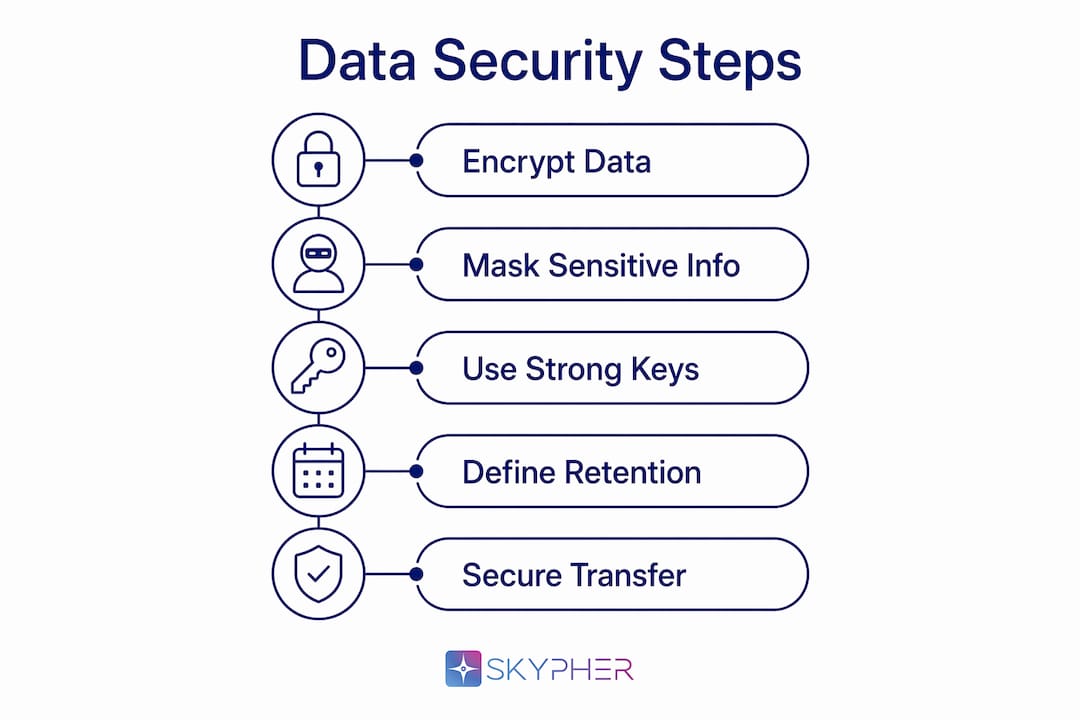
Beyond encryption, secure data handling requires data masking for non-production environments, defined retention periods with secure disposal procedures, and DLP controls on data leaving your organization's boundary. Classification drives handling: Restricted data requires stricter controls than Internal data, and those distinctions must be enforced technically, not just documented in policy.
Compliance requirements for finance and tech organizations
The regulatory landscape for US tech and finance organizations spans multiple overlapping frameworks:
- GDPR: Applies to any organization processing EU residents' personal data, requiring documented security measures and breach notification within 72 hours
- HIPAA: Governs protected health information; the Security Rule mandates administrative, physical, and technical safeguards
- PCI DSS: Requires encryption, MFA, and access controls for any system that processes payment card data
- SOX: Requires public companies to secure financial systems and maintain audit-ready data trails
- CCPA: Grants California consumers rights over their personal data, requiring robust discovery and deletion workflows
Compliance platforms that generate audit-ready documentation aligned to these frameworks reduce the burden on compliance teams significantly. Building trust online with enterprise clients increasingly depends on demonstrating this compliance posture proactively, not just during audits.
Security awareness training reduces your biggest attack surface
Human error remains the most exploited vulnerability in enterprise environments. Phishing simulations, role-based training modules, and clear incident reporting procedures address this directly. Effective programs share a few characteristics: they run continuously rather than annually, they tailor content to specific roles (finance teams face different threats than engineering teams), and they measure behavior change rather than just completion rates.
The SANS Institute provides free policy templates and training frameworks that organizations can adapt to their specific environments. Pairing those resources with a SaaS cybersecurity checklist gives security and compliance teams a practical starting point for evaluating and communicating their posture.
How Skypher helps you communicate your security posture at scale

Completing security questionnaires accurately and quickly is one of the most time-consuming tasks in enterprise sales and vendor management. Skypher's AI-powered questionnaire automation maps your internal controls directly to questionnaire frameworks, answering up to 200 questions in under a minute with responses grounded in your actual policy documentation.
The platform integrates with over 40 third-party risk management portals, connects with Slack, Microsoft Teams, Confluence, and SharePoint, and supports multilingual enterprise setups. Skypher's Trust Center lets you share your security and compliance posture proactively, so prospects and partners can access verified documentation without waiting for a manual review cycle.
Key Takeaways
Strong data and cyber security requires integrating governance frameworks, technical controls, and accurate documentation into a single, continuously updated program.
| Point | Details |
|---|---|
| CIA triad is the foundation | Every control decision maps back to confidentiality, integrity, and availability. |
| Breach costs are concrete | The global average cost of a data breach has become substantial in recent years. |
| Governance needs clear ownership | NIST SP 800-53 requires defined roles from Board level down to individual asset owners. |
| Documentation gaps lose deals | Outdated questionnaire responses expose compliance risk and stall enterprise contracts. |
| Control mapping drives automation | Mapping internal controls to NIST 800-53 or ISO 27001 is what makes questionnaire automation accurate. |