

TL;DR:
- Finance organizations are highly targeted by cyber threats due to valuable, monetizable data and high payout likelihood.
- Automation of compliance and security processes is essential to overcome manual limitations, reducing effort, errors, and fatigue.
Finance leaders sit on one of the most targeted sectors in the global economy, yet many organizations still conflate regulatory compliance with genuine security. That distinction is costing them. The Verizon DBIR 2025 finance snapshot confirms that breaches in financial services consistently involve system intrusion, social engineering, credential abuse, and ransomware, making cybersecurity a direct operational and revenue concern, not just a checkbox exercise. This guide cuts through that confusion, laying out why finance is uniquely targeted, where manual defenses break down, how regulations like DORA are reshaping the rules, and what automation-first strategies actually work in practice.
Table of Contents
- Why finance is uniquely attractive to cyber threats
- Compliance pressures and the limits of manual defense
- Operational resilience and ICT risk management: The DORA effect
- Best practices: Automating compliance and payments security
- Our perspective: Why traditional security fails and what actually works
- Automate compliance and security with Skypher
- Frequently asked questions
Key Takeaways
| Point | Details |
|---|---|
| Finance is a top cyber target | Financial organizations face relentless, financially motivated cyberattacks requiring advanced defense. |
| Compliance is necessary, not sufficient | Meeting regulations helps but does not guarantee real cyber resilience or operational safety. |
| Automation scales risk and compliance | Automated evidence collection and control validation address compliance fatigue and audit surges. |
| DORA and payment standards matter | New mandates like DORA and PCI DSS demand robust, continuous ICT risk management and payment security. |
| Continuous, measurable security wins | Finance cybersecurity works best when treated as ongoing, evidence-backed operational resilience. |
Why finance is uniquely attractive to cyber threats
Threat actors are rational. They follow the money, and financial services organizations hold two things that make every attack worth the effort: immediately monetizable data and high payout probability. Account credentials, payment card numbers, wire transfer access, and loan records can all be converted to cash within hours on dark web markets. That calculation drives an extraordinary concentration of attacks on the sector.
The numbers tell a stark story. According to the Verizon DBIR 2025 finance snapshot, roughly 78% of breaches in financial services involve external actors, and approximately 90% of those actors are financially motivated. This is not opportunistic crime. These are organized, persistent operations running at scale.
| Attack vector | What it targets | Why finance is high risk |
|---|---|---|
| System intrusion | Core banking platforms, trading systems | High-value, always-on infrastructure |
| Social engineering | Employees, executives, vendors | Large workforces, complex supply chains |
| Credential abuse | Identity and access systems | Privileged access to financial records |
| Ransomware | Operations and data | High willingness to pay, critical uptime needs |
The top attack vectors in finance are not exotic. Social engineering alone, including phishing, pretexting, and business email compromise, accounts for a significant share of initial access events. What makes finance especially vulnerable here is the volume of high-stakes communications that employees handle daily. A convincing wire transfer request or vendor invoice doesn't raise alarms the way it might in other industries.
"Financial services cybersecurity is an enterprise risk and board-level issue because regulators require disclosure and governance over cybersecurity risk, and breaches create direct financial and reputational harm." — CFO's Guide to Cybersecurity and Financial Data Protection 2026
Regulators have responded accordingly. Breach disclosure deadlines under frameworks like SEC rules, SOX, and EU mandates require rapid notification and board-level attestation. That means a security event is never just an IT problem. It becomes an executive liability, a reputational incident, and a regulatory filing event, often within 72 hours. Understanding the automation benefits for finance organizations starts with recognizing how much of this exposure is predictable and preventable. Equally important is mapping your risk against established key compliance frameworks so your board reporting reflects actual control posture, not just policy documentation.
Compliance pressures and the limits of manual defense
Once you accept the threat landscape, the next hard conversation is about how organizations actually respond to it. Most finance teams are operating under at least three or four major compliance regimes simultaneously: SOX for financial reporting integrity, PCI DSS for payment security, DORA for operational resilience (especially in Europe), and sector-specific mandates from bodies like the OCC or FCA. Each one requires evidence, documentation, and periodic review cycles.
The problem is scale. Manual compliance processes, spreadsheets, shared drives, email chains, and point-in-time audits were designed for a simpler regulatory environment. As cybersecurity compliance pressures have intensified, these approaches simply don't stretch. Evidence collection alone can consume weeks of your security team's capacity ahead of a single audit cycle.
Here's a direct comparison of where manual and automated compliance approaches diverge:
| Capability | Manual approach | Automated approach |
|---|---|---|
| Evidence collection | Weeks of manual effort per audit | Continuous, real-time collection |
| Error rate | High, due to human data entry | Low, standardized and validated |
| Scalability | Limited by headcount | Scales with regulatory scope |
| Audit readiness | Periodic, reactive | Always-on, proactive |
| Cross-framework mapping | Duplicated work across regimes | Single control mapped to multiple frameworks |
| Reporting turnaround | Days to weeks | Hours |
The bottlenecks most teams experience cluster around three recurring problems. First, evidence collection requires chasing down control owners across multiple business units. Second, reporting deadlines create crunch periods that divert skilled staff from actual security work. Third, as frameworks proliferate, teams duplicate effort because the same control often satisfies multiple requirements but gets documented separately for each one.
A stepwise approach to moving from manual to automated compliance typically looks like this:
- Audit your current evidence collection process and identify the tasks that repeat most frequently across frameworks.
- Prioritize automation for those high-frequency, low-judgment tasks first (log collection, access reviews, policy attestations).
- Integrate your compliance tooling with your identity and access management systems for real-time control validation.
- Establish a continuous monitoring cadence rather than point-in-time reviews.
- Build regulator-ready report templates so your team isn't recreating documentation under deadline pressure.
Understanding how automation transforms security questionnaire compliance is one of the fastest ways to reclaim that capacity. The same logic applies to broader security operations. When you streamline security automation across your monitoring and response workflows, you reduce the surface area where human error can introduce gaps. For practical guidance on where to start, the cybersecurity compliance tips most applicable to finance and technology teams center on eliminating duplication and building audit trails that persist without manual intervention.
Compliance fatigue is real, and it's measurable. When your security team spends more time preparing evidence than improving controls, the security posture deteriorates even while compliance scores hold steady. That gap between appearance and reality is exactly where breaches occur.

Pro Tip: Track the ratio of security team hours spent on compliance documentation versus active threat management. If documentation exceeds 30% of total capacity, that's a leading indicator of compliance fatigue and a strong business case for automation investment.
And don't underestimate the operational advantages of integrated onboarding and compliance. When compliance workflows live in the same environment as operational processes, adoption improves and evidence gaps shrink.
Operational resilience and ICT risk management: The DORA effect
DORA, the Digital Operational Resilience Act, came into force across EU financial entities in January 2025, and its reach extends well beyond European borders. Any financial organization that operates in or serves EU markets, including many US and APAC institutions, must align their ICT risk management, incident reporting, and third-party oversight to DORA's requirements.
The regulation is structured around five core domains:
- ICT risk management: Documented frameworks covering identification, protection, detection, response, and recovery.
- Incident reporting: Mandatory classification and notification timelines for major ICT incidents, often within 24 hours for initial reports.
- Resilience testing: Regular testing of digital systems, including advanced threat-led penetration testing (TLPT) for larger institutions.
- Third-party risk oversight: Formal due diligence, contractual requirements, and ongoing monitoring of critical ICT service providers.
- Information sharing: Structured mechanisms for sharing threat intelligence across the financial sector.
What makes DORA particularly consequential is that it formalizes what many organizations were already supposed to be doing informally. The difference now is that regulators want documented, measurable evidence that these practices are embedded, not just planned. A policy document is not enough. You need control testing results, vendor assessment records, and incident response logs that are maintained continuously and retrievable on demand.
From a practical standpoint, organizations that have already mapped their critical business services to their underlying ICT assets are starting from a better position. That mapping forms the backbone of your DORA compliance program. Without it, you cannot demonstrate that your resilience controls are calibrated to actual risk exposure. Financial controls best practices consistently point to that service-to-asset mapping as a foundational step before any compliance program can be credibly executed.
As noted in the DORA Compliance Guide for Financial Entities, modern finance cybersecurity programs must account for operational resilience and ICT risk management, including third-party service provider oversight and incident reporting. That third-party dimension is where many organizations are currently underexposed. If a critical payment processor or cloud provider suffers an outage or breach, your regulator wants to know that you identified that dependency in advance, had contractual protections in place, and had a tested recovery plan ready.
Strong third-party risk management programs are no longer a nice-to-have. Under DORA, they are a formal compliance requirement with audit consequences.
Pro Tip: If your organization operates across multiple jurisdictions, map DORA requirements against your existing frameworks early. Many DORA controls overlap with ISO 27001, NIST CSF, and SOC 2, so reusing existing evidence can significantly reduce the compliance lift for international teams.
Best practices: Automating compliance and payments security
With the regulatory framework set, the practical question becomes execution. How do you operationalize these requirements without burning out your team or bloating your security budget? The answer, consistently, is automation applied to the right tasks in the right sequence.
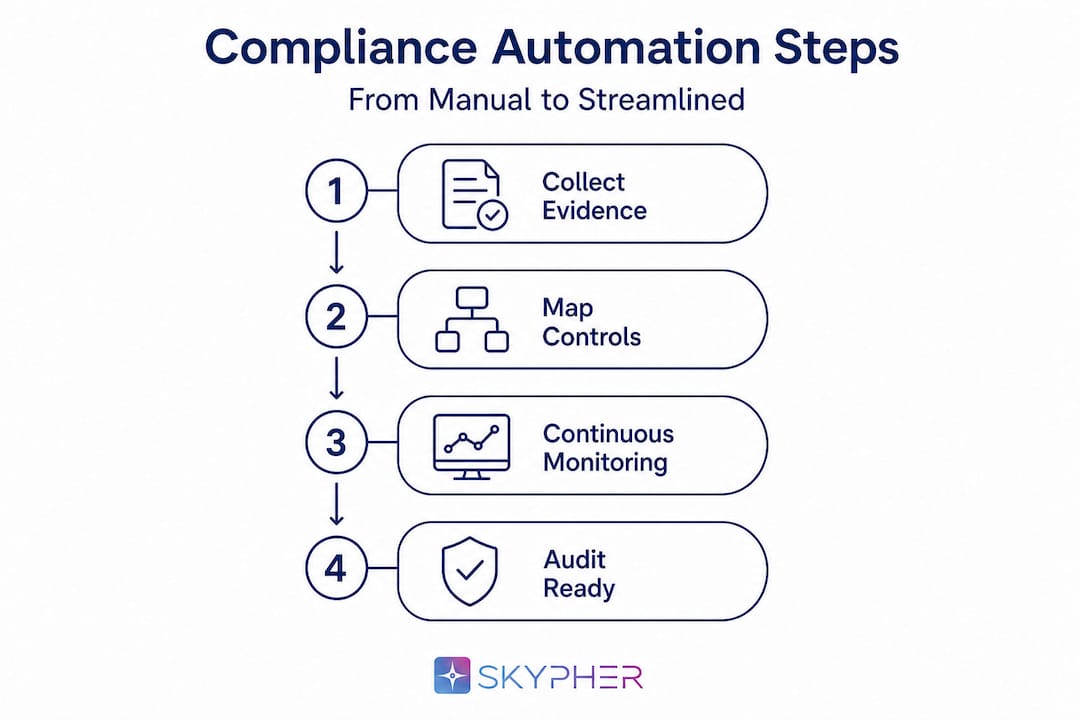
Start with the evidence layer. Every compliance framework requires proof that controls are operating. Automating evidence collection, whether that means continuous log aggregation, automated access certification workflows, or real-time configuration monitoring, removes the single biggest source of compliance friction. As the SecureWorld research on compliance pressures confirms, automation is most valuable when it replaces repeated evidence-gathering work while keeping controls continuously validated.
Payment security deserves specific attention. Finance organizations depend on transaction integrity, and that means aligning with PCI DSS standards set by the PCI Security Standards Council. PCI DSS v4.0 introduced more flexible, outcome-based requirements that reward continuous monitoring over point-in-time snapshots. The core security practices it mandates, network segmentation, encryption, strong authentication, and vulnerability management, are also foundational to broader cybersecurity hygiene.
A stepwise approach to securing payment flows:
- Scope your cardholder data environment (CDE) precisely, because every system that touches payment data must meet PCI DSS standards.
- Implement multi-factor authentication (MFA) across all access points into the CDE, with no exceptions for administrative accounts.
- Deploy automated transaction monitoring that flags anomalous patterns in real time rather than through overnight batch reviews.
- Automate vulnerability scanning of payment systems on a continuous basis, not just quarterly.
- Document everything automatically, so that audit evidence is generated as a byproduct of normal operations rather than a separate manual effort.
The operational benefit of cutting compliance time with automation extends far beyond the audit cycle. When your controls generate their own evidence, your security team gets back the hours they were spending on documentation and can redirect that capacity toward threat detection and response. The process of automating accounting tasks follows a similar logic: reduce repetition, increase accuracy, free skilled staff for higher-judgment work.
What this looks like in practice is a shift from reactive compliance sprints to a continuous assurance model. Your controls are always monitored. Your evidence is always current. Your audit readiness is a steady state, not a crisis mode. If you're still managing security reviews manually, see how transforming security reviews through automation can fundamentally change the equation for your team.
Pro Tip: Schedule resilience drills quarterly rather than annually. Real incident response capability degrades quickly without practice, and regulators under DORA now expect evidence of regular testing, not just documented plans.
Our perspective: Why traditional security fails and what actually works
The most persistent failure mode in finance cybersecurity is treating compliance as an outcome rather than a floor. Organizations invest heavily in documentation, pass their audits, and then experience a breach from an attack vector that their controls technically covered but never actually tested under realistic conditions.
Tick-box controls create a false sense of security because they answer the question "do we have a policy?" not "does our policy actually stop attacks?" Social engineering campaigns succeed against organizations with perfectly scored phishing awareness programs. Ransomware hits environments with documented backup procedures because the backups hadn't been restoration-tested in 18 months. The gap between paper posture and operational reality is where modern attacks live.
What actually works is treating security as measurable operational resilience. As the DORA Compliance Guide for Financial Entities articulates, effective finance security programs map critical business services to ICT assets, enforce identity and access controls with cryptographic standards, monitor continuously, and maintain regulator-ready evidence as a byproduct of normal operations rather than a periodic scramble.
The shift from detect-and-respond to report-and-file thinking is the single biggest mindset change finance security leaders need to make. Compliance filing is not a security outcome. Detecting a credential abuse attempt before it becomes a full breach is a security outcome. Getting ahead of compliance risks in security automation means instrumenting your environment to catch failures as they happen, not after the quarterly review.
What to automate first? Identity and access management verification, continuous control monitoring, and security questionnaire responses represent the highest return on automation investment. These are the tasks that consume disproportionate human time while being entirely rule-based and repeatable. Measure your progress by tracking mean time to detect, mean time to respond, and the ratio of controls continuously validated versus point-in-time attested.
Automate compliance and security with Skypher
The strategies in this article represent a meaningful shift in how finance and technology organizations need to operate. But knowing what to do and having the infrastructure to do it are two different problems.

Skypher is built specifically for the compliance and security review demands that finance and technology teams face at scale. The platform's security questionnaires automation tools allow your team to respond to even 200 complex security questions in under a minute, using AI models trained on your organization's own documentation. The AI-powered recommendation engine surfaces accurate, context-aware answers without requiring manual lookup across multiple systems. And with import and export workflows supporting every major format and 30-plus integrations with platforms like OneTrust and ServiceNow, Skypher fits directly into the workflows your team already uses. Book a demo and see what continuous audit readiness actually looks like in practice.
Frequently asked questions
What are the most common cyber threats in finance?
System intrusion, social engineering, credential abuse, and ransomware are the leading threats in financial services, accounting for the majority of documented breaches in the sector.
Why isn't compliance alone enough for finance cybersecurity?
Compliance frameworks define minimum controls, but threat actors continuously develop methods that exploit gaps between policy and practice, meaning a clean audit score does not guarantee security for customers or revenue.
What is DORA and how does it impact financial organizations?
DORA is an EU regulation that mandates unified ICT risk management, resilience testing, and incident reporting for financial entities, and it applies to many organizations globally as of January 2025.
How does automation improve finance compliance?
Automation eliminates manual evidence collection and reduces compliance fatigue, allowing teams to scale security management across multiple regulatory frameworks without proportionally increasing headcount.
What basic steps should finance leaders take to secure payment systems?
Follow PCI DSS standards, enforce multi-factor authentication across all payment system access points, and use automation to continuously monitor and document payment security controls rather than relying on periodic reviews.