

Compliance in finance and tech has become a high-stakes balancing act. In 2024, the SEC fined 26 firms nearly $63 million for non-compliance with record-keeping, proving that manual workflows carry serious financial risk. Many organizations still hesitate to automate, fearing AI can't handle regulatory nuance or that automation introduces new vulnerabilities. The reality is different. When implemented strategically, automation slashes costs, accelerates processes, and frees compliance teams to focus on judgment-intensive work. This article explains why automating compliance in 2026 is no longer optional for medium to large finance and tech firms, and how to balance technology with human expertise for maximum impact.
Table of Contents
- The Rising Cost And Complexity Of Compliance In Finance And Tech
- How Automation Improves Compliance Efficiency And Reduces Costs
- Limitations Of Automation And The Need For Human Oversight
- Practical Benefits Of Automating Security Questionnaire Processes
- Explore Skypher's AI Security Questionnaire Automation Solutions
- Frequently Asked Questions
Key takeaways
| Point | Details |
|---|---|
| Cost reduction | Automation cuts compliance costs by reducing manual labor and accelerating transaction processing. |
| Improved accuracy | AI-driven systems reduce false positives, allowing analysts to focus on genuine high-risk cases. |
| Human oversight required | Complete automation fails without expert judgment for regulatory nuance and evolving requirements. |
| Questionnaire efficiency | Automating security questionnaires can reduce response times by 40-50% while improving accuracy. |
| Strategic balance | Successful compliance automation combines technology with adaptable human oversight for regulatory complexity. |
The rising cost and complexity of compliance in finance and tech
Regulatory demands for finance and tech firms have exploded over the past five years. Organizations face overlapping requirements from federal agencies, state regulators, and international bodies, each with distinct reporting standards and timelines. According to PwC's global compliance survey, 85% of compliance professionals report increasing complexity in regulatory requirements, with many citing difficulty keeping pace with evolving standards. This complexity translates directly into operational costs as teams expand headcount, invest in training, and dedicate more hours to manual documentation and review processes.
Manual compliance workflows create bottlenecks that slow business operations and increase labor expenses. Teams spend countless hours collecting data across departments, validating information manually, and preparing reports for submission. These tasks are repetitive, error-prone, and pull skilled professionals away from strategic risk assessment. When compliance becomes a drag on productivity, organizations face a choice: hire more people or find smarter ways to work. The financial impact of getting it wrong is substantial. In 2024, the SEC fined 26 firms nearly $63 million for non-compliance with record-keeping, demonstrating that enforcement actions target even established players who fail to maintain proper documentation standards.
The consequences extend beyond fines. Compliance failures damage reputation, trigger investor scrutiny, and can delay critical business initiatives like mergers or product launches. For tech firms pursuing enterprise clients, inadequate compliance posture becomes a sales barrier. Finance firms face heightened regulatory examination and potential restrictions on operations. Organizations that continue relying on manual processes face mounting pressure from competitors who have already adopted automation to gain speed and cost advantages. The question is no longer whether to automate, but how to do it effectively while maintaining the oversight and judgment that regulators expect.
Pro Tip: Start by streamlining your security questionnaire workflow to identify repetitive tasks that drain team capacity before implementing broader automation strategies.
How automation improves compliance efficiency and reduces costs
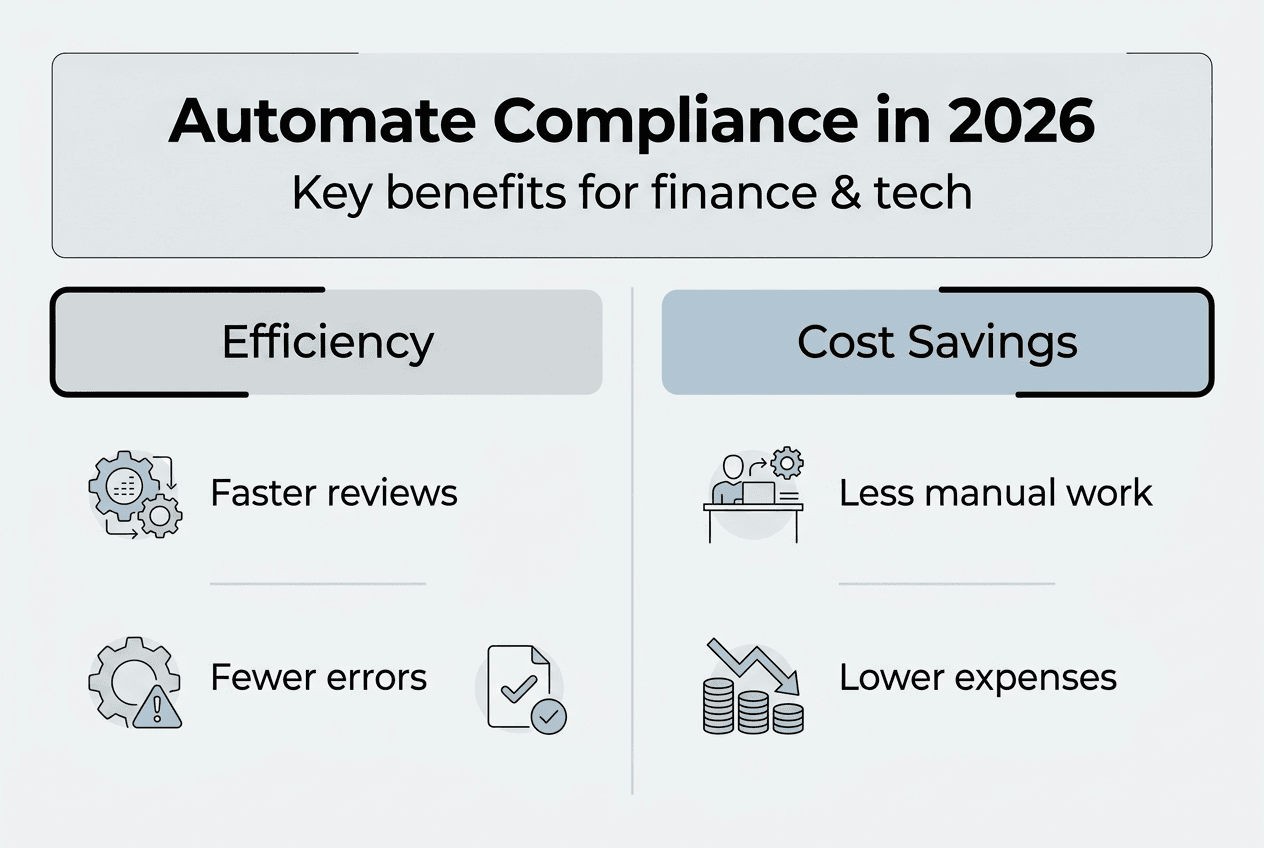
Automation delivers measurable financial benefits by eliminating manual work in data collection, validation, and reporting. An APAC bank achieved $1 million in annual savings and a 40% reduction in transaction processing time through AI-powered compliance, demonstrating the scale of efficiency gains possible when technology handles routine tasks. These savings come from reduced labor costs, faster processing cycles, and fewer errors that require correction. When systems automatically gather data from source systems, validate it against compliance rules, and generate reports, teams can redirect their focus to high-value activities like policy development and risk strategy.

One of automation's most powerful benefits is its ability to reduce false positives in compliance monitoring. Traditional rule-based systems flag countless transactions for review, overwhelming analysts with alerts that turn out to be legitimate business activity. AI-powered business rules cut down false positives, letting analysts focus on high-priority cases that genuinely require investigation. This precision improves both efficiency and effectiveness. Analysts spend less time dismissing irrelevant alerts and more time investigating actual risks, leading to better outcomes and higher job satisfaction.
The speed advantages extend throughout the compliance lifecycle. Automated systems process transactions in real time, flagging issues immediately rather than days or weeks later when remediation becomes more complex and costly. This acceleration enables organizations to meet tighter regulatory deadlines without last-minute scrambles or overtime costs. For organizations handling thousands of transactions daily, even small percentage improvements in processing speed compound into significant operational advantages. Faster compliance cycles also improve customer experience by reducing delays in account openings, loan approvals, and other customer-facing processes.
| Metric | Manual Process | Automated Process | Improvement |
|---|---|---|---|
| Transaction processing time | 10 minutes | 6 minutes | 40% faster |
| False positive rate | 60% | 25% | 58% reduction |
| Annual labor cost | $2 million | $1 million | 50% savings |
| Report generation time | 5 days | 2 hours | 99% faster |
Pro Tip: Combine automation with targeted human review by configuring systems to escalate only high-confidence alerts to analysts, maximizing both efficiency and accuracy. Learn more about automating security questionnaires for faster responses to see this principle in action.
Limitations of automation and the need for human oversight
Compliance requirements shift constantly in response to political pressures, public scandals, and emerging risks. Regulators issue new guidance, amend existing rules, and reinterpret standards based on enforcement actions and court decisions. AI struggles with the context, nuance, and politics crucial for regulatory compliance, particularly when requirements involve judgment calls about materiality, reasonableness, or intent. Automated systems excel at applying consistent rules to structured data, but they falter when faced with ambiguous situations that require understanding regulatory philosophy or predicting how examiners might interpret a gray area.
Local regulatory nuances present another challenge for pure automation approaches. A compliance rule that works perfectly in one jurisdiction may fail in another due to different legal frameworks, cultural expectations, or enforcement priorities. Organizations operating across multiple markets need systems flexible enough to accommodate these variations without creating compliance gaps. Rigid, one-size-fits-all approaches risk either over-compliance that wastes resources or under-compliance that invites regulatory action. Using AI-driven cookie-cutter compliance systems can cause founders to burn cash or cut corners when the technology doesn't adapt to their specific business model or regulatory environment.
The most successful compliance programs combine automation's efficiency with human judgment's flexibility. Automated systems handle data gathering, initial screening, and routine reporting, while experienced professionals interpret complex cases, make risk-based decisions, and engage with regulators. This division of labor maximizes the strengths of both approaches. Technology provides speed, consistency, and scalability. Humans provide context, judgment, and adaptability. Organizations that try to eliminate human oversight entirely often discover that automation can fail in real-time compliance scenarios when unexpected situations arise that fall outside programmed parameters.
Human experts also play a critical role in training and refining automated systems. Compliance teams must review system outputs, identify patterns in false positives or missed risks, and adjust rules to improve accuracy over time. This feedback loop ensures automation evolves alongside regulatory changes and business growth. Without ongoing human oversight, automated systems become stale, generating increasingly irrelevant results that undermine trust and effectiveness. The goal is not to replace compliance professionals but to amplify their impact by removing repetitive tasks that don't require their expertise.
Key areas requiring human judgment:
- Interpreting new or ambiguous regulatory guidance
- Assessing materiality and risk significance in edge cases
- Engaging with regulators during examinations or inquiries
- Making strategic decisions about compliance program design
- Training and refining automated systems based on outcomes
For practical guidance on balancing automation with oversight, review these best practices for automating security questionnaires which demonstrate how to maintain quality while gaining efficiency.
Practical benefits of automating security questionnaire processes
Security questionnaires represent one of compliance's most time-consuming activities, particularly for tech firms pursuing enterprise clients or finance firms undergoing vendor due diligence. These questionnaires often contain hundreds of questions covering information security practices, data protection measures, and operational controls. Manual completion requires gathering information from multiple departments, validating responses against current practices, and formatting answers for submission. Automating security questionnaires reduces response times by 40-50%, transforming what once took weeks into a process measured in days or hours.
Accuracy improvements are equally significant. Manual questionnaire responses suffer from inconsistencies when different team members answer similar questions differently, outdated information when policies change between questionnaires, and errors when copying responses across documents. Automated systems maintain a centralized knowledge base that ensures consistent, current answers across all questionnaires. This consistency reduces follow-up questions from clients or auditors and minimizes the risk of contradictory responses that raise red flags during reviews. Organizations using automation report fewer audit findings related to questionnaire discrepancies and faster approval cycles for new business relationships.
| Aspect | Manual Process | Automated Process |
|---|---|---|
| Average completion time | 2-3 weeks | 3-5 days |
| Response consistency | Variable across questionnaires | Standardized from central repository |
| Cost per questionnaire | $2,000-$5,000 (labor) | $500-$1,000 (platform + review) |
| Accuracy rate | 85% (human error) | 95% (validated responses) |
| Follow-up question rate | 40% of submissions | 15% of submissions |
Implementing effective questionnaire automation requires a systematic approach:
- Build a comprehensive knowledge base of your organization's security and compliance practices, including policies, certifications, and technical controls.
- Map common questionnaire frameworks (SOC 2, ISO 27001, NIST) to your knowledge base to enable quick matching of questions to answers.
- Establish a review workflow where subject matter experts validate automated responses before submission, maintaining quality while gaining speed.
- Integrate your automation platform with document repositories and collaboration tools to streamline information gathering and approval processes.
- Track metrics on response time, accuracy, and client feedback to continuously refine your automation approach and knowledge base.
Pro Tip: Integrate AI recommendation engines with easy import and export workflows to seamlessly handle questionnaires in any format while maintaining accuracy and speed.
The business impact extends beyond efficiency gains. Faster, more accurate questionnaire responses accelerate sales cycles by reducing delays in vendor approval processes. They also improve customer confidence by demonstrating organizational maturity and responsiveness. For compliance teams, automation eliminates the frustration of repetitive questionnaire work, allowing professionals to focus on strategic initiatives like improving security posture or developing new risk management capabilities. Organizations that have automated their security questionnaire processes report higher team satisfaction alongside measurable cost and time savings. Explore the case for security questionnaire automation to understand the full strategic value.
Explore Skypher's AI security questionnaire automation solutions
Skypher delivers purpose-built automation for compliance and security questionnaire workflows, designed specifically for medium to large tech and finance organizations. The platform combines proprietary AI models for questionnaire parsing with a centralized knowledge base that maintains consistent, accurate responses across all your security reviews. AI-powered recommendation engines suggest optimal answers based on your organization's specific policies and past responses, while easy import and export workflows handle any questionnaire format without manual reformatting.

Skypher integrates with over 40 third-party risk management platforms and connects seamlessly with tools your team already uses, including Slack, ServiceNow, Confluence, and SharePoint. This integration eliminates context switching and ensures compliance work fits naturally into existing processes. Organizations using Skypher report measurable efficiency gains, with some cutting questionnaire response times in half while improving accuracy and consistency. Explore Skypher's security questionnaire automation platform to see how AI-driven tools can transform your compliance operations in 2026.
Frequently asked questions
What is compliance automation, and why is it important?
Compliance automation uses technology to handle regulatory tasks like data collection, monitoring, and reporting without manual intervention. It's important because regulatory complexity continues increasing while organizations face pressure to control costs and improve operational efficiency. Automation reduces the labor required for repetitive compliance work, minimizes human errors, and accelerates processes that traditionally created business bottlenecks. For medium to large finance and tech firms, automation has become essential for managing compliance obligations at scale while freeing skilled professionals to focus on strategic risk management. Learn how to streamline your security questionnaire workflow as a starting point for broader automation initiatives.
Can automation fully replace human compliance experts?
No, automation supports but cannot replace human compliance expertise due to regulatory nuance and judgment requirements. While automated systems excel at processing structured data and applying consistent rules, they struggle with ambiguous situations requiring interpretation of regulatory intent or assessment of materiality. Human oversight remains critical for making strategic compliance decisions, engaging with regulators, and adapting to evolving requirements that fall outside programmed parameters. The most effective compliance programs combine automation's efficiency with human judgment's flexibility, using technology to handle routine tasks while preserving expert capacity for complex decision-making.
Which compliance processes benefit most from automation?
Processes involving repetitive data collection, validation, and reporting show the greatest automation benefits. Security questionnaire responses, transaction monitoring, regulatory reporting, and documentation management are prime candidates because they require gathering similar information repeatedly with minimal variation. Security questionnaire automation delivers immediate efficiency improvements by maintaining centralized knowledge bases and auto-populating responses based on organizational policies. Other high-value automation targets include Know Your Customer (KYC) data gathering, anti-money laundering (AML) screening, and audit trail generation where consistency and speed directly impact business outcomes.
How does automation reduce errors in compliance workflows?
Automation standardizes workflows to minimize human mistakes that occur during manual data entry, copying information across documents, or applying complex rules inconsistently. Automated systems validate data against predefined criteria in real time, flagging anomalies immediately rather than discovering errors weeks later during audits or regulatory reviews. This immediate validation enables faster corrections before issues compound or reach regulators. Automation also eliminates transcription errors, ensures calculations follow consistent logic, and maintains complete audit trails that document every action. The result is higher accuracy rates, fewer compliance findings, and reduced risk of costly violations stemming from preventable mistakes.