

TL;DR:
- Response automation significantly reduces compliance turnaround times by up to 95% and minimizes errors. It uses AI-driven answer matching, workflow orchestration, and real-time updates to streamline security questionnaires across various formats and jurisdictions. Implementing response automation enhances organizational efficiency, accuracy, audit readiness, and scalability while fostering a proactive compliance culture.
Security and compliance teams in tech and finance spend countless hours every week manually filling out security questionnaires, copying answers from old spreadsheets, chasing subject matter experts over email, and hoping nothing gets lost in the process. The assumption driving this behavior is that manual review is more reliable. It isn't. Questionnaire automation cuts compliance time by 95%, and organizations that haven't made the switch are paying the price in wasted hours, inconsistent responses, and slower deal cycles. This article breaks down exactly what response automation is, why it outperforms manual methods, and how to apply it inside your organization.
Table of Contents
- Understanding response automation for security questionnaires
- Key benefits of automating security questionnaire responses
- Comparing manual versus automated security questionnaire processes
- Real-world applications: How response automation drives organizational success
- Why response automation is more than just efficiency
- Accelerate compliance with response automation tools
- Frequently asked questions
Key Takeaways
| Point | Details |
|---|---|
| Efficiency gains | Automating questionnaire responses can cut compliance time by up to 95%. |
| Error reduction | Automation minimizes human errors and boosts data accuracy. |
| Scalability | Response automation grows alongside your organization without increased resource strain. |
| Audit readiness | Automated workflows provide clear documentation and make preparing for audits easier. |
| Strategic focus | Teams can shift from repetitive compliance tasks to proactive risk management with automation. |
Understanding response automation for security questionnaires
Response automation, in the context of security questionnaire automation, means using software to intelligently match incoming questions to pre-approved answers stored in a centralized knowledge base. It removes the need for someone to start from scratch every time a vendor, client, or regulator sends a new questionnaire. The system learns from past responses, surfaces the most relevant answers, and routes anything novel to the right person for review.
This is not just a glorified copy-paste tool. Modern platforms include several layers of capability:
- AI-driven answer recommendations that analyze the question semantically, not just by keyword
- Workflow orchestration that assigns open questions to subject matter experts with deadlines and tracks completion status
- Real-time updates so that any change to a policy or control is instantly reflected across all active questionnaire responses
- Format flexibility covering Excel, PDF, Word, and native portal submissions
- Multilingual support for global organizations managing questionnaires across multiple jurisdictions
Manual response, by contrast, involves pulling up last quarter's questionnaire, scanning for similar questions, copying text into the new document, and then routing the draft through a slow email chain for review. Each of those steps introduces delay and risk. A single miscommunication between teams can mean a wrong answer gets sent to a client or auditor. That kind of error doesn't just waste time. It damages trust.
Pro Tip: When evaluating response automation platforms, prioritize those that connect directly with your existing compliance stack, whether that's ServiceNow, OneTrust, Slack, or your document repositories in Confluence or SharePoint. Native integrations cut onboarding time and reduce the chance that your knowledge base gets siloed.
The scope of what response automation covers is broader than many compliance managers initially expect. It's not only external vendor assessments. It handles SOC 2 evidence requests, RFPs with security sections, GDPR data processing questionnaires, and internal audit documentation. Any structured question-and-answer process can be automated once your knowledge base is built.
Key benefits of automating security questionnaire responses
With a clear definition in place, the practical gains become easy to evaluate. The headline number is significant: automation can reduce response time by up to 95%, which translates directly into headcount savings, faster deal cycles, and fewer compliance backlogs. But the benefits go well beyond raw speed.
"Automation slashes compliance turnaround times, enabling teams to focus on strategic tasks."
Faster questionnaire responses free up your security analysts, GRC (Governance, Risk, and Compliance) team, and legal staff to concentrate on issues that actually require human judgment. Instead of spending three days completing a 150-question VSAQ (Vendor Security Assessment Questionnaire), a trained analyst spends 20 minutes reviewing AI-generated draft answers and approving them.
Here is a direct comparison of the efficiency gap between manual and automated approaches:
| Metric | Manual process | Automated process |
|---|---|---|
| Average completion time | 8 to 40 hours | Under 1 hour |
| Error rate | High (12 to 18% inconsistency) | Low (under 2% with review) |
| Audit trail availability | Inconsistent | Always available |
| Scalability | Limited by headcount | Scales without added staff |
| Knowledge reuse | Ad hoc, relies on memory | Systematic, version-controlled |
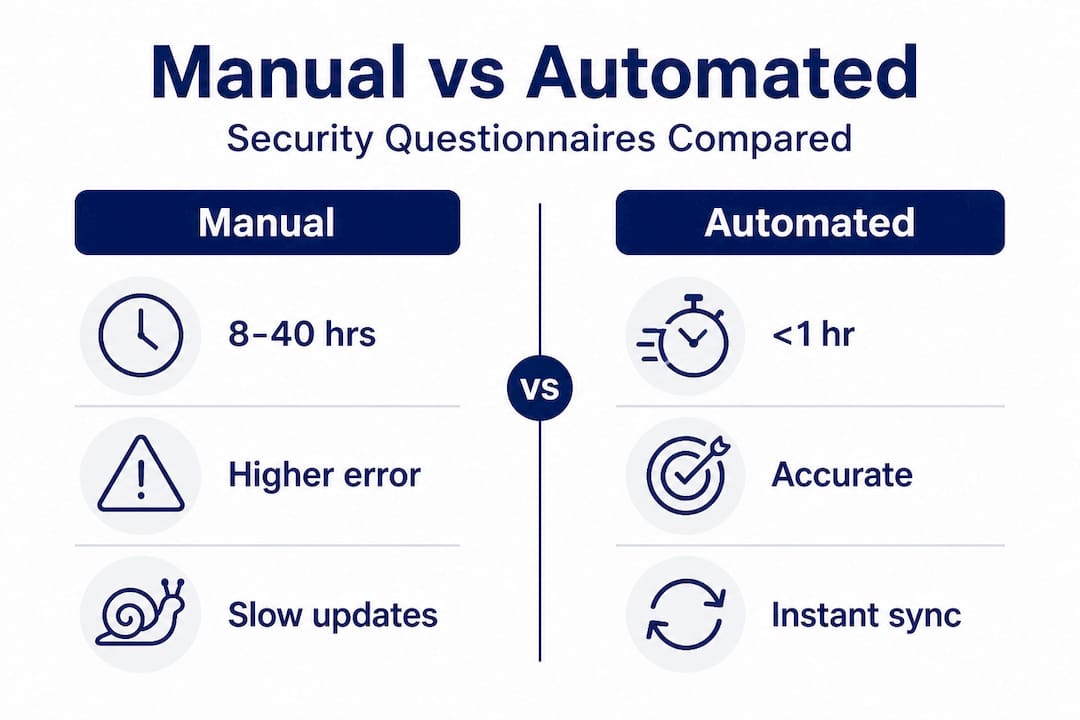
The accuracy improvement matters as much as the speed. Template-driven automation ensures that every response aligns with your current security posture. If your encryption standard changes from AES-128 to AES-256, you update one record in your knowledge base and every future answer reflects that change automatically. No more outdated answers slipping through because someone used last year's template.

Compliance automation benefits also extend to audit readiness. Automated platforms log every response, every reviewer action, and every approval. When an auditor asks for evidence of your response process, you have a clean, timestamped record instead of a scattered email thread.
Additional benefits worth noting:
- Reduced legal exposure from inconsistent or contradictory responses across questionnaires
- Faster deal closures because security reviews no longer bottleneck sales contracts
- Higher client confidence when you can respond thoroughly and quickly
- Better cross-team collaboration through shared workflows rather than forwarded emails
Comparing manual versus automated security questionnaire processes
Now that the benefits are clear, a direct side-by-side comparison of workflows shows where the real differences emerge and why they matter for organizations managing dozens or hundreds of questionnaires per year.
Manual workflow:
- Receive questionnaire in any format
- Manually parse and categorize each question
- Search archived responses for relevant answers
- Email subject matter experts for input
- Consolidate replies into a single document
- Review for consistency and accuracy
- Submit and hope no errors slipped through
Automated workflow:
- Upload or connect to the incoming questionnaire
- AI matches each question to your knowledge base
- Unanswered or low-confidence questions route to designated owners
- Owners review and approve within a centralized platform
- Final response exports in the required format
- All actions logged for audit purposes
Manual response approaches are slower, risk-prone, and harder to audit compared to automation. The numbers in the comparison table above illustrate this clearly, but the workflow breakdown makes it visceral. Every step in the manual process is a potential failure point.
Here is what changes when automation is introduced:
- Time to first draft drops from days to minutes, freeing reviewers to focus on gaps rather than generation
- Answer consistency improves immediately because all responses pull from a single, version-controlled source of truth
- Subject matter experts get targeted requests rather than entire questionnaires forwarded to them
- Audit trails are created automatically, removing the scramble to reconstruct review history later
- Scalability improves without hiring, because the same team can handle three times the volume with automation in place
Following automation best practices during implementation is critical. This includes building a clean knowledge base before launch, tagging answers by category and regulatory framework, and setting clear review cycles so outdated answers don't persist. Organizations that skip these steps often find that automation amplifies existing knowledge management problems rather than solving them.
For organizations managing RFP automation and security reviews, the workflow integration is equally valuable. Many RFPs contain security sections that can represent 30 to 50 percent of the document's total questions. Handling those with automation while your sales team handles the commercial sections cuts RFP response time significantly and removes a major bottleneck from the revenue pipeline.
Real-world applications: How response automation drives organizational success
Theory and comparison tables are useful. Real outcomes from actual organizations are more convincing. The pattern is consistent across tech vendors, financial services firms, and enterprise SaaS companies.
A mid-sized cybersecurity software company managing over 200 vendor assessments per year reduced their compliance time by 95% after deploying response automation. Their GRC team went from dedicating four full-time analysts to questionnaire work to one analyst handling oversight and exception review. The other three analysts shifted to proactive risk assessment and policy development work that had previously been deprioritized due to workload.
A regional bank with multiple business entities faced a different challenge. Each entity operated under slightly different regulatory requirements, and responses needed to reflect those differences consistently. Manual coordination across teams was creating both errors and duplicated effort. After implementing automation with support for multiple product and entity configurations, the bank was able to centralize its knowledge base while maintaining entity-specific answer variants. The result was a dramatic reduction in cross-entity inconsistencies and a much cleaner audit record.
Automation enables tech and finance providers to scale efficiently, handle higher volumes, and improve customer experience. This is especially relevant for organizations that are growing their enterprise client base, since larger clients tend to send longer and more complex questionnaires.
Key outcomes organizations commonly report after deploying response automation:
- 95% reduction in time per questionnaire compared to fully manual methods
- Significant drop in escalations to senior security staff for routine questions
- Faster POC and contract cycles because security reviews no longer hold up procurement decisions
- Improved client satisfaction scores tied to faster response times during vendor due diligence
- Higher knowledge reuse rates, with some organizations reaching 80 to 90 percent of questions answered automatically without human intervention
The AI benefits for B2B extend beyond the compliance function as well. Sales teams closing enterprise deals see security reviews as a predictable obstacle. When that obstacle shrinks from three weeks to one day, the entire sales cycle accelerates. Win rates improve, revenue recognition happens faster, and the sales team can credibly promise prospects a frictionless procurement process.
Key stat: Organizations using response automation report handling 3 to 5 times more questionnaires per quarter with the same team size, without sacrificing accuracy or audit quality.
Why response automation is more than just efficiency
Here is the perspective most articles miss: response automation is not primarily an efficiency tool. It is a transparency tool. And that distinction changes how you should think about implementing it.
When every response is logged, reviewed, and version-controlled, you stop managing compliance reactively and start managing it proactively. You can see which questions your knowledge base answers confidently and which ones consistently require human escalation. Those escalation patterns tell you exactly where your security controls have gaps or where your documentation is weak. That's intelligence you simply can't extract from a folder of completed PDFs.
Teams that fully adopt security automation also report a cultural shift. Compliance stops feeling like busywork and starts feeling like a strategic function. Analysts who previously spent their days copying and pasting text are now interpreting data, identifying risk trends, and advising leadership on control improvements. That's a significant change in job satisfaction and team retention.
The contrarian view worth stating plainly: organizations that defend manual review as "more reliable" are usually protecting institutional inertia, not quality. Manual processes are only as reliable as the least informed person completing them. Automation, properly implemented with human oversight, is systematically more reliable because it removes individual knowledge gaps from the equation.
Pro Tip: Don't automate and walk away. Invest in training your compliance team to interpret the data that automation surfaces, such as answer confidence scores, escalation frequencies, and knowledge base coverage rates. The teams that get the most from automation are the ones that treat it as a tool for insight, not just speed.
Accelerate compliance with response automation tools
After exploring both the evidence and the real-world impact, the natural next step is putting the right tools in place to make this happen inside your organization.

Skypher's AI questionnaire automation platform is built specifically for tech and finance organizations that need to handle high volumes of security questionnaires without sacrificing accuracy or audit quality. The platform's AI recommendation engine uses custom models trained on your knowledge base to surface the most accurate answers with a confidence score, so reviewers know exactly where to focus their attention. With streamlined import and export workflows supporting every major format, plus native integrations with OneTrust, ServiceNow, Slack, Confluence, and over 40 TPRM platforms, Skypher fits directly into the way your teams already work. Book a demo to see how fast your first questionnaire can be completed.
Frequently asked questions
How does response automation save time in compliance?
Automation cuts compliance time by up to 95% by instantly matching incoming questions to a pre-approved knowledge base, eliminating the need to draft responses from scratch each time.
Does automation increase accuracy for security questionnaire responses?
Yes. Automated workflows reduce errors by drawing all answers from a single, version-controlled knowledge base, ensuring consistency across every questionnaire your team submits.
Can automated tools handle industry-specific compliance standards?
Modern platforms support tailored compliance workflows for finance and tech, including customizable answer sets aligned to specific frameworks like SOC 2, ISO 27001, and GDPR.
What are common pitfalls when implementing response automation?
The biggest pitfalls are launching without a clean, well-organized knowledge base, skipping staff training on how to interpret AI confidence scores, and failing to set regular review cycles to keep answers current.
Will response automation scale as our organization grows?
Properly configured automation handles higher questionnaire volumes efficiently without requiring proportional increases in headcount, making it a reliable foundation as your client base and regulatory obligations expand.