

TL;DR:
- Adaptive trust-decay models significantly reduce breaches and improve threat detection speed.
- Automating security questionnaires saves time, ensures consistency, and enhances compliance accuracy.
- Modern monitoring integrates AI to track cloud, edge, and AI systems, addressing complex threat surfaces.
Security and compliance teams at mid-to-large tech and finance organizations know the pressure all too well: questionnaires pile up, audit cycles never slow down, and a single oversight can unravel months of work. Adaptive models are rewriting what's possible here. Research shows that adaptive trust-decay models cut breaches by 87% and shrink mean time to detect (MTTD) threats from 4.7 hours to just 42 minutes in critical infrastructure settings. That's not a marginal gain; it's a fundamental shift in how security monitoring works. This guide breaks down modern frameworks, automation best practices, and practical steps you can act on today.
Table of Contents
- Understanding modern security and monitoring frameworks
- Automating security questionnaires: Best practices and pitfalls
- Continuous monitoring strategies for complex environments
- Integrating AI and automation for enhanced cybersecurity posture
- Why conventional wisdom on monitoring misses the mark
- Next steps: Accelerate your automation journey
- Frequently asked questions
Key Takeaways
| Point | Details |
|---|---|
| Adaptive frameworks matter | Switching to adaptive trust-decay models can dramatically reduce breach risk and improve detection times. |
| Automate security questionnaires | Leveraging AI-driven automation simplifies compliance and reduces manual workload for security teams. |
| Monitor edge and cloud threats | Continuous monitoring strategies must address threats from edge devices, cloud platforms, and AI-powered attacks. |
| AI boosts cybersecurity posture | Integrating AI and automation can streamline workflows, save time, and strengthen organizational security. |
Understanding modern security and monitoring frameworks
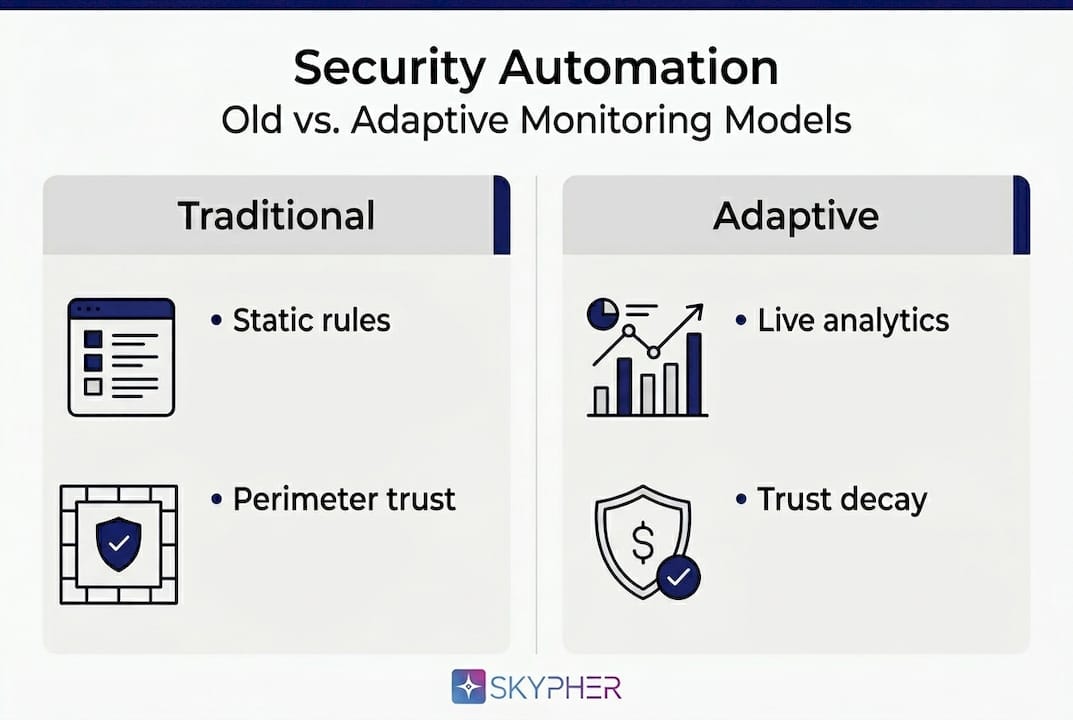
Traditional security monitoring was built on a simple idea: trust what's inside the perimeter, block what's outside. That model served organizations well for years. But in 2026, with hybrid cloud deployments, remote workforces, and AI-driven attack surfaces, the perimeter is essentially gone. You need a fundamentally different mental model.
Modern security monitoring treats trust as something that must be constantly re-earned, not assumed. It watches behavior patterns, evaluates context in real time, and adjusts permissions dynamically. This is where adaptive frameworks come in. Rather than relying on static rules, adaptive systems apply continuous scoring models that decay trust over time unless user and device behavior remains consistent with established baselines.
The contrast with traditional monitoring is stark:
| Dimension | Traditional monitoring | Adaptive trust-decay monitoring |
|---|---|---|
| Trust model | Static, perimeter-based | Dynamic, behavior-driven |
| Threat detection speed | Hours to days | Under 1 hour |
| False positive rate | ~23% | ~8% |
| Breach reduction | Baseline | 87% improvement |
| Response type | Manual review | Automated remediation |
The numbers tell the real story. Adaptive trust-decay model evidence confirms false positives drop from 23% to 8% and MTTD collapses from 4.7 hours to 42 minutes. For security teams managing thousands of endpoints, that time difference is the gap between containing a breach and dealing with a regulatory filing.
The foundational elements you need in a modern monitoring framework include:
- Continuous authentication: Verify users and devices repeatedly throughout sessions, not just at login
- Behavioral baselining: Establish what "normal" looks like for every user, role, and device class
- Real-time policy enforcement: Automate access changes when behavior deviates from baseline
- Integrated threat intelligence: Feed external threat data into your detection models continuously
- Auditability at every layer: Every access decision must generate a log that survives compliance review
"The shift from static to adaptive monitoring isn't an upgrade. It's a replacement of the entire operating philosophy."
Tracking security automation trends in 2026 shows that organizations embracing adaptive models are pulling away from those still relying on signature-based detection. The speed advantage alone justifies the transition, but the compliance benefits are equally compelling. Auditors want to see continuous control evidence, not point-in-time snapshots, and adaptive frameworks generate exactly that.
Automating security questionnaires: Best practices and pitfalls
With modern frameworks established, we turn to the practical realities of automating questionnaire handling. Security questionnaires are the unglamorous workhorse of compliance. Every new enterprise customer, every vendor onboarding cycle, and every regulatory audit triggers another round of them. Manual handling burns hours of skilled security engineer time on repetitive tasks that should be automated.
The automation workflow for security questionnaires, done well, looks like this:
- Ingest the questionnaire in any format. PDF, Excel, Word, or proprietary portal format, your automation layer needs to parse all of them reliably. Proprietary AI models trained specifically on security content outperform generic large language models here because they understand the nuance of control frameworks like SOC 2, ISO 27001, and NIST.
- Match questions to your knowledge base. The AI searches your existing documentation, previous questionnaire responses, and policy documents to find accurate, current answers.
- Score confidence on each answer. Not every question has a clear match. High-confidence answers get auto-populated; lower-confidence answers get flagged for human review.
- Route for review and approval. Collaborative workflows let subject matter experts review flagged items without touching the completed portions.
- Deliver in the required format. Export back to the original format or submit directly through portal integrations.
Compare the two approaches:
| Factor | Manual approach | AI-automated approach |
|---|---|---|
| Time per questionnaire | 8 to 40+ hours | Under 1 hour |
| Consistency of answers | Variable by author | Standardized from knowledge base |
| Audit trail | Fragmented | Centralized and complete |
| Scalability | Linear with headcount | Near-unlimited |
| Error risk | High (fatigue-related) | Low (model-driven) |
The AI advantages in questionnaire automation go well beyond raw speed. Consistency matters enormously in compliance. When two engineers answer the same control question differently across two questionnaires, it creates regulatory exposure. Automation eliminates that drift by pulling every answer from a single, version-controlled knowledge base.
Common pitfalls to avoid:
- Incomplete integration: If your automation tool doesn't connect to your actual policy repositories, it will generate outdated or inaccurate answers. Integration with Confluence, SharePoint, Notion, and similar platforms is non-negotiable.
- Ignoring low-confidence flags: Teams under deadline pressure sometimes approve flagged answers without review. This is how compliance gaps appear in audits.
- Single-language assumption: Enterprise organizations with global operations need multilingual support. Questionnaires arrive in German, French, Japanese, and other languages regularly.
- Neglecting portal-based submissions: Many enterprise buyers require submission through platforms like OneTrust or ServiceNow. Automation without security questionnaire automation model portal connectivity forces manual re-entry.
The AI-driven transformation in compliance workflows shows consistent patterns: teams that automate questionnaire responses free up 70 to 80 percent of the time previously spent on manual completion and redirect that capacity toward higher-value security work.

Pro Tip: Pair your questionnaire automation platform with behavioral analytics from your monitoring framework. When you can reference real-time security posture data in your answers, your questionnaire responses become more accurate and more defensible to auditors.
Continuous monitoring strategies for complex environments
Automation and adaptive models work best when paired with strategic, resilient monitoring in real-world environments. The "real world" for most enterprise security teams in 2026 means cloud-native workloads, edge devices, AI-powered internal tools, and a browser environment that has become its own attack surface.
The threat landscape has grown significantly more complex. AI attacks on edge devices now include compromised AI assistants embedded in browsers, tampering with cold storage cryptographic assets, and adversarial inputs targeting on-device ML models. These threats require behavioral analytics and provenance tagging to detect, because signature-based tools simply don't recognize them as anomalous.
Key continuous monitoring capabilities for complex environments:
- Cloud workload protection: Monitor API calls, data egress patterns, and role assumption events across AWS, Azure, and GCP simultaneously
- Edge device telemetry: Collect behavioral signals from IoT sensors, remote access terminals, and AI-enabled endpoints
- Browser session monitoring: Track what AI assistants and browser extensions access during authenticated sessions
- Cold storage integrity checks: Verify cryptographic asset integrity against known-good provenance records
- AI model input monitoring: Detect adversarial prompts or unusual query patterns targeting internal AI systems
"The SOC of 2026 doesn't just watch servers. It watches AI pipelines, browser sessions, and the edge devices that legacy tools never tracked."
Scaling continuous monitoring across these environments requires a layered strategy. You can't treat a cloud API gateway and an edge temperature sensor the same way. Each environment type needs tailored telemetry collection, alert thresholds calibrated to normal behavior for that environment, and escalation paths appropriate to the risk level.
Cloud security essentials for modern enterprises emphasize the importance of coverage across multiple cloud providers simultaneously. Siloed monitoring tools that only see one cloud platform create blind spots that attackers actively exploit.
Common challenges in scaling continuous monitoring include:
- Alert fatigue: Too many low-fidelity alerts cause analysts to miss critical signals. Behavioral baselining reduces noise dramatically.
- Data volume: Edge deployments can generate enormous telemetry volumes. You need intelligent filtering at the collection layer, not just at the analysis layer.
- Latency in distributed environments: A monitoring gap caused by network latency in a remote region is a real attack window. Redundant collection agents matter.
- Integration between monitoring and compliance tools: Your monitoring data needs to flow directly into your compliance reporting, not sit in a separate silo.
Pro Tip: Implement provenance tagging at the data source level. When every telemetry event carries a signed record of its origin, you can detect tampering attempts at the collection layer rather than after data has been processed. This is especially critical for AI-adjacent workloads where input manipulation is a growing threat vector.
Integrating AI and automation for enhanced cybersecurity posture
Having seen the practical monitoring solutions, let's reveal how AI and automation integrate for tangible improvements. The investment trends alone signal where the industry is headed. Cybersecurity budget growth reached 13.1% in 2025, pushing total spending to $174.8 billion, with software capturing 40% of that spend and cloud security and continuous monitoring as the top priority areas according to Forrester. That's not discretionary spending; it reflects recognized risk.
AI's role in compliance and risk management has matured well beyond basic pattern matching. Modern AI applied to security questionnaires performs document vectorization and semantic chunking, meaning it understands the intent of a question, not just its keywords. This matters because questionnaire authors phrase the same control question in dozens of different ways. AI that understands intent matches questions to answers correctly even when the phrasing varies significantly.
Steps for leveraging automation strategically in your cybersecurity program:
- Audit your current questionnaire backlog. Understand volume, average completion time, and error rate before automation. You need a baseline to measure improvement.
- Map your knowledge sources. Identify where accurate security policy documentation lives: SharePoint, Confluence, Google Drive, local repositories. Your automation platform must connect to all of them.
- Integrate with your TPRM platform. Third-party risk management platforms like OneTrust, ServiceNow, and others need direct API connectivity. Manual re-entry between systems destroys efficiency gains.
- Establish confidence scoring thresholds. Define what percentage confidence triggers automatic approval versus human review. Start conservative and adjust based on observed accuracy.
- Build feedback loops. When reviewers correct AI-generated answers, that correction should update the knowledge base, improving future performance.
Immediate actions security professionals should take right now:
- Evaluate your current MTTD and false positive rates against adaptive model benchmarks
- Inventory all questionnaire formats your team currently handles manually
- Identify which TPRM portals your customers and auditors require for submission
- Assess your team's multilingual needs for global questionnaire coverage
- Review whether your monitoring data currently flows into compliance reporting automatically
AI transforming risk management in security-forward organizations follows a consistent pattern: they start with questionnaire automation as a quick win, then extend AI capabilities into continuous control monitoring, and ultimately use integrated data to produce real-time compliance dashboards that satisfy auditors without manual report generation.
The AI risk management for security questionnaires evolution in 2026 shows organizations moving from reactive compliance to proactive posture management. That shift depends entirely on having automation in place for the repetitive work so your team can focus on strategic analysis.
The organizations winning in compliance right now are not adding headcount. They are adding automation.
Why conventional wisdom on monitoring misses the mark
Here's an uncomfortable truth: most security teams treat automation as a productivity tool rather than a strategic asset. They automate to save time on questionnaires, which is valid, but they miss the larger opportunity.
When your questionnaire automation platform connects to your continuous monitoring data, your compliance answers stop being historical documents and start reflecting your actual, real-time security posture. That changes the conversation with enterprise buyers and auditors entirely. You're no longer saying "here's what our policy says." You're saying "here's what our controls demonstrate, continuously."
Most leaders in tech and finance also underestimate the compounding effect of integrated automation. Legacy systems require separate tools for questionnaire response, monitoring, compliance reporting, and vendor risk management. The integration overhead consumes the time you were supposed to save. The lesson from faster, smarter security compliance approaches is that the platform matters as much as the capability. A unified system that connects your knowledge base, monitoring data, TPRM integrations, and collaboration workflows compounds efficiency gains over time instead of creating new integration burdens.
The teams ahead of the curve are not chasing individual tools. They are building integrated, automated compliance ecosystems where each component reinforces the others.
Next steps: Accelerate your automation journey
Security questionnaire automation is no longer a nice-to-have for enterprise tech and finance teams. It's table stakes for staying competitive in vendor evaluations and audit cycles.

Skypher's security questionnaire automation tool connects directly to your existing knowledge sources, integrates with 30+ TPRM portals including OneTrust and ServiceNow, and can complete 200-question questionnaires in under one minute using proprietary AI models trained specifically for security content. With multilingual support, Slack and Microsoft Teams integrations, and real-time collaboration built in, your team gets the unified platform that eliminates the integration overhead holding other organizations back. The smart security knowledge base keeps every answer current, consistent, and audit-ready, so your compliance posture improves with every questionnaire your team handles.
Frequently asked questions
How do adaptive trust-decay models improve security monitoring?
Adaptive trust-decay models reduce breach risk by 87% and cut MTTD from 4.7 hours to 42 minutes by continuously re-evaluating trust based on real-time behavioral signals rather than static access rules. This dynamic approach also drops false positives from 23% to 8%, reducing analyst fatigue significantly.
What's the biggest challenge in automating security questionnaires?
Integrating AI-driven tools with your actual policy documentation and TPRM portals is the hardest part. Without deep integration, automated answers become outdated quickly and low-confidence flags get bypassed under deadline pressure, which creates real compliance exposure.
How are AI and automation reshaping compliance workflows?
AI automation eliminates the manual effort of questionnaire completion, standardizes answers across your organization, and feeds real-time monitoring data into compliance reporting. With cybersecurity software spending at 40% of a $174.8 billion total market, organizations are clearly investing in AI-driven compliance at scale.
What are edge case threats in security monitoring?
Edge case threats in 2026 include AI attacks on edge devices, compromised browser AI assistants, and cold storage tampering, all of which require behavioral analytics and provenance tagging because traditional signature-based tools cannot detect them reliably.