

TL;DR:
- Organizations are overwhelmed by cybersecurity tools causing fragmented workflows and manual remediation delays.
- AI, especially agentic AI, is shifting security automation from dashboards to autonomous decision-making.
- Managing machine identities and integrating GenAI into security processes significantly reduce risks and incidents.
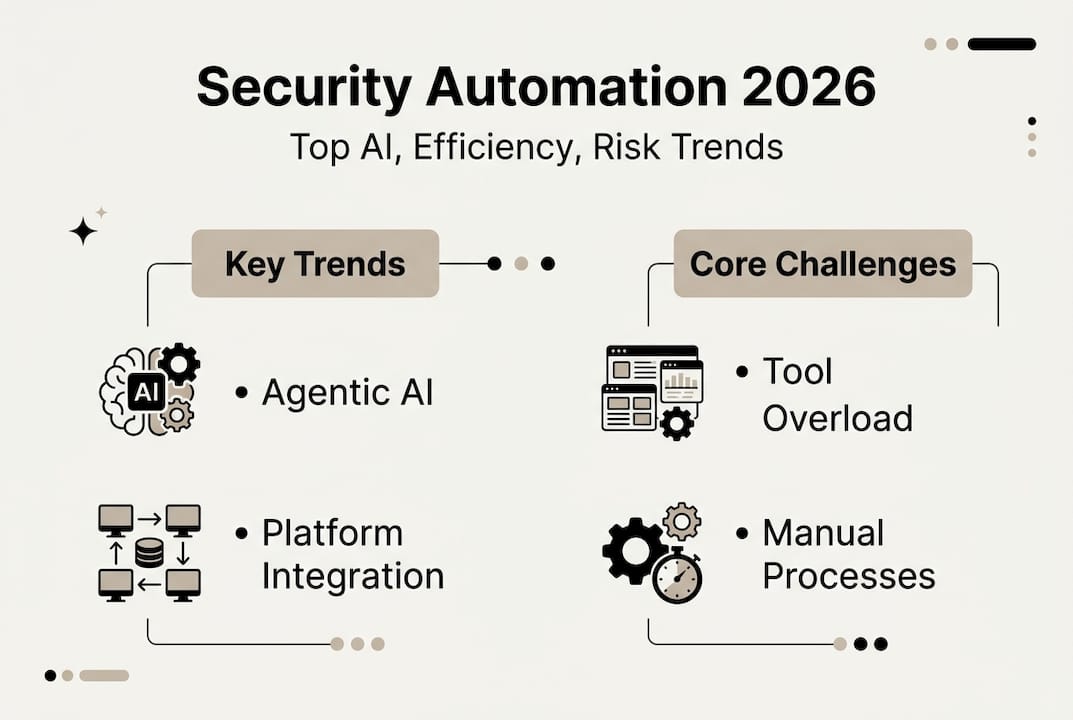
Security teams in tech and finance are drowning in tools, not solutions. Organizations average 45 cybersecurity tools, yet most still rely on manual processes that slow response times and increase risk exposure. The gap between owning automation technology and actually automating anything is wider than most leaders want to admit. This guide cuts through the noise and maps the most important security automation trends shaping 2026, from agentic AI and machine identity management to platform consolidation and GenAI-driven incident reduction. If you manage risk, compliance, or security operations at scale, this is where you need to focus your attention.
Table of Contents
- The state of security automation: Too many tools, not enough integration
- Emergent AI trends: From agentic intelligence to tactical automation
- Machine identities and GenAI: Managing the invisible attack surface
- SBCPs and platforms: Maximizing incident reduction and integration
- Why most security automation fails—and how to actually fix risk management
- Supercharge your security automation with AI-powered platforms
- Frequently asked questions
Key Takeaways
| Point | Details |
|---|---|
| Tool overload | Managing dozens of security tools creates complexity and hinders automation progress. |
| AI integration | Emergent agentic and tactical AI help automate decisions, driving efficiency and confidence. |
| Machine identity management | New strategies are needed to secure proliferating machine identities from GenAI and automation. |
| Quantifiable results | GenAI-driven platforms can reduce employee-driven security incidents by 40% by 2026. |
| Human-in-loop | Despite advances, human expertise is critical for bridging automation gaps and ensuring robust risk management. |
The state of security automation: Too many tools, not enough integration
The average security team is not understaffed on software. It is overwhelmed by it. 45 cybersecurity tools per organization sounds like a strength. In practice, it creates fragmented workflows, duplicated alerts, and analysts spending more time switching between dashboards than actually responding to threats.
The data on remediation makes this worse. 62% of organizations still rely on manual vulnerability remediation workflows, and only 2% have achieved full automation. That is not a technology gap. That is an integration and prioritization gap. Teams have the tools but lack the connective tissue to make them work together.
| Workflow type | Speed | Error rate | Scalability |
|---|---|---|---|
| Manual remediation | Slow (days to weeks) | High | Limited |
| Partially automated | Moderate (hours to days) | Medium | Moderate |
| Fully automated | Fast (minutes to hours) | Low | High |
The key drivers pushing organizations toward consolidation include alert fatigue from siloed tools, compliance pressure from regulators demanding faster response times, and the rising cost of analyst burnout. Reviewing 2025 questionnaire trends shows that these same pressures are reshaping how organizations handle third-party risk reviews, not just internal security operations.
The solution is not buying fewer tools. It is building smarter integration layers that let your existing stack communicate and act without human intervention at every step. Understanding AI in risk management is the first step toward building that connective tissue effectively.
- Alert deduplication across platforms reduces analyst noise
- Automated triage routes incidents to the right team without manual sorting
- Integrated remediation workflows close vulnerabilities faster
- Consolidated reporting gives leadership a single source of truth
Emergent AI trends: From agentic intelligence to tactical automation
Agentic AI is the term you will hear most in 2026 security conversations. It refers to AI systems that can take sequences of actions, make decisions, and complete multi-step tasks without a human approving each move. This is a significant shift from traditional automation, which executes predefined rules, toward systems that reason about context and adapt.

Agentic AI is emerging for autonomous decision-making in security, but Gartner recommends a tactical AI focus given the mixed results seen in early deployments. The promise is real. The execution risk is equally real.
| Agentic AI use case | Outcome |
|---|---|
| Automated threat triage | Faster escalation, reduced analyst load |
| Dynamic policy enforcement | Consistent rule application across environments |
| Autonomous patch scheduling | Reduced mean time to remediate (MTTR) |
| Adaptive access control | Context-aware decisions without manual review |
Dashboard-based automation strategies are fading fast. The old model asked analysts to monitor alerts, interpret dashboards, and then trigger responses. Agentic AI flips this. The system monitors, interprets, and responds. Analysts review outcomes rather than manage every step. This shift is already visible in how leading teams handle AI advantages in cybersecurity for questionnaire automation and compliance workflows.
Pro Tip: Do not deploy agentic AI without guardrails. Prompt injection attacks, where malicious input manipulates AI behavior, and brittle playbooks that break on edge cases are the two most common failure modes. Build in observability from day one and keep humans in the loop for high-stakes decisions.
The teams getting the most from AI are those treating it as a decision accelerator, not a decision replacer. AI streamlining compliance works best when the AI handles volume and humans handle judgment. That balance is what separates successful deployments from automation failures in production.
Machine identities and GenAI: Managing the invisible attack surface
Human identities are hard enough to manage. Machine identities, the credentials and certificates used by applications, APIs, containers, and automated scripts, are multiplying at a rate that most IAM (Identity and Access Management) programs are not equipped to handle.
Machine identities are proliferating due to GenAI deployments, cloud-native architectures, and widespread automation. Every new microservice, every AI agent, every CI/CD pipeline step creates a new identity that needs credentials, permissions, and lifecycle management. Most organizations have no clear inventory of these identities, let alone a governance process.
"Machine identity management is now mission-critical. Organizations that cannot inventory and govern their machine identities are operating with a blind spot that attackers actively exploit."
The risks from machine identity sprawl are concrete and serious:
- Orphaned credentials from decommissioned services remain active and exploitable
- Overprivileged service accounts give attackers lateral movement once compromised
- Short-lived certificates that are not rotated automatically create outages and vulnerabilities
- Lack of visibility means breaches go undetected longer
Pro Tip: Implement context-aware access for machine identities using frameworks like SPIFFE (Secure Production Identity Framework for Everyone) and OAuth 2.0 with strict scoping. These approaches bind identity to workload context, not just static credentials, which dramatically reduces the blast radius of a compromise.
For security teams managing AI-driven questionnaire essentials, machine identity questions are appearing more frequently in vendor assessments. Understanding your own posture here is not just an internal security concern. It directly affects your AI risk management for questionnaires and your ability to answer third-party due diligence requests with confidence.
SBCPs and platforms: Maximizing incident reduction and integration
Security Business Critical Processes, or SBCPs, are the workflows that directly affect your organization's ability to operate securely at scale. Think access provisioning, vulnerability remediation, incident response, and compliance reporting. When these processes are manual or fragmented, every security event costs more time and money than it should.
SBCPs integrated with GenAI and platform-based architectures are projected to reduce employee-driven security incidents by 40% by 2026. That is not a marginal improvement. It is a structural shift in how organizations protect themselves from insider risk and human error.
Here is how leading organizations are building platform-based integration with GenAI:
- Audit existing SBCPs to identify which processes are highest risk and highest volume
- Select a platform that integrates natively with your existing TPRM, SIEM, and ticketing tools
- Embed GenAI into decision points within each process, starting with triage and classification
- Connect CI/CD pipelines so security checks run automatically at every deployment stage
- Measure and iterate using 2025 remediation benchmarks as your baseline
Risk-based prioritization is the engine that makes this work. Not every vulnerability needs immediate attention. Not every alert requires human review. Platforms that use GenAI to score and rank risks let your team focus on what actually matters. This is also where proactive security methods are shifting from finding exposures to fixing them systematically.
Key features of successful automated security platforms include:
- Native integrations with 30 or more third-party risk and compliance tools
- Real-time collaboration features that keep distributed teams aligned
- AI-powered recommendation engines that suggest actions based on context
- Audit-ready reporting that reduces manual documentation burden
- Support for overcoming questionnaire challenges at scale
Why most security automation fails—and how to actually fix risk management
Here is the uncomfortable truth most automation vendors will not tell you. The majority of security automation deployments fail not because the technology is bad, but because the playbooks are brittle and the context is missing.
Brittle playbooks, context gaps, and agentic AI risks are the edge cases that break automation in production. A playbook built for one environment fails silently in another. A stateless automation system that does not carry context between steps makes decisions that look correct in isolation but cause downstream problems.
Most teams treat automation as a one-time implementation project. It is not. It is an ongoing engineering discipline. The organizations that succeed treat their automation layer the same way they treat their codebase: with version control, testing, and continuous improvement.
Agentic AI adds another layer of complexity. The promise of autonomous decision-making is real, but deploying it without robust risk controls is how you create new attack surfaces while trying to close old ones. Teams reviewing AI in security reviews consistently find that human oversight at key decision points is not a weakness in automation strategy. It is what makes automation trustworthy enough to actually scale.
Pro Tip: Build a human-in-loop checkpoint for any automated action that touches access control, data classification, or external communication. These are the areas where context gaps cause the most damage.
Supercharge your security automation with AI-powered platforms
The trends covered in this article point to one clear direction: security teams that integrate AI-driven automation into their core processes will outperform those that do not, on speed, accuracy, and risk reduction. The gap between leaders and laggards is widening fast.

Skypher's security questionnaire automation platform is built for exactly this environment. It connects with over 40 TPRM platforms, answers up to 200 questions in under a minute, and keeps your team aligned through real-time collaboration. The AI-powered recommendation engine learns from your existing knowledge base, so every response gets smarter over time. If reducing manual workload and improving response accuracy are priorities for your team in 2026, Skypher is the platform worth evaluating first.
Frequently asked questions
What are the biggest barriers to security automation in 2025?
Tool overload and manual remediation workflows are the primary barriers. 45 tools on average per organization creates fragmentation, and with 62% of teams still on manual remediation, response times and confidence levels stay low.
How does agentic AI improve security automation?
Agentic AI enables autonomous decision-making, replacing dashboard-dependent workflows with systems that triage, respond, and escalate without waiting for manual input at each step.
What tactical steps should tech and finance organizations take to manage machine identities?
Adopt IAM frameworks like SPIFFE and OAuth 2.0 with strict scoping to bind identity to workload context. Machine identities are proliferating rapidly, and static credential management is no longer sufficient at enterprise scale.
How much can GenAI reduce employee-driven security incidents?
Platform-based automation with GenAI is projected to reduce employee-driven incidents by up to 40% by 2026, primarily by removing manual steps from high-risk business processes.
Recommended
- Stay ahead of security questionnaire trends for 2025
- How AI transforms security compliance: faster, smarter
- Why automate compliance in 2026: benefits for finance & tech firms
- How AI transforms security reviews: efficiency, accuracy, challenges
- Nectar Blog | Why automation in ecommerce boosts efficiency and sales