

Most security and compliance teams assume that more human hours equal better security reviews. The data says otherwise. AI can cut review cycle time by 30 to 60%, yet a significant portion of mid-to-large organizations still rely heavily on manual methods. That gap represents real risk: slower vendor onboarding, inconsistent policy enforcement, and compliance teams buried under repetitive questionnaire work. This guide breaks down exactly how AI reshapes security reviews, where it performs best, where it falls short, and how to build a workflow that gets the most out of both AI and human judgment.
Table of Contents
- What is the role of AI in modern security reviews?
- Benchmarking AI performance: Speed, accuracy, and coverage
- Strengths and mechanics: Where AI excels and where it doesn't
- Pitfalls and edge cases: Understanding AI's limitations in security reviews
- Case studies: Real impacts and lessons from finance and tech
- A practitioner's take: Why AI won't fully replace the human element
- How to get started: Smarter security review automation with Skypher
- Frequently asked questions
Key Takeaways
| Point | Details |
|---|---|
| Efficiency gains | AI reduces security review cycle times by 30-60% for faster compliance and audit preparation. |
| Improved accuracy | Modern AI reliably catches the majority of common vulnerabilities and compliance issues. |
| Human-AI synergy | Keeping a human in the loop ensures nuanced judgment and reduces risk from AI blind spots. |
| Edge case caution | AI may fail on complex, adversarial, or poorly configured cases, so vigilance remains essential. |
| Proven enterprise results | Major banks and tech firms have achieved dramatic improvements using AI for KYC, TPRM, and due diligence. |
What is the role of AI in modern security reviews?
AI does not just speed up what humans already do. It changes the scope of what is even possible to review. A manual security review might cover a handful of vendor questionnaires per week. An AI-driven workflow can process hundreds of documents, flag policy gaps, classify sensitive data, and surface vulnerabilities across entire codebases in the same timeframe.
The core tasks AI now handles in security reviews include:
- Vulnerability detection: Scanning code diffs and configurations for known weaknesses, including OWASP Top 10 and CWE issues
- Policy enforcement: Comparing documentation against regulatory frameworks automatically
- Document classification: Sorting and tagging security artifacts at scale
- Log summarization: Condensing audit trails into actionable findings
- Compliance text analysis: Extracting obligations from dense regulatory language
Large language models (LLMs) power much of this by reading context across long documents, not just matching keywords. Machine learning models trained on historical vulnerability data recognize patterns that would take a human analyst hours to spot.
"The shift from keyword-based scanning to context-aware AI analysis is what makes modern security review fundamentally different from what came before."
The practical result is that AI compliance transformation is no longer theoretical. Teams using AI-assisted review report fewer missed findings on routine checks and faster turnaround on third-party risk assessments. According to 2026 AI code review trends, adoption is accelerating across both tech and finance sectors as tooling matures and integration costs drop.
Benchmarking AI performance: Speed, accuracy, and coverage
Understanding the basic roles of AI, let's quantify its actual effectiveness and what these numbers mean in practice.
Raw capability claims are common in this space. Actual benchmarks are rarer and more useful. Here is what the data shows across leading tools and enterprise deployments:
| Metric | AI-assisted | Manual only |
|---|---|---|
| Review cycle time | 40-60% faster | Baseline |
| Vulnerability detection rate | 70-80% (top tools) | 50-65% |
| Document classification accuracy | Up to 97% | 75-85% |
| False positive rate | 7-25% | 5-15% |
Key findings from real-world benchmarks:
- Augment achieves 65% precision, while Zylos reaches 70 to 80% on security vulnerability detection
- KPMG reports 97% document classification accuracy in enterprise deployments
- Banks using AI for KYC and compliance review see 40 to 60% review time reduction
Statistic to know: Top-performing AI tools now detect security vulnerabilities at rates that match or exceed experienced human reviewers on well-defined vulnerability classes.
Performance varies significantly by tool configuration and the type of review being run. AI tools perform best on structured, high-volume tasks like questionnaire response matching and known vulnerability scanning. They perform less reliably on novel attack patterns or complex multi-system interactions.
For compliance and security teams evaluating tools, the automation benefits for compliance go beyond speed. Consistency matters enormously in regulated industries. An AI system applies the same rules every time, eliminating the variance that comes from reviewer fatigue or differing interpretations. Explore AI-powered security review automation to see how these benchmarks translate into real workflow improvements.
Strengths and mechanics: Where AI excels and where it doesn't
Performance benchmarks reveal AI's promise, but how exactly do these systems achieve such gains and where do they still depend on human expertise?

Multi-agent workflows, spec-driven analysis, and CI/CD integration are the three mechanisms that most consistently boost AI precision in security reviews. Multi-agent setups assign specialized models to specific tasks, such as one agent for policy matching and another for code scanning, then reconcile findings. Spec-driven analysis means the AI checks code or documents against a defined specification rather than guessing intent.
| Task type | AI performance | Human performance |
|---|---|---|
| Known vulnerability patterns | Excellent | Good |
| Compliance text matching | Excellent | Good |
| Architecture and design review | Weak | Excellent |
| Novel logic errors | Weak | Strong |
| High-volume repetitive checks | Excellent | Poor (fatigue) |
| Nuanced risk acceptance decisions | Poor | Excellent |
AI excels at mechanical and security flaws but struggles with deep architecture reasoning or logic errors that require understanding business context. This is not a flaw to be patched. It reflects a genuine difference in how AI and human cognition work.
Pro Tip: Build your hybrid workflow so AI handles the first pass on all high-volume, pattern-based checks, then route only flagged or ambiguous findings to senior reviewers. This cuts human review time by 50% or more without sacrificing quality on the decisions that matter most.
For teams managing AI in risk management, the practical takeaway is clear. AI is a force multiplier for routine work. Human reviewers should be reserved for judgment calls, architecture sign-off, and anything requiring regulatory or ethical context. Pairing the right information security tools for compliance with clear escalation paths is what separates effective hybrid programs from ones that just add complexity.
Pitfalls and edge cases: Understanding AI's limitations in security reviews
Knowing where AI shines isn't enough. Security professionals need to recognize its pitfalls and prepare for atypical risks.
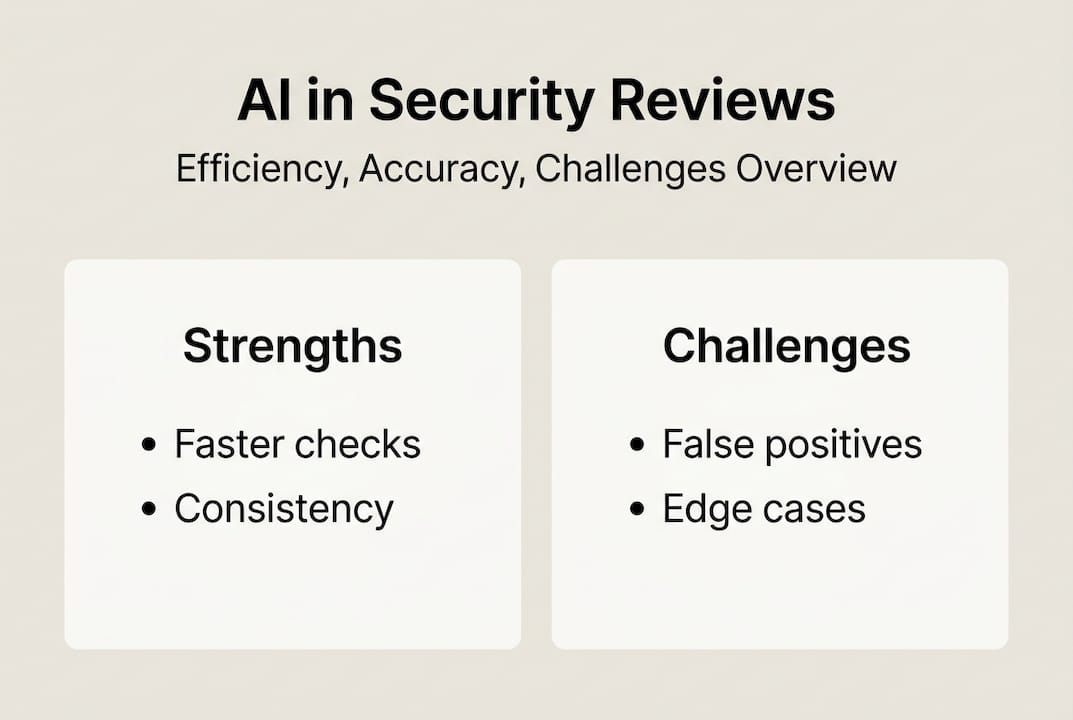
Edge cases in AI security reviews are scenarios where the model encounters inputs it was not well-trained on, such as uncommon coding patterns, novel attack vectors, or ambiguous compliance language. These are not rare. False positives run 7 to 12% with well-configured AI tools, rising to 25% without proper tuning. More critically, 80% of AI security review failures trace back to edge cases.
The most common pitfalls to watch for:
- False positive overload: Too many low-quality alerts erode reviewer trust and lead to alert fatigue, where real issues get ignored
- Adversarial inputs: Attackers who understand AI review patterns can craft code or documents designed to evade detection
- Poor global reasoning: AI struggles to connect findings across multiple systems or files to identify systemic risks
- Model overconfidence: Some tools present findings with high confidence scores even when the underlying evidence is thin
- Configuration drift: Models tuned for one environment may perform poorly as codebases or policies evolve
"Overreliance on AI findings without human validation is one of the fastest ways to introduce blind spots into a security program."
Mitigation is straightforward in principle but requires discipline in practice. Tune false positive thresholds regularly. Maintain a human-in-loop process for any finding above a defined risk threshold. Treat compliance risk as a living category that requires ongoing model updates, not a one-time configuration. For a deeper look at where AI tools carry the most risk, the AI security risk analysis from ELEKS is worth reviewing. You can also see how AI strengths in SOCs translate to questionnaire automation specifically.
Case studies: Real impacts and lessons from finance and tech
With a healthy skepticism established, let's examine how these principles and technologies play out for real organizations.
The most instructive deployments come from financial services, where regulatory pressure is high and the cost of errors is significant. Here is what the data from major implementations shows:
- KYC and CDD automation: Global banks using AI for Know Your Customer and Client Due Diligence processes report 40 to 60% review time saved, with fewer escalations due to more consistent initial screening
- TPRM acceleration: Third-party risk management programs using AI achieve 77% faster due diligence and a 40% improvement in consistency across vendor assessments
- Data classification at scale: AI-driven document classification reaches 97% accuracy in enterprise settings, far outperforming manual tagging at volume
Tech firms deploying AI for internal security reviews report similar gains, particularly in reducing the time between code commit and security sign-off. Faster review cycles mean faster product releases without increasing risk exposure.
Pro Tip: Start your AI security review rollout with a single, well-defined use case, such as vendor questionnaire response or policy gap analysis, before expanding. Teams that try to automate everything at once typically see lower adoption and more configuration problems.
Recurring implementation challenges include data quality issues (AI is only as good as the policies and examples it learns from), change management resistance from reviewers who fear displacement, and integration complexity with legacy systems. Teams that invest in AI in risk questionnaire management early tend to build the institutional knowledge needed to avoid these pitfalls. For fintech teams specifically, security awareness for fintech remains a critical complement to any automated program.
A practitioner's take: Why AI won't fully replace the human element
Having seen both the strengths and limitations, let's step back for a practitioner's perspective on what responsible AI adoption should mean.
The narrative that AI will eventually replace security reviewers misunderstands what security review actually is. It is not just pattern matching. It is risk acceptance. When a CISO signs off on a vendor, they are making a judgment call that weighs regulatory exposure, business need, and organizational risk appetite. No model does that reliably today.
AI is not robust to adversarial cases and high false positive rates can erode the trust that makes any security program function. The organizations getting the most value from AI are not the ones that replaced their teams. They are the ones that freed their teams from repetitive work so reviewers could focus on the decisions that actually require judgment.
The regulatory risk in compliance dimension adds another layer. Regulators increasingly scrutinize how AI is used in financial and security contexts. A program that cannot explain its AI-driven decisions is a liability, not an asset. Building explainability and human oversight into your workflow from day one is not optional. It is what responsible AI for compliance checks looks like in practice. The compliance team impact will be felt most by those who adapt their roles around AI rather than resist it.
How to get started: Smarter security review automation with Skypher
For those ready to move from theory to practice, the right tooling makes all the difference.

Skypher's AI security questionnaires automation platform is built specifically for security and compliance teams in tech and finance. It handles the full workflow: ingesting questionnaires in any format, matching responses using your existing knowledge base, and flagging items that need human review. The AI recommendation engine learns from your team's past responses to improve accuracy over time. With integrations across 40-plus TPRM platforms, Slack, MS Teams, and major document repositories, Skypher fits into the workflows your team already uses. If your goal is faster, more consistent security reviews without adding headcount, this is where to start.
Frequently asked questions
How accurate is AI in detecting security vulnerabilities compared to manual reviews?
State-of-the-art AI tools reach 65 to 80% precision on common vulnerability classes and often outperform human reviewers on high-volume, pattern-based checks, but they still miss complex logic and architecture issues that require human judgment.
Can AI reduce the time needed for compliance and security reviews?
Yes. AI tools typically cut review cycles by 30 to 60%, and banks report up to 77% faster due diligence processes when AI is applied to KYC and third-party risk management workflows.
What are the most common risks or limitations in using AI for security reviews?
The biggest risks are false positives reaching 25% without proper tuning, adversarial robustness gaps, and overreliance on AI findings without human validation, all of which can introduce blind spots into your security program.
How can organizations balance AI and human expertise in security reviews?
The most effective approach uses AI for first-pass, high-volume checks and routes flagged or ambiguous findings to human-in-loop review, which preserves human judgment for architecture decisions, risk acceptance, and anything requiring regulatory or ethical context.