

TL;DR:
- Cloud adoption has increased vulnerabilities due to misconfigurations, identity complexity, and rapid environment changes.
- Effective cloud security requires specialized tools like CSPM, CIEM, CASB, and CNAPP, each targeting specific risks.
- Success depends on clear ownership, integrated automation, and understanding shared responsibility to prevent breaches.
Cloud adoption has fundamentally changed the attack surface for enterprise organizations, and 99% of organizations experienced AI-driven attacks in the cloud in 2025. Legacy perimeter defenses were built for a world where your data lived in a data center you controlled. That world is gone. Tech and finance organizations running workloads across AWS, Azure, and Google Cloud face a completely different threat landscape, one where misconfigurations, identity sprawl, and shadow IT create vulnerabilities that traditional tools simply cannot see. This guide breaks down exactly which cloud security tools matter, what they do, and how to get real value from them.
Table of Contents
- Cloud security challenges: What makes the cloud different?
- Key categories of cloud security tools and how they address cloud risks
- Real-world impact: Measured results from cloud security tool deployment
- Best practices: Getting the most value from cloud security tools
- The uncomfortable truth about cloud security tools no one tells you
- Accelerate secure cloud operations with integrated automation
- Frequently asked questions
Key Takeaways
| Point | Details |
|---|---|
| Cloud ≠ on-premises | Cloud environments need dedicated tools due to unique risks and complexities. |
| Right tool for the risk | CSPM, CIEM, CASB, and CNAPP each target specific types of cloud threats. |
| Measure real outcomes | Deploying specialized cloud security tools leads to measurable gains in speed and risk reduction. |
| Consolidate, don’t sprawl | Fewer, integrated platforms deliver stronger security and simpler management. |
| People and process matter | Even with advanced tools, effective cloud security relies on training, culture, and continuous improvement. |
Cloud security challenges: What makes the cloud different?
The cloud is not just a different location for your servers. It is a fundamentally different operating model, and that distinction matters enormously for security teams.
The first major shift is the shared responsibility model. Cloud providers secure the infrastructure, but everything above that layer, including your configurations, identity policies, data, and applications, is your responsibility. Many enterprises underestimate how much falls on their side of that line, and that gap is where breaches happen.
Beyond shared responsibility, cloud environments introduce a set of risks that have no real equivalent on-premises:
- Configuration drift: Cloud resources spin up and down constantly. A misconfigured S3 bucket or overly permissive IAM role can exist for days before anyone notices.
- Identity-based access complexity: In the cloud, identity is the new perimeter. Managing who can access what, across thousands of roles and service accounts, is exponentially harder than managing firewall rules.
- Shadow IT: Development teams can provision new cloud services in minutes without informing security. You cannot protect what you do not know exists.
- Rapid change velocity: Cloud environments change faster than any security team can manually track. Automation is not optional; it is survival.
- Multi-cloud sprawl: Scalability and security connectivity across AWS, Azure, and GCP simultaneously means each platform has its own security model, its own logging format, and its own blind spots.
Traditional on-premises tools were built for static environments. They assume known network boundaries, predictable change cycles, and centralized visibility. Cloud environments offer none of those things. A firewall appliance cannot tell you that a developer in Singapore just granted public read access to a production database bucket.
"Cloud introduces a shared responsibility model, configuration complexity, and multi-cloud/hybrid setups that traditional tools can't address."
This is also where compliance risks in automation become acute. When your environment changes 500 times a day, manual compliance checks are not just slow, they are meaningless. You need tools purpose-built for this reality.
Key categories of cloud security tools and how they address cloud risks
Not all cloud security tools solve the same problem. Understanding the major categories helps you build a layered defense rather than buying overlapping solutions. CSPM, CIEM, CASB, and CNAPP each target distinct risks across the cloud stack.

| Tool type | Primary function | Risk addressed | Key compliance standards |
|---|---|---|---|
| CSPM (Cloud Security Posture Management) | Monitors cloud configurations continuously | Configuration drift, misconfigurations | CIS, NIST, SOC 2, PCI DSS |
| CIEM (Cloud Infrastructure Entitlements Management) | Manages and right-sizes cloud permissions | Excessive IAM privileges, identity sprawl | ISO 27001, SOC 2 |
| CASB (Cloud Access Security Broker) | Controls SaaS and cloud app access | Shadow IT, data leakage, unauthorized apps | GDPR, HIPAA, SOC 2 |
| CNAPP (Cloud-Native Application Protection Platform) | Unified workload and application security | Runtime threats, supply chain, IaC misconfigs | NIST, PCI DSS, SOC 2 |
Here is how each category delivers concrete value:
- CSPM tools scan your cloud accounts continuously, flagging misconfigurations against benchmarks like CIS Controls. They are the baseline for any cloud security program.
- CIEM tools analyze every permission granted across your cloud environment and identify which ones are never used. Removing unused permissions is one of the highest-ROI security actions available.
- CASB tools sit between your users and cloud applications, giving you visibility into cybersecurity for SaaS platforms your team uses, including ones IT never approved.
- CNAPP platforms consolidate workload protection, IaC scanning, and runtime defense into a single platform, reducing the number of consoles your team needs to monitor.
For a deeper look at how these tools fit into a compliance scanning for operations strategy, the overlap between tool categories and compliance requirements is significant. A solid security tool guide can help you map each tool type to your specific regulatory obligations.
Real-world impact: Measured results from cloud security tool deployment
Theory is useful. Numbers are better. Here is what organizations have actually achieved after deploying purpose-built cloud security tools.
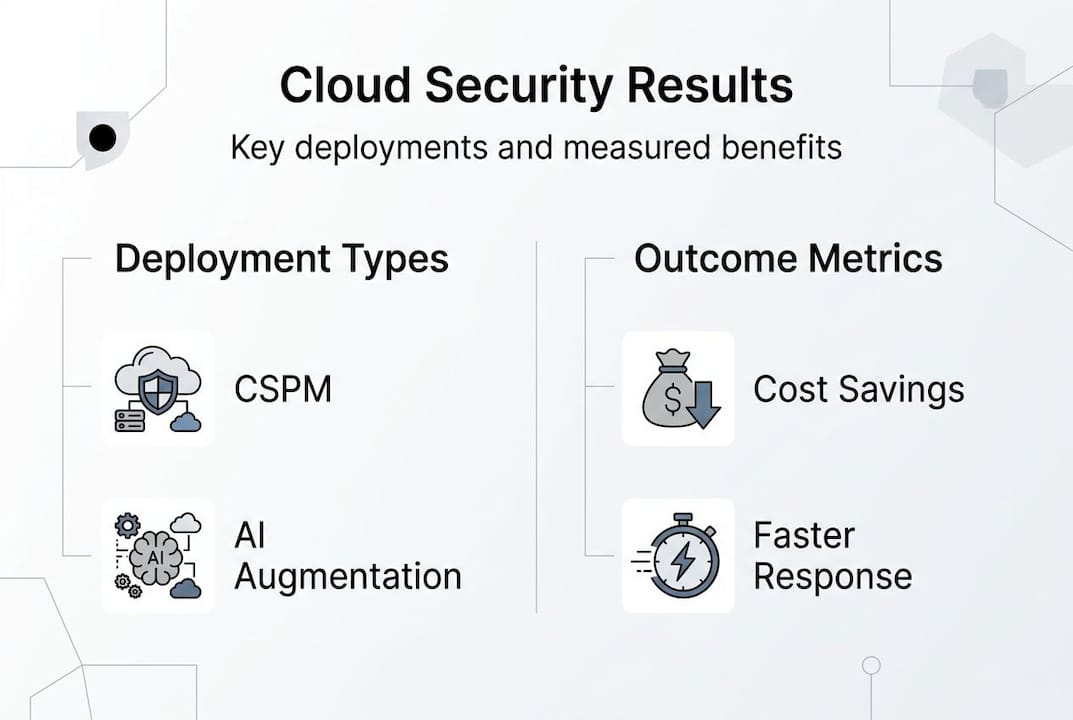
| Organization | Tool type used | Result metric | Business outcome |
|---|---|---|---|
| athenahealth | Cloud security platform | 95% cost reduction in inspection costs | 120 accounts protected in days |
| Enterprise SOC teams | AI-augmented detection | 45 to 61% faster investigations | Reduced mean time to respond |
| Multiple SOC environments | AI-augmented analysis | 22 to 29% more accurate investigations | Fewer false positives, better triage |
| Wiz customers | Graph-based CNAPP | Risk prioritization at scale | Reduced alert fatigue significantly |
The athenahealth result is particularly striking. A 95% reduction in inspection costs while simultaneously expanding coverage to 120 accounts is not a marginal improvement. It is a structural change in how security operations scale. That kind of outcome is only possible when the tool is designed for cloud-native environments from the ground up.
The AI augmentation data from Dropzone AI and the Cloud Security Alliance is equally important. Faster investigations matter less than accurate ones. A 22 to 29% accuracy improvement means fewer false positives consuming analyst time and fewer real threats slipping through.
For automated compliance reviews, these results translate directly. When your security tools can automatically flag, prioritize, and in some cases remediate issues, your compliance posture improves continuously rather than only at audit time.
Pro Tip: If your organization runs workloads across more than one cloud provider, and 55% of large enterprises do, the compounding risk means the ROI on automation tools is even higher. Each additional cloud multiplies the number of configurations, identities, and potential misconfigurations you need to track.
Best practices: Getting the most value from cloud security tools
Buying the right tool is only half the work. How you deploy, integrate, and operate it determines whether you get real security value or just another dashboard no one checks.
Here is a practical sequence for maximizing your investment:
- Start with native controls. AWS Security Hub, Azure Defender, and Google Security Command Center are free or low-cost and give you immediate baseline visibility. Use them before adding third-party tools.
- Add CSPM as your first specialized layer. Configuration monitoring is the highest-priority gap for most enterprises and the easiest to justify to leadership.
- Integrate with your DevSecOps pipeline. IaC (Infrastructure as Code) scanning catches misconfigurations before they reach production. Shift security left, not just right.
- Automate remediation where you can. Auto-remediation for low-risk findings reduces alert volume and lets analysts focus on high-severity issues.
- Evaluate CNAPP for platform consolidation. Streamlining compliance platforms into fewer consoles reduces cognitive load and improves response times.
- Use a security compliance checklist to ensure your tool coverage maps to your actual regulatory requirements, not just general best practices.
On consolidation: 81% of enterprises want to reduce the number of security vendors they work with. Tool sprawl is a real problem. More tools mean more integrations to maintain, more training required, and more alert noise. But consolidation for its own sake is also a mistake. Every platform you consolidate onto must genuinely cover the use cases you need.
Pro Tip: Train your entire engineering and DevOps team on the shared responsibility model, not just your security team. Customer-side configuration errors remain the leading cause of cloud breaches. Security awareness at the team level prevents more incidents than any single tool.
The uncomfortable truth about cloud security tools no one tells you
Here is what experienced security professionals say behind closed doors: most cloud breaches do not happen because organizations lacked a tool. They happen because configuration errors and process failures outpaced the team's ability to respond.
You can have CSPM, CIEM, CASB, and CNAPP all running simultaneously and still get breached if no one owns the alerts, if remediation workflows are undefined, or if your team does not understand what the shared responsibility model actually requires of them.
The organizations that get the most value from cloud security tools are not the ones with the biggest budgets. They are the ones with clear ownership, documented runbooks, and a culture where security is a shared engineering responsibility, not a compliance checkbox. Tools amplify good process. They cannot replace it.
For deeper context on building that foundation, security system management insights cover the operational side of what makes security programs actually work at scale. Platformization is a smart trend, but every platform must fit your enterprise context, your team's skills, and your actual threat model.
Accelerate secure cloud operations with integrated automation
Securing cloud environments at enterprise scale means managing an enormous volume of compliance tasks, security questionnaires, and audit requests alongside your technical controls. Manual processes create bottlenecks that slow down deals, delay certifications, and introduce human error.

Skypher's security questionnaires automation platform integrates directly with the tools and workflows your security team already uses, including over 40 TPRM platforms, Slack, ServiceNow, and major document repositories. The AI recommendation engine can answer up to 200 questions in under a minute, with accuracy powered by your own knowledge base. If you are serious about reducing compliance overhead while strengthening your security posture, Skypher is built for exactly that.
Frequently asked questions
What is the shared responsibility model in cloud security?
The shared responsibility model defines which security tasks are managed by the cloud provider versus the customer, requiring clear delineation to prevent gaps. Misunderstanding this boundary is one of the most common causes of enterprise cloud breaches.
Which cloud security tool type should my organization implement first?
Most organizations start with CSPM for baseline configuration and compliance monitoring, then expand to CIEM, CASB, and CNAPP as needs mature. Each tool type targets a distinct layer of cloud risk, so sequencing matters.
How do cloud security tools help with compliance?
They automatically monitor and benchmark configurations against standards like CIS and NIST, identifying and remediating misconfigurations for continuous compliance. CSPM tools in particular are designed to map directly to regulatory frameworks your auditors already use.
Are native cloud provider tools enough for security?
Native tools are a strong starting point, but third-party platforms add layered detection, automation, and cross-cloud visibility for complex enterprise needs. Customer errors cause most breaches, so balancing native and specialized tools based on your actual risk profile is the right approach.
What is tool sprawl, and why is it a problem?
Tool sprawl means using too many separate security tools, which creates complexity, alert fatigue, and lower overall effectiveness. 81% of enterprises are actively seeking to consolidate vendors for exactly this reason.