

Most organizations assume their in-house security team is their strongest line of defense. That assumption is expensive. SaaS providers allocate 15–20% of revenue to security, a figure that dwarfs what most internal IT budgets can sustain. For security and compliance professionals in tech and finance, this gap has real consequences: missed patches, compliance failures, and breach exposure that SaaS platforms are specifically engineered to prevent. This article breaks down exactly where SaaS outperforms traditional setups and how you can use that knowledge to make smarter infrastructure decisions.
Table of Contents
- How SaaS security surpasses traditional in-house solutions
- Built-in compliance and certifications: Streamlining standards for finance and tech
- Disaster recovery, uptime, and scalability: Security advantages you don't see with on-premise
- Shared responsibility and Zero Trust: Dividing security for maximal protection
- Managing complexity, shadow IT, and edge risks: SaaS tools and governance
- Cost advantages: SaaS frees budget for security improvements
- Discover smarter SaaS security solutions
- Frequently asked questions
Key Takeaways
| Point | Details |
|---|---|
| Enterprise-grade protection | SaaS providers invest heavily in security, offering protections often beyond in-house systems. |
| Built-in compliance features | Major certifications and tools simplify regulatory adherence for tech and finance teams. |
| High uptime and rapid recovery | SaaS offers geo-redundancy and 99.99% uptime SLAs, minimizing risk and downtime. |
| Shared responsibility clarity | Security roles are divided clearly between provider and customer, making defense easier to manage. |
| Cost savings enable reinvestment | Lower total cost of ownership allows budget for ongoing security enhancements. |
How SaaS security surpasses traditional in-house solutions
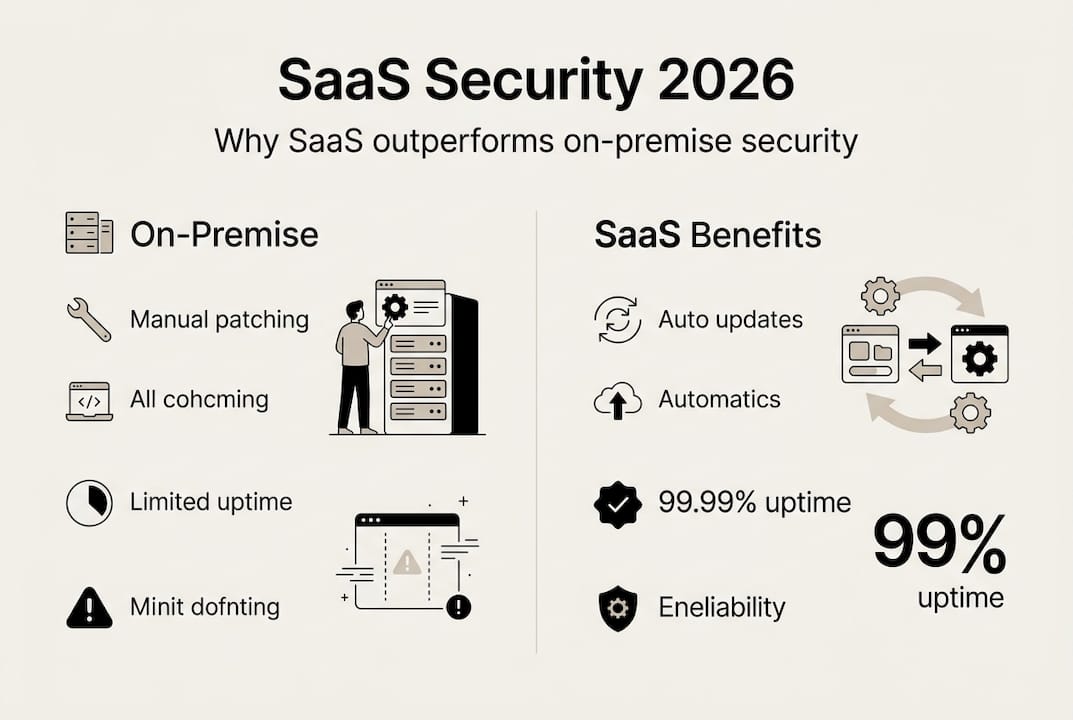
Legacy on-premise environments put the full security burden on your internal team. That means your staff is responsible for patching, monitoring, threat detection, and compliance, often with limited resources and competing priorities. SaaS vendors, by contrast, treat security as a core product feature.
Enterprise SaaS providers invest 15–20% of revenue in security, which translates into dedicated threat intelligence teams, automated monitoring pipelines, and continuous vulnerability management. Your internal team simply cannot replicate that at the same cost. And the consequences of falling short are measurable: 95% of SMB breaches trace back to unpatched systems on-premise, a problem SaaS eliminates through automatic updates.
| Feature | On-premise | SaaS |
|---|---|---|
| Security spend | Varies, often under 5% of IT budget | 15–20% of vendor revenue |
| Patch management | Manual, scheduled | Automatic, continuous |
| Threat monitoring | Business hours or limited SOC | 24/7 automated monitoring |
| Compliance support | Internal effort required | Built-in certifications |
| Vulnerability window | Days to weeks | Hours or less |
"Automatic updates reduce vulnerability windows significantly. On-premise environments where patching is delayed remain the primary attack surface for most enterprise breaches."
For a deeper look at how this plays out in practice, SaaS security for tech companies covers the specific controls and frameworks that matter most. You can also review IT support service trends to see how the broader industry is shifting toward managed and cloud-based security models.
Built-in compliance and certifications: Streamlining standards for finance and tech
Compliance is not a one-time project. It is an ongoing operational requirement, and in regulated sectors like finance and tech, the cost of getting it wrong is severe. SaaS platforms address this by embedding compliance directly into their infrastructure.
Built-in compliance features covering SOC 2, ISO 27001, GDPR, and HIPAA are standard among enterprise SaaS vendors. Instead of building and maintaining these controls yourself, you inherit them. That means faster audit cycles, cleaner evidence packages, and less strain on your compliance team.
Here is what SaaS compliance support typically covers:
- SOC 2 Type II certification with continuous control monitoring
- ISO 27001 alignment with documented information security management
- GDPR data residency controls and processing agreements
- HIPAA safeguards for organizations handling health-adjacent data
- Automated audit logs and access reporting for faster evidence collection
- Pre-built policy templates that map to regulatory requirements
Pro Tip: Before signing with any SaaS vendor, request their most recent SOC 2 report and ask specifically about the audit period. A report older than 12 months is a red flag. You can learn more about what to look for in SOC 2 auditors and trust and how GDPR compliance in SaaS works in practice.
If you are evaluating frameworks, the comparison between ISO 27001 vs SOC 2 is worth reading before you finalize your vendor requirements. And for a full breakdown of what certification actually demands, SOC 2 requirements lays it out clearly.
Disaster recovery, uptime, and scalability: Security advantages you don't see with on-premise
A security strategy that does not account for continuity is incomplete. Downtime is not just an operational inconvenience. It is a security event. When systems go offline unexpectedly, incident response slows, audit trails break, and recovery becomes chaotic.

SaaS platforms are built with resilience as a default. Scalable disaster recovery, geo-redundancy, and 99.99% uptime SLAs are standard features, not premium add-ons. That level of availability is nearly impossible to replicate with on-premise infrastructure without significant capital investment.
| Metric | On-premise | SaaS |
|---|---|---|
| Typical uptime SLA | 99.5% or less | 99.99% |
| Recovery time objective (RTO) | Hours to days | Minutes |
| Recovery point objective (RPO) | Hours | Near real-time |
| Geo-redundancy | Rare, expensive | Standard |
| Scalability during incidents | Manual intervention | Automatic |
Key stat: Gartner forecasts SaaS as the largest cloud segment at $299B, with 90% hybrid adoption expected by 2027. That trajectory reflects enterprise confidence in SaaS resilience and security at scale.
For organizations managing SaaS security standards across multiple products or entities, the built-in redundancy of SaaS removes a major operational risk. You can also explore the enterprise IT cloud guide for a broader view of how cloud infrastructure is evolving to support enterprise security needs.
Shared responsibility and Zero Trust: Dividing security for maximal protection
One of the most misunderstood concepts in SaaS security is the shared responsibility model. Many teams assume that moving to SaaS means handing over all security concerns. That is not accurate, and misunderstanding this boundary creates real gaps.
Providers secure the infrastructure; customers manage data and access. Zero Trust and defense-in-depth are not aspirational frameworks in SaaS. They are baseline architecture. Your job is to control who accesses what, and the vendor's job is to ensure the platform itself cannot be compromised.
Here is a clear breakdown of responsibilities:
- Your organization controls: User provisioning and deprovisioning, access permissions and role assignments, data classification and handling policies, integration configurations, and incident response for data-level events.
- Your SaaS provider controls: Physical infrastructure security, network perimeter defense, platform-level encryption, application security testing, and uptime and availability.
- Shared zone: Identity and access management frameworks, audit logging visibility, and compliance evidence generation.
Pro Tip: Document your shared responsibility boundaries in writing before go-live. Map each control to an owner, and review that mapping quarterly. This is especially important in hybrid environments where compliance risk management spans both cloud and on-premise systems. For teams implementing Zero Trust, AI security implementation offers practical guidance on layering controls effectively.
Managing complexity, shadow IT, and edge risks: SaaS tools and governance
As your SaaS footprint grows, so does the attack surface. The risk is not always from external threats. Often, it comes from within: unauthorized tools, overprivileged accounts, and AI-driven data exfiltration that bypasses traditional controls.
"55% of organizations report unauthorized SaaS use within their environments. Shadow IT is not a fringe problem. It is a mainstream security gap that governance tools must address directly."
The good news is that SaaS-native governance tools are designed for exactly this challenge. Here is what a mature SaaS governance stack looks like:
- SSPM (SaaS Security Posture Management): Continuously scans your SaaS environment for misconfigurations, excessive permissions, and policy drift
- CASB (Cloud Access Security Broker): Monitors and controls data movement between users and cloud applications, including unauthorized tools
- Vendor assessment protocols: Structured questionnaires and risk scoring for every third-party SaaS tool in your environment
- Access reviews: Automated periodic reviews of user permissions to catch privilege creep before it becomes a breach vector
- AI monitoring controls: Policies that govern what data employees can input into AI tools, reducing exfiltration risk
For teams building out cybersecurity strategies in SaaS, combining SSPM with a strong vendor assessment process is the most effective starting point. Shadow IT shrinks when visibility increases.
Cost advantages: SaaS frees budget for security improvements
Security leaders often face a painful trade-off: invest in better tools or maintain existing infrastructure. SaaS changes that equation by dramatically lowering the total cost of ownership (TCO), freeing capital for proactive security investment.
Five-year TCO is 35–52% lower for SaaS, with SaaS environments costing $83,000 to $245,000 compared to $177,000 to $390,000 for on-premise equivalents. That is a significant budget gap that can be redirected toward threat detection, compliance tooling, or security training.
| Factor | On-premise | SaaS |
|---|---|---|
| 5-year TCO range | $177k–$390k | $83k–$245k |
| Management complexity | High | 76% report reduced complexity |
| Time-to-value | Months | 70% faster with SaaS |
| Infrastructure overhead | Significant | Minimal |
| Security reinvestment potential | Limited | High |
The savings are not theoretical. Organizations that shift to SaaS consistently report faster deployment, lower maintenance burden, and more budget available for the security controls that actually reduce risk. For context on why protecting that freed-up budget matters, business asset data security outlines the financial stakes of getting security investment wrong.
Discover smarter SaaS security solutions
The evidence is clear: SaaS outperforms on-premise on security investment, compliance coverage, uptime, cost efficiency, and governance tooling. But knowing the advantages is only half the equation. The other half is putting them to work in your day-to-day security operations.

For security and compliance teams in tech and finance, one of the highest-friction tasks is still the security questionnaire. Vendor assessments, customer due diligence requests, and compliance reviews pile up fast. Skypher's security questionnaire automation platform is built to solve exactly that problem, using AI to answer even 200 questions in under a minute. The AI-powered recommendation engine learns from your existing responses to deliver accurate, consistent answers at scale. And with easy import and export workflows, your team can handle every format without manual reformatting or copy-paste errors.
Frequently asked questions
How does SaaS improve security compared to on-premise solutions?
SaaS providers deliver continuous monitoring, automatic patching, and invest 15–20% of revenue in enterprise-grade security, a level most internal teams cannot sustain. This translates directly into fewer vulnerabilities and faster incident response.
What compliance standards do SaaS solutions typically support?
Most enterprise SaaS vendors are certified for SOC 2, ISO 27001, GDPR, and HIPAA, which significantly reduces the compliance burden for tech and finance organizations managing multiple regulatory requirements.
How does SaaS handle disaster recovery and uptime?
SaaS platforms include geo-redundancy and high availability by default, with 99.99% uptime SLAs and recovery time objectives measured in minutes rather than hours or days.
What is the shared responsibility model in SaaS?
Under the shared responsibility model, SaaS providers secure the underlying infrastructure while customers manage data handling, user access, and integration configurations using Zero Trust principles.
How does SaaS reduce total cost of ownership for security?
SaaS delivers a 35–52% lower five-year TCO compared to on-premise, reducing management complexity and freeing budget that organizations can redirect into proactive security tools and compliance programs.
Recommended
- Enhance cybersecurity in SaaS platforms: 2026 guide
- SaaS security standards: 75% face incidents annually
- ISO 27001 Certification Company: Streamlining SaaS Security
- SOC 2 Requirements: Boosting SaaS Trust and Speed
- Key cloud computing trends to boost business in 2026
- Why prioritize cybersecurity in AI for business 2026 | Artificial Intelligence