

TL;DR:
- Effective risk management is a living discipline that integrates identifying, analyzing, evaluating, treating, and monitoring risks into organizational decision-making. Mature programs embed risk assessments into daily operations, focusing on decision support rather than mere documentation, and leverage automation for efficiency. Continuous review, clear ownership, and mapping risk outputs to real decisions are critical for transforming risk management into strategic value.
Risk management gets reduced to a stack of compliance documents and annual audits far too often. That misread costs organizations real money, real security incidents, and real strategic blind spots. For risk management professionals and compliance officers at tech and finance companies, the stakes are too high to treat this discipline as a checkbox exercise. This guide cuts through the noise to give you a rigorous, framework-grounded view of what risk management actually is, how enterprise and security-specific methodologies work in practice, and what separates programs that drive decisions from programs that just produce reports.
Table of Contents
- Defining risk management: Frameworks and fundamentals
- Enterprise risk management: Moving beyond compliance
- Security and IT risk assessment: Methodologies for actionable results
- Embedding risk management: Continuous review and mature practice
- Our take: What most risk management articles miss
- Streamline your risk management with automation
- Frequently asked questions
Key Takeaways
| Point | Details |
|---|---|
| Strategic, not just compliance | Risk management drives decision-making and resource allocation beyond completing checklists. |
| Established frameworks matter | ISO 31000, COSO ERM, and NIST SP 800-30 structure risk processes for tech and finance companies. |
| Embedment is essential | Mature risk programs are embedded across operations and reviewed continuously. |
| Automation boosts efficiency | Automated tools streamline responses and support consistent risk assessment. |
| Continuous improvement required | Regular monitoring and adaptation ensure risk management remains relevant and effective. |
Defining risk management: Frameworks and fundamentals
Risk management is not a reporting exercise. It is a living operational discipline. ISO 31000 defines it as a set of coordinated activities to direct and control an organization with regard to risk, typically involving identifying, analyzing, evaluating, treating, and monitoring risk. That definition matters because it describes a system, not a document.
"Risk management frameworks are only as effective as the processes that embed them. A risk register no one acts on is just a spreadsheet."
For tech and finance organizations, the process needs to be both systematic and repeatable. Here is what each stage actually involves when done well:
- Identify: Surface every plausible threat source, whether that is a third-party vendor, a misconfigured cloud bucket, or a regulatory change that reshapes your liability exposure.
- Analyze: Estimate how likely each risk is to materialize and what its impact would be if it did. Quantitative models work here; so do structured qualitative scales when data is limited.
- Evaluate: Compare analyzed risks against your organization's risk tolerance. Not everything needs immediate treatment, and misallocating resources to low-priority risks is its own kind of failure.
- Treat: Choose a response: accept, avoid, reduce, or transfer the risk. Each treatment decision should connect directly to a business rationale, not just a compliance requirement.
- Monitor: Track whether treatments are working and whether the risk environment has shifted. This stage is where most programs fall short because it requires ongoing effort, not a one-time assessment.
The distinction between embedment and documentation is where mature programs separate from weak ones. Documenting a risk is trivial. Embedding risk assessment into vendor onboarding, product launches, and architectural decisions is what actually protects your organization. That embedment requires structured processes, clear ownership, and tooling that fits how your teams already work.
Enterprise risk management: Moving beyond compliance
Enterprise risk management, commonly called ERM, takes the foundational stages above and scales them across the entire organization. The COSO ERM framework is the most widely adopted structure for this, and its core purpose is to integrate risk thinking into strategy and everyday decision-making rather than treating risk as only a compliance checklist.
That distinction is sharper than it sounds. Here is how compliance-focused and strategic risk management actually differ in practice:
| Dimension | Compliance-focused approach | Strategic risk management |
|---|---|---|
| Primary output | Audit reports and control logs | Decisions supported by risk data |
| Update frequency | Annual or triggered by audit cycles | Continuous, tied to operational changes |
| Audience | Regulators and internal audit | Executive leadership and boards |
| Success metric | Control coverage percentage | Business outcomes and risk-adjusted performance |
| Resource allocation | Based on regulatory requirements | Based on risk prioritization |
The gap between what organizations believe they are doing and what they are actually doing is wider than most leaders realize. COSO's own survey evidence shows that many ERM programs are still primarily perceived as compliance or assurance reporting rather than as a tool that informs strategic decisions and resource allocation.
Common pitfalls that keep programs stuck in compliance mode include:
- Treating the risk register as the final product rather than as an input to decision-making
- Assigning risk ownership to the risk team alone instead of distributing it across business units
- Measuring program success by documentation completeness rather than by how often risk data actually changes a decision
- Conflating compliance risk meaning with the full spectrum of operational, financial, and strategic risks the organization faces
- Siloing risk management from budgeting, hiring, and product roadmap conversations
For deeper reading on how compliance and risk management intersect without becoming the same thing, the compliance risk explained resource and the risk management and compliance blog are worth bookmarking.
Pro Tip: Every risk treatment decision should map to a resource allocation consequence. If your risk data does not change how you spend time, budget, or personnel, your ERM program is producing reports, not value. Start asking in every risk review meeting: "What decision does this change?"
Security and IT risk assessment: Methodologies for actionable results
When ERM meets information security, you need frameworks built specifically for the technical domain. The most rigorous and widely adopted is NIST SP 800-30. NIST SP 800-30 provides a structured methodology to conduct risk assessments using a likelihood-and-impact style risk model based on threats, vulnerabilities, and resulting adverse impacts.
The likelihood-and-impact model sounds straightforward, but its power comes from how it forces specificity. You cannot just say "data breach is a high risk." You need to specify the threat source (external attacker, insider, vendor), the vulnerability being exploited (unpatched system, weak access controls, phishing susceptibility), and the adverse impact on confidentiality, integrity, or availability. That specificity is what turns a risk assessment into something actionable.
What makes NIST SP 800-30 particularly useful for large tech and finance organizations is its tiered structure:
| Tier | Scope | Decision audience |
|---|---|---|
| Tier 1: Organization | Enterprise-wide risk posture and governance | Board, C-suite, CISO |
| Tier 2: Mission/business process | Risk tied to specific business functions or workflows | Business unit leaders, risk owners |
| Tier 3: System | Technical risk at the application or infrastructure level | IT teams, security engineers, auditors |
Running assessments at all three tiers and connecting the outputs is what gives leadership a real picture of risk. A system-level finding about a misconfigured API gateway means nothing to a CFO. But when it gets translated into Tier 2 and Tier 1 language, it becomes a business process risk with revenue and regulatory implications that leadership can act on.
For cybersecurity best practices specific to questionnaire handling, aligning your assessment tiers to the types of questions you receive is a practical shortcut. Vendors and clients asking about your security controls are essentially conducting a Tier 3 assessment of your organization. Your responses should map to the right tier of your internal risk program.
This is also where security review strategies become operationally critical. If your team is manually completing dozens of security questionnaires per quarter, that manual effort is pulling resources away from the actual risk analysis that should be happening. The cybersecurity trends shaping 2026 risk programs all point toward automation as the mechanism for scaling security reviews without scaling headcount.
Pro Tip: Map your NIST SP 800-30 assessment outputs directly to the questionnaire categories your team most frequently encounters, whether that is SOC 2, ISO 27001, or customer-specific security reviews. When your internal risk documentation already speaks the language of incoming questionnaires, response time drops dramatically. For compliance tips on making this mapping work, structured knowledge bases are your best starting point.
Embedding risk management: Continuous review and mature practice
Running a one-time risk assessment is table stakes. What distinguishes mature programs from performative ones is whether risk management is embedded into how the organization actually operates every day.

ISO 31000's guidance on mature programs is explicit on this point: mature programs emphasize embedment, repeatability of the assessment method, documentation of assumptions and uncertainty, and ongoing monitoring and review to keep risk decisions current. Each of those four elements deserves attention.
Embedment means risk conversations happen before decisions are made, not after incidents occur. In practice, this looks like risk assessments being required before any new vendor is onboarded, before any major product feature is deployed, and before any significant architectural change is approved.
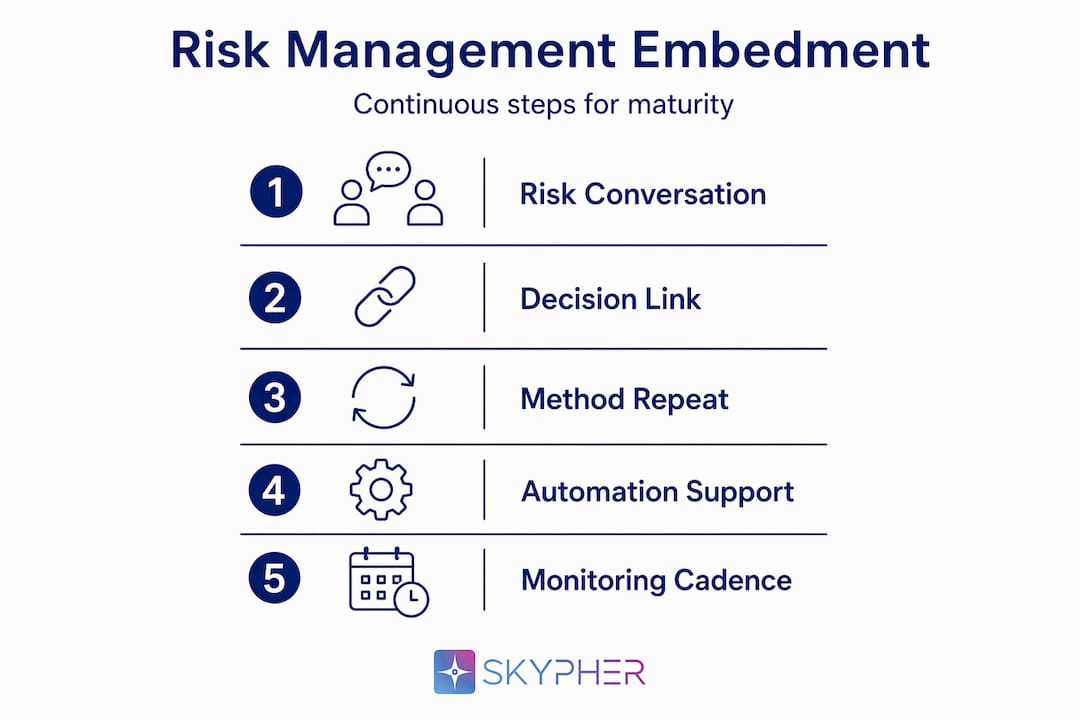
Repeatability means your methodology does not change every year based on who is running the program. When assessments are repeatable, you can compare results over time and actually measure whether your risk posture is improving.
Documentation of assumptions and uncertainty is the element most organizations skip. When you document why you rated a risk as medium instead of high, you create a record that is invaluable when the risk environment changes and you need to re-evaluate that call.
Ongoing monitoring and review is the hardest to sustain because it requires continuous investment rather than a one-time project. Practical mechanisms include:
- Automated alerts tied to changes in vendor security posture
- Quarterly risk reviews that are scoped to changes since the last review, not full reassessments
- Integration of risk data into existing operational dashboards so that risk never becomes a separate report nobody reads
- Clear escalation triggers that define exactly when a change in risk level requires executive notification
The goal of risk management automation is not to replace human judgment in risk decisions. It is to remove the manual overhead that prevents human judgment from being applied where it actually matters.
Pro Tip: Define your monitoring cadence based on risk velocity, not on calendar convenience. High-velocity risks such as those tied to third-party software dependencies or regulatory changes need monthly or even weekly check-ins. Lower-velocity risks tied to physical infrastructure can be reviewed quarterly. A one-size schedule for all risks is a sign the program is built around reporting, not reality.
Our take: What most risk management articles miss
Most articles on risk management spend their energy on definitions and framework comparisons. That is useful to a point, but it leaves out the hard part: what actually breaks when you try to run these frameworks inside a real organization with competing priorities, limited staff, and quarterly targets that dominate every room.
The most common failure we see is not that organizations choose the wrong framework. It is that they treat risk management as a documentation project rather than a decision-support system. Teams spend months building beautifully formatted risk registers and then discover that nobody outside the risk function references them when making actual business decisions. The register becomes an artifact, not an input.
The second failure is treating maturity as a destination. Organizations launch a risk program, complete an assessment, achieve a certain control coverage percentage, and then quietly shift into maintenance mode. But risk is not static. The threat landscape changes. Vendors get acquired. Regulatory requirements shift. A program that stops actively monitoring is a program that is invisibly degrading.
The third and most underappreciated failure is the belief that embedment happens organically. It does not. Embedding risk into vendor resilience risk decisions, product planning, and resource allocation requires deliberate process design, executive sponsorship, and tooling that meets people where they already work. Sending a spreadsheet to a product manager and asking them to "consider the risks" is not embedment. It is wishful thinking.
The organizations that do this well share one trait: they connect every risk assessment output to a specific decision. Not a report. A decision. When risk data changes what gets funded, what gets delayed, or what vendor gets dropped, the program is working. Until then, it is just documentation with good intentions.
Streamline your risk management with automation
Now that you have a clear view of how frameworks like ISO 31000, COSO ERM, and NIST SP 800-30 work in practice, the next step is building the operational infrastructure to sustain them without burning out your team.

Skypher's security questionnaire automation is built specifically for risk and compliance teams at tech and finance organizations who need to move faster without sacrificing accuracy. The platform's AI recommendation engine draws on your existing security documentation to generate accurate, consistent responses across formats, including custom enterprise questionnaires, standard frameworks, and portal-based reviews across 30-plus TPRM platforms. With import and export workflows that handle every major format and integrations with Slack, Microsoft Teams, Confluence, and SharePoint, Skypher fits into how your team already operates rather than adding another tool to manage. When your risk documentation is current and your questionnaire responses are automated, your team can spend its time on what actually drives value: the risk decisions.
Frequently asked questions
What are the main steps in a risk management process?
The main steps follow the ISO 31000 structure: identify, analyze, evaluate, treat, and monitor risks in a coordinated, repeatable cycle. Each step feeds into the next and should connect directly to operational decisions rather than stopping at documentation.
How is risk management different from compliance?
Risk management focuses on understanding and controlling uncertainty to support better business decisions, while compliance focuses on meeting specific legal and regulatory requirements. COSO's survey findings confirm that many organizations still conflate the two, which limits the strategic value their risk programs can deliver.
What frameworks are most used for tech and finance risk management?
ISO 31000, COSO ERM, and NIST SP 800-30 are the leading frameworks, each serving different scopes. NIST SP 800-30 is particularly relevant for information security teams because it provides a structured likelihood-and-impact methodology tied to threats and vulnerabilities at multiple organizational tiers.
How can automation help with security questionnaires?
Automation tools use AI to match incoming questionnaire questions against your existing security documentation, generating accurate responses in a fraction of the time manual completion requires. This consistency matters most during risk assessments when multiple questionnaires arrive simultaneously from different vendors or clients.
What is continuous risk monitoring?
Continuous risk monitoring means regularly reviewing whether your risk treatments are working and whether the risk environment has shifted since your last assessment. Mature risk programs treat monitoring as an operational function with defined triggers and escalation paths, not as an annual review that happens when an audit is scheduled.