

Article 32 of the GDPR requires organizations to implement technical and organizational measures "appropriate to the risk," which in practice means a risk-based mix of encryption, access controls, and monitoring, backed by documentation. There's no fixed checklist, but the shortest version is this: assess your risk, deploy proportionate controls like encryption and identity management, and keep evidence proving both exist. Demonstrability isn't optional. It's the difference between compliance and a claim of compliance.
TL;DR:
- Most organizations should implement layered encryption practices, including TLS 1.2 or higher, at-rest encryption with key rotation, and field-level encryption for sensitive data.
- Role-based access controls, multi-factor authentication, and regular access reviews are essential to prevent breaches originating from inadequate identity management.
- Regular testing activities such as vulnerability scans, penetration tests, and backup restore exercises are mandatory, with documented evidence to demonstrate compliance.
- Organizational measures like maintaining updated records of processing activities, conducting DPIAs, and building clear incident response plans are crucial for effective governance.
- Automating evidence collection, using tools like AI-driven questionnaires and real-time reporting platforms, significantly eases compliance verification and accelerates audits.
Table of Contents
- What Article 32 Actually Requires of Your GDPR Security Controls
- The Technical Controls That Satisfy Article 32
- Organizational Controls: Governance, Response Plans, and Vendor Oversight
- An Implementation Checklist for Engineering Teams
- Testing, Monitoring, and Ongoing Verification
- What Evidence to Keep and How to Present It
- How Automation Changes the Evidence Problem
- Prioritizing Controls: A Short Note on What Comes First
- Turning Evidence Collection Into a Faster Sales Cycle
- Where to Verify These Requirements Directly
- Sources
What Article 32 Actually Requires of Your GDPR Security Controls
Article 32 GDPR doesn't hand you a control catalog. It hands you a legal obligation with four concrete pillars, and it expects you to figure out how those pillars apply to your own processing activities. That ambiguity frustrates a lot of engineering teams used to prescriptive frameworks, but it's deliberate: a five-person startup handling résumés and a hospital network handling genetic data can't be governed by the same fixed list.
The statute names these elements explicitly:
- Pseudonymization and encryption of personal data, wherever practical
- Confidentiality, integrity, availability, and resilience of processing systems
- Restoration of access and availability to personal data in a timely manner following a physical or technical incident
- Regular testing, assessment, and evaluation of the effectiveness of security measures
What counts as "appropriate" depends on the state of the art, implementation cost, and the nature, scope, context, and purpose of your processing, along with the actual risk to the people whose data you hold. This is where the Data Protection Impact Assessment and the Record of Processing Activities stop being paperwork and start doing real work. A DPIA identifies where risk concentrates; a RoPA tells you what data you're even responsible for. Skip either one and you're guessing at "appropriate," which is exactly the position regulators expect you not to be in.
The Technical Controls That Satisfy Article 32
Security teams tend to ask the same question once they've read the statute: fine, but what do we actually build? Article 32 is intentionally abstract, so translating it into infrastructure decisions is where most of the real work happens.
Encryption deserves a layered approach, not a single checkbox. Require TLS 1.2 or higher, and ideally 1.3, for every connection carrying personal data, including internal service-to-service traffic that teams often assume is "safe" because it never leaves the private network. Layer cloud-provider default encryption at rest on top of that, and add customer-managed keys through a KMS for anything genuinely sensitive. For attributes like national ID numbers or health data, field-level encryption keeps the value unreadable even to someone with database access but no specific authorization. Document your key rotation schedule and run automated checks confirming no storage bucket or table sits unencrypted, because auditors will ask for the check, not just the policy.
Identity and access management is where most breaches actually start, not in some exotic zero-day. Role-based access control, enforced least privilege, and mandatory multi-factor authentication should be table stakes, not aspirational goals. Automate provisioning and deprovisioning so an offboarded employee isn't still holding valid credentials weeks later, and run regular access reviews rather than whenever someone remembers to.
Data discovery and classification narrow the entire problem. You can't protect what you can't find, and most organizations discover during their first serious audit that personal data has quietly spread into spreadsheets, log files, and third-party analytics tools nobody flagged. Classification lets you target your strongest controls at the smallest, riskiest dataset instead of applying uniform protection everywhere, which is both more secure and cheaper.
Round out the technical stack with data loss prevention tooling, endpoint protection, network segmentation, and locked-down cloud storage configurations. Misconfigured storage buckets remain one of the most common and most avoidable causes of exposure. Centralized logging paired with a SIEM or UEBA platform gives you the alerting and the audit trail Article 32 implicitly demands. Retention on those logs should match your evidence needs, not just your storage budget.
Backups close the loop. Article 32(1)(c) specifically requires the ability to restore access to personal data "in a timely manner" after an incident, which means backups you've never test-restored don't count as a real control, only a hopeful one.
| Control area | Minimum baseline | Why it maps to Article 32 |
|---|---|---|
| Encryption | TLS 1.2+/1.3, at rest via KMS | Confidentiality, pseudonymization |
| IAM | RBAC, MFA, quarterly reviews | Confidentiality, least privilege |
| Monitoring | Centralized logs, SIEM alerting | Integrity, resilience |
| Backups | Tested restores, defined RTO/RPO | Availability, restoration of access |
Pro Tip: Tie every technical control to a specific artifact the moment you deploy it. If a control doesn't produce a log, a report, or a sign-off, you'll struggle to prove it existed when a regulator or a customer's security team asks.
Cloud providers publish their own mappings that echo this structure closely. Microsoft's Azure security benchmark for data protection, for instance, walks through discovery, classification, encryption, and monitoring in almost the same order GDPR practitioners recommend, which is a useful sanity check if you're building your control set from scratch.
Organizational Controls: Governance, Response Plans, and Vendor Oversight
Technical controls protect systems. Organizational controls protect decisions, and GDPR treats both as equally load-bearing. A perfectly encrypted database won't save you if nobody in the company knows who's accountable for it or what to do when something goes wrong.
Start with governance basics:
- Maintain a current Record of Processing Activities and assign clear accountability, appointing a Data Protection Officer where your processing volume or category requires one under EU guidance.
- Run a DPIA for any high-risk processing activity, and use its findings to justify the specific controls you chose rather than the ones you didn't. The ICO's guidance on privacy by design treats DPIAs as good practice well beyond the mandatory cases, precisely because they document your reasoning.
- Build an incident response playbook with a clear timeline, because supervisory authorities expect breach notification within 72 hours of becoming aware of an incident.
- Formalize vendor and processor oversight through Data Processing Agreements, security due diligence before onboarding, and periodic reassessment afterward.
- Train staff by role, not with one generic annual module, and keep completion records that double as evidence.
A few of these deserve more than a line item. Incident response plans fail most often not because nobody wrote one, but because nobody rehearsed it. A response plan sitting in a wiki nobody has opened since it was written isn't a control. It's a document.
Vendor management is the other place organizations underinvest. Every third party touching personal data is effectively an extension of your own risk surface, and a signed DPA without any follow-up monitoring is a paper promise. Ask processors for their own security attestations, revisit those annually, and treat a vendor's security posture as part of your own.
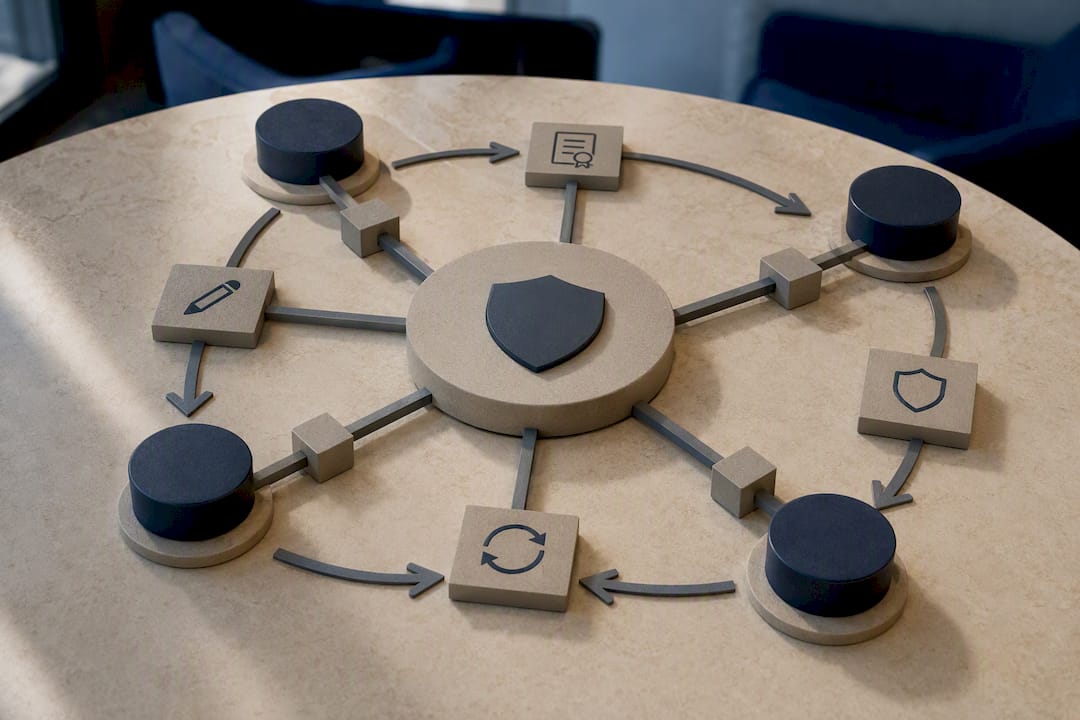
Training completion records matter more than most security teams assume: they're the artifact that proves the "organizational" half of "technical and organizational measures" isn't theoretical.
An Implementation Checklist for Engineering Teams
GDPR security controls stop being abstract the moment you sequence them correctly. Most implementation failures come from teams jumping straight to encryption and access control without first understanding what data they actually hold.
- Build a data inventory and map data flows across production systems, backups, analytics pipelines, and third-party integrations. You cannot secure what you haven't located.
- Classify and minimize data, applying pseudonymization wherever it doesn't break legitimate functionality. Fewer identifiable fields mean a smaller attack surface and a shorter DPIA.
- Enforce encryption and key management standards, mandating TLS 1.2 or higher internally and at the perimeter, with documented rotation schedules for every key in use.
- Implement IAM controls with automated offboarding and a quarterly access review cycle that produces a sign-off record each time.
- Automate retention and deletion, and connect that automation to your subject-rights workflows so a deletion request actually propagates through backups and downstream systems instead of stopping at the primary database.
- Centralize logging, enable meaningful alerts, and schedule penetration tests, then actually verify that your recovery procedures restore data within the timeframe Article 32(1)(c) implies.
This sequence isn't arbitrary. Implementation guides that follow an engineering-first order consistently start with inventory and classification because every downstream control depends on knowing what you're protecting and where it lives.
Pro Tip: Automate step five before you automate anything else on this list. Manual retention and deletion is the control most likely to quietly rot within six months, because nobody notices a missed deletion job the way they notice a failed login attempt.
Testing, Monitoring, and Ongoing Verification
Controls that have never been tested are assumptions wearing a compliance costume. Article 32 explicitly requires "regular testing, assessing, and evaluating" the effectiveness of your measures, which means a one-time deployment checklist doesn't satisfy the obligation on its own.
Vulnerability scanning should run continuously or at minimum weekly, with patch SLAs tied to severity, critical findings closed in days, not quarters. Penetration testing belongs on an annual cadence at minimum, with red-team exercises added for organizations handling especially sensitive categories of data or operating at a scale that makes them an attractive target. Policy-as-code and automated cloud configuration guardrails catch the misconfigurations that manual reviews miss, particularly in fast-moving cloud environments where a single storage bucket setting can undo months of other work.
Access reviews need a schedule and a record, not just a schedule. Every review should produce a document showing who was reviewed, what changed, and who approved it.
| Verification activity | Recommended cadence | Evidence produced |
|---|---|---|
| Vulnerability scanning | Continuous or weekly | Scan reports, patch tickets |
| Penetration testing | Annually, plus after major changes | Pen-test report |
| Access reviews | Quarterly | Sign-off logs |
| Backup restore tests | Per your organization's policy | Restore test report |
Each of these activities should map to a specific artifact your team can produce on demand: a scan report, a signed access-review log, a restore test output. That mapping is what turns "we have controls" into "we can prove we have controls," which is the actual standard GDPR enforcement holds you to.
What Evidence to Keep and How to Present It
Controls without proof are indistinguishable from controls that don't exist, at least from a regulator's or a customer's point of view. Build your evidence library alongside your controls, not after an auditor asks for it.
Keep these current and ready to produce:
- Your RoPA and DPIAs, updated whenever processing activities materially change
- Encryption and key management policies, along with KMS usage logs and rotation records
- Access-review logs showing who was reviewed and what was changed
- Penetration test reports and vulnerability-scan histories, not just the summary slide
- Backup and restore test outputs, proving Article 32(1)(c) restoration capability isn't theoretical
- Third-party certifications and audit reports, which carry weight with customers even when they don't fully substitute for your own documentation
Security questionnaires from enterprise customers increasingly ask for exactly this evidence, often in slightly different formats depending on which framework the customer follows. Building reusable evidence packages, rather than assembling documentation from scratch for every request, saves real time once your organization handles more than a handful of these reviews a year.
How Automation Changes the Evidence Problem
The hardest part of GDPR compliance usually isn't building the controls. It's proving they exist, every time a customer's security team, an auditor, or a regulator asks. Manually assembling that proof from scattered logs, spreadsheets, and Slack threads is where most compliance teams lose entire weeks every quarter.
Automation changes that math by tying controls directly to their evidence artifacts instead of leaving someone to hunt them down later. Platforms built for security questionnaire response typically bring a specific set of capabilities to that problem:
- AI-driven parsing that reads incoming questionnaires and matches questions to existing, approved answers
- Connectors to third-party risk management platforms, reducing the manual copy-paste between systems that introduces errors
- A customer-facing Trust Center that surfaces current certifications and control documentation without a new email thread every time
- Real-time collaboration so security, legal, and engineering can respond jointly instead of passing a document around
- 24/7 support for enterprise teams fielding questionnaires across time zones
Skypher was built around exactly this problem: the gap between having real controls and being able to demonstrate them fast enough to close a deal or satisfy an audit.
Prioritizing Controls: A Short Note on What Comes First
If you're staring at this entire list wondering where to start, start with what's cheap and fast. Data inventory, MFA, TLS enforcement, automated retention, and basic centralized logging are quick wins most teams can deploy within a quarter, and they cover a surprising share of Article 32's intent.
Field-level encryption, automated subject-rights workflows, and continuous evidence mapping are strategic investments. They take longer and cost more, but they're what separates an organization that's compliant on paper from one that can prove it under pressure. When justifying budget to leadership, frame these not as legal overhead but as deals and audits you'll close faster because the evidence is already assembled.
— Gaspard
Turning Evidence Collection Into a Faster Sales Cycle
Every control covered above eventually gets tested by someone outside your organization, usually a prospective customer's security team holding a 150-question spreadsheet. Skypher's AI-powered recommendation engine is built specifically for that moment: it reads incoming questionnaires in whatever format they arrive, matches questions against your existing evidence and approved answers, and surfaces a confidence-scored response your team can verify instead of draft from scratch. Combined with a customizable Trust Center and connectors into multiple risk management platforms, it helps turn the evidence library built under Article 32 into something deliverable to a customer more quickly. If evidence packaging is currently the bottleneck between a signed deal and a stalled one, consider exploring platforms that map to your current questionnaire volume to improve the process.
Where to Verify These Requirements Directly
For the primary legal text, read Article 32 GDPR directly rather than relying on secondhand summaries. The European Commission's GDPR overview covers DPIAs, RoPA, and breach timelines. NCSC's security outcomes guidance and ENISA's SME security resources translate the legal language into engineering practice.
Sources
- Art. 32 GDPR – Security of processing - General Data Protection Regulation (GDPR)
- NCSC guidance: GDPR security outcomes
- Data protection under GDPR - Your Europe
- GDPR Technical Measures Implementation Guide