

GRC risk register integration connects your risk registers directly with governance, risk, and compliance systems to create a unified, automated view of enterprise risk. Done right, it replaces disconnected spreadsheets and manual tracking with API-driven connectivity that pulls data automatically, triggers alerts, and maps risks to regulatory controls in real time. For teams managing compliance under frameworks like NIST SP 800-53 or FedRAMP, that shift from reactive to continuous assurance is the defining capability of 2026.
Here is what effective integration delivers:
- Real-time risk visibility: Every risk entry reflects current control status, audit findings, and key risk indicator (KRI) thresholds without manual refresh.
- Automated alerts and escalation: When a KRI breaches its threshold, the system notifies owners, opens a tracked remediation task, and surfaces the breach on leadership dashboards automatically.
- Regulatory mapping: Risk entries link directly to compliance categories such as ISO 27001 Annex A, HIPAA Security Rule sections, and SOC 2 trust services criteria, so a compliance finding immediately adjusts the mapped risk score.
- Centralized audit trail: Controls, policies, incidents, and assessments live in one system of record, making audit preparation a reporting exercise rather than a data-gathering scramble.
- Financial and sustainability alignment: Platforms like Workiva connect GRC processes with financial reporting and sustainability disclosures, so the same data powers risk registers and external reports.
The shift from isolated tools toward unified, AI-enabled platforms is the 2026 industry standard for continuous risk assurance. The sections below walk through how to build, maintain, and get the most from an integrated GRC risk register.
What makes a GRC risk register the backbone of enterprise risk management?
A GRC risk register is more than a list of risks. At its core, it is a structured repository that ties every identified risk to its likelihood, potential impact, assigned owner, linked controls, and treatment status. When that register is properly integrated into a broader GRC platform, it becomes a live management tool rather than a static document.
Key components every integrated risk register must include:
- Risk identification fields: Unique risk IDs, descriptions, categories (operational, financial, cyber, regulatory), and the business units or assets affected.
- Assessment data: Inherent risk scores, residual risk scores after controls are applied, and target risk scores that define acceptable exposure.
- Controls linkage: Each risk entry connects bidirectionally to the controls designed to mitigate it, so a change in control effectiveness immediately recalculates residual risk.
- Ownership and accountability: Named risk owners with defined review cycles, escalation paths, and sign-off workflows.
- Compliance mapping: Direct links to regulatory requirements, policy statements, and audit evidence so that compliance teams and risk teams work from the same data.
- Reporting outputs: Heat maps, trend charts, and board-level dashboards generated from live register data rather than manually assembled slide decks.
Centralized, consistent risk tracking across an organization depends on this structure. Without it, department-level registers diverge in taxonomy, scoring methodology, and update frequency, making enterprise-wide rollup impossible. Unified risk registers link risk, control, policy, and audit data to financial and sustainability reporting, giving leadership a single, coherent picture of exposure.
Governance and compliance teams benefit directly. When audit results feed back into risk scores automatically, the register reflects real exposure rather than last quarter's assessment. That feedback loop is what separates a true GRC platform from a point solution.

Pro Tip: Assign a named risk owner to every entry at the time of creation, not after the register is built. Ownership gaps are the most common reason risk registers go stale within six months of deployment.
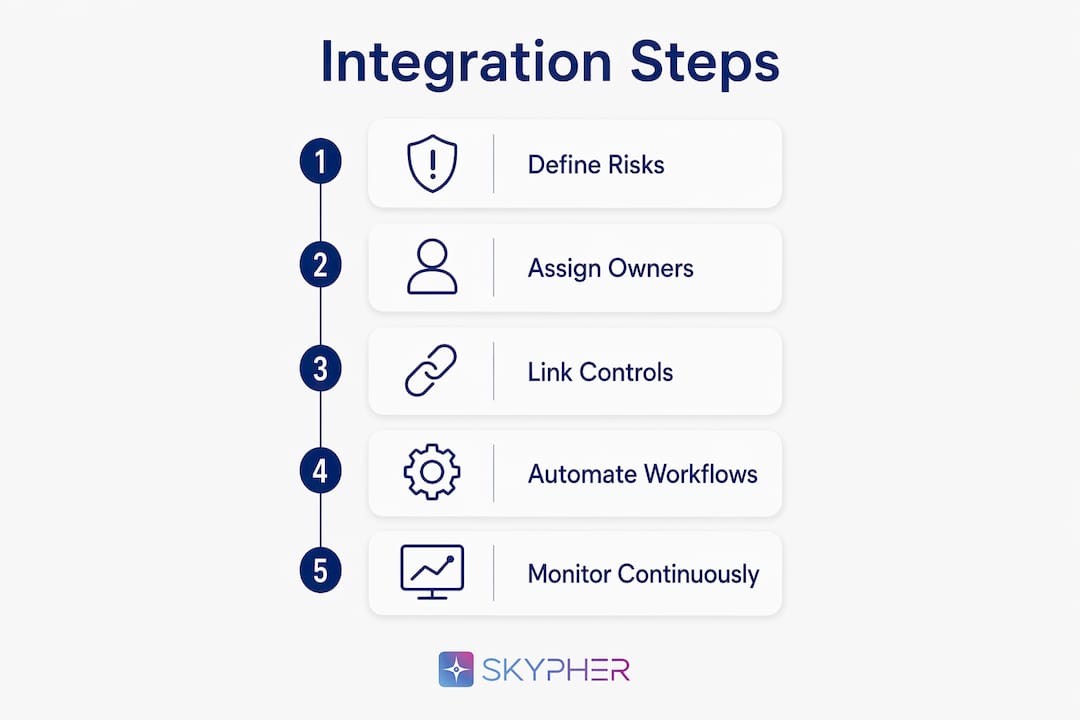
How to build, maintain, and integrate your GRC risk register effectively
Getting integration right requires deliberate planning before a single risk entry is imported. The most common failure mode is rushing to populate the register without first establishing the data architecture that makes integration coherent.
Step-by-step process
-
Define your risk taxonomy. Establish a primary classification hierarchy (strategic, operational, financial, compliance, cyber) before importing any data. A consistent taxonomy prevents duplication and ensures that risks from different departments roll up meaningfully at the enterprise level.
-
Assign unique risk identifiers. Every risk entry needs a unique ID that persists across systems. Without unique identifiers, legacy data imports create duplicates that corrupt scoring and reporting.
-
Import and normalize legacy data. Bulk-import existing risks, controls, KRIs, threats, vulnerabilities, and assets. Map legacy fields to your new taxonomy during import rather than after, because post-import remapping is significantly more labor-intensive.
-
Configure bidirectional control linkages. Link each risk to its associated controls and set the system to recalculate residual scores when control testing results change. This is the step that transforms a register from a list into a management instrument.
-
Integrate with adjacent systems. Connect the risk register to your compliance management module, internal audit system, HR platform, and ERP using APIs or pre-built connectors. Risk management platforms with extensible, multi-register foundations and shared data schemas make this integration far more reliable than point solutions that require custom middleware.
-
Set KRI thresholds and escalation rules. Define the numeric thresholds at which each KRI triggers an alert, who receives that alert, and what remediation workflow opens automatically.
-
Establish review cadences and ownership workflows. Schedule periodic reviews for every risk entry, assign owners, and configure automated reminders. Without this, even a well-built register drifts out of date.
Pitfalls to avoid:
- Importing data without a finalized taxonomy creates a cleanup project that delays go-live by weeks.
- Skipping bidirectional control linkage produces a register that looks complete but does not respond to control failures.
- Treating integration as an IT project rather than a cross-functional initiative leads to user resistance and low adoption.
- Building the register in isolation from compliance and audit teams means the register will not reflect the findings those teams generate.
Stakeholder collaboration considerations:
- Involve risk owners from each business unit during taxonomy design, not just at training time.
- Run a pilot with one department before enterprise-wide rollout to surface configuration gaps early.
- Document the data dictionary and share it with every team that will contribute to or consume register data.
- Schedule a formal post-go-live review at 30 and 90 days to catch drift before it becomes structural.
User resistance is one of the most common reasons integration stalls. Risk registers must link to controls and KPIs from the start to function dynamically. A register that does not visibly connect to the decisions people make every day will be ignored, regardless of how technically sound the integration is.
How AI, automation, and modular platforms are reshaping GRC risk register integration in 2026
The technology driving integrated risk registers has moved well beyond workflow automation. The 2026 generation of GRC platforms combines AI-powered insight generation, low-code configuration, and modular architecture to make integration faster, more adaptive, and genuinely predictive.
What AI brings to integrated risk registers:
- Ripple effect prediction: AI-powered analytics identify how a risk flagged in one department could escalate across the organization. Siloed risk management conceals exactly these connections, and cross-functional dashboards with KRI libraries surface them before they become material events.
- Automated regulatory ingestion: AI continuously monitors regulatory sources and maps new requirements to existing risk and control entries, reducing the manual effort of compliance gap analysis.
- Anomaly detection: Machine learning models flag unusual patterns in control testing results or KRI trends that human reviewers would likely miss in large data sets.
- Audit fieldwork automation: Platforms like MetricStream use AI to automate audit fieldwork, highlight control gaps, and generate recommendations so audit teams focus on remediation rather than documentation.
Automation benefits that change daily operations:
- Real-time KRI monitoring with threshold-triggered escalation eliminates the dashboard-nobody-checks problem.
- Workflow automation routes remediation tasks to the right owner, tracks progress, and escalates overdue items without manual intervention.
- Evidence collection for compliance certifications runs continuously, so audit preparation draws on an always-current evidence library rather than a last-minute data pull.
Modular and low-code architecture:
Low-code and no-code GRC platforms let risk and compliance professionals configure registers, workflows, and dashboards without writing code or waiting for IT resources. That independence matters because organizational risk profiles change faster than traditional IT development cycles. Modular GRC platforms allow teams to deploy only the components they need and can become operational within the first week, which dramatically reduces the time between decision and value.

The broader shift, from tool consolidation to intelligent, AI-enabled platforms that unify risk, compliance, sustainability, and financial data, represents the direction the industry has committed to for continuous assurance. We are seeing GRC integration strategies evolve from connecting systems to connecting intelligence layers across those systems.
| Technology trend | Practical benefit | Example capability |
|---|---|---|
| AI-powered risk analytics | Predicts cross-domain risk escalation before it occurs | Ripple effect modeling across business units |
| Real-time KRI monitoring | Eliminates manual threshold checks | Auto-escalation when a KRI breaches its limit |
| Low-code configuration | Reduces IT dependency for register updates | Business users build workflows without coding |
| API-driven data integration | Replaces manual data entry with automatic pulls | Live compliance data feeds into risk scores |
| Modular platform deployment | Speeds implementation and reduces scope risk | Deploy audit module independently of ERM module |
| Unified reporting layer | Connects GRC data to financial and sustainability disclosures | Single data set powers risk register and 10-K |
Pro Tip: When evaluating platforms, ask vendors specifically whether their KRI thresholds trigger automated remediation workflows or only send notifications. Notification-only systems still require a human to open a task, which reintroduces the manual gap you are trying to close.
For teams building or upgrading their GRC software solutions, the practical question is not whether to adopt AI-enabled integration but how to sequence the rollout so that AI capabilities have clean, well-structured data to work with from day one.
How integrated risk registers handle risk classification, prioritization, and compliance alignment
Classification and prioritization are where integrated risk registers deliver their clearest advantage over spreadsheet-based approaches. A unified system applies consistent scoring methodology across every department, eliminating the variation that makes enterprise-level risk comparison unreliable.
Risk scoring and prioritization in a unified system:
Integrated platforms calculate inherent risk scores from likelihood and impact ratings, then apply control effectiveness data to produce residual scores. The residual score drives prioritization: risks above a defined threshold surface automatically on executive dashboards and trigger review workflows. Heat maps generated from live register data give leadership a current view of the risk portfolio without any manual assembly.
Prioritization also benefits from cross-department visibility. A risk that scores moderate in isolation may score critical when the system identifies that three other departments carry correlated risks that compound the exposure. That kind of analysis is only possible when all registers share a common data schema and feed a single reporting layer.
Compliance framework alignment:
Risk entries map directly to compliance categories across frameworks including NIST SP 800-53, FedRAMP, ISO 27001 Annex A, HIPAA Security Rule sections, and SOC 2 trust services criteria. When a compliance assessment captures a finding against one of those categories, the mapped risk score adjusts automatically. Audit results feed back into residual risk in real time rather than waiting for the next scheduled review cycle.
The NIST Interagency Report 8286 framework formalizes the relationship between enterprise risk management and cybersecurity risk, providing a structured approach that integrated GRC platforms operationalize through exactly this kind of bidirectional mapping. For organizations subject to FedRAMP, that mapping is not optional. It is the mechanism by which continuous monitoring requirements are met without manual reporting overhead.
Classification and prioritization best practices:
- Use a consistent scoring scale (typically 1–5 for likelihood and impact) across all departments and enforce it through platform-level field validation, not policy documents.
- Tag every risk entry with its applicable compliance frameworks at creation time so that new regulatory requirements can be mapped to existing risks without a full register review.
- Distinguish between inherent risk (before controls) and residual risk (after controls) in every entry. Conflating the two produces misleading prioritization.
- Review risk scores whenever a linked control changes status, not only on scheduled review dates.
- Use the platform's compliance mapping screen to trace any score change back to its compliance source, giving auditors a clear chain of evidence.
Continuous monitoring is what keeps classification current. Compliance requirements evolve, threat landscapes shift, and control effectiveness changes with personnel and technology. An integrated register that updates scores automatically as these inputs change gives risk and compliance teams a genuinely live picture of organizational exposure, which is the foundation of enterprise risk management programs that hold up under regulatory scrutiny.
Skypher brings AI-powered automation to your GRC security workflows
Security questionnaires are a constant pressure point in GRC workflows. Every vendor assessment, customer due diligence request, and third-party risk review generates a questionnaire that someone on your team has to answer accurately and quickly. That process sits directly inside the broader GRC ecosystem you are building, and it deserves the same level of automation you are applying to your risk register.

Skypher is built specifically for that challenge. Its AI-powered questionnaire automation tool parses incoming security questionnaires in any format, matches questions against a vectorized knowledge base, and generates accurate responses in a fraction of the time manual review requires. The platform connects with over 40 third-party risk management platforms, including integrations with ServiceNow, Slack, Microsoft Teams, Confluence, Notion, Google Drive, OneDrive, and SharePoint, so questionnaire data flows directly into the GRC systems your team already uses.
For enterprise teams managing complex, multi-entity environments, Skypher supports multiple products and entities within a single deployment, with multilingual capability and 24/7 enterprise support. The Trust Center gives your organization a centralized, always-current security and compliance posture that you can share with prospects and auditors without assembling a new package each time.
If your GRC program is maturing toward continuous assurance, Skypher's security questionnaire automation removes one of the most time-consuming manual processes from your team's plate, freeing capacity for the higher-value work that integrated risk registers are designed to support.
Key Takeaways
Effective GRC risk register integration requires shared data schemas, bidirectional control linkages, and AI-enabled automation to move from static documentation to continuous, real-time risk assurance.
| Point | Details |
|---|---|
| Start with taxonomy | Define a primary risk classification hierarchy and unique risk IDs before importing any data to prevent duplication and enable enterprise rollup. |
| Link controls from day one | Risk registers must connect to controls and KPIs at deployment; registers built without these links function as static lists with no management value. |
| Use AI for continuous assurance | AI-powered platforms predict cross-domain risk escalation, automate regulatory ingestion, and keep compliance mappings current without manual effort. |
| Align to compliance frameworks | Map every risk entry to applicable frameworks such as NIST SP 800-53, FedRAMP, or SOC 2 so that audit findings automatically update residual risk scores. |
| Skypher automates questionnaire workflows | Skypher's AI automation integrates with 40+ TPRM platforms to handle security questionnaires within the same GRC ecosystem your risk register operates in. |