

Over 40% of organizations report their GRC programs remain in adolescent stages, struggling with tool fatigue and siloed operations that undermine security goals. This persistent challenge stems from fundamental misunderstandings about what GRC truly encompasses. For compliance officers navigating complex regulatory landscapes, GRC represents far more than a compliance checklist or isolated risk assessment. It's an integrated framework coordinating governance, risk management, and compliance to achieve principled performance and strategic business objectives. This guide clarifies GRC's core components, explores proven frameworks, examines current market realities, and provides actionable implementation strategies.
Table of Contents
- Key Takeaways
- Understanding GRC: What governance, risk, and compliance truly mean
- Popular GRC frameworks and methodologies used today
- Current landscape: market growth, trends, and challenges in GRC
- Applying GRC frameworks effectively: case study and best practices
- Enhance your GRC efforts with Skypher solutions
- Frequently asked questions
Key Takeaways
| Point | Details |
|---|---|
| Integrated GRC framework | GRC coordinates governance, risk, and compliance into a single framework aligned with strategic business objectives. |
| OCEG method model | The OCEG GRC Capability Model structures activities into Learn, Align, Perform, and Review phases to drive continuous improvement. |
| Centralized visibility | Centralized visibility into risks, controls, and compliance status enables continuous monitoring rather than periodic assessments. |
| Strategic alignment | True GRC ties governance, risk, and compliance to business objectives to achieve principled performance. |
Understanding GRC: What governance, risk, and compliance truly mean
GRC stands for Governance, Risk, and Compliance, an integrated framework that coordinates three distinct but interconnected organizational functions. Governance establishes oversight structures, defines strategic direction, and ensures accountability across your organization. It creates the decision-making frameworks that guide how your teams operate and align their activities with business objectives.
Risk management identifies potential threats to your organization, assesses their likelihood and impact, and implements mitigation strategies. This goes beyond traditional security risks to encompass operational, financial, reputational, and strategic threats. Your risk management function continuously monitors the threat landscape and adapts controls as new vulnerabilities emerge.
Compliance ensures adherence to external regulations, industry standards, and internal policies. This includes everything from data protection laws to sector-specific requirements in finance or healthcare. Compliance teams translate regulatory requirements into operational controls and verify ongoing adherence through audits and assessments.
The power of GRC lies in integration rather than treating these as separate functions. When governance sets strategic priorities, risk management identifies threats to those priorities, and compliance ensures regulatory alignment, your organization achieves principled performance. This integrated approach prevents the blind spots that emerge when teams operate in silos.
Many organizations mistakenly treat GRC as a checklist exercise or compliance-only initiative. True GRC implementation requires:
- Cross-functional collaboration between governance, risk, and compliance teams
- Unified terminology and taxonomy across all three domains
- Centralized visibility into risks, controls, and compliance status
- Continuous monitoring rather than periodic assessments
- Strategic alignment with business objectives, not just regulatory requirements
"GRC integration transforms compliance from a cost center into a strategic enabler that protects value while supporting business growth."
For compliance officers in tech and finance sectors, understanding this integrated perspective is essential. Your role extends beyond checking regulatory boxes to actively supporting GRC governance, risk, and compliance initiatives that strengthen organizational resilience and competitive positioning.
Popular GRC frameworks and methodologies used today
Several established frameworks provide structured approaches to implementing GRC programs effectively. The OCEG GRC Capability Model, detailed in Red Book 3.5, offers one of the most comprehensive methodologies with four core components and 20 specific elements. This model organizes GRC activities into Learn, Align, Perform, and Review phases that create continuous improvement cycles.
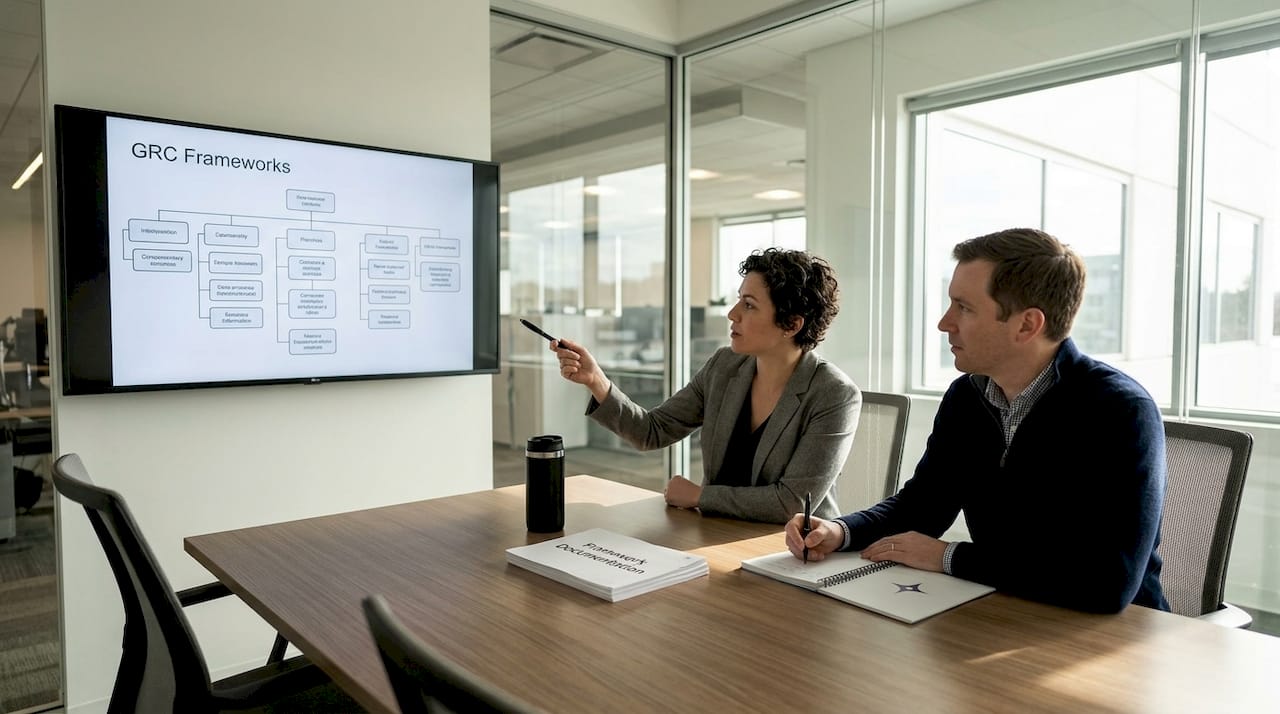
The Learn component focuses on understanding context, including stakeholder expectations, regulatory requirements, and organizational culture. Align establishes governance structures, defines risk appetite, and creates policies that guide behavior. Perform implements controls, executes processes, and manages day-to-day operations. Review monitors performance, conducts audits, and identifies improvement opportunities.
COSO Enterprise Risk Management provides another widely adopted framework, particularly strong in financial services. COSO ERM emphasizes risk identification, assessment, and response strategies integrated with strategic planning. COBIT focuses specifically on IT governance and management, offering detailed processes for technology risk and compliance.
Implementing these frameworks typically follows an eight-step roadmap:
- Assess your current state across governance, risk, and compliance functions
- Unify taxonomy and terminology to enable cross-functional communication
- Design an operating model that defines roles, responsibilities, and workflows
- Select and implement technology platforms to support GRC activities
- Develop policies, procedures, and control frameworks
- Train teams on new processes and tools
- Execute pilot programs in specific business units or risk domains
- Scale successful approaches across the organization while continuously improving
Choosing the right framework depends on your organization's specific context:
| Framework | Primary focus | Best suited for | Key strength |
|---|---|---|---|
| OCEG GRC Capability Model | Integrated GRC across all functions | Organizations seeking comprehensive GRC transformation | Holistic approach with 20 detailed elements |
| COSO ERM | Enterprise risk management | Financial services and publicly traded companies | Strong integration with strategic planning |
| COBIT | IT governance and management | Technology-driven organizations | Detailed IT control objectives and processes |
Pro Tip: Don't adopt frameworks rigidly. Tailor your approach to your organization's size, industry sector, regulatory environment, and risk profile. A financial services firm faces different challenges than a SaaS company, requiring customized implementation strategies.
For GRC managers leading implementation efforts, selecting appropriate frameworks provides the structure needed for consistent execution. Modern GRC compliance software platforms increasingly embed these frameworks, automating workflows and providing templates that accelerate deployment.
Current landscape: market growth, trends, and challenges in GRC
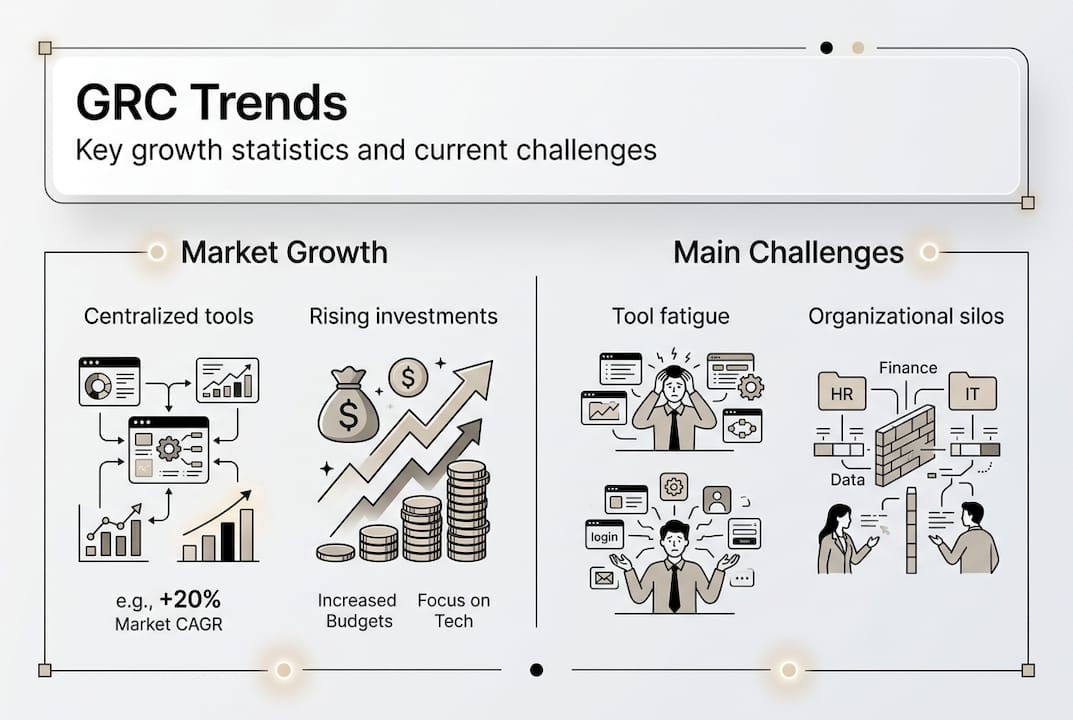
The GRC market demonstrates explosive growth, reflecting increasing organizational investment in integrated risk and compliance management. The market reached USD 62.9 billion in 2024, with projections to USD 135 billion by 2030, representing a compound annual growth rate of 13.2%. This growth signals widespread recognition that effective GRC programs deliver measurable business value.
Current adoption patterns reveal significant organizational commitment:
| Metric | Current state | Implication |
|---|---|---|
| Organizations with centralized GRC teams | 91% | Clear shift toward integrated rather than siloed approaches |
| Expected budget increases in 2025 | 63% | Strong executive support for GRC investment |
| AI and automation adoption in mature programs | 100% | Technology becomes essential for effective GRC at scale |
| Programs still in adolescent stage | 41% | Significant maturity gap persists across organizations |
Artificial intelligence transforms how leading organizations approach GRC. Mature programs universally leverage AI for risk identification, control testing, and compliance monitoring. This technology shift enables continuous rather than periodic assessments, dramatically improving risk visibility while reducing manual effort.
Despite growing investment, organizations face persistent implementation challenges. Common GRC pitfalls include:
- Tool fatigue after initial implementation, leading to low adoption rates and manual fallbacks
- Organizational silos preventing information sharing between governance, risk, and compliance teams
- Incomplete risk identification causing blind spots in control frameworks
- Rigid assessment schedules that fail to adapt during crises or rapid change
- Insufficient integration between GRC tools and operational systems
"Sixty percent of audit issues stem from unidentified risks rather than control failures, highlighting the critical importance of comprehensive risk discovery processes."
Tool fatigue represents a particularly insidious challenge. Organizations invest heavily in GRC tools only to see adoption decline as users find platforms cumbersome or disconnected from daily workflows. This drives teams back to spreadsheets and email, undermining the integration that makes GRC effective.
Organizational silos create dangerous blind spots. When governance teams don't communicate with risk managers, or compliance operates independently, critical information fails to flow. A security team might identify a vulnerability that compliance needs to report, but without integration, the connection never happens.
Pro Tip: Combat tool fatigue and silos by monitoring usage metrics closely and creating cross-functional working groups. Regular collaboration sessions where governance, risk, and compliance teams share insights build the relationships that make integration work.
For compliance officers in tech and finance, understanding these market realities helps set realistic expectations. Cybersecurity GRC compliance requires sustained effort, executive support, and willingness to address organizational and technical challenges beyond initial implementation.
Applying GRC frameworks effectively: case study and best practices
Real-world success stories demonstrate how organizations apply GRC frameworks to achieve measurable security and compliance outcomes. A Tier-1 bank achieved 100% compliance across 80+ controls through comprehensive GRC audits combined with penetration testing. This case illustrates the power of integrated approaches that combine policy compliance with technical validation.
The bank's program integrated governance oversight, continuous risk assessment, and automated compliance monitoring. Executive leadership established clear accountability for control ownership. Risk teams conducted regular threat assessments that informed control priorities. Compliance teams verified adherence through both automated checks and manual audits. Penetration testing validated that technical controls actually prevented the attacks they were designed to stop.
This multi-layered approach caught issues that single-function programs miss. Governance identified strategic risks requiring board attention. Risk assessments revealed emerging threats before they materialized. Compliance audits verified policy adherence. Penetration testing exposed implementation gaps where controls existed on paper but failed in practice.
Based on successful implementations and lessons from common failures, compliance officers should prioritize these best practices:
- Implement continuous monitoring rather than periodic assessments to catch issues early
- Align GRC activities directly with business objectives so teams understand strategic value
- Establish centralized governance with clear accountability and decision-making authority
- Leverage AI and automation to scale GRC activities without proportional staff increases
- Create feedback loops where audit findings and risk events improve control frameworks
- Integrate GRC tools with operational systems to reduce manual data entry and improve accuracy
- Develop cross-functional relationships between governance, risk, and compliance teams
- Regularly validate that technical controls actually work through testing and simulation
The shift toward predictive GRC represents the next evolution. Traditional approaches react to risks after they emerge or regulations after they're published. Leading organizations now use AI to anticipate risks, predict regulatory changes, and proactively adjust controls before issues arise.
For compliance officers implementing or improving GRC risk compliance enterprise programs, these practices provide a roadmap. Success requires moving beyond checkbox compliance to create integrated systems that genuinely strengthen organizational resilience while supporting business objectives.
Enhance your GRC efforts with Skypher solutions
Now that you understand GRC frameworks and implementation strategies, consider how modern automation accelerates your compliance efforts. Skypher's AI-powered platform transforms security questionnaire responses, a critical component of vendor risk management and compliance programs. Our proprietary models parse every format reliably, answering even 200 questions in under one minute with accuracy that exceeds generic AI tools.

Compliance officers managing vendor assessments, security reviews, and audit responses gain immediate efficiency through Skypher's security questionnaire automation. Integration with over 30 online portals including OneTrust and ServiceNow centralizes your GRC workflows. Real-time collaboration features and connections to Slack, Microsoft Teams, Confluence, and SharePoint ensure your teams work seamlessly across platforms. Explore opportunities to join our mission, including our CEO right hand internship, and discover how AI-driven automation strengthens your GRC program.
Frequently asked questions
What does GRC stand for and why is it important?
GRC stands for Governance, Risk, and Compliance, an integrated framework that coordinates organizational oversight, threat management, and regulatory adherence. It's important because integration prevents the blind spots and inefficiencies that emerge when these functions operate in silos, enabling organizations to achieve strategic objectives while managing risks and meeting compliance obligations.
How do integrated GRC frameworks improve organizational security?
Integrated GRC frameworks improve security by ensuring governance structures prioritize security risks, risk management processes identify threats comprehensively, and compliance functions verify control effectiveness. This coordination creates defense in depth where multiple perspectives identify vulnerabilities that single-function approaches miss, as demonstrated by the Tier-1 bank achieving 100% compliance through combined audits and penetration testing.
What are common pitfalls in GRC implementation to avoid?
Common pitfalls include tool fatigue from complex platforms with low adoption, organizational silos preventing information sharing, incomplete risk identification causing control gaps, and rigid assessment schedules that fail during crises. Sixty percent of audit issues stem from unidentified risks rather than control failures, highlighting the critical importance of comprehensive discovery processes and cross-functional collaboration.
How is AI changing the landscape of GRC management?
AI enables continuous monitoring, predictive risk identification, and automated compliance checking that scales without proportional staff increases. Mature GRC programs show 100% AI adoption, using machine learning to analyze vast data sets, identify patterns indicating emerging risks, and automate routine compliance tasks. This shift moves organizations from reactive to predictive GRC, anticipating issues before they materialize.
What key steps should compliance officers take to implement a GRC program?
Start by assessing your current state across governance, risk, and compliance functions, then unify terminology to enable communication. Design an operating model defining roles and workflows, select appropriate technology platforms, and develop supporting policies. Execute pilot programs in specific areas before scaling successful approaches organization-wide, continuously improving based on feedback and changing requirements.