

TL;DR:
- Most organizations now have dedicated GRC teams, emphasizing their strategic importance.
- Hybrid GRC models balance consistency and agility, suited for scaling tech companies.
- Automation significantly reduces manual work, enhances efficiency, and lowers breach risks.
91% of organizations now have a dedicated Governance, Risk, and Compliance team, a number that has climbed sharply in recent years. For security and risk professionals in tech and finance, this signals something important: GRC is no longer a back-office function managed by a single overworked analyst. It has become a strategic pillar that directly shapes your organization's resilience, audit readiness, and competitive positioning. This guide covers how modern GRC teams are structured, where automation creates the biggest leverage, what pitfalls derail even well-resourced teams, and how to build a function that actually keeps pace with your business.
Table of Contents
- What is a GRC team and why does it matter?
- Key GRC team models: Centralized, distributed, and hybrid
- How automation transforms GRC team impact
- Common pitfalls and pro tips for building a high-performing GRC team
- A fresh perspective: Building a GRC team that adapts with your business
- Supercharge your GRC team with automation
- Frequently asked questions
Key Takeaways
| Point | Details |
|---|---|
| GRC teams are critical | Most organizations now leverage dedicated GRC teams to centralize risk and compliance. |
| Model choice matters | The structure of your GRC team affects agility, consistency, and audit readiness. |
| Automation drives results | Automating security questionnaires turns GRC from a cost center into a business enabler. |
| Avoid common pitfalls | Address common team challenges like unclear mandates and poor tool integration for lasting success. |
| Agility beats rigidity | Teams that adapt and interface with business needs scale their GRC impact fastest. |
What is a GRC team and why does it matter?
Having established how prevalent GRC teams have become, it is worth clarifying what they actually do and why so many organizations now treat them as mission-critical.
GRC stands for Governance, Risk, and Compliance. Governance refers to the policies, decision-making structures, and accountability frameworks that guide how your organization operates. Risk management is the process of identifying, assessing, and reducing threats to business objectives, whether those threats are cybersecurity incidents, third-party vendor failures, or regulatory violations. Compliance is the ongoing effort to meet legal, contractual, and regulatory obligations. Together, these three disciplines form a system for running an organization securely, predictably, and with clear accountability at every level.
What separates a modern GRC team from a traditional compliance function is scope. Legacy compliance teams often operated reactively, responding to audits, filing reports, and managing policies in silos. A true GRC team integrates risk management with daily operations and security strategy. They are not just checking boxes. They are actively shaping how your organization makes decisions, onboards vendors, responds to incidents, and handles client due diligence. Understanding GRC basics helps illustrate exactly why this integrated view matters so much more than siloed compliance work.
Several forces are driving the surge in dedicated GRC teams. Regulatory complexity has increased significantly, with frameworks like SOC 2, ISO 27001, GDPR, and NIST requiring sustained, structured attention rather than annual checkboxes. Third-party risk has also exploded, as supply chain attacks and vendor breaches have made organizations responsible not just for their own security posture, but for that of every supplier, SaaS tool, and contractor they work with. And client expectations have shifted: enterprise buyers increasingly demand security questionnaire responses, trust documentation, and audit evidence before signing contracts.
A modern GRC team typically includes several core roles:
- GRC Manager or Director: Sets strategy, manages the team, and communicates risk posture to leadership
- Risk Analyst: Identifies and quantifies operational, cyber, and compliance risks
- Compliance Specialist: Monitors regulatory changes and manages framework adherence
- Security Questionnaire Analyst: Handles vendor assessment requests and client-facing due diligence
- GRC Engineer or Automation Lead: Manages tooling, integrations, and workflow optimization
"A well-structured GRC team does not just protect the organization from risk. It creates the conditions for faster sales, stronger client trust, and more confident executive decision-making."
91% of firms now have a dedicated GRC team, up from 88% the prior year. That growth reflects how seriously boards and executive teams now treat these functions. When GRC operates effectively, it reduces breach likelihood, accelerates vendor onboarding, and turns compliance from a cost center into a genuine business enabler.
Key GRC team models: Centralized, distributed, and hybrid
Now that we understand the purpose and value of GRC teams, let us examine how organizational structure shapes their effectiveness. The model you choose will directly impact speed, consistency, and your team's ability to scale.
Centralized GRC consolidates all governance, risk, and compliance activity under a single team, typically reporting to the CISO, CRO, or General Counsel. This model is highly effective for organizations that operate primarily in one jurisdiction, have consistent product lines, and prioritize audit efficiency over operational speed. With one team owning all the policies and frameworks, you reduce redundancy, maintain consistent documentation standards, and create a clear chain of accountability. Auditors and regulators love it because everything lives in one place. The downside is agility: when business units move fast, a centralized team can become a bottleneck.
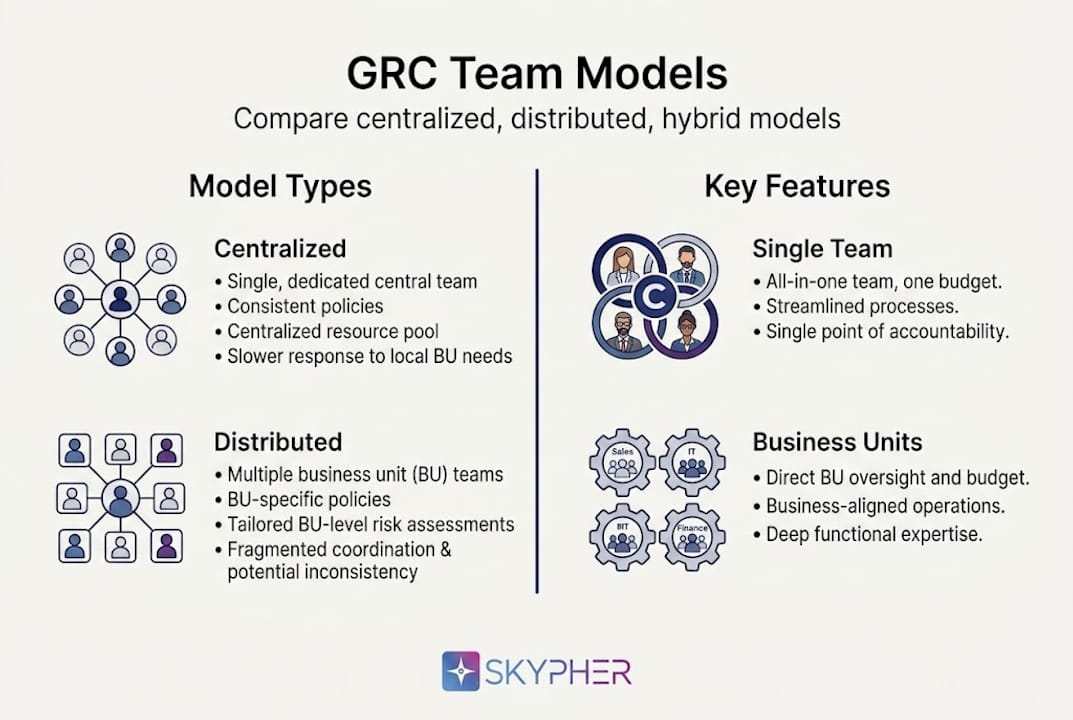
Distributed GRC places compliance and risk ownership inside individual business units, product teams, or regional offices. A fintech operating across five regulatory jurisdictions, for example, may need local compliance specialists who understand regional law and can respond quickly without waiting for central approval. This model is more adaptive but harder to govern. Without strong communication interfaces, you get policy drift, inconsistent documentation, and gaps that auditors will find.
Hybrid and platform-hybrid GRC combine a central team that owns frameworks, tooling, and standards with embedded specialists in business units who execute locally. This is rapidly becoming the model of choice for scaling tech organizations. According to GRC team topology research, centralized models excel in consistency and audit efficiency but risk slowing adaptation, while platform-hybrid structures offer optimal agility for organizations growing across products and geographies. Understanding how centralized and hybrid GRC models compare in practice is essential before committing to a structure.
| Model | Best fit | Key strength | Key risk |
|---|---|---|---|
| Centralized | Single-jurisdiction, stable operations | Consistency, audit efficiency | Bottlenecks, slow adaptation |
| Distributed | Multi-region, high operational velocity | Agility, local expertise | Policy drift, documentation gaps |
| Platform-hybrid | Scaling tech and fintech organizations | Balance of speed and control | Requires strong tooling and interfaces |
Pro Tip: Before selecting a GRC model, map out how your organization makes decisions, not just how it is structured on paper. A company with an agile engineering culture will struggle under a purely centralized GRC model, regardless of how well it is designed on paper.
The platform-hybrid model works particularly well because it treats GRC tooling as infrastructure rather than an afterthought. The central team builds the platform, sets the standards, and manages integrations. Embedded GRC practitioners use that platform to execute locally. This creates repeatability without sacrificing the contextual knowledge that local teams provide.
How automation transforms GRC team impact
With an organizational model in place, it is crucial to target efficiency, and this is where automation makes all the difference.
The traditional GRC function spent enormous amounts of time on administrative work. Manually completing security questionnaires, copying policy text into spreadsheets, tracking evidence requests via email, and chasing down stakeholders for signatures. Research shows that admin tasks consume 30 to 50% of GRC team capacity, but organizations that automate their core workflows increasingly report GRC as a direct business driver rather than a cost. That same data reveals that structured, automated GRC programs experience 60% fewer breaches compared to ad-hoc approaches.
Security questionnaire automation is one of the clearest entry points for this transformation. When a client or prospect sends a 200-question vendor assessment, the manual approach means hours of work, cross-referencing policy documents, hunting for the right stakeholder to validate each answer, and reformatting the output to match their template. With AI-powered automation, that same questionnaire can be completed in minutes using your existing documentation and prior responses, with human review reserved for edge cases.
Here is a practical sequence for introducing automation into your GRC workflow:
- Audit your current time sinks: Map where your team spends the most hours. Security questionnaires, evidence collection for audits, and policy version control are typically the biggest drains.
- Centralize your knowledge base: Connect your documentation sources, whether that is Confluence, SharePoint, Notion, or Google Drive, so your automation tools can draw from a single source of truth.
- Automate questionnaire intake and response: Use AI tools to parse incoming questionnaires in any format and generate accurate draft responses, flagging only the items that genuinely require human judgment.
- Integrate with your existing platforms: Connect your GRC automation tools with the portals and platforms your clients and vendors already use, such as OneTrust and ServiceNow, so responses flow directly without manual re-entry.
- Build feedback loops: Track which responses your team edits most often and use that to refine your knowledge base over time, improving accuracy with every cycle.
The table below illustrates the before and after impact of automation on a mid-size GRC team:
| Activity | Without automation | With automation |
|---|---|---|
| Security questionnaire (200 questions) | 6 to 8 hours | Under 15 minutes |
| Evidence collection for SOC 2 | 3 to 4 weeks | 3 to 5 days |
| Policy update and distribution | 2 to 3 days | Same day |
| Vendor risk assessment completion | 1 to 2 weeks | 2 to 3 days |
Exploring GRC automation best practices gives your team a concrete framework for rolling out automation without disrupting ongoing compliance cycles. The key is starting with your highest-volume, most repetitive tasks and building from there. Choosing the right GRC compliance software also matters because integration depth determines how much of that time savings you actually capture versus spending it on workarounds.
Common pitfalls and pro tips for building a high-performing GRC team
Even with the right automation and structure, real-world challenges persist. Here is how to overcome them effectively.
The biggest accelerant of GRC team dysfunction is growth without process maturity. 72% of organizations plan to grow their compliance teams in the near term, and 74% already have security budgets exceeding $1 million. But headcount and budget alone do not solve the underlying challenges. When teams scale rapidly without clear mandates, role boundaries, and communication protocols, you get duplicated effort, policy drift, and a team that is perpetually reactive instead of strategically proactive.
The most common pitfalls we see in GRC teams across tech and finance organizations include:
- Unclear ownership: When multiple people or teams are responsible for the same compliance domain, accountability disappears. Define who owns each framework, each vendor relationship, and each questionnaire type.
- Poor tech integration: Running GRC workflows across disconnected tools, spreadsheets, email threads, and shared drives creates version control nightmares and audit gaps. Your GRC tooling should connect to where your team actually works.
- Treating frameworks as finished products: Regulatory and business environments change constantly. GRC teams that set up a framework and stop updating it will fail their next audit or miss an emerging risk vector.
- Neglecting upskilling: GRC is increasingly technical. Teams that lack members who understand AI tools, API integrations, and risk quantification methods will struggle to keep pace with the demands placed on them.
- Weak communication with the business: A GRC team that only speaks to auditors and legal counsel becomes isolated. Your team needs strong interfaces with engineering, sales, and product to stay relevant and add real value.
Pro Tip: Run a quarterly "interface audit" where you map every point of contact between your GRC team and the rest of the business. If those touchpoints are mostly reactive, such as responding to requests rather than proactively sharing risk intelligence, that is a signal your team needs stronger communication structures and possibly better tooling to surface information automatically.
Building resilience into your GRC team also means investing in continuous improvement. Streamlining GRC audits through documented runbooks, automated evidence collection, and standardized questionnaire libraries gives your team the foundation to handle growth without proportional increases in manual effort. Think of it as building leverage: every hour invested in systematizing a workflow saves many hours across every future audit cycle.
A fresh perspective: Building a GRC team that adapts with your business
Most guidance on GRC teams focuses on structure and tooling, and both matter. But what often gets missed is a core mindset shift that separates high-performing GRC teams from those that plateau.
Many GRC teams stagnate because they treat frameworks as static checklists. They implement SOC 2 or ISO 27001, complete the certification, and then enter maintenance mode. The problem is that your business is not static. Products change, vendors change, regulatory expectations change, and threat actors adapt faster than any framework committee. A GRC team built around a checklist mentality will always be catching up.
The organizations with the most resilient GRC functions we have observed treat their frameworks as living systems. They build feedback loops between their compliance workflows and their business operations. They invest in people who can bridge technical depth and business communication. They use the best GRC tools not as a replacement for judgment but as infrastructure that frees their team to focus on the risks that actually require human analysis.
Agility, not organizational model, is the real differentiator. A hybrid team with strong interfaces and a culture of continuous improvement will consistently outperform a perfectly designed centralized org chart that never questions its own assumptions. Build your team to adapt, and the structure will serve you rather than constrain you.
Supercharge your GRC team with automation
If the insights in this article resonate, the next question is how to act on them quickly and without disrupting your current operations. Skypher's AI-driven platform is built specifically for GRC and security teams in tech and finance who need to move faster without sacrificing accuracy or compliance quality.

Skypher lets you automate security questionnaires at scale, answering even 200-question assessments in under a minute using your existing documentation. With 30-plus API connectors to platforms like OneTrust and ServiceNow, integrations with Slack, MS Teams, Confluence, and SharePoint, and multilingual support for complex enterprise setups, Skypher fits directly into how your team already works. Explore the Trust Center Platform to give your clients instant, accurate visibility into your security posture and reduce the back-and-forth that slows down every sales cycle.
Frequently asked questions
What are the core responsibilities of a GRC team?
A GRC team manages governance, risk, and compliance processes, ensuring organizations stay secure, audit-ready, and aligned with regulations. Given that 91% of organizations now maintain a dedicated GRC function, these responsibilities increasingly include security questionnaire management, vendor risk oversight, and automation strategy.
How does automating security questionnaires help GRC teams?
Automation allows GRC teams to save time, reduce manual errors, and lower breach risk by making compliance activities repeatable and consistent. Structured GRC programs report 60% fewer breaches than ad-hoc approaches, and automation is a key driver of that structured discipline.
Which GRC team model is best for scaling tech companies?
A platform-hybrid GRC model offers optimal agility and consistency for scaling tech organizations. Research on GRC team topologies confirms that this model balances the need for central standards with the operational speed that growing tech teams require.
What is the typical budget for GRC and compliance functions?
Most organizations now allocate significant resources to GRC, with 74% reporting security budgets exceeding $1 million. That investment reflects how central compliance and risk management have become to overall business strategy in tech and finance.