

When a security questionnaire arrives, respond with a concise, evidence-backed Yes, No, or N/A drawn from your master answer library, each answer paired with a documented evidence path. That single discipline separates teams that close deals in days from those stuck in weeks of back-and-forth. Here is the immediate checklist:
- Triage first. Identify the format (SIG, CAIQ, or custom) and assign a vendor tier before drafting a single answer.
- Map your evidence path. For Tier 1 responses, attach your SOC 2 Type II report, penetration test summary, and relevant policy documents.
- Set a realistic deadline. A full Standardized Information Gathering (SIG) questionnaire warrants 2–4 weeks; standard templated exchanges can move in 3 business days.
Standards like the NIST Cybersecurity Framework and CISA guidance define the control domains these questionnaires test. Tools like Skypher can automate answer population and evidence mapping so your team spends time on judgment calls, not copy-paste.
Key Takeaways
A consistent, evidence-backed response process built on a master answer library and tiered evidence requirements is the most reliable way to reduce turnaround time and build procurement trust.
| Point | Details |
|---|---|
| Triage before drafting | Identify questionnaire type and vendor tier before assigning any resources or drafting answers. |
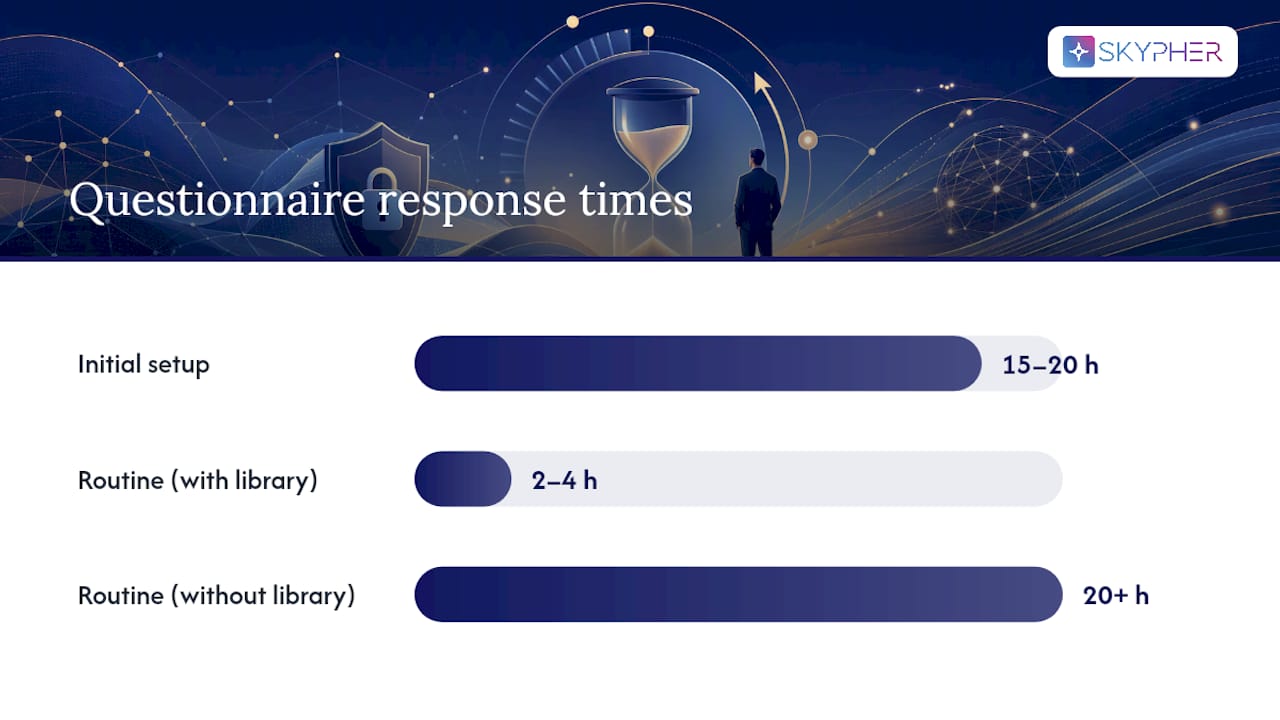
| Master answer library ROI | Initial setup takes roughly 15–20 hours; ongoing responses drop to 2–4 hours per questionnaire. |
| Three valid answer types | Every response is Yes (with evidence), No (with remediation plan and timeline), or N/A (with justification). |
| Tiered evidence requirements | Tier 1 vendors must provide SOC 2 Type II, a current pen test summary, and relevant policy documents. |
| Skypher for automation | Skypher parses every format, populates answers from a vectorized master library, and integrates with 40-plus TPRM platforms. |
Table of Contents
- How should you triage an incoming security questionnaire?
- Build a standardized response process and master answer library
- What are the three valid answer types for security questionnaire responses?
- What evidence does each vendor tier actually require?
- How do you score responses and escalate risk flags?
- Practical steps to improve response quality before you submit
- When does automation pay off for questionnaire responses?
- How do you manage reassessments and ongoing vendor monitoring?
- Copy-ready answer templates and an attachment checklist
- Why honest answers and consistent process win more than polished ones
- Skypher fits directly into this playbook
- Sources
How should you triage an incoming security questionnaire?
Not every questionnaire deserves the same effort. Identify the format first: a full SIG covers hundreds of controls across domains like access management, incident response, and business continuity; a CAIQ (Consensus Assessments Initiative Questionnaire) is narrower and cloud-focused; custom questionnaires vary widely. Map the request to your vendor tier before anything else.
- Tier 1 (critical): Processes sensitive data or is deeply integrated into your infrastructure. Requires full questionnaire, SOC 2 Type II, and independent verification.
- Tier 2 (important): Moderate data access. Requires audit summaries and configuration evidence.
- Tier 3 (low risk): Minimal exposure. Attestation letter is typically sufficient.
Your triage checklist should confirm: which data and systems are in scope, applicable regulatory drivers (HIPAA, SOX, PCI DSS), the decision deadline, required evidence formats, and whether the requester expects verification calls or automated scans. Loop in engineering for technical controls, legal for contractual language, and executive sponsors for Tier 1 escalations. Manual processes do not scale for large vendor populations, so triage discipline is what keeps the queue manageable.
Pro Tip: Ask the requester upfront whether they accept third-party exchange platforms like Whistic or HITRUST MyCSF, or whether a current SOC 2 Type II substitutes for specific questionnaire sections. That single question can cut your response effort by half.
Build a standardized response process and master answer library
A repeatable process is the highest-leverage investment your team can make. Initial setup of a master answer library takes roughly 15–20 hours; after that, routine questionnaire responses drop to 2–4 hours instead of 20-plus. The process flow looks like this:
- Intake: Log the request, format, requester, and deadline in your tracking system.
- Triage: Assign vendor tier, identify in-scope controls, and route to the questionnaire coordinator.
- Draft: Pull pre-approved answers from the master library; flag gaps for subject-matter experts.
- Technical validation: Engineering or security lead confirms control accuracy and evidence currency.
- Legal review: Counsel checks contractual language and remediation commitments.
- Submission: Deliver via the requester's preferred channel (portal, email, or exchange platform).
- Logging: Record submission date, version, and evidence artifacts for audit trail.
Your master library should map each answer to its evidence source, carry a version date, and be reviewed quarterly. Track operational metrics: average turnaround time, percentage of green-rated answers, and number of follow-up queries per submission. Those numbers tell you where the process is leaking.
Pro Tip: Publish a trust page that hosts your SOC 2 report, pen test summary, and key policy excerpts. Many procurement teams will check it before sending a questionnaire, which reduces the volume you receive.
What are the three valid answer types for security questionnaire responses?
Every answer falls into one of three categories. Using anything else creates ambiguity that procurement teams interpret as a red flag.
- Yes (with evidence path): Confirm the control is implemented and cite the specific artifact. Name the algorithm, the testing cadence, or the monitoring scope. "We encrypt data at rest using AES-256 and in transit using TLS 1.3; see attached SOC 2 Type II report, Section 4.2."
- No (with remediation plan + timeline): State the gap honestly and provide a milestone-dated plan. A "No" paired with a credible remediation plan is often scored more favorably than an unverifiable "Yes" by procurement teams evaluating coverage, credibility, and maturity.
- N/A (with justification): Explain why the control does not apply to your environment. "Not applicable: our architecture is fully serverless and does not use physical media."
Specificity builds credibility. Vague answers like "we encrypt everything" are red flags to experienced reviewers. Name the standard, the scope, and the evidence. The HITRUST Alliance makes the case that questionnaires should drive collaborative risk conversations, not checkbox compliance, which means your answers need to hold up under follow-up scrutiny.
What evidence does each vendor tier actually require?
| Vendor Tier | Required Artifacts | Verification Method |
|---|---|---|
| Tier 1 (critical) | SOC 2 Type II, pen test summary (within 12 months), incident response policy, BCP/DR plan | Reference call, automated scan, or on-site review |
| Tier 2 (important) | Audit summary, relevant policy excerpts, configuration screenshots | Document review |
| Tier 3 (low risk) | Signed attestation letter | Self-attestation accepted |
Validate every artifact before submission: confirm the audit date, auditor identity, scope alignment, and that the report covers the systems actually in scope for this engagement. Stale evidence (a SOC 2 report older than 12 months, a pen test from two years ago) triggers follow-up requests that stall deals.
Many organizations accept third-party exchange platforms like Whistic or HITRUST MyCSF, and a current SOC 2 Type II often substitutes for entire questionnaire sections when scope and currency requirements are met. Confirm acceptance with the requester during triage. For Tier 1 vendors, independent verification through reference calls or automated security scans adds a layer of assurance that documents alone cannot provide.
How do you score responses and escalate risk flags?
Score each answer on a red/amber/green rubric at the question level, then aggregate to domain and vendor scores. Red answers require immediate escalation; amber answers require a remediation commitment before onboarding proceeds; green answers are logged and filed.
Automatic escalation triggers include:
- No encryption at rest or in transit
- No documented incident response plan
- No business continuity or disaster recovery plan
- No multi-factor authentication on privileged accounts
- Open critical vulnerabilities with no remediation timeline
When a red flag fires, notify the business owner and the TPRM lead within one business day. Set a remediation SLA (typically 30–90 days depending on severity), document the business-owner acceptance or contract pause decision, and log everything for regulator review. NIST Cybersecurity Framework control families and CISA advisories provide the baseline for what constitutes an unacceptable gap in US-regulated environments.
Practical steps to improve response quality before you submit
Incomplete or evasive answers are the single biggest source of follow-up churn. A structured kickoff call for Tier 1 responses pays for itself immediately.
- Vendor kickoff checklist: Walk through the questionnaire scope, acceptable evidence formats, and deadline expectations before drafting begins.
- Attach guidance notes to each questionnaire section explaining what constitutes acceptable evidence (e.g., "attach the relevant SOC 2 section, not the full report").
- Deadline discipline: Allow 2–4 weeks for a full SIG; 3 business days for templated exchanges. Build in a 48-hour review buffer before the stated deadline.
- Follow-up template for incomplete responses: "We noted that Section 3 (Access Control) is missing evidence for questions 3.4 and 3.7. Please provide the relevant policy excerpt or SOC 2 reference by [date]."
- Quality control gate: A second reviewer checks evidence currency, answer specificity, and that no sensitive architecture details are exposed before submission.
Pro Tip: Log every submission with its version number, evidence attachments, and submission date. When a reassessment arrives six months later, that log cuts your prep time dramatically and satisfies auditor requests for historical records.
When does automation pay off for questionnaire responses?
Automation earns its cost when your team handles more than five questionnaires per month, when deal velocity is high, or when questionnaires arrive in multiple formats (Excel, PDF, portal). The benefits are concrete: reduced turnaround, centralized evidence paths, auto-scoring, and a persistent audit log.
Integration patterns that deliver the most value:
- Slack and MS Teams notifications when a new questionnaire is assigned or a deadline is approaching
- Confluence, Notion, Google Drive, or SharePoint as knowledge sources that feed the master answer library
- TPRM platform connectors (OneTrust, ServiceNow, and 30-plus others) for automated distribution and scoring
Skypher's AI-powered questionnaire automation parses every common format, populates answers from a vectorized master library, and can handle 200 questions in under a minute. Its AI recommendation engine surfaces the most relevant pre-approved answer and evidence path for each question, reducing the manual review burden to genuine judgment calls. Automation of live controls is what turns responses from weeks into hours.
Pro Tip: Before buying any automation tool, audit your master answer library first. Automation amplifies what is already there — a library with stale or vague answers produces stale, vague automated responses.
How do you manage reassessments and ongoing vendor monitoring?
Submitting a questionnaire is not the end of the process. Build reassessment cadence into your vendor management program from day one.
For each open remediation item, log: the issue description, assigned owner, milestone dates, target completion date, and evidence attached upon closure. Shorten reassessment intervals after significant vendor changes: a major product update, a merger, a reported breach, or a change in data processing scope all warrant an out-of-cycle review. Tie monitoring outcomes directly to contract renewal decisions so that unresolved red items have contractual consequences, not just advisory ones.
Copy-ready answer templates and an attachment checklist
Use these templates as starting points and adapt the specifics to your environment.
Yes template (encryption): "Yes. Data at rest is encrypted using AES-256; data in transit uses TLS 1.3. Evidence: SOC 2 Type II report (attached), Section 4.2, audit period ending [date]."
No template (penetration testing): "No. Annual penetration testing has not been completed for the current period. Remediation plan: engagement with [third-party firm] scheduled for [Q3 2026]; report to be available by [date]. Compensating control: continuous vulnerability scanning via [tool] with weekly review."
N/A template (physical media): "Not applicable. Our infrastructure is fully cloud-hosted on AWS; no physical media is used or stored."
Attachment checklist:
- SOC 2 Type II report (audit date within 12 months)
- Penetration test executive summary (within 12 months)
- Incident response policy (version-dated)
- Business continuity and disaster recovery plan
- Relevant policy excerpts (access control, encryption, vendor management)
- Configuration screenshots where requested
Avoid over-generalized language. "We follow industry best practices" tells a reviewer nothing. Specific technical detail, like naming the algorithm, the testing cadence, and the monitoring scope, builds credibility without exposing sensitive architecture. Frame every gap with a milestone and a date so the deal keeps moving.
Pro Tip: Map each answer in your library to its evidence artifact and the date that artifact was last verified. That single discipline prevents the most common failure mode: submitting an accurate answer backed by expired evidence.
Why honest answers and consistent process win more than polished ones
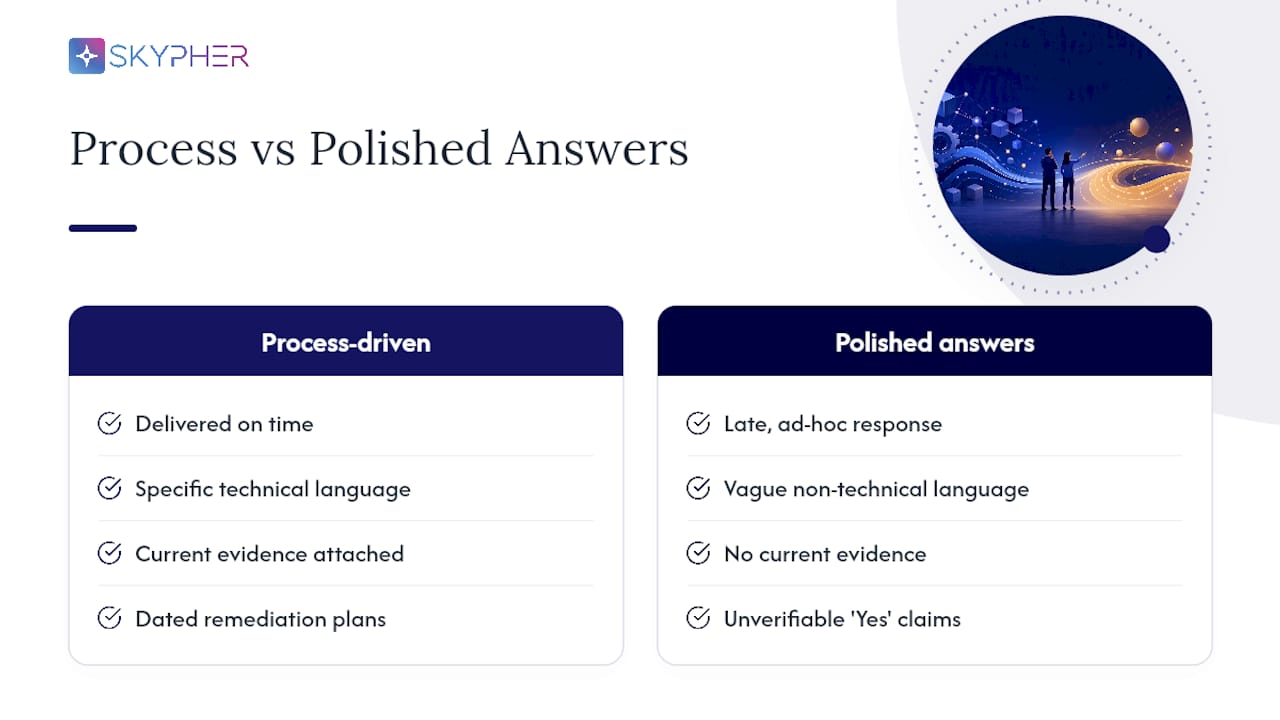
The conventional wisdom in vendor risk is that you should present the strongest possible security posture. That is not wrong, but it misses the more important point: procurement teams are not just reading your answers, they are reading your process. A response that arrives on time, uses specific technical language, attaches current evidence, and frames gaps with dated remediation plans signals operational maturity. That signal is often worth more than a perfect score on paper.
Gaps are not disqualifying when they are handled honestly. A "No" with a 90-day remediation plan and a named milestone is a credible, professional answer. An unverifiable "Yes" that collapses under a follow-up question is a deal-stopper and a potential contractual liability. The HITRUST Alliance's position that questionnaires should drive collaborative risk conversations reflects exactly this: the goal is a working relationship built on accurate information, not a one-time checkbox exercise.
The teams that win consistently are the ones that treat questionnaire response as a repeatable operational process, not a fire drill. Master answer library, tiered evidence requirements, scoring rubric, escalation flow, and automation where volume justifies it. That is the playbook.
Skypher fits directly into this playbook
Security and compliance teams handling five or more questionnaires per month spend a disproportionate amount of time on tasks that should be automated: parsing formats, locating evidence, populating answers, and chasing approvals. Skypher eliminates that overhead.

Skypher's Trust Center lets you publish your SOC 2 report, pen test summary, and policy documents in a single shareable location, so procurement teams can self-serve before a questionnaire even arrives. The AI parsing engine handles every common format and populates answers from your master library in under a minute, with integrations across Slack, MS Teams, Confluence, Notion, SharePoint, and 40-plus TPRM platforms including OneTrust and ServiceNow. For enterprise teams managing multiple products or entities, Skypher supports complex multi-entity setups with multilingual capability. Request a demo to see how your team's current questionnaire volume maps to the platform.
Sources
These references are the authoritative starting points for building and validating your questionnaire response program.
- Vendor Security Questionnaires: How to Answer and How to Send Them - Secure Systems
- Vendor Risk Assessment Questionnaire: TPRM Guide 2026 - LearnTPRM
- What Is a Vendor Risk Assessment? | Complete Guide | LexFlag Blog
- Why due diligence questionnaires are essential but security questionnaires need a rethink - HITRUST Alliance
- Vendor Security Questionnaire: How to Answer and How to Send Them - Decryption Digest
- The Security Questionnaire Problem | Linera Tech
When a platform like Whistic or HITRUST MyCSF is accepted, verify that the shared profile covers the specific control domains in scope for your engagement and that the underlying evidence is current. If scope gaps exist, request native artifacts for those sections rather than accepting an incomplete substitution.