

TL;DR:
- Scaling security responses involves creating a verified answer library and automating retrieval to handle more questionnaires quickly. Regularly reviewing and linking certifications help maintain accuracy and build buyer trust. Proper workflow and clean data are essential to prevent errors and close deals faster.
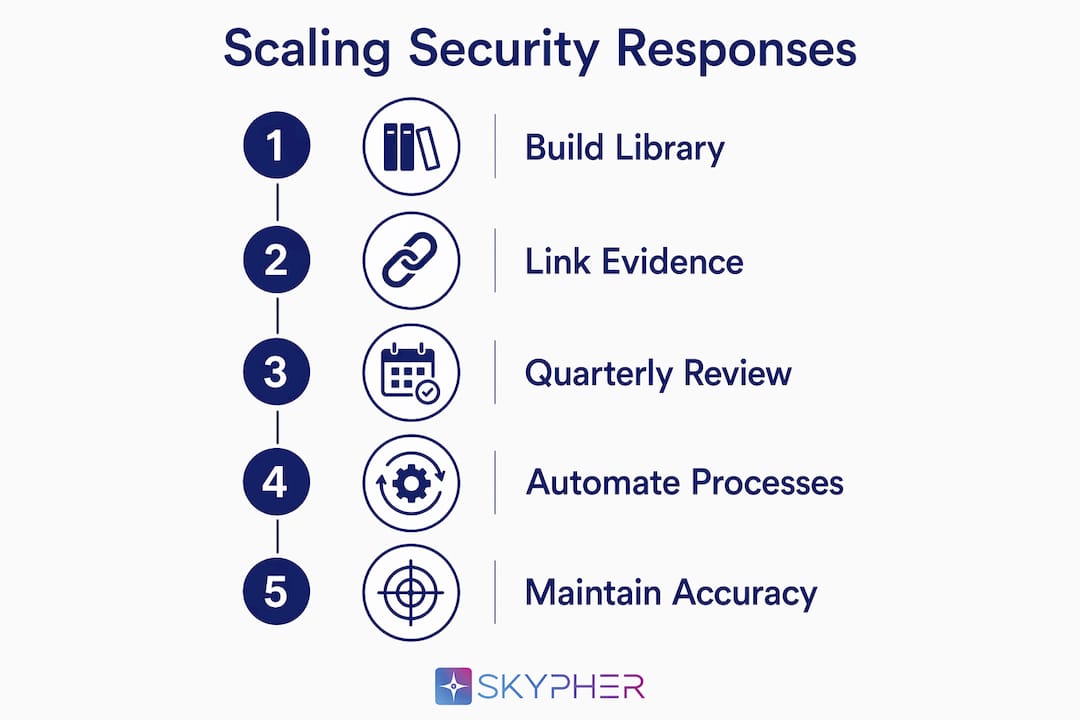
Scaling security questionnaire responses is defined as systematizing and automating the process of answering vendor security reviews at volume, without sacrificing accuracy or compliance. Security teams that build this capability cut average completion time from three weeks to four days, achieve a 60–70% time reduction, and win 30–50% more enterprise deals. The most common frameworks driving this demand include SOC 2, SIG Core, and NIST controls. Each of these frameworks generates dozens to hundreds of questions per engagement, making manual, one-off responses unsustainable for any security team handling more than a handful of reviews per quarter.
How to scale security questionnaire responses with a centralized answer library
A centralized answer library is the single most important foundation for scaling security assessments. Without it, every questionnaire becomes a research project. With it, the majority of questions become retrieval tasks.
Setting the right size and scope
Target a library of 200–400 entries to cover roughly 80% of typical SIG Core questions. That coverage threshold is the tipping point where automation becomes genuinely useful. Below it, too many questions require bespoke answers, and automation adds little value. Above it, your team handles most questionnaires with minimal manual effort.

Structure the library as a knowledge base, not a spreadsheet. Each entry should contain three components: the question, the verified answer, and a link to supporting evidence. That evidence can be a policy document, a sanitized screenshot, or a SOC 2 Type II report summary. Structured knowledge base entries yield faster reuse and consistent answers across every engagement.
Linking answers to auditable evidence
SOC 2 Type II and ISO 27001 certifications together cover approximately 80% of typical questionnaire questions. That means your certifications are not just compliance artifacts. They are answer accelerators. Map each certification control to the relevant library entries so your team can attach evidence in seconds rather than searching for it during a live review.
Avoid over-claiming. Every answer in the library must reflect actual operational practice. If your organization does not yet enforce multi-factor authentication on all systems, do not state that it does. Evidence-backed responses lower clarification requests by 20–40%, which means honest, specific answers close deals faster than inflated ones.
Keeping the library current
Schedule quarterly reviews of every library entry. Assign ownership to the subject matter expert responsible for each control domain. Network security answers belong to the infrastructure team. Data retention answers belong to legal or compliance. Ownership without accountability produces stale content, and stale content is worse than no library at all.
Pro Tip: Tag each library entry with a "last verified" date and a responsible owner. Any entry older than 90 days without a review flag should be treated as unverified until confirmed.
What tools and methods enable automation for faster responses?
Automation does not replace a good answer library. It multiplies its value. The right tools retrieve, match, and populate answers from your library into incoming questionnaires, reducing response time from hours to minutes.
Types of automation tools
Security teams use three categories of tools to accelerate questionnaire completion:
-
AI-assisted drafting platforms. These tools parse incoming questionnaires, match questions to library entries using semantic similarity, and propose answers for human review. Skypher's AI Questionnaire Automation Tool, for example, can answer 200 questions in under one minute by drawing from a vectorized knowledge base. That speed is only possible when the underlying content is clean and verified.
-
Retrieval engines with duplicate detection. Many questionnaires repeat questions across sections or across different frameworks. Duplicate detection identifies these overlaps automatically, so your team answers once and applies the response everywhere it fits. This feature alone removes a significant source of manual rework.
-
Portal connectors and integrations. Enterprise buyers often require responses submitted through third-party risk management platforms such as OneTrust or ServiceNow. Platforms with direct API connectors to these portals eliminate the copy-paste step entirely. Skypher connects to over 40 TPRM platforms, which means your team submits directly without reformatting.
Pro Tip: Before activating any automation, audit your answer library for accuracy. Automation without clean data propagates errors at scale, which is far more damaging than slow manual responses.
Common pitfalls of automation
The most frequent mistake is deploying automation before the content foundation is ready. Teams that automate against an unverified library accelerate the distribution of wrong or outdated answers. A prospect who catches a factual error in a security questionnaire rarely gives a second chance. The fix is simple: verify first, automate second.
Integration with collaboration tools also matters. When questionnaire tasks route through Slack or Microsoft Teams, subject matter experts respond faster because the work appears in the tools they already use. Skypher's integrations with Slack and MS Teams, including chatbot support, reduce the friction of pulling in the right reviewer at the right time.
What does a scalable response workflow look like?
A repeatable workflow converts questionnaire intake into a predictable, auditable process. The following steps reflect a mature seven-step model used by security teams that handle high questionnaire volume consistently.
-
Intake and triage. Receive the questionnaire and classify it by framework type, deal size, and deadline. High-value enterprise deals with tight SLAs get priority routing. Set a response SLA at intake, not after the team has already started working.
-
Library matching. Run the questionnaire through your retrieval tool or AI platform to identify which questions map to existing library entries. Flag unmatched questions for bespoke handling.
-
Question routing. Assign unmatched or high-risk questions to the appropriate subject matter expert. Use a RACI model: one owner per question domain, one reviewer per answer, one final approver before submission.
-
Trust pack deployment. Prepare a pre-answered trust pack covering your most common security topics: access control, encryption, incident response, and data retention. Attach this pack to every response as a supplement. It answers questions before they are asked and signals maturity to the buyer.
-
Quality assurance review. A second reviewer checks every answer for accuracy, avoids absolute statements like "we always" or "we never," and confirms that each claim links to supporting evidence.
-
Evidence packaging. Attach policy excerpts, certification summaries, and sanitized screenshots to the final response. This step directly reduces follow-up rounds.
-
Archive and reuse. Store the completed questionnaire in your knowledge base. Tag it by framework, buyer type, and date. Future questionnaires from similar buyers will draw heavily from this archive.
| Workflow stage | Primary output |
|---|---|
| Intake and triage | Classified questionnaire with SLA assigned |
| Library matching | Pre-populated draft with flagged gaps |
| Question routing | Assigned owners per question domain |
| Quality assurance | Verified, evidence-linked final draft |
| Archive and reuse | Stored response for future retrieval |
Common mistakes that break questionnaire scaling
The most dangerous trap in scaling is over-claiming. Failed audits and six-figure deal stalls frequently trace back to unsupported security claims made in questionnaire responses. A buyer's security team will verify your answers during due diligence. If your response says you conduct annual penetration tests but your last test was three years ago, that discrepancy surfaces and the deal stops.
"The most dangerous trap in scaling is answering questions with claims your organization cannot support with evidence or actual operational practice. Over-claiming does not accelerate deals. It kills them at the worst possible moment."
Stale content is the second major risk. A library that has not been reviewed in over a year will contain answers that no longer reflect your environment. Personnel changes, infrastructure migrations, and policy updates all invalidate previously accurate answers. Quarterly reviews are not optional maintenance. They are the mechanism that keeps your scaling effort credible.
A few additional mistakes to avoid:
- Answering "not applicable" without explanation. Buyers interpret unexplained N/A responses as evasion. Always include a one-sentence rationale.
- Using absolute language. Phrases like "we always encrypt all data" invite scrutiny. Use qualified language: "all data in transit is encrypted using TLS 1.2 or higher."
- Skipping negative answers. If you do not have a control in place, say so and describe your compensating control or roadmap. Transparency builds more trust than a gap in the response.
Use questionnaires as a forcing function. Every question your team cannot answer confidently reveals a gap in your security program. Treat those gaps as a prioritized improvement list, not as embarrassments to hide.
Key takeaways
Scaling security questionnaire responses requires a verified answer library, clean automation, and a repeatable workflow. Without all three, speed gains come at the cost of accuracy.
| Point | Details |
|---|---|
| Build a verified answer library | Target 200–400 entries to cover 80% of SIG Core questions and link each answer to auditable evidence. |
| Automate only on clean content | AI tools multiply the value of accurate libraries but propagate errors from unverified ones. |
| Follow a structured workflow | Intake, triage, routing, QA, and archiving convert questionnaire responses into a repeatable process. |
| Avoid over-claiming | Unsupported claims cause audit failures and stall enterprise deals at the worst possible stage. |
| Review quarterly | Assign ownership and set 90-day review cycles to keep library content accurate and current. |
Why I think most teams are scaling the wrong thing
Security teams under pressure to respond faster often reach for automation before they have earned the right to use it. I have seen this pattern repeatedly. A team deploys an AI drafting tool, celebrates the speed gain, and then loses a deal because the tool pulled an outdated answer about their encryption standard. The buyer's security team caught it. The deal did not recover.
The insight that changed how I think about this is simple: questionnaire scaling is a content problem first and a technology problem second. The teams that close deals faster are not the ones with the most sophisticated tools. They are the ones with the most accurate, well-maintained answer libraries. Automation is the accelerator. The library is the engine.
There is also a cultural dimension that most articles ignore. Treating questionnaires as a sales obstacle produces reactive, inconsistent responses. Treating them as a live audit of your security program produces a team that maintains its library proactively, flags gaps honestly, and answers with confidence. That confidence is visible to buyers. It shows up in response quality, in the absence of follow-up rounds, and in the speed of deal progression.
The teams winning enterprise deals in 2026 are not just faster. They are more credible. Credibility comes from verified content, not from automation alone.
— Gaspard
Skypher's automation features for teams ready to scale
Security and compliance teams that have built their answer library and are ready to move faster will find that the gap between a good library and a fast response process comes down to tooling.

Skypher's automated review cycles and duplicate detection address the two most time-consuming parts of questionnaire work: keeping content current and eliminating redundant manual effort. The platform's AI engine can process 200 questions in under one minute, drawing from a vectorized knowledge base that connects to Confluence, Notion, Google Drive, OneDrive, and SharePoint. With over 40 TPRM platform connectors and direct integrations with Slack and ServiceNow, Skypher fits into the workflows your team already uses. For teams handling high questionnaire volume in tech or finance, that means fewer manual steps and faster, more consistent submissions.
FAQ
What does it mean to scale security questionnaire responses?
Scaling security questionnaire responses means systematizing the answer process so your team handles more questionnaires faster without increasing headcount. The core method is a centralized, verified answer library paired with automation tools.
How many entries should a security questionnaire answer library contain?
A library of 200–400 entries covers approximately 80% of typical SIG Core questions. That threshold makes automation effective and reduces bespoke writing to a small fraction of each questionnaire.
What is the biggest risk when automating questionnaire responses?
The biggest risk is automating against unverified or outdated content. AI tools that draw from a stale library propagate incorrect answers at scale, which can cause audit failures and stall enterprise deals.
How often should a security questionnaire answer library be reviewed?
Quarterly reviews are the standard for maintaining accuracy. Each entry should carry a "last verified" date and an assigned owner responsible for confirming the answer still reflects current operational practice.
How do SOC 2 and ISO 27001 certifications help with questionnaire responses?
SOC 2 Type II and ISO 27001 together cover approximately 80% of common questionnaire questions. Mapping certification controls to library entries lets your team attach evidence quickly and reduces the number of questions requiring custom answers.