

OTE (on-target earnings) is the total annual cash compensation a sales rep is expected to earn at 100% of quota: base salary plus target variable pay. That number is a projection, not a promise. What actually lands in your bank account depends on the pay split, whether the plan is capped, how draws work during ramp, and whether the quota behind that OTE is realistic in the first place.
TL;DR:
- OTE typically excludes benefits, equity, sign-on bonuses, and above-quota accelerators, making it a narrow target compensation figure.
- The calculation involves adding the fixed base salary to the target variable pay at 100% quota, but actual earnings can vary based on payout structure and plan caps.
- Role-specific splits and quota-to-OTE ratios vary, with SDRs often at 60/40 or 70/30, while enterprise reps usually have higher base-to-variable ratios like 65/35 or 70/30.
- Capped plans limit earnings regardless of exceeding quota, whereas uncapped plans reward top performers through accelerators, influencing motivation and pay potential.
- Always verify details like guaranteed base, historical quota attainment, payout timing, and clawbacks before negotiating or accepting an offer.
Table of Contents
- What Is OTE in Sales, Exactly?
- How to Calculate OTE (With a Real Example)
- OTE Examples by Sales Role
- Capped vs. Uncapped Plans and How Quotas Get Set
- Why OTE Exists: Benefits for Candidates and Employers
- Red Flags and a Negotiation Checklist for Evaluating OTE
- Practitioner Notes: Ramp, Draws, and What Actually Shortens Time to Quota
- What Hiring Managers and Candidates Should Both Take From This
- Sources and Further Reading
- FAQ
What Is OTE in Sales, Exactly?
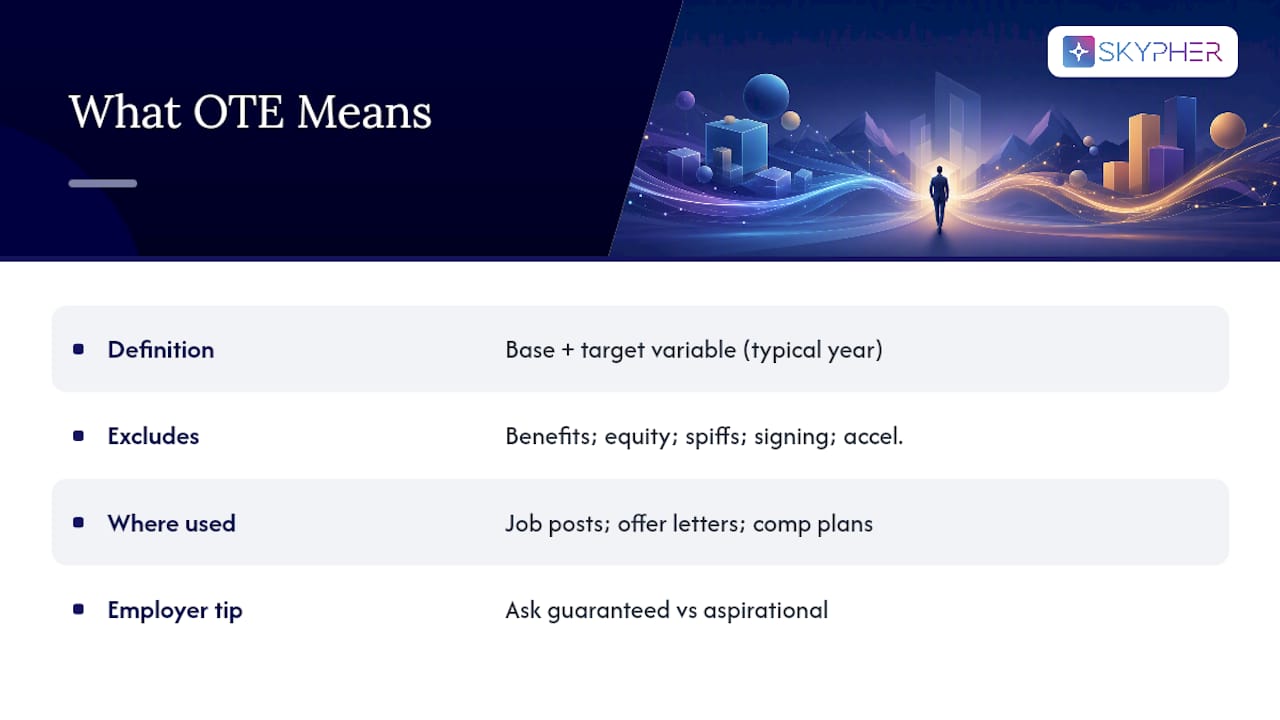
OTE, sometimes written as "on-track earnings," is the figure a company puts on a job posting or offer letter to represent what a rep in that role could earn in a typical year. Salesforce's breakdown of OTE frames it exactly this way: base plus target variable, nothing more.
Here's what OTE leaves out, and this is where a lot of confusion starts. It does not include health benefits, equity or stock options, one-time spiffs, signing bonuses, or accelerator earnings above quota. The Cambridge Dictionary's entry on OTE confirms the same narrow scope: it's a target compensation figure, not a catch-all for every dollar you might see.
You'll run into OTE most often in three places: job postings ("$90K OTE"), offer letters (where it should be broken into base and variable), and internal sales compensation plans that HR and finance teams use to model payroll costs. Indeed's guide to OTE makes a point worth repeating: employers use OTE as a recruiting benchmark, and it's on you to ask what's actually guaranteed versus what's aspirational.
How to Calculate OTE (With a Real Example)
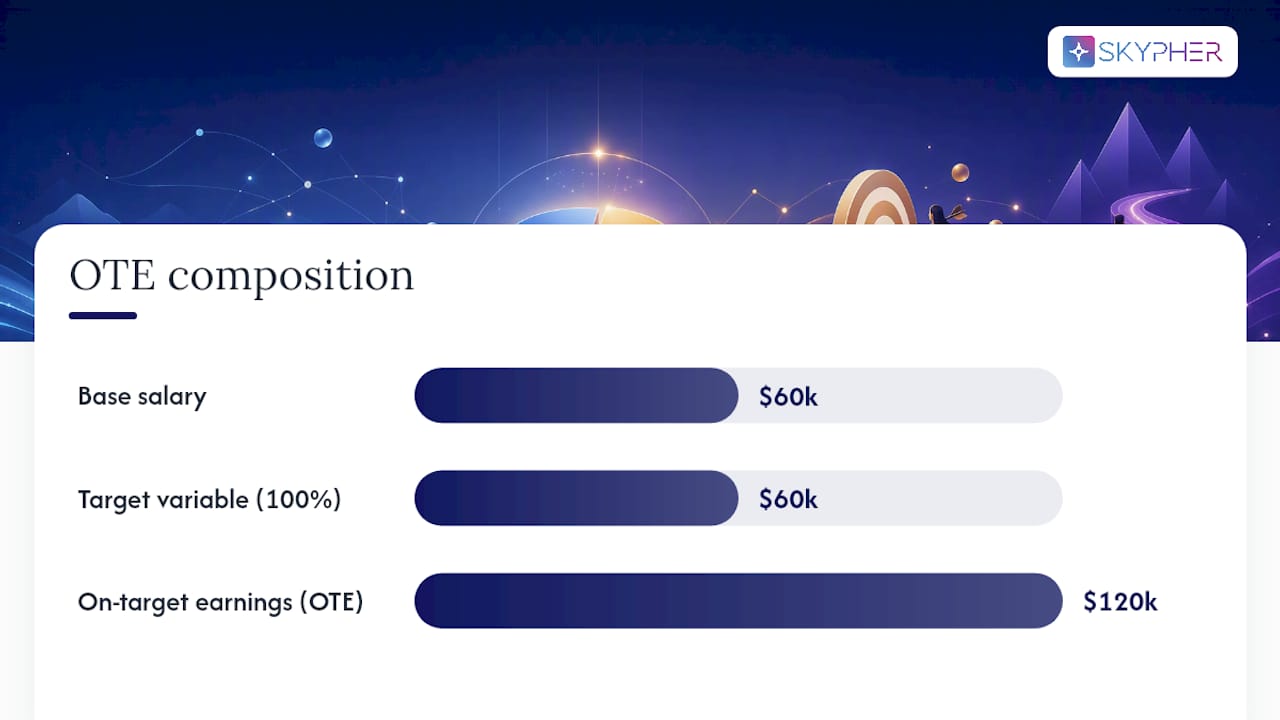
The formula is simple on paper: Annual base salary + annual target variable pay (at 100% quota) = OTE. The complexity shows up in the details underneath it.
Here's how to work through any offer that lists an OTE figure:
- Identify the base salary. This is the fixed number, paid regardless of performance.
- Identify the target variable. Ask what "100% quota" actually means in dollars, not just percentage.
- Add them together. A $60,000 base plus $60,000 in target commission equals $120,000 OTE.
- Check the payout structure. Is commission paid monthly, quarterly, or on collection of payment from the customer? Cadence affects your actual cash flow, even if the annual math is identical.
- Ask about draws if the role is commission-heavy. A recoverable draw is essentially a loan against future commissions. A non-recoverable draw is closer to a guaranteed floor during ramp. Confirming which one applies matters for your cash-flow planning during the first few months.
- Ask about accelerators and decelerators. Accelerators pay a higher commission rate above 100% quota. Decelerators, less common but real, reduce your rate below a certain attainment threshold.
For commission-only roles, annualize carefully. If a rep earns $8,000 in a strong month during a seasonal peak, that's not $96,000 annualized. Look at trailing 12-month averages instead.
One more distinction that trips people up: OTE is a gross figure. What lands on your W-2, and what you take home after taxes and withholdings, is a different number entirely. Payroll deductions, benefit contributions, and tax brackets all sit between the OTE quoted in your offer and your actual net pay.
OTE Examples by Sales Role
OTE numbers mean very little without context on the split behind them. A $120,000 OTE with a 50/50 split behaves completely differently from a $120,000 OTE with a 70/30 split, especially in a slow quarter.
- SDR (Sales Development Representative): Often structured at a 60/40 or 70/30 base-to-variable split, since SDRs influence pipeline volume but rarely control closed revenue directly. A $70,000 OTE at 65/35 might mean roughly $45,500 base and $24,500 in variable tied to qualified meetings booked or opportunities created.
- SMB or mid-market Account Executive (AE): Commonly runs a 50/50 split, giving the rep meaningful upside while keeping a livable base. A $130,000 OTE at 50/50 means $65,000 base and $65,000 in target commission, usually tied to closed revenue against a quota that might be 4 to 5 times the AE's own OTE, according to The CRO Report's compensation benchmarks.
- Enterprise AE: Longer sales cycles and bigger, less predictable deals push these plans toward a higher base, often 60/40 or 70/30 in favor of base. An OTE with a higher base-to-variable split, such as 65/35, provides a larger fixed salary portion, which helps stabilize income during slower sales periods.
- Sales leadership or VP of Sales: Quotas here are usually team-level rollups rather than individual deal targets, and multipliers run lower relative to OTE since the leader's job is coaching and forecasting, not just closing. Sales leadership roles typically have a higher base salary compared to variable pay, with bonus components tied more to team performance than individual deals.
The quota-to-OTE ratio shifts with the role too. Shorter-cycle roles like SMB AE positions can sustain higher multiples, often 5x to 6x OTE in bookings, while enterprise roles with longer cycles typically sit closer to 3x to 4x, according to CRO Report's quota benchmarking data.
Capped vs. Uncapped Plans and How Quotas Get Set
A capped plan limits how much variable pay a rep can earn, even if they blow past quota. An uncapped plan lets earnings keep climbing with performance, sometimes through an accelerator that pays a higher commission rate once a rep crosses 100% attainment. Employers lean toward capped structures when they're worried about windfall deals skewing pay unpredictably, and uncapped structures when they want top performers to have a real incentive to keep pushing past target.
Base and variable splits aren't arbitrary. They track two things: how long the sales cycle runs, and how much control the rep actually has over the outcome. Roles with short cycles and high rep influence, like SDR positions, tolerate a lighter base. Roles with long cycles and more external variables, like enterprise AE positions, need a heavier base so reps aren't financially stranded during a slow quarter.
A few structural levers worth knowing:
- Accelerators reward attainment above 100%, often at 1.5x or 2x the standard commission rate.
- Clawbacks let employers recover commission already paid if a deal falls through, cancels, or fails to renew within a set window.
- Payout frequency (monthly vs. quarterly) affects how quickly variable pay actually reaches you, independent of the annual OTE math.
Pro Tip: *Ask what percentage of the sales team actually hit 100% of quota last year.
Why OTE Exists: Benefits for Candidates and Employers
OTE gives candidates a quick way to compare offers across companies without digging through a full compensation plan on day one. It's a recruiting shorthand, and used honestly, it works well for that purpose.
For employers, OTE supports budgeting and forecasting. Finance teams can model total sales payroll costs across a team by multiplying average OTE by headcount, then adjusting for expected attainment rates. It also aligns incentives when designed properly: reps who exceed quota earn more, and the company only pays that variable pay when revenue actually comes in.
The catch is that OTE only works as an honest signal when the quota behind it is achievable. It's giving them a marketing figure dressed up as compensation.
Red Flags and a Negotiation Checklist for Evaluating OTE
Before accepting any offer with an OTE figure attached, ask these questions directly:
- What is the guaranteed base, separate from OTE?
- What percentage of the team hit 100% quota last year, and what did the average rep actually earn?
- Is there a ramp period, and is the draw during that period recoverable or non-recoverable?
- How and when does variable pay get paid out, monthly, quarterly, or on collection?
- Are there clawback provisions, and under what conditions do they apply?
Watch for these red flags: quotas the hiring manager can't or won't explain clearly, reluctance to share historical attainment data, frequent clawbacks built into the plan, or an OTE split that's wildly inconsistent with industry norms for that role.
If the number doesn't move where you want it, negotiate the structure instead. You can trade a lower OTE for a higher guaranteed base, ask for a non-recoverable draw during ramp instead of a recoverable one, or push for a guaranteed ramp period at full base while you build pipeline.
Pro Tip: If a recruiter can't tell you the average attainment rate for the team, that's usually because the number isn't flattering. Push for it anyway.
Practitioner Notes: Ramp, Draws, and What Actually Shortens Time to Quota
Recoverable draws feel like extra pay in month one, but they create a future commission obligation. If you draw $3,000 in a recoverable structure and only earn $1,500 in commission that month, you owe the difference back later. Non-recoverable draws don't carry that obligation, functioning closer to a guaranteed salary floor during training.
It builds attainment curves that stay financially sustainable even when half the team lands at 70% to 80%, then uses accelerators to reward the reps who clear the bar, a design principle SV Academy's breakdown of OTE structures covers in more depth.
One underappreciated lever in time-to-quota: how fast a rep can move deals through security review and procurement. Enterprise sales cycles often stall waiting on security questionnaires and proof-of-concept sign-off, and AI-driven questionnaire automation can meaningfully compress that stall, which matters directly for how quickly a new rep starts hitting the quota their OTE assumes.
What Hiring Managers and Candidates Should Both Take From This
Hiring managers: publish OTE with the split visible, and be ready to share real attainment data. A number without context invites distrust before the first interview even starts.
Candidates: treat OTE as the starting question, not the answer. Run through the negotiation checklist above before you sign anything, and don't be shy about asking for attainment history in writing. Teams handling long enterprise cycles should also look at how AI adoption is changing quota attainment timelines, since faster deal cycles change what a realistic ramp actually looks like.
— Gaspard
Sources and Further Reading
For readers who want to go deeper on the mechanics covered here, these sources back the specific figures and definitions used throughout this article:
- Salesforce's OTE explainer covers the canonical formula and what OTE typically excludes
- BLS Occupational Outlook Handbook offers government pay data for sales occupations, useful for checking regional and industry pay ranges.
Teams evaluating how automation affects sales cycle speed and quota attainment can also look at how automated review cycles reduce deal friction, and companies weighing broader go-to-market efficiency may find this piece on SaaS growth economics useful context for how revenue predictability ties back into quota design.
FAQ
What Does OTE Mean in Sales?
It excludes benefits, equity, and one-time bonuses.
What Does $120K OTE Mean?
A $120,000 OTE means the total expected pay at full quota attainment is $120,000, split between a fixed base and target commission or bonus. The exact split (50/50, 60/40, or another ratio) determines how much is guaranteed versus performance-based.
What Does 70K OTE Mean?
OTE for entry-level or SDR roles is often split 60/40 or 70/30 in favor of base salary, meaning the guaranteed portion is significantly more than half, with the remainder tied to hitting activity or pipeline targets.
How Much Does OTE Actually Pay?
Actual take-home pay depends on the base/variable split, whether the plan is capped, and how consistently the team historically reaches target.