

TL;DR:
- AI automates responses to security questionnaires, reducing response time from days to hours.
- Organizations see up to 41% higher revenue per sales rep and significant cost savings with AI.
- Successful AI adoption requires strong governance, data quality, and cultural readiness before scaling.
Most sales and compliance teams at tech and finance organizations know security questionnaires are painful. What's surprising is just how much they cost: teams responding manually can spend 30 or more hours per questionnaire, stalling deals and burning out engineers. Yet many organizations still default to spreadsheets and shared inboxes. AI-driven compliance is changing that calculation fast. When AI automates responses, centralizes InfoSec content, and improves speed by 2.5x, the downstream gains for sales cycles and compliance posture are impossible to ignore. This guide cuts through the hype and shows you exactly where AI delivers, where it falls short, and how to apply it with confidence.
Table of Contents
- How AI transforms sales enablement
- AI and security questionnaire automation
- Productivity gains and ROI of AI in sales
- Realities, risks, and readiness: What to know before scaling AI
- Why real AI sales enablement requires more than tech
- Unlock sales and compliance speed with AI-driven security solutions
- Frequently asked questions
Key Takeaways
| Point | Details |
|---|---|
| AI speeds compliance | AI-driven tools automate security questionnaires, boosting speed and accuracy for tech and finance sales teams. |
| ROI is proven | Firms using AI for sales and compliance report higher revenue, less manual work, and measurable cost savings. |
| Risks demand oversight | Human review, data quality, and governance are essential to avoid pitfalls like hallucinations or compliance failure. |
| Culture and strategy matter | Sustainable AI adoption relies on more than just software—integration, training, and leadership are also key. |
How AI transforms sales enablement
Sales enablement used to mean better decks, sharper scripts, and faster follow-ups. Today, it means putting the right information in front of the right person at the right moment, automatically. AI-enabled sales enablement takes that a step further by using machine learning and natural language processing to reduce manual steps, surface insights from large data sets, and accelerate every stage of the buying cycle.
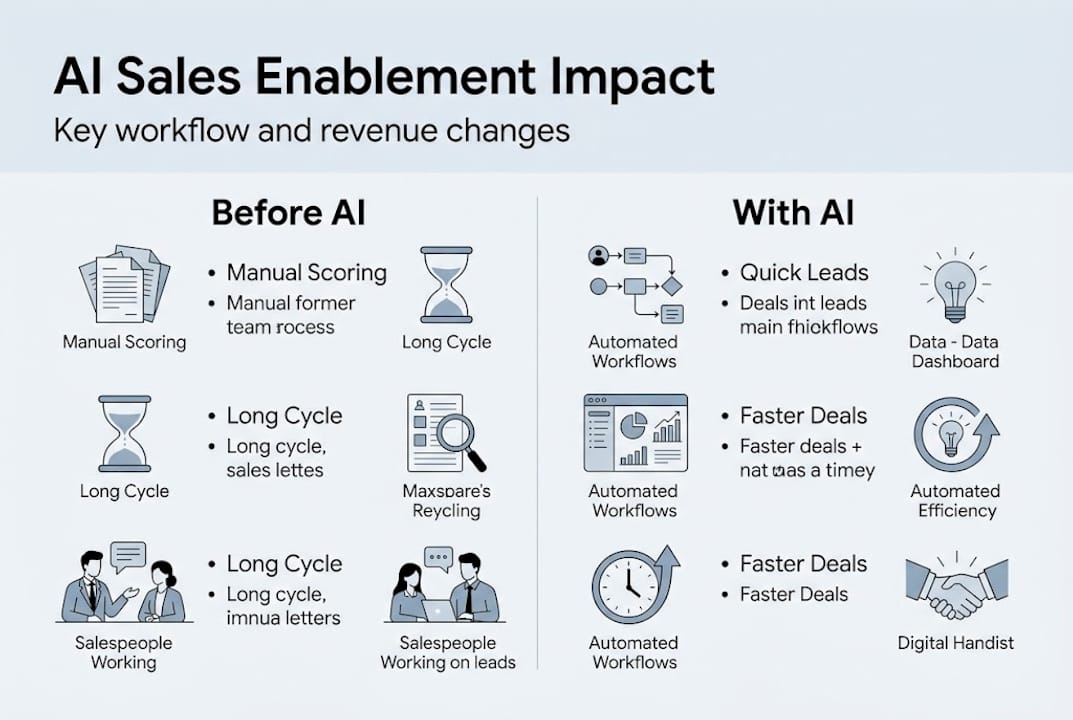
For tech and finance organizations, the traditional approach involved manual lead scoring, static content libraries, and compliance reviews that could stall a contract for weeks. AI replaces much of that friction. It prioritizes leads based on behavioral signals, recommends tailored content in real time, and automates the routine documentation tasks that used to eat up your top performers' time.
The numbers back this up. Sales productivity benchmarks show AI-enabled reps generate 41% higher revenue per rep, averaging $1.75M versus $1.24M, with 18% fewer activities required to close deals. That is not incremental improvement. That is a structural shift in what a sales team can accomplish.
Adoption is surging in tech and finance specifically because these sectors deal with high-stakes compliance requirements, large volumes of technical documentation, and enterprise buyers who demand precision. AI reshaping sales enablement has moved from a competitive advantage to a baseline expectation in these verticals.
Here is where AI creates immediate, measurable value in sales workflows:
- Lead prioritization: AI scores and ranks inbound leads based on engagement signals, firmographics, and intent data
- Content recommendation: Real-time surfacing of case studies, security documentation, and product materials tailored to the buyer's stage
- Questionnaire automation: Auto-drafting responses to security and vendor questionnaires using a centralized knowledge base
- Pipeline forecasting: Predictive models that flag at-risk deals and recommend next steps
- Faster response automation: Reducing the time from questionnaire receipt to submission from days to minutes
One misconception worth addressing: AI does not replace your sales team. It augments them. The goal is not full automation but precision augmentation, where AI handles repeatable, data-heavy tasks so your people can focus on judgment calls and relationships.
AI and security questionnaire automation
Security questionnaires are one of the most persistent bottlenecks in enterprise sales. A solutions engineer receives a SIG (Standardized Information Gathering) or CAIQ (Consensus Assessments Initiative Questionnaire) from a prospective client, then spends days hunting down answers from InfoSec, legal, and product teams. By the time the response goes out, the deal momentum has cooled.

AI fundamentally changes this workflow. It centralizes content, auto-fills drafts, and flags risks, reducing manual effort for compliance teams and enabling faster, more consistent responses. The AI model learns from your past approved answers and applies them to new questionnaires, matching questions semantically rather than by keyword alone.
Here is how manual and AI-driven workflows compare:
| Dimension | Manual workflow | AI-driven workflow |
|---|---|---|
| Average response time | 3 to 10 days | Under 1 hour |
| Error rate | High (inconsistent sourcing) | Low (centralized, version-controlled) |
| Staff hours per questionnaire | 15 to 30 hours | 1 to 3 hours |
| Scalability | Limited by headcount | Scales with volume |
| Audit trail | Manual or absent | Automated and searchable |
The ROI case is straightforward once you see the comparison. Organizations overcoming questionnaire challenges with AI report not just time savings but better win rates, because faster, more accurate responses signal operational maturity to enterprise buyers.
To implement AI for security questionnaires effectively, follow these steps:
- Select a purpose-built tool that supports your questionnaire formats (Excel, Word, PDF, portal-based) and integrates with your existing stack
- Centralize your content library by consolidating approved answers, security policies, and certifications in one searchable repository
- Run a pilot on a low-risk questionnaire to calibrate accuracy and identify gaps in your knowledge base
- Set confidence thresholds so the AI flags low-confidence answers for human review rather than auto-submitting them
- Monitor and refine by tracking acceptance rates, edit frequency, and turnaround times to continuously improve model performance
For tips on streamlined response practices and AI-driven essentials in modern compliance reviews, building a structured review cadence is just as important as the tool itself.
Pro Tip: Always keep a human reviewer in the loop for high-risk or high-stakes questionnaire responses. AI excels at drafting and consistency, but a compliance officer's judgment is non-negotiable when liability is on the line.
Productivity gains and ROI of AI in sales
If you are building a business case for AI adoption, the data is compelling. AI-driven ROI benchmarks point to 41% higher revenue per rep and a 236% return on investment over three years for organizations that deploy AI-enabled sales platforms at scale.
Here is what the before-and-after picture looks like in practice:
| Metric | Before AI | After AI |
|---|---|---|
| Revenue per rep (annual) | $1.24M | $1.75M |
| Activities required per close | Baseline | 18% fewer |
| Questionnaire response time | 3 to 10 days | Under 1 hour |
| Compliance team hours/quarter | 200+ | Under 50 |
| Estimated 3-year ROI | Baseline | 236% |
$4.3M in cumulative savings is achievable for large enterprise sales teams, according to the same Forrester Total Economic Impact study. That figure accounts for reduced staff hours, faster deal cycles, and lower error-related rework.
Key lessons from organizations that have achieved these outcomes:
- Start with the highest-volume, most repetitive compliance tasks first. The ROI compounds fastest there.
- Tie AI adoption to specific KPIs before launch. Teams that track metrics from day one see 2x faster optimization cycles.
- Finance sector deployments, with their stricter compliance requirements, have reported up to 16x return when AI reduces audit prep time alongside questionnaire work.
- Invest in data quality upfront. Poor input data is the single fastest way to erode AI's output quality and undercut your ROI case.
To track AI ROI in your organization, measure response time reduction, rep activity counts, deal velocity, and questionnaire acceptance rates. Connect those metrics to revenue outcomes quarterly. For specifics on AI advantages in security automation and compliance time reduction, the data consistently shows that organizations which measure early optimize faster.
The productivity argument is not theoretical. It is built on measurable workflow change, and the compounding effect of small time savings across hundreds of questionnaires per year is where the real enterprise value lives.
Realities, risks, and readiness: What to know before scaling AI
The productivity case is strong. But scaling AI without preparation is one of the fastest ways to create new problems while trying to solve old ones.
"73% of enterprise AI efforts fail due to data quality issues before they ever reach deployment."
That statistic should be the first thing on every leader's mind before signing a platform contract. Agentic AI risks include hallucinations, compliance gaps under GDPR and TCPA, bias in lead scoring models, and failure to interpret weak or ambiguous signals accurately. These are not edge cases. They are recurring failure patterns.
Common failure points to watch for:
- Hallucinations: AI generating plausible but factually incorrect compliance responses, which can create legal exposure
- Data quality gaps: Stale or inconsistent knowledge bases producing outdated answers in customer-facing documents
- Regulatory blind spots: AI tools that lack built-in GDPR or TCPA guardrails, creating liability in regulated industries
- Bias in scoring models: Lead prioritization algorithms trained on historical data that reflects past biases, not future opportunity
- Over-reliance: Teams that stop reviewing AI outputs critically, assuming accuracy without verification
Organizational readiness criteria to assess before scaling:
- Is your content library current, version-controlled, and accessible to the AI system?
- Do you have a governance policy that defines who approves AI-generated responses?
- Have your compliance and legal teams reviewed the AI tool's data handling practices?
- Is your team trained to recognize when AI output requires escalation?
For a fuller picture of streamlining completion with AI and transforming compliance responsibly, governance is the layer most organizations underinvest in. Forrester's skepticism about agentic AI is well-founded: the tools can deliver, but only when the humans directing them are prepared.
Pro Tip: Before full deployment, run a 30-day governance test with a small team. Document every edge case, escalation, and incorrect output. Use that log to build your escalation playbook before scaling.
Why real AI sales enablement requires more than tech
Here is the part that most platform vendors will not tell you: the technology is rarely the bottleneck. We see organizations with best-in-class AI tools that still fail to capture meaningful gains because the culture, governance, and measurement frameworks were not in place before the software was.
Optimism about productivity versus skepticism about signals reflects a real tension in the market. Both views are correct in different contexts. AI delivers when organizations treat it as a managed system, not a hands-off solution.
The myth of "set it and forget it" AI is particularly dangerous in compliance-heavy environments. A questionnaire response that goes out without review can introduce contractual or regulatory risk that no ROI multiplier will cover. The real-world AI impact stories that hold up over time share one common trait: structured, measurable deployment with a named human owner for every AI-generated output.
Watch for "shiny object syndrome," the tendency to adopt new AI features before the previous ones are fully embedded in workflow. Every new capability adds governance complexity. The organizations that win are disciplined about sequencing adoption and measuring outcomes before expanding scope.
Pro Tip: Invest as much in governance, training, and upskilling as you do in the platform itself. A well-governed mediocre tool will outperform a poorly governed excellent one every time.
Unlock sales and compliance speed with AI-driven security solutions
If the data in this guide points to one thing, it is that AI's impact on sales enablement and compliance is real, measurable, and within reach for organizations that approach adoption with structure and intent.

Skypher's security questionnaire automation platform is built specifically for the pain points this article covers. From the AI-powered recommendation engine that drafts responses based on your approved content library to the import and export workflow tools that handle every format your prospects send, Skypher reduces questionnaire response time from days to minutes. If your team is ready to turn compliance from a bottleneck into a competitive signal, Skypher is where that starts.
Frequently asked questions
How does AI improve the efficiency of security questionnaires?
AI centralizes answers, auto-completes drafts, and flags risks, cutting response time by 2.5x while reducing the manual coordination burden on InfoSec and compliance teams.
What financial gains can organizations expect from adopting AI in sales?
Benchmarks point to 41% higher revenue per rep, a 236% three-year ROI, and up to $4.3M in cumulative savings for large enterprise sales teams that deploy AI-enabled platforms at scale.
What are the main risks or challenges with AI-powered sales enablement?
AI can produce hallucinations, surface biased lead scores, and create regulatory exposure under GDPR and TCPA without robust human oversight and governance frameworks in place.
How should an organization prepare for AI-driven sales enablement adoption?
Prioritize data hygiene, governance, and training before scaling. Clean content libraries, clear approval workflows, and staff readiness are the foundation that makes AI output trustworthy and auditable.