

PCI compliance for small businesses, in the context of vendor questionnaires, means answering PCI DSS related questions accurately and backing every answer with real evidence. The right approach pairs automated question-to-control mapping with mandatory subject matter expert (SME) sign-off before anything gets submitted. Automation speeds the draft. It should never replace the human check on accuracy.
TL;DR:
- Automating PCI questionnaire responses speeds up the process but must be paired with human review for accuracy and accountability.
- Confirm the correct SAQ category based on payment architecture before answering, and document all control scope, data flow, and vendor involvement first.
- Build a control-mapped evidence index that links each control to authoritative sources, owners, and test methods, and update it regularly to maintain readiness.
- Use unscheduled sample checks to verify evidence quality and prevent gaps related to incomplete populations, expired exceptions, or untraceable artifacts.
- Start automation with a small pilot, ensure governance, and verify control mappings before expanding to avoid costly errors and compliance risks.
Table of Contents
- Understanding PCI Compliance for Small Businesses: Scope Before You Start
- How Automation Fits Into PCI Questionnaire Readiness
- Building an Evidence Checklist Mapped to PCI Controls
- Human-in-the-Loop Controls That Keep Automated Answers Defensible
- Readiness Testing: Catching Gaps Before an Auditor Does
- What PCI DSS Actually Requires From Smaller Organizations
- Payment Security Risks That Surface Most Often in Questionnaires
- A Step-by-Step Path to PCI Compliance Readiness
- Budgeting for PCI Compliance: Where the Real Costs Sit
- Keeping PCI Compliance Current After the First Questionnaire
- What Non-Compliance Actually Costs a Small Organization
- Publisher Perspective: Adopting Automation Responsibly
- Ready to Move Faster on PCI Questionnaires Without Losing Control
- Sources
Understanding PCI Compliance for Small Businesses: Scope Before You Start
Before any team touches a questionnaire, it has to know which Self-Assessment Questionnaire (SAQ) actually applies. SAQ eligibility hinges on how payment data flows through your systems and what controls apply to that architecture, not on how many transactions you process in a quarter. A business with a fully outsourced payment page and one with an in-house checkout can both be "small," yet they land in entirely different SAQ categories.
The PCI Security Standards Council treats SAQs as eligibility-based validation tools, so architecture and control applicability determine which one is correct, and that determination isn't yours to make alone. Confirm the accepted SAQ or Report on Compliance (ROC) route directly with the acquirer or whichever entity is requiring the questionnaire. Skipping this step is the single most common reason teams answer the wrong set of questions entirely.
Before drafting a single answer, get three things documented:
- A current payment-flow map showing where cardholder data enters, moves, and exits
- A defined list of everything inside the cardholder data environment (CDE)
- A vendor list covering every third party that touches payment data or the CDE
Skip this groundwork and even the best automation platform will map questions to the wrong controls.
How Automation Fits Into PCI Questionnaire Readiness
A practical automation workflow follows six steps: ingest, retrieve, draft, route, approve, archive. Automation starts by ingesting whatever format a questionnaire arrives in, whether that's a spreadsheet, a portal export, or a PDF, and parsing it into structured, individually addressable questions. From there, the system retrieves authoritative artifacts from a knowledge base or GRC platform and maps each question to the control it actually tests.
The workflow generally runs like this:
- Ingest the questionnaire and normalize every question into a structured format.
- Retrieve the matching policy, procedure, or evidence artifact tied to that control.
- Draft an answer grounded in that retrieved evidence, not a generic template.
- Route the draft to the SME who owns that control area.
- Approve the response after review, with any edits captured in the record.
- Archive the final answer and its supporting evidence for reuse on the next questionnaire.
Automation combined with data-grounded retrieval and human review can turn a multi-week questionnaire cycle into a matter of hours, according to Compyl's analysis of security questionnaire automation. The gains compound over time: consistent answers across every questionnaire, a permanent audit trail instead of scattered email threads, and continuous readiness instead of a scramble every time a new vendor risk assessment lands. Teams that rely on ad hoc screenshots pulled the night before a deadline lose that consistency almost immediately.
Pro Tip: Automation delivers the biggest gains when it pulls from a live GRC or policy source rather than a static template library. Tie every approved answer to the exact evidence export it cites, so a reviewer six months from now can trace the claim back to its source in seconds.
Building an Evidence Checklist Mapped to PCI Controls
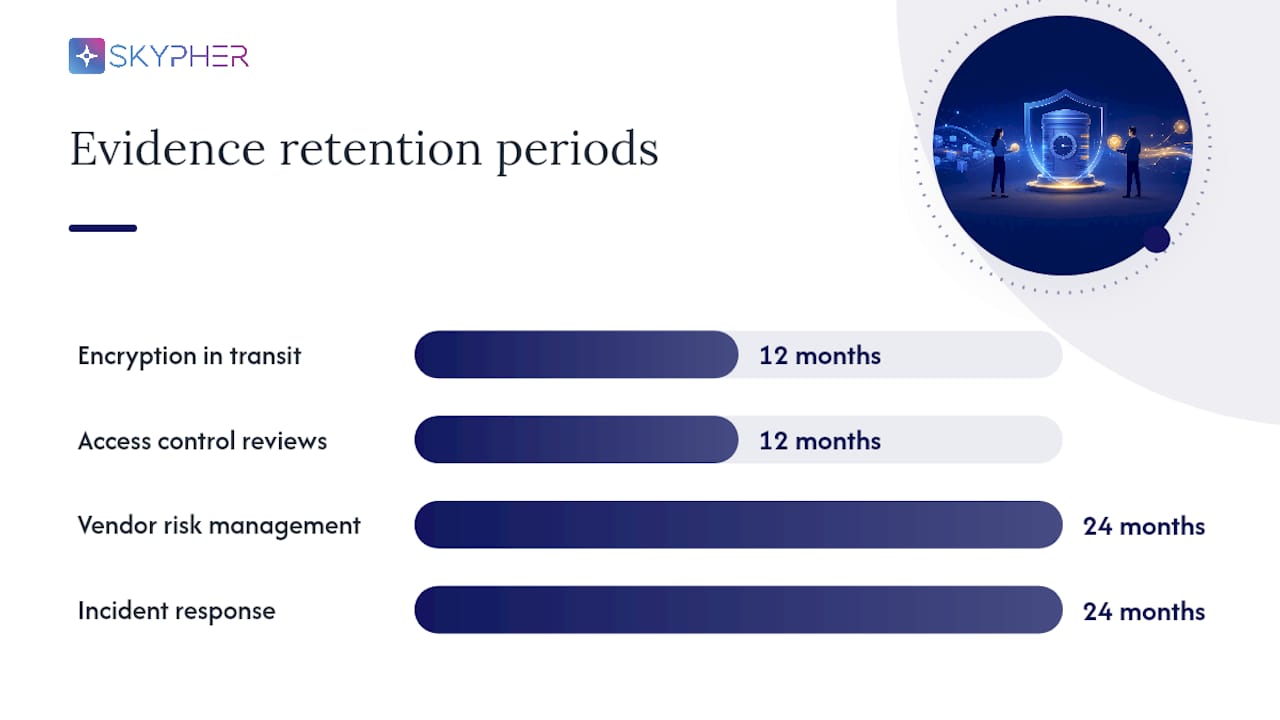
Loose folders of screenshots collapse the moment an assessor asks a follow-up question. What holds up is an evidence index that maps every control to a single authoritative source, an owner, a testing method, and a retention period. Duplication disappears, and provenance stays intact.
A workable index structure looks like this:
| Control area | Authoritative source | Owner | Test method | Retention |
|---|---|---|---|---|
| Encryption in transit | TLS configuration export | Security engineering | Automated scan | 12 months |
| Access control reviews | IAM system export | IT operations | Quarterly access audit | 12 months |
| Vendor risk management | Third-party risk register | Vendor management | Annual reassessment | 24 months |
| Incident response | Ticketing system logs | Security operations | Tabletop exercise record | 24 months |
Each control should point to real system exports, logs, tickets, and signed reports rather than a screenshot someone took once and never updated. Evidence should record the system of record, the population it covers, the collection method, the owner, the reviewer, the period tested, and the result, according to OC Security Audit's evidence checklist guidance.
Organize artifacts by area so nothing falls through a gap:
- Scope evidence: network diagrams, CDE boundary documentation, data flow maps
- Control evidence: firewall rule sets, encryption configurations, patch management logs
- Testing evidence: vulnerability scan results, penetration test reports, ASV attestation
- Governance evidence: policy sign-offs, training completion records, risk assessment reports
Third-party artifacts deserve the same rigor. Automated vendor validation platforms can collect Third-Party Service Provider (TPSP) attestations, Attestations of Compliance (AOC), ROCs, and Approved Scanning Vendor (ASV) or penetration test reports, then score them for consistency, according to VISO TRUST's PCI risk assessment framework.
Run three quality checks before you trust any entry in the index: confirm population completeness (does the sample cover the full environment, not a convenient subset), confirm reproducibility (can someone else pull the same artifact and get the same result), and document every exception with a reason and an expiration date rather than letting it sit unresolved.
Human-in-the-Loop Controls That Keep Automated Answers Defensible
Automation drafts faster. It doesn't carry accountability. Submitting AI-generated responses without a documented human review is a genuine compliance risk, because the organization, not the software, remains responsible for every answer that goes out the door, as industry practitioners note in Security Boulevard's guide to PCI DSS SAQ preparation. SME sign-off has to be a gate, not a formality.
A defensible workflow needs these elements in place:
- Every draft answer routes to a named SME based on the control area it touches, tagged by category like encryption, identity and access management, or incident response
- Approval requires an explicit sign-off action, logged with a timestamp and the reviewer's identity
- Exceptions or disagreements escalate to a designated second reviewer within a set SLA, not an open-ended email chain
- Every version of a response, including edits made during review, stays in a permanent audit trail
- Approved evidence and answers carry a retention period that matches your compliance cycle, typically 12 to 24 months
Tagging questions by category and routing them automatically keeps human review focused on judgment calls rather than routine confirmations, a distinction that matters once volume climbs past a handful of questionnaires a month. A well-organized review cycle with duplicate detection also catches the same question phrased differently across two portals, so an SME reviews it once instead of five times.
Pro Tip: Set your SLA for SME review before volume forces the issue. Teams that wait until they're drowning in questionnaires tend to skip the sign-off step under deadline pressure, which is exactly when a wrong answer slips through.
Readiness Testing: Catching Gaps Before an Auditor Does
Planned, scheduled evidence pulls tell you almost nothing about whether a control operates day to day. Evidence quality has to be tested with unscheduled samples, because a screenshot taken on request doesn't prove a control was running last Tuesday, an issue OC Security Audit's evidence checklist flags directly. Pull a sample cold, reproduce it from the authoritative source, and see if it matches what's already indexed.
The gaps that show up most often follow a pattern:
- Population incompleteness: the sample covers part of the environment, not all of it.
- Expired exceptions: an exception was documented once but never revisited or closed.
- Unclear ownership: no single person can explain who's responsible for a control.
- Weak artifact provenance: evidence exists, but nobody can say where it came from or when it was pulled.
Before submission, run through a short validation pass: confirm every control in scope has a current owner, confirm every piece of evidence is less than one review cycle old, confirm exceptions carry expiration dates, and confirm at least one artifact per control area has been reproduced from its source rather than pulled from a static file. Assessor logistics matter too. A single designated point of contact for evidence coordination is a strong predictor of a faster assessment timeline, according to GRCTrack's research on evidence collection.
What PCI DSS Actually Requires From Smaller Organizations
PCI DSS applies the same twelve core requirement categories to every organization handling payment card data, regardless of size, but the validation path scales with risk. Smaller organizations typically complete an SAQ rather than a full ROC, yet the underlying control expectations, protecting stored data, restricting access, monitoring systems, maintaining a vulnerability management program, don't shrink just because the organization is smaller.
Where size does change the picture is in questionnaire volume and evidence maturity. A larger enterprise fielding dozens of vendor security questionnaires a month needs the same evidence, mapped and current, on demand, every time a customer's risk team asks. That reality is why questionnaire-driven PCI validation depends so heavily on having an indexed, control-mapped evidence library rather than reassembling documentation from scratch for each request. The Cartelta overview of PCI DSS 4.0.1 reinforces that documenting payment flows and mapping the CDE is the recommended starting point regardless of organizational size, because scope confusion is the root cause of most downstream questionnaire errors.
Treat PCI DSS requirements as a fixed target and your evidence infrastructure as the variable that needs to keep pace with how often you're asked to prove compliance.
Payment Security Risks That Surface Most Often in Questionnaires
The risks that show up repeatedly across PCI-related security questionnaires tend to cluster around a few recurring themes: unclear scope boundaries, inconsistent vendor oversight, and stale evidence presented as current.
Scope creep is the quiet one. A CDE boundary that looked clean six months ago can drift once a new integration, a new payment processor connection, or a new internal tool touches cardholder data without anyone updating the scope documentation. Every questionnaire answer built on outdated scope is technically inaccurate the moment it's submitted.
Third-party risk compounds fast. Every vendor with access to payment data or the CDE extends your risk surface, and questionnaires increasingly ask organizations to prove they're actively managing that exposure, not just listing vendors in a spreadsheet. Weak provenance is the third recurring theme: evidence that exists but can't be traced to a specific system, date, or reviewer reads as unreliable to an assessor even when the underlying control is sound.
None of these risks require a dramatic breach to matter. They surface the moment a questionnaire asks a specific, pointed question and the honest answer is "we're not sure," which is exactly the answer a rigorous evidence index and SME sign-off process is designed to prevent.
A Step-by-Step Path to PCI Compliance Readiness
Getting to a defensible state doesn't require reinventing your compliance program. It requires sequencing the work correctly.
- Map your payment flows and CDE boundary before touching any questionnaire; this is the foundation everything else depends on.
- Confirm your SAQ or ROC route with your acquirer or the entity requesting the questionnaire.
- Build your evidence index, mapping every relevant control to its authoritative source, owner, and test method.
- Set up automated ingestion and routing so incoming questionnaires map to that evidence index instead of starting from a blank document.
- Establish SME sign-off gates for every drafted answer, with a defined SLA for review.
- Run an unscheduled readiness sample to test evidence reproducibility before a real assessment arrives.
- Remediate any gaps the sample surfaces, prioritizing incomplete populations and unclear ownership first.
- Archive the approved responses and evidence for reuse on the next questionnaire cycle.
The teams that struggle most are the ones that try to answer questionnaires and build their evidence index simultaneously. Sequence it the other way. Build the index first, even a partial one, and every questionnaire after that gets faster.
Budgeting for PCI Compliance: Where the Real Costs Sit
The direct cost of PCI compliance readiness rarely shows up as a single line item. It shows up as the hours spent chasing evidence, the SME time pulled away from other work to answer the same question a fifth time, and the opportunity cost of a delayed vendor deal because a questionnaire took three weeks instead of three days.
Budget planning should account for three categories. First, the one-time cost of building your evidence index and CDE documentation, which is front-loaded but pays down over every subsequent questionnaire. Second, the recurring cost of keeping evidence current, refreshed scans, updated policy sign-offs, renewed vendor attestations, on a defined cycle rather than reactively. Third, the tooling cost of whatever platform ingests questionnaires and manages the SME review workflow, weighed against the labor cost of doing that manually at your questionnaire volume.
Organizations fielding a handful of questionnaires a year can often manage with spreadsheets and manual coordination. Once volume climbs past a moderate number each quarter, the manual cost, measured in SME hours and delayed sales cycles, usually exceeds what a dedicated automation platform costs. That crossover point is worth calculating explicitly rather than assuming manual processes stay cheaper indefinitely.
Keeping PCI Compliance Current After the First Questionnaire
Compliance readiness isn't a project with an end date. It's a maintenance cycle, and the organizations that treat it as a checklist to close out are the ones caught flat when the next questionnaire arrives with a question their evidence can't answer anymore.
Set a defined review cadence for every entry in your evidence index, typically tied to when the underlying artifact naturally refreshes, such as for access reviews, vendor attestations, or immediately after any material change to the CDE or payment architecture. Automated evidence collection paired with continuous monitoring keeps documentation current instead of stale by the time someone requests it, according to Security Boulevard's guidance on PCI DSS automation.
Monitoring should also flag when an exception is approaching its expiration date, when a control owner changes roles, or when a new system enters the CDE without a corresponding evidence entry. Each of those triggers a re-index, not a wait-and-see approach. Ongoing maintenance is what turns a one-time compliance push into a permanent, low-friction state where the next questionnaire is answered from an already-current index rather than triggering a fresh scramble.
What Non-Compliance Actually Costs a Small Organization
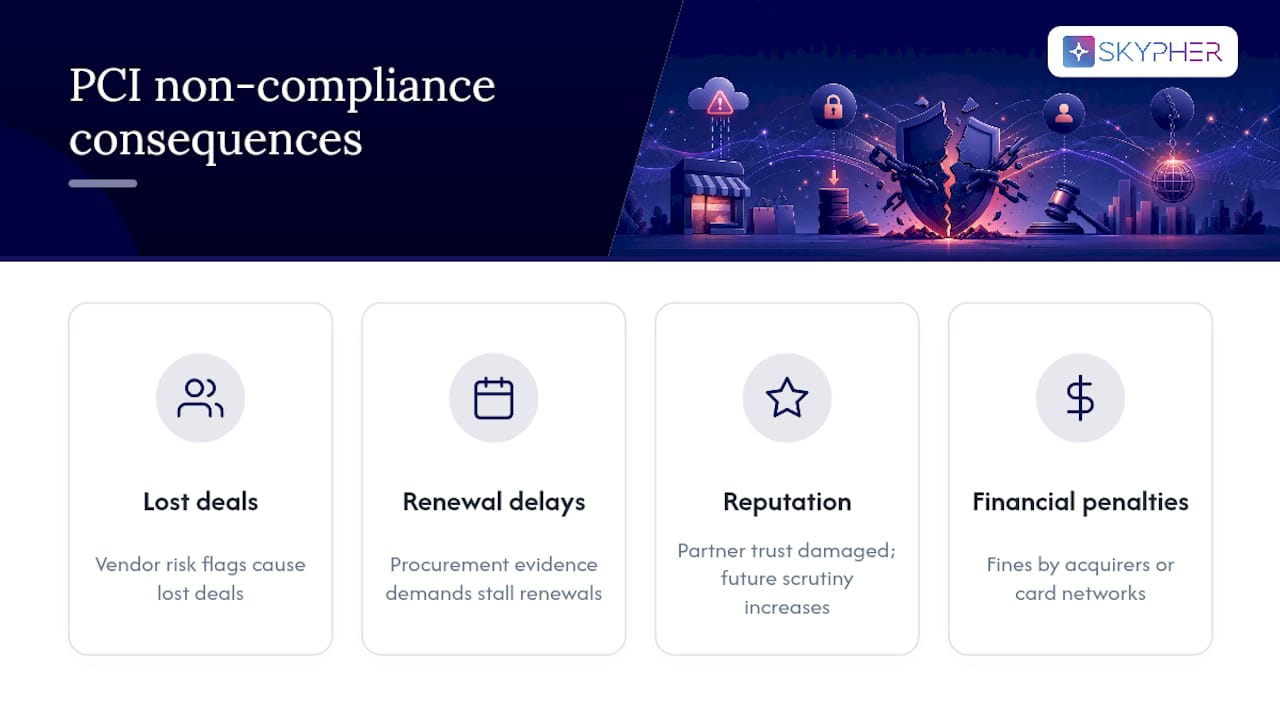
The consequences of failing a PCI-related questionnaire or assessment rarely announce themselves as a single dramatic penalty. They show up as a lost deal when a prospective customer's vendor risk team flags an incomplete or inconsistent answer. They show up as a renewal that stalls because a customer's procurement team requires updated evidence you don't have ready. They show up as the reputational cost of a partner discovering, mid-relationship, that your compliance posture was thinner than represented.
Financial penalties tied to payment card industry violations do exist and can be significant, typically assessed by acquiring banks or card networks rather than a government regulator, and the exact structure varies by contract and payment brand. The more immediate and more common cost for organizations fielding vendor questionnaires is commercial friction: extended sales cycles, added scrutiny on every future request, and in some cases suspension of the ability to process card payments until gaps are remediated.
Reputational damage compounds quietly. A vendor risk team that catches one inconsistent or unsupported answer tends to scrutinize every subsequent submission more closely, which slows down every future deal with that customer, not just the current one. Treating questionnaire accuracy as a sales enablement issue, not just a compliance checkbox, reflects how customers actually experience the consequences of getting it wrong.
Publisher Perspective: Adopting Automation Responsibly
The instinct when adopting a new automation platform is to point it at everything at once. Don't. Start with a pilot of five to ten actual questionnaires, ideally ones you've already answered manually, and use them to validate that the system's control mappings are accurate and that SME routing actually reaches the right owner for each tagged category. A pilot at that scale surfaces mapping errors while the stakes are low, before a live customer deadline is riding on the output.
Before scaling past the pilot, confirm four governance checkpoints are solid: every control has a named owner, every review step has a defined SLA, retention periods are documented and enforced, and the platform's integrations with your existing GRC tooling actually sync evidence rather than requiring manual re-entry. The approach reflects this discipline by using connectors to numerous third-party risk management platforms, a customizable Trust Center for sharing evidence externally, and proprietary retrieval AI designed to ground answers in real, current documentation rather than static templates. Speed only matters if what's fast is also accurate, and that's the balance worth testing before you trust automation with your next hundred questionnaires.
— Gaspard
Ready to Move Faster on PCI Questionnaires Without Losing Control
The platform helps teams move beyond spreadsheet-and-screenshot cycles by connecting directly to existing evidence sources and routing every drafted answer through SME sign-off gates before submission.

The platform's questionnaire automation tool ingests any format your customers or partners send, maps each question to the control it tests, and drafts a response grounded in the evidence you've already indexed, not a generic template. Pair that with a Trust Center so your most frequently requested PCI evidence is available on demand, and you cut the number of one-off questionnaires that hit your inbox in the first place.
If your team is fielding enough vendor risk assessments to feel the strain of manual coordination, run a pilot with your own past questionnaires and see how the control mappings hold up. Connect your existing GRC platform, route a handful of real requests through the workflow, and judge the accuracy for yourself before scaling further.
Sources
- Security Questionnaire Automation: How to Cut Response Time by 80% - Compyl
- PCI DSS policies, procedures and evidence checklist — OC Security Audit
- PCI Security Standards Council: Merchants