

Risk management methodologies are structured approaches for identifying, analyzing, and prioritizing risk. The main families are qualitative, quantitative, semi-quantitative, asset-based, vulnerability-based, and threat-based. We recommend choosing among them by matching the method to your decision audience, the quality of data you actually have, and the precision your stakeholders require.
TL;DR:
- Qualitative assessments are quick and accessible but should be escalated to quantitative models when high-impact risks with high uncertainty are identified.
- Quantitative methods require reliable data, defensible assumptions, and produce ranges to better inform decision-makers, with modeling costs justified by risk significance.
- Semi-quantitative scoring suits regulatory and self-assessment reporting by ranking risks on simple scales, but it should avoid false precision and overinterpretation of scores.
- Specialized techniques like FMEA, Bowtie, and fault trees are valuable for high-consequence risks, requiring more upfront investment but providing more reliable, regulator-ready outputs.
- Clear documentation of risk rationale and a decision-focused methodology selection process significantly improve assessment defensibility and consistency over time.
Table of Contents
- Comparing Risk Management Methodologies at a Glance
- How Do You Run a Defensible Qualitative Risk Assessment?
- What Quantitative Methods and Scenario Models Actually Tell You
- When Should You Use Semi-Quantitative Scoring Instead?
- FMEA, Bowtie, and Fault Trees: Specialized Techniques for High-Consequence Risk
- How Do ISO 31000 and NIST SP 800-30 Structure the Assessment Process?
- A Decision Checklist for Choosing the Right Methodology
- How Automation Supports Faster, More Consistent Assessments
- Common Pitfalls That Undermine Risk Assessments
- Three Examples of Methodology Selection in Practice
- What This Guide Gets Right That Most Advice Misses
- Sources
Comparing Risk Management Methodologies at a Glance
Every methodology trades speed for precision somewhere, and knowing that trade-off upfront saves you from picking the wrong tool for a board presentation or a technical remediation plan. Here's how the major families stack up:
- Qualitative (workshops, expert judgment, risk registers): Fast to run and accessible to non-technical stakeholders, but subjective and hard to compare across business units. Best for early screening and cultural risk discussions.
- Quantitative (FAIR, Monte Carlo, expected loss modeling): Produces dollar-denominated outputs that resonate with finance leaders, but demands clean historical data and specialized skill. Best for board-level financial exposure reporting.
- Semi-quantitative (scored matrices, 1-5 or 1-25 scales): Balances speed with comparability, letting you rank dozens of risks quickly. Best for regulatory reporting and risk and control self-assessments (RCSAs).
- Asset-based: Starts from what you're protecting (systems, data, facilities) and works outward. Best for inventory-heavy environments like data centers or manufacturing plants.
- Vulnerability-based: Starts from known weaknesses and asks what could exploit them. Best for technical security teams running penetration tests or code audits.
- Threat-based: Starts from who or what might attack you, then maps exposure. Best for organizations facing targeted adversaries, like financial institutions or critical infrastructure operators.
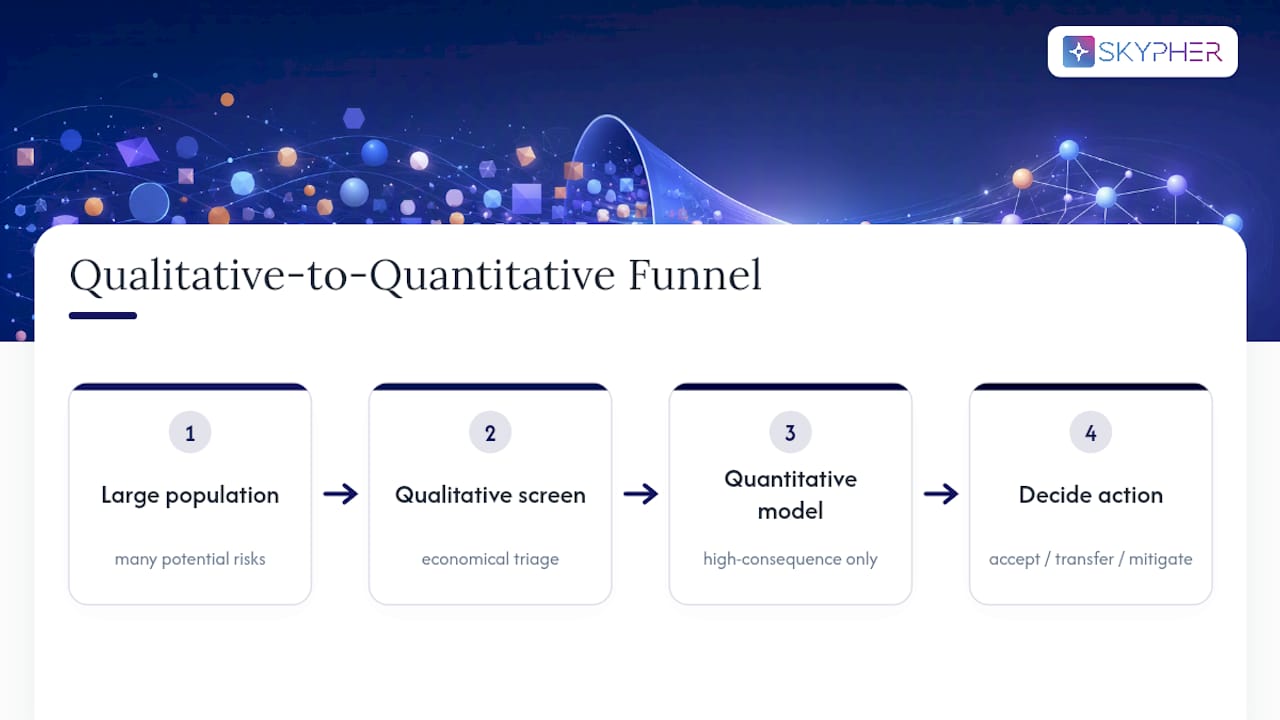
Most mature risk programs don't pick just one. They screen broadly with a qualitative or semi-quantitative pass, then apply quantitative rigor to the handful of risks that matter most. That hybrid pattern, described in industry methodology explainers, shows up constantly because pure qualitative analysis lacks defensibility for major capital decisions, while pure quantitative analysis is too slow and expensive to run on every risk in your register.
How Do You Run a Defensible Qualitative Risk Assessment?
Qualitative assessment relies on structured expert judgment rather than numerical modeling. It typically draws on facilitated workshops, interviews with subject-matter experts, and existing risk registers as raw material. Done well, it produces a defensible, reproducible record of reasoning. Done poorly, it becomes a room full of opinions with no audit trail.
Here's a repeatable process we've seen work across risk teams:
- Define your scales before the workshop starts. Decide whether you're using a three-point, five-point, or descriptive scale for likelihood and impact, and write down what each point means in concrete terms.
- Run facilitated sessions with a neutral moderator. Someone needs to keep the conversation from collapsing into groupthink or getting dominated by the loudest voice in the room.
- Record assumptions as you go, not after the fact. Every rating should have a one-line rationale attached so a future reviewer understands why a risk landed at "high" instead of "medium."
- Calibrate raters periodically. Have two people independently score the same risk and compare results; if they diverge wildly, your scale definitions need work.
- Escalate to quantitative analysis when the stakes justify it. If a qualitative screen flags a risk as high-impact and high-uncertainty, that's your signal to bring in modeling rather than relying on gut feel alone.
Pro Tip: Keep a one-page "rating rationale" template attached to every workshop. It turns a subjective discussion into a documented decision trail you can defend to an auditor eighteen months later.
What Quantitative Methods and Scenario Models Actually Tell You
Quantitative methodology replaces adjectives like "high" and "medium" with numbers, usually a probability distribution or an expected loss range denominated in currency. The three techniques you'll encounter most often are Factor Analysis of Information Risk (FAIR), Monte Carlo simulation, and straightforward expected loss modeling, which multiplies estimated frequency by estimated magnitude.
These approaches need real inputs to work:
- Historical loss data or incident frequency records, even if imperfect.
- Defensible assumptions about threat frequency, ranged rather than pinned to a single number.
- A documented method for handling uncertainty, since single-point estimates almost always overstate precision.
Analysts often express outputs as a range: "There's an 80% chance annual loss falls between $200,000 and $1.4 million," rather than a single misleadingly precise figure. That range matters more than the midpoint, because it tells a CFO how much confidence to place in the number rather than just what the number is.
When presenting to a board or a CFO, strip the modeling jargon and lead with the range and the decision it implies. Say what action the number supports (accept, transfer, mitigate) before you explain how you got there. Quantitative modeling costs more in analyst time and data preparation than qualitative screening, so reserve it for the risks where a wrong decision is genuinely expensive.
One trade-off is unavoidable: the more precise your output looks, the more scrutiny it invites. A single wrong assumption buried in a Monte Carlo model can produce a confident-looking number that's completely wrong, which is why documenting the risk model and rationale matters as much as the math itself.
When Should You Use Semi-Quantitative Scoring Instead?
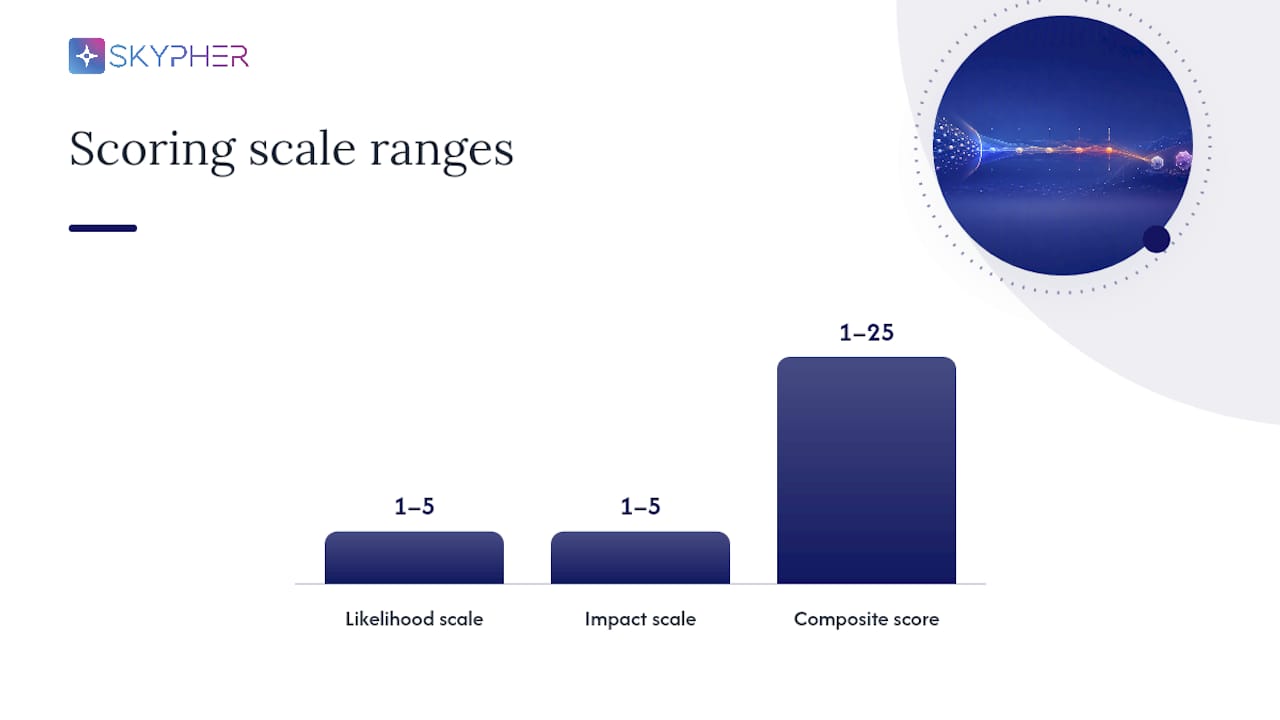
Semi-quantitative scoring sits between narrative judgment and full modeling. It assigns numbers to qualitative ratings, typically on a 1-5 scale for likelihood and impact multiplied into a 1-25 composite score, then plots results on a risk matrix.
This approach earns its place in regulatory reporting and risk and control self-assessments, where you need to compare hundreds of risks side by side without modeling each one individually. Here's what makes semi-quantitative scoring work:
- Write rater guidance in plain language, not just numbers, so a "4" always means the same thing regardless of who's scoring it.
- Anchor each score to observable evidence (incident counts, audit findings, control test results) rather than pure intuition.
- Resist adding decimal precision to a scale that's fundamentally a rank order, not a measurement.
The biggest pitfall is false precision: treating a score of 16 as meaningfully different from 15 when both numbers came from the same rough judgment call. Semi-quantitative scores are ordinal, useful for ranking, not for arithmetic like averaging across departments.
FMEA, Bowtie, and Fault Trees: Specialized Techniques for High-Consequence Risk
Some risks carry consequences severe enough that generic scoring isn't good enough. Engineering and safety disciplines developed specialized techniques for exactly this problem.
- Failure Mode and Effects Analysis (FMEA) breaks a system into components and asks, for each one, how it could fail, how severe that failure would be, and how likely it is to go undetected. It produces a Risk Priority Number for each failure mode, ranking where engineering attention should go first. Manufacturing and product design teams use it most.
- Bowtie analysis maps a single hazardous event with all its potential causes on one side and all its potential consequences on the other, with preventive and mitigating controls sitting on each connecting line. It's especially good at making control gaps visually obvious to non-technical stakeholders. Critical infrastructure operators favor it.
- Fault tree analysis works backward from a specific failure event, mapping the combination of conditions that would need to occur simultaneously to cause it. It's a staple in safety engineering, where regulators expect a documented causal chain.
- Monte Carlo scenario analysis runs thousands of randomized simulations across a range of input assumptions to generate a distribution of possible outcomes. High-consequence cyber scenarios, project cost overruns, and complex financial exposures all benefit from this technique because it captures interacting variables that a single-point estimate misses.
Each of these requires more upfront investment than a workshop-based qualitative pass, but they produce outputs regulators, auditors, and engineers can actually rely on.
How Do ISO 31000 and NIST SP 800-30 Structure the Assessment Process?
Regardless of which methodology you pick, the underlying process should follow a recognizable lifecycle. ISO 31000:2018 defines risk assessment as identification, analysis, and evaluation, nested inside a broader risk management framework that also covers treatment, monitoring, and communication. NIST SP 800-30 breaks this down further, specifying a risk model, an assessment approach, and an analysis approach, and it explicitly recommends documenting all three to improve reproducibility.
Practical toolkits built on ISO 31000, including guidance from NSW Treasury, lay the lifecycle out in seven stages:
- Establish context (objectives, scope, stakeholders)
- Identify risks
- Analyze likelihood and consequence
- Evaluate against risk criteria
- Treat (accept, mitigate, transfer, avoid)
- Monitor for change
- Report to governance bodies
Neither ISO 31000 nor NIST SP 800-30 mandates a single methodology. Both treat method selection as context-dependent, and both put documentation of the model and rationale ahead of the specific numbers you generate. Reproducibility, not precision, is the standard they actually hold you to.
COSO's enterprise risk management framework adds one more layer: it insists that risk assessment outputs feed directly into strategy and performance discussions rather than sitting in a compliance binder. If your assessment results never reach a decision-maker with budget authority, the methodology you chose barely matters. Teams building this out from scratch often start with a risk management framework aligned to NIST, ISO 31000, and COSO before layering specific assessment techniques on top.
A Decision Checklist for Choosing the Right Methodology
Picking a methodology gets easier when you turn it into a short set of questions rather than a judgment call made from scratch each time.
- Who is the audience for this output? A board wants dollar ranges; an engineering team wants failure modes; a compliance officer wants a documented score against a defined scale.
- What data do you actually have? Quantitative modeling on thin or unreliable data produces false confidence, not insight. If your loss history has three data points, don't pretend otherwise.
- How much precision does the decision actually require? A capital allocation decision worth millions justifies quantitative rigor. A routine vendor risk screen usually doesn't.
- What do regulators or auditors expect? Some sectors (financial services, critical infrastructure) have documentation expectations that push you toward semi-quantitative or quantitative approaches regardless of preference.
- Do you need to screen broadly first? If you're facing dozens of risks and limited analyst time, run a qualitative or semi-quantitative pass, then apply quantitative modeling only to the top handful, an approach Secureframe's methodology guide describes as standard practice for balancing speed against depth.
Pro Tip: Ask stakeholders one question before you start: "What decision will this assessment inform?" If nobody can answer that clearly, you're not ready to pick a methodology yet, you're still defining scope.
How Automation Supports Faster, More Consistent Assessments
Manual risk assessments run into a familiar problem: evidence lives in spreadsheets, emails, and someone's memory of a conversation six months ago. Automation tools address this by centralizing evidence capture, standardizing scoring templates, and feeding key risk indicator (KRI) data into the assessment cycle continuously rather than annually.
Practical benefits show up quickly:
- Faster assessment cycles because evidence doesn't need to be tracked down manually each time.
- Consistent scoring because templates enforce the same rating logic across teams.
- A documented audit trail linking every score to the evidence that supports it.
Automation tools for security questionnaires help teams answering the same control questions repeatedly benefit from a maintained, vectorized knowledge base rather than rebuilding answers from scratch. Tools built for this purpose can meaningfully cut the manual burden that erodes assessment quality over time, a pattern also observed in continuous monitoring research from Protecht.
Common Pitfalls That Undermine Risk Assessments
Most assessment failures aren't methodological. They're operational.
- Inconsistent scales across teams make cross-department comparison meaningless.
- Stale risk registers get reviewed once a year and then ignored until the next audit.
- Ignoring risk interactions treats correlated risks as independent when they aren't.
- No clear owner accountability means identified risks never get resourced for treatment.
Fix these with rater calibration sessions, scheduled quarterly reviews rather than annual ones, and controls linked directly to KRIs so drift gets flagged automatically. Pro Tip: Track "time since last review" as its own KRI. A risk register where the average entry is fourteen months old is a bigger problem than any individual risk score inside it.
Three Examples of Methodology Selection in Practice
- Project risk management. A construction firm screens dozens of project risks qualitatively during planning, then runs Monte Carlo simulation on schedule and cost specifically for the three risks flagged as high-impact, producing a probable completion date range instead of a single optimistic deadline.
- Cyber risk reporting to a CFO. A software company facing quarterly board reporting adopts FAIR to translate a ransomware scenario into an annualized loss expectancy range, replacing a red-yellow-green heat map that the CFO had stopped trusting.
- Manufacturing safety. A plant uses FMEA to rank component failure risks by Risk Priority Number, then builds a Bowtie diagram for the single highest-consequence hazard to show inspectors exactly which controls prevent and mitigate it.
Each case starts from the same question: what decision does this output need to support, and for whom?
What This Guide Gets Right That Most Advice Misses
The conventional advice on this topic treats methodology selection as a maturity ladder: start qualitative, graduate to quantitative once you're "sophisticated enough." That framing is backward. Mature programs use qualitative screening constantly, not as a training-wheels phase they outgrow, because it's the only economical way to triage a large risk population. The skill isn't escalating to bigger models. It's knowing which risks deserve them.
What's genuinely underrated is documentation discipline. Both ISO 31000 and NIST SP 800-30 spend more effort on requiring you to record your rationale than on prescribing which method to use, and most organizations skip that part entirely. A defensible risk assessment isn't the one with the fanciest model. It's the one where a new reviewer, eighteen months later, can reconstruct exactly why a risk was scored the way it was.
If you take one action from this guide, make it this: before your next assessment cycle, write down the decision each risk score needs to support. That single habit will do more for methodology selection than any framework comparison chart.
— Gaspard
Sources
- ISO 31000:2018
- NIST SP 800-30 Revision 1
- Risk Management Toolkit (NSW Treasury)
- Risk Assessment Methodologies: 6+ Types & How to Choose | MetricStream