

TL;DR:
- Your organization's security posture is a dynamic system encompassing people, policies, controls, and capabilities to defend and adapt. Building organized evidence for each component allows faster, more accurate responses to security questionnaires and competitive assessments. Automation tools amplify this process by maintaining current evidence and streamlining questionnaire workflows.
Your organization's security posture is, as NIST defines it, "the security status of an enterprise's networks, information, and systems based on IA resources (people, hardware, software, policies) and capabilities in place to manage the defense of the enterprise and to react as the situation changes." That definition matters because it frames posture not as a single score or a checklist, but as a living system of capabilities. For tech and finance organizations, that distinction is the difference between winning a vendor assessment in days and losing a deal because your evidence is stale.
NIST CSRC: Security posture encompasses people, hardware, software, policies, and capabilities — not just technical controls. Scoping your posture to only one layer produces incomplete questionnaire answers and exposes gaps that sophisticated buyers will find.
Table of Contents
- What is a security posture made of?
- Why security posture matters for tech and finance enterprises
- How do you measure security posture effectively?
- How to improve your security posture: a prioritized checklist
- How good security posture speeds up questionnaire responses
- Where does automation fit in your posture and questionnaire workflow?
- Key Takeaways
- Security posture programs need a different kind of ownership
- Ready to turn your posture into faster questionnaire responses?
- Useful sources and further reading
What is a security posture made of?
Rapid7 frames posture as the sum of existing controls, documented policies, visibility into systems, response capability, and ongoing validation. In practice, that maps to six concrete layers every security and compliance team must be able to document.
- People and governance: Org chart for security roles, RACI matrices, security awareness training records, and board-level risk reporting cadence.
- Policies and procedures: Acceptable-use policy, access-control policy, incident response plan, change-management procedures, and data-classification standards.
- Technical controls: Firewall rule sets, endpoint detection and response (EDR) configurations, MFA enforcement records, encryption standards, and patch-management reports.
- Visibility and telemetry: SIEM log sources, asset inventory exports, vulnerability scan results, and cloud security posture management (CSPM) dashboards.
- Incident response and recovery: IR playbooks, tabletop exercise after-action reports, recovery time objective (RTO) documentation, and business continuity plans.
- Validation and continuous improvement: Penetration test reports, red-team findings, remediation tracking tickets, and control-effectiveness metrics.
One important distinction: Microsoft notes that practitioners often conflate broad organizational posture (people, policy, culture) with the narrower cybersecurity or data security posture (technical controls). Questionnaire respondents who blur that line routinely produce incomplete answers, because a question about data encryption belongs to a different evidence folder than a question about security culture.
Pro Tip: Build a canonical evidence folder for each component above, named to match the layer (e.g., "04_Visibility_Telemetry"). When a questionnaire asks about log retention, your team navigates directly to that folder rather than hunting across SharePoint. That single organizational habit cuts evidence-retrieval time significantly.
Why security posture matters for tech and finance enterprises
A weak posture is not just a compliance problem. It is a direct financial and competitive liability.
IBM Cost of a Data Breach: According to IBM's research, the average global cost of a data breach represents one of the most significant business risk drivers organizations face today — making a strong security posture a financial imperative, not an optional investment.
Beyond breach costs, posture shapes how quickly your organization closes enterprise deals. In tech and finance, procurement teams routinely issue security questionnaires before signing contracts. A vendor that can respond accurately within 48 hours signals a mature posture. One that takes three weeks signals the opposite, and some buyers will simply move on. Microsoft's security guidance reinforces this: a proactive security posture functions as both a shield and a radar, enabling faster detection and recovery while simultaneously building the external trust signals that accelerate contracting.
Regulatory pressure adds another layer. Finance organizations operating under SOC 2, PCI DSS, or DORA, and tech firms subject to FedRAMP or HIPAA, are expected to demonstrate posture maturity on demand. Auditors and enterprise customers are asking the same questions; the organizations that answer them consistently are the ones with documented, continuously maintained posture programs.
How do you measure security posture effectively?
Measurement starts with picking the right metrics and pairing them with a maturity model that gives the numbers context.

| Metric | What it measures | Common data source | Questionnaire relevance |
|---|---|---|---|
| Mean Time to Detect (MTTD) | Speed of threat identification | SIEM, EDR alerts | Demonstrates detection capability |
| Mean Time to Respond (MTTR) | Speed of containment and recovery | Ticketing system, IR logs | Proves incident response maturity |
| Vulnerability coverage | % of assets scanned regularly | Vulnerability scanner exports | Validates patch and scan program |
| Control coverage | % of required controls implemented | GRC platform, audit reports | Maps directly to framework compliance |
| Asset coverage | % of assets in inventory | CMDB, cloud asset APIs | Confirms scope of monitoring |
| Risk score | Aggregate exposure rating | Risk platform, CSPM | Provides executive-level posture summary |
TechTarget's security posture definition highlights that enterprises are moving from fragmented, point-in-time tools toward end-to-end frameworks that produce unified internal and external views. That shift makes the maturity model you choose as important as the metrics themselves.
Three models work well for most tech and finance organizations:
- NIST Cybersecurity Framework (CSF): Maps controls to five functions (Identify, Protect, Detect, Respond, Recover) and provides a tiered maturity scale from Partial (Tier 1) to Adaptive (Tier 4). Widely recognized by enterprise buyers and regulators.
- CIS Controls v8: Eighteen prioritized control groups with implementation groups (IG1–IG3) that let teams sequence improvements by risk and resource level. Particularly useful for mapping quick wins.
- ISO 27001 maturity mapping: Clause-by-clause control assessment that aligns with certification requirements and satisfies European and financial-sector buyers.
Recommended cadence: continuous automated monitoring for asset coverage and vulnerability data, monthly metric reviews for MTTD and MTTR trends, and quarterly maturity assessments against your chosen framework. Rapid7 emphasizes that posture is a dynamic, living status, not a static score, because assets and vulnerabilities change daily.
How to improve your security posture: a prioritized checklist
Improvement works best when sequenced by speed-to-evidence and risk reduction.
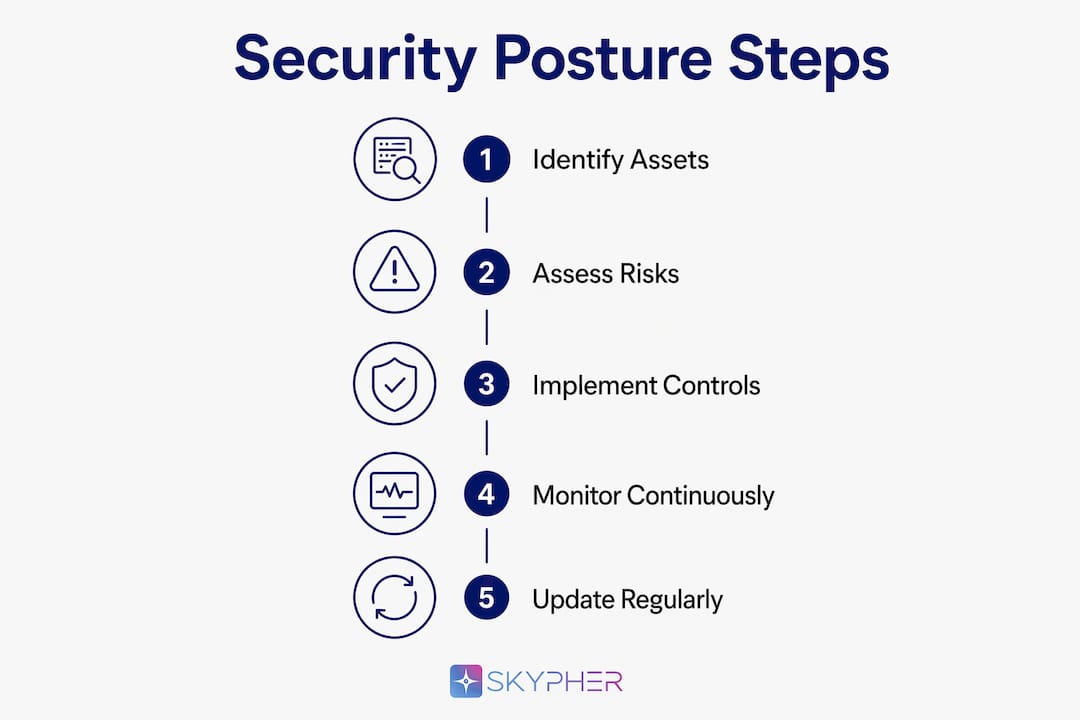
- Week 1–2 (Quick wins): Complete an asset inventory using your CMDB or a cloud asset discovery tool. Enforce MFA across all privileged accounts. Centralize logs into a SIEM. These three steps immediately produce evidence artifacts usable in questionnaires.
- Month 1–3 (Foundation): Stand up a vulnerability management program with weekly authenticated scans. Document your IR playbook and assign owners. Conduct a gap assessment against CIS Controls IG1.
- Month 3–6 (Depth): Run a tabletop IR exercise and document findings. Map controls to your chosen framework (NIST CSF or ISO 27001). Begin tracking MTTD and MTTR in your ticketing system.
- Month 6–12 (Maturity): Launch a continuous control validation program. Establish a security awareness training cadence with completion tracking. Publish a Trust Center so customers can access your posture evidence on demand.
- Ongoing: Automate evidence collection from your SIEM, vulnerability scanner, and IAM platform. Review maturity quarterly. Treat posture assessment as a continuous process, not a project with an end date.
TechTarget notes that treating posture assessment as a one-time project is the most common operational failure. High-performing teams automate evidence collection and versioning so questionnaire answers stay accurate as the environment changes.
Pro Tip: After completing the Week 1–2 quick wins, draft three to five canned control statements (e.g., "All privileged access requires MFA enforced via [your IAM platform]") and store them in a shared knowledge base. Those statements become reusable, pre-approved answers that cut first-draft questionnaire time dramatically. See Skypher's practical posture improvement guide for a full template library.
How good security posture speeds up questionnaire responses
The connection between posture and questionnaire performance is direct: every questionnaire question maps to an artifact, an owner, and a pre-approved answer. When those three elements are organized in advance, response time drops from weeks to hours.
| Questionnaire question | Required artifact | Artifact owner | Pre-approved answer source |
|---|---|---|---|
| Do you enforce MFA for all users? | IAM policy + enforcement report | Identity team | Canned control statement |
| How do you manage vulnerabilities? | Vulnerability management policy + scan schedule | Security operations | Policy document + scan export |
| What is your average incident response time? | MTTR metric from ticketing system | IR team | Quarterly metrics report |
| Do you conduct annual security awareness training? | Training completion records | HR / Security | LMS export |
| Is customer data encrypted at rest and in transit? | Encryption standard + configuration evidence | Cloud/infrastructure team | Architecture document |
The critical discipline here is evidence currency. An artifact that was accurate six months ago may no longer reflect your environment. Rapid7's posture research reinforces that posture changes daily as new assets and vulnerabilities appear, which means evidence must be versioned and refreshed on a defined schedule.
Pro Tip: Tag every evidence artifact with a "valid through" date and assign a quarterly refresh owner. When a questionnaire arrives, your team checks the tag before using the artifact. Stale evidence in a questionnaire is worse than no evidence — it creates liability if the buyer later discovers the control lapsed.
Where does automation fit in your posture and questionnaire workflow?
Automation does not replace a mature posture program. It amplifies one. The tool classes below each solve a distinct problem in the posture-to-questionnaire pipeline.
- Posture management and observability platforms (CSPM, SIEM, vulnerability scanners): Continuously collect telemetry, generate asset inventories, and surface control gaps. They are the data source for everything downstream.
- Evidence stores and Trust Centers: Centralize artifacts, apply versioning, and make evidence accessible to both internal teams and external buyers. Skypher's Trust Center lets organizations publish a curated, always-current view of their posture to customers without manual document sharing.
- Questionnaire automation and response engines: Query the evidence store to generate draft answers, apply AI confidence scoring, and route low-confidence items for human review. Skypher's platform can process 200 questions in under a minute, integrates with over 40 third-party risk management platforms, and connects directly with Slack, Microsoft Teams, Confluence, and ServiceNow.
- GRC platforms: Maintain control frameworks, track remediation, and produce audit-ready reports. They feed the evidence store with policy documents and control-effectiveness data.
The workflow looks like this: posture telemetry updates the evidence store nightly, the questionnaire engine queries the store when a new assessment arrives, AI drafts answers with confidence scores, and your team reviews only the flagged items. That loop is what AI-driven product workflows increasingly make possible across enterprise security programs.
Adoption criteria worth checking before you buy: Does the tool ingest your existing SIEM and asset inventory? Can it map evidence to multiple frameworks simultaneously (SOC 2, ISO 27001, NIST CSF)? Does it support role-based access so sales engineers can pull questionnaire answers without touching raw security data? Those three integration points determine whether automation produces trustworthy answers or just fast ones.
Key Takeaways
A strong security posture, built on continuous assessment and organized evidence, is the single most reliable foundation for faster, more accurate security questionnaire responses.
| Point | Details |
|---|---|
| NIST-backed definition | Security posture covers people, hardware, software, policies, and capabilities — not technical controls alone. |
| Continuous assessment wins | Treating posture as a living status (not a one-time project) keeps questionnaire answers accurate as your environment changes. |
| Six components to document | People/governance, policies, technical controls, visibility, incident response, and validation each require dedicated evidence artifacts. |
| Metrics that matter | Track MTTD, MTTR, vulnerability coverage, and control coverage to measure posture and satisfy questionnaire evidence requirements. |
| Automation multiplies maturity | Questionnaire automation tools produce reliable answers only when connected to a current, well-organized evidence store. |
Security posture programs need a different kind of ownership
Most security posture programs stall not because of missing tools, but because of missing ownership. The CISO owns the framework; nobody owns the evidence. That gap is where questionnaire responses fall apart.
The teams we see execute this well treat posture evidence as a product, with a named owner, a versioning policy, and a quarterly review cycle. They align their security operations team with their sales and procurement teams early, so when a vendor assessment arrives, the response process is already defined. The metrics they track are not just technical: time-to-evidence (how long it takes to locate and validate an artifact), percentage of questionnaire items that can be answered without human intervention, and MTTD and MTTR as proof points for the resilience story they tell buyers.
If you are building or rebuilding a posture program, start with the CISO resilience checklist and work backward from the questionnaire items your sales team receives most often. That reverse-engineering exercise will tell you exactly which controls and artifacts to prioritize, and it will make the business case for continuous assessment far easier to defend to leadership.
Ready to turn your posture into faster questionnaire responses?

Skypher's questionnaire automation platform connects directly to your evidence store, applies AI confidence scoring to every answer, and integrates with the tools your team already uses — including OneTrust, ServiceNow, Slack, and Microsoft Teams. Organizations using Skypher complete security reviews significantly faster, with higher accuracy and full audit trails. If you want to see how your current posture maps to questionnaire readiness, we would be glad to walk you through it.
Useful sources and further reading
- NIST CSRC — Security Posture Glossary: The authoritative definition; cite this when scoping posture for internal governance or questionnaire responses.
- IBM — What Is Security Posture?: Financial impact framing and breach cost rationale for executive-level investment cases.
- Microsoft Security — What Is Security Posture?: Proactive posture framing, the shield-and-radar model, and scope distinctions between organizational and data security posture.
- Rapid7 — Security Posture Key Elements and Best Practices: Cyber resilience framing, continuous monitoring rationale, and component-level best practices.
- TechTarget — Security Posture Definition: End-to-end framework trends, continuous assessment guidance, and the pitfalls of point-in-time tools.
- Skypher — Improving Security Posture: A Practical Guide for 2026: Step-by-step improvement framework with templates and control statement examples.
- Skypher — Trust Center Platform: How to publish and share your posture evidence with customers and prospects on demand.