

TL;DR:
- Cyber threats are becoming increasingly complex, with adversaries deploying AI-powered attacks and exploiting unmanaged assets rapidly. Improving security posture requires a continuous, structured approach involving asset visibility, risk governance, attack path analysis, and third-party risk management. Tracking control effectiveness, automating responses, and aligning initiatives with enterprise risk frameworks are essential for sustained resilience.
Cyber threats are not getting simpler. Adversaries are deploying AI-powered attack chains, exploiting unmanaged assets, and moving laterally through enterprise networks faster than most teams can respond. Improving security posture, which is the industry term for strengthening your organization's overall readiness and resilience against those threats, is no longer something you achieve once and revisit annually. It requires a structured, continuous approach that connects risk data to governance decisions, remediation workflows, and measurable outcomes. This guide walks you through the full cycle: preparation, execution, and verification.
Key Takeaways
| Point | Details |
|---|---|
| Start with asset visibility | A complete inventory of assets, applications, and access controls is the prerequisite for every posture improvement effort. |
| Connect risk to governance | Cybersecurity risk registers must roll up into enterprise risk profiles so leadership can prioritize resources effectively. |
| Prioritize by exploitability | Severity scores alone mislead remediation efforts. Attack path analysis reveals what attackers can actually reach. |
| Measure control effectiveness | Track posture through control performance and resilience over time, not just vulnerability counts. |
| Avoid third-party blind spots | Supply chain and vendor risks must be included in every posture assessment to avoid governance gaps. |
Improving security posture: foundational prerequisites
Before you run a single scan or adjust a firewall rule, you need to understand what you are protecting. Microsoft's 2026 CISO guidance makes this sequencing explicit: build your asset and application inventory first, then review authentication, authorization, and network isolation controls, and only then author a multi-month risk summary that guides ongoing security actions. Skipping that order produces one-off assessments rather than a functioning operating model.
Here are the foundational elements every organization needs in place before launching a posture improvement program:
- Complete asset and application inventory. You cannot protect what you cannot see. This means cataloging cloud workloads, endpoints, SaaS applications, shadow IT, and third-party integrations. A missing asset is an unmonitored attack surface.
- Access control review. Audit authentication mechanisms (MFA coverage, privileged account controls) and authorization policies (least privilege, role-based access). Identify where tokens are long-lived, where service accounts have excessive permissions, and where network segmentation is absent or poorly enforced.
- Network isolation mapping. Understand lateral movement paths. Which systems are unnecessarily peered? Where do flat network segments create blast radius risk?
- Governance and risk communication structure. Identify who owns posture metrics, who reports upward to the board, and how cyber risk connects to business objectives.
Two frameworks dominate this preparation phase. The NIST CSF 2.0 treats posture improvement as an enterprise risk management activity, not a purely technical one. It explicitly ties governance and workforce decisions to risk reality. NIST IR 8286 adds the mechanics, explaining how cyber risk data must integrate with enterprise risk management programs so senior leaders can manage cybersecurity risks alongside business objectives.
| Preparation area | Key questions to answer |
|---|---|
| Asset inventory | Are all assets, including cloud and SaaS, cataloged and assigned an owner? |
| Access controls | Where do authentication gaps or excessive permissions exist? |
| Network isolation | Which segments allow unnecessary lateral movement? |
| Governance structure | Who owns posture metrics and reports risk upward? |
| Framework alignment | Does your program map to NIST CSF 2.0 or equivalent? |

Pro Tip: Before your first formal assessment, spend two weeks on access control hygiene alone. Teams consistently underestimate how many orphaned accounts, overprivileged service accounts, and undocumented API tokens exist until they audit systematically. That exercise alone reveals more exploitable risk than most automated scans.
Step-by-step execution for continuous improvement
With your baseline in place, execution becomes about making posture improvement repeatable rather than heroic. The following sequence reflects what high-maturity security teams actually do, not what vendor marketing materials describe.
-
Conduct regular security posture assessments. Schedule structured risk reviews quarterly, not just after incidents. Structured risk reviews transform reactive security data into proactive insights by forcing teams to ask explicit questions about assets, detections, and overlooked areas. This discipline surfaces drift before attackers exploit it.
-
Build and maintain a cybersecurity risk register. Document identified risks, their likelihood and impact, assigned owners, and remediation status. Then, critically, ensure this register feeds your enterprise risk management program. NIST IR 8286C explains how aggregating risk registers into enterprise risk profiles enables governance oversight and auditability across organizational layers.
-
Shift from severity scores to attack path analysis. CVSS scores tell you how bad a vulnerability looks in isolation. They do not tell you whether an attacker can actually reach it from the internet or pivot to critical systems through it. Cisco made this shift explicitly, moving from chasing CVSS severity to continuous exposure validation and attack path analysis to identify what is genuinely exploitable. Runtime protection is now part of their defense against AI-powered threats.
-
Implement layered defense controls. No single control is sufficient. Combine endpoint detection and response, network segmentation, identity governance, and data loss prevention into a coordinated stack. Update patch management policies to prioritize based on exploitability, not just severity.
-
Automate monitoring and response where possible. AI-powered tools can correlate telemetry across sources faster than any human analyst team. Use them for anomaly detection, alert triage, and compliance monitoring. The goal is to reduce mean time to detect and respond without burning out your SOC team. For deeper context on the specific threats driving this urgency in 2026, the cybersecurity trends shaping compliance article covers the threat landscape well.
Pro Tip: Treat your risk register as a living document, not a compliance artifact. The organizations I have seen get the most value from it assign a named owner to every risk line item and review it in leadership meetings. That single practice closes the gap between security teams and business decision-makers faster than any reporting dashboard.
Verification and validation for sustained posture management
Execution without measurement is guesswork. This phase is where most programs stall because teams revert to counting vulnerabilities closed rather than measuring whether their controls are actually working.
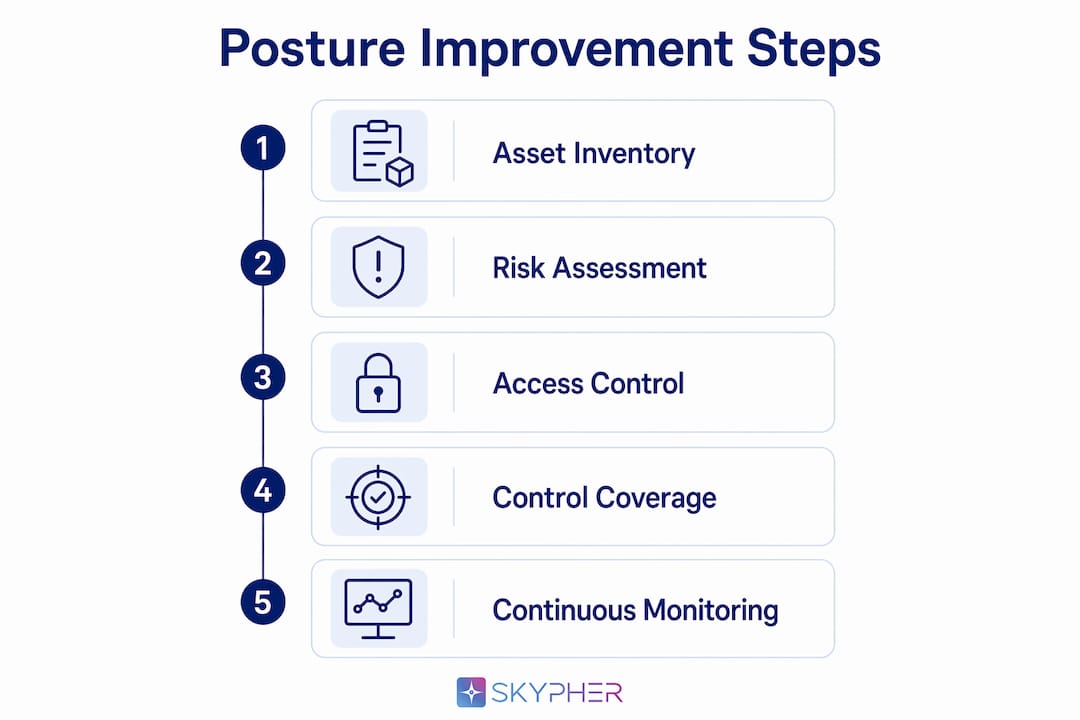
The distinction matters enormously. Posture management treats security as a continuous resilience metric, not a pass/fail state. That means tracking control effectiveness over time, measuring detection coverage against known threat patterns, and validating that remediated vulnerabilities are actually closed and not reintroduced through configuration drift.
Key metrics worth tracking in your posture management program:
- Control coverage rate. What percentage of your critical assets are covered by each control layer (EDR, MFA, network monitoring)?
- Mean time to remediate by risk tier. Track this separately for critical, high, and medium risks. You want the trend lines moving down.
- Detection-to-response gap. How long between alert generation and analyst action? This number should shrink as your automation matures.
- Patch compliance rate by asset class. Track separately for internet-facing systems, internal systems, and third-party software.
| Metric | What it tells you |
|---|---|
| Control coverage rate | Whether your defenses actually reach all critical assets |
| Mean time to remediate | Whether your remediation workflows are keeping pace with risk |
| Detection-to-response gap | Whether your monitoring is translating into real response capability |
| Patch compliance rate | Whether your most exposed systems are staying current |
| Risk register closure rate | Whether identified risks are being resolved, not just logged |
When a heightened threat environment exists (think frontier AI developments or geopolitical tension), the NY DFS 2026 guidance recommends going beyond baseline requirements. That includes enhanced monitoring, third-party coordination, and operational resilience tests like backup integrity validation and breach impact simulations. Building that adaptive capacity into your verification cadence separates mature programs from reactive ones.
Common pitfalls that undermine posture programs
Even well-resourced teams fall into predictable traps. Knowing them in advance is the most direct way to avoid losing months of progress.
- Relying on static vulnerability scans alone. A scan that produces 4,000 findings and ranks them by CVSS score gives your team an enormous list and zero prioritization guidance. Without exploitability context and attack path analysis, your team will spend cycles on low-impact fixes while genuinely critical exposure goes unaddressed.
- Fragmented posture data. When your cloud security tool, endpoint platform, identity system, and network monitoring solution each produce separate reports with no unified view, governance blind spots are inevitable. Posture programs fail when teams cannot connect exposure, controls, and threat intelligence into a single remediation workflow.
- Ignoring third-party and supply chain risk. Your posture is only as strong as your weakest vendor integration. Third-party risk must be part of every assessment, including reviewing access permissions granted to external parties and the security practices of your software supply chain. The infrastructure security guide from Ailerons IT Consulting covers vendor risk within complex IT environments well.
- Treating posture improvement as a purely technical effort. NIST CSF 2.0 is explicit that posture improvements extend beyond technical controls to governance and workforce adaptation based on realistic risk scenarios. If your security team cannot communicate risk in business terms, executive support will evaporate during the first competing priority.
- Token and segmentation implementation gaps. OAuth tokens with excessive scope, API keys stored in code repositories, and network segments that exist on paper but are not enforced in practice are three of the most common gaps that appear in breach post-mortems. Verify these controls functionally, not just through configuration reviews.
Pro Tip: When you consolidate posture data into a single platform, start with your three highest-risk asset classes rather than attempting a full rollout. Demonstrating clear value on a narrow scope builds the organizational trust you need to expand the program without political friction.
My take: what actually moves the needle
I have reviewed posture programs at organizations ranging from regional banks to global technology companies, and the pattern I keep seeing is the same. The teams that make real progress share one habit: they treat the risk register as the connective tissue between security operations and the C-suite, not as a compliance checkbox.
The shift from severity scores to attack path analysis was the single biggest improvement I have watched organizations make in recent years. When Cisco published their approach to continuous exposure validation, it validated what practitioners already knew in practice: most high-severity vulnerabilities are not exploitable in context, and the ones that are often carry a moderate CVSS score. Chasing the list wastes engineering cycles on theoretical risk while real exposure stays open.
What I find most underrated is the governance side. Security leaders invest heavily in tools and relatively little in getting leadership to speak the same risk language. A board that understands your risk register as a business document, not a technical artifact, will approve remediation budgets faster, support difficult architectural changes, and absorb security costs without treating them as pure overhead. That relationship does not happen automatically. It requires deliberate communication work that most security programs never prioritize.
The organizations that sustain posture improvements over time also invest in workforce adaptation. When the threat environment shifts, and in 2026 it is shifting fast with frontier AI capabilities entering adversarial toolkits, your team needs the latitude and training to adapt defenses without waiting for a new policy cycle. Building that operational flexibility into your program architecture is not optional anymore.
— Gaspard
How Skypher helps you manage security posture at scale
Security questionnaires are one of the most time-consuming touchpoints in any posture management program, and they are also where compliance and risk data tend to fragment most severely across teams.

Skypher's AI-powered recommendation engine generates prioritized security responses based on your existing risk data, reducing the time your team spends on questionnaire completion from hours to minutes. The Trust Center platform gives you a centralized place to share your security and compliance posture with customers, auditors, and partners, replacing the back-and-forth that slows deals and vendor reviews. With easy import and export workflows supporting over 40 TPRM platform integrations, Skypher fits directly into the risk management infrastructure you already have. If security questionnaire bottlenecks are limiting your team's capacity for higher-value posture work, Skypher's automation platform is worth a close look.
FAQ
What is security posture?
Security posture refers to an organization's overall readiness and resilience against cyber threats, encompassing its controls, policies, access management, and risk governance. It is best understood as a continuous measure of how effectively an organization can prevent, detect, and respond to attacks.
How do you start improving security posture?
Start with a complete asset and application inventory, then review authentication and authorization controls before drafting a risk summary. Microsoft's CISO best practices recommend this sequencing specifically because it produces an operating model rather than isolated, one-time assessments.
Why are vulnerability counts a poor posture metric?
Vulnerability counts do not reflect exploitability. A long list of high-severity findings may contain very few that an attacker can actually reach, while moderate findings with a clear attack path represent real exposure. Attack path analysis and continuous exposure validation give you a far more accurate picture.
How does a cybersecurity risk register support posture management?
A risk register documents identified threats, their likelihood and impact, assigned owners, and remediation status. When structured to roll up into enterprise risk profiles, as outlined in NIST IR 8286C, it enables governance teams to oversee, compare, and prioritize cyber risks alongside broader business objectives.
What should organizations do when the threat environment is heightened?
NY DFS 2026 guidance recommends augmenting baseline defenses with enhanced monitoring, third-party coordination, accelerated patching, and backup integrity testing when the threat environment is elevated due to factors like frontier AI capabilities or geopolitical developments.