

TL;DR:
- User provisioning manages the entire identity lifecycle, ensuring accurate and timely access control across systems. Proper implementation of the JML model and standards like SCIM minimizes risks of privilege escalation and orphaned accounts. Automating routine steps while maintaining manual review for sensitive access safeguards security and compliance.
User provisioning is defined as the process of creating, managing, and removing user accounts and their associated access rights across an organization's systems throughout the entire identity lifecycle. This covers everything from account creation and permissions on day one to access removal when someone leaves. For IT managers and cybersecurity professionals, getting this process right is not optional. Weak provisioning creates orphaned accounts, excess privileges, and audit failures. Tools like Okta, standards like SCIM, and frameworks like the Joiner–Mover–Leaver (JML) model exist precisely because the stakes are high and the complexity is real.

What is user provisioning and why does it matter?
User provisioning, in its formal definition, is the lifecycle management of digital identities and the access rights attached to them. The process spans three phases: initial setup when a user joins, ongoing updates as their role changes, and full deprovisioning when they leave. Each phase carries distinct security implications.
The importance of user provisioning becomes clear when you consider what happens without it. A new hire waits days for system access, costing productivity. A promoted employee retains permissions from their old role, creating privilege accumulation. A terminated employee keeps active credentials for weeks, opening a direct path for data exfiltration. These are not edge cases. They are the default outcome when provisioning is manual, inconsistent, or undocumented.
User account provisioning also carries direct compliance weight. Regulations like SOC 2, ISO 27001, and HIPAA require demonstrable controls over who has access to what, and when that access was granted or revoked. Provisioning records serve as the audit trail that proves those controls exist. Without a structured process, your organization cannot pass a serious access review.
How does the user provisioning process work in practice?
The user provisioning process follows a structured lifecycle that mirrors the employment journey. Most mature organizations model this using the Joiner–Mover–Leaver (JML) framework, which governs access control across three distinct events.
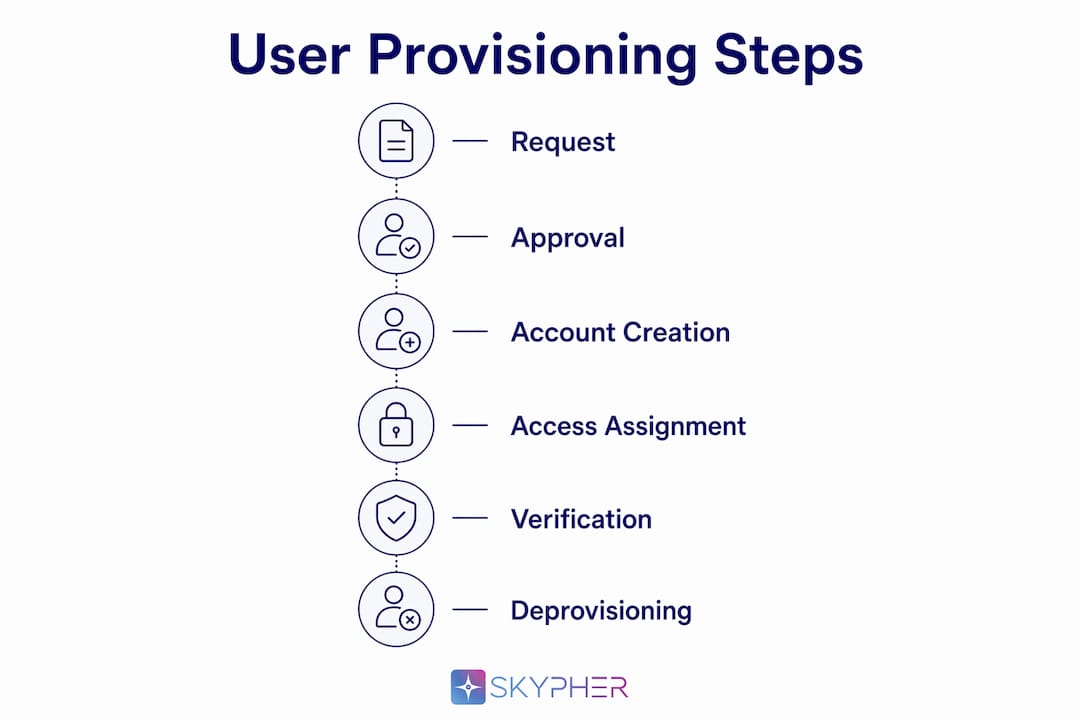
The typical provisioning workflow runs in this order:
- Trigger event. An authoritative source, usually an HRIS system like Workday or BambooHR, fires a signal. A new hire record is created, a role change is approved, or a termination is processed.
- Identity creation or update. The identity provider (IdP), such as Microsoft Entra ID or Okta, receives the event and creates or modifies the user record with the correct attributes.
- Role and permission assignment. Access rights are assigned based on the user's role, department, or attributes. Role-based access control (RBAC) maps job titles to permission sets. Attribute-based access control (ABAC) adds contextual conditions like location or device type.
- Application provisioning. The IdP pushes the account and permissions to connected applications, from Salesforce to GitHub to internal tools, via protocols like SCIM or LDAP.
- Verification. The provisioning system confirms the account exists, permissions are correctly applied, and the identity is linked to a verified owner.
- Deprovisioning. When the leaver event fires, access is revoked across all connected systems, active sessions are terminated, and the account is disabled or deleted.
Pro Tip: Never treat deprovisioning as a lower priority than provisioning. An account that exists when it shouldn't is a live vulnerability. Build your offboarding trigger into the same HRIS workflow as your onboarding trigger so neither can happen without the other.
The JML model also applies to non-human identities. Service accounts, API keys, and bots follow the same lifecycle control points of approval, provisioning, review, and revocation. Most organizations manage human identities reasonably well and leave service accounts completely untracked. That gap is where breaches happen.
What technologies and standards support automated user provisioning?
Automated provisioning depends on a small set of well-established technologies that handle the heavy lifting of syncing identity data across systems.
The key components are:
- SCIM (System for Cross-domain Identity Management). SCIM is the leading standard for provisioning automation, enabling identity providers to send create, update, and deprovision requests to connected applications in near real time. It replaces manual CSV imports and custom scripts with a standardized API.
- Identity providers (IdPs). Platforms like Okta, Microsoft Entra ID, and JumpCloud act as the central authority for user identities. They receive signals from HRIS systems and push changes to service providers via SCIM or SAML.
- Service providers (SPs). These are the downstream applications, think Slack, GitHub, Snowflake, or your internal ticketing system, that receive provisioning instructions from the IdP.
- HRIS integrations. Systems like Workday, BambooHR, or SAP SuccessFactors serve as the authoritative source of truth for employment status and role data. Automated provisioning software connects HR systems to IT apps, triggering access changes based on real employment events rather than manual IT tickets.
- APIs and webhooks. For applications that do not support SCIM natively, REST APIs and webhooks fill the gap, though they require more custom configuration and ongoing maintenance.
"Standards like SCIM facilitate interoperability but require correct attribute mappings and governance to prevent erroneous access propagation." Misconfigured SCIM mappings are one of the most common sources of over-provisioning in enterprise environments. A user mapped to the wrong group in your IdP will inherit every permission that group carries, often silently.
One critical nuance: SCIM defines the protocol for sending lifecycle requests, but actual deprovisioning behavior, including session termination, depends entirely on how each connected application implements the standard. An application can acknowledge a deprovision request and still leave active sessions running. Always test deprovisioning end-to-end in each integrated application, not just at the IdP level.
What are the best practices for secure and efficient user provisioning?
Effective user provisioning in IT management requires balancing speed with control. Full automation without governance creates new risks. Manual processes without automation create backlogs and human error. The answer is selective automation.
The core best practices for a secure provisioning program are:
- Automate deterministic steps. Account creation, standard role assignments, and license provisioning are safe to automate fully. These follow clear rules with predictable outcomes.
- Keep manual review for high-risk access. Privileged access to production systems, financial data, or customer PII should require human approval before provisioning. Integrate with a Privileged Access Management (PAM) tool like CyberArk or BeyondTrust to enforce this gate.
- Apply the least privilege principle from day one. Users should receive only the access their current role requires, nothing more. Treat any access beyond that as an exception requiring documented justification.
- Audit provisioning and deprovisioning actions. Log every provisioning event with timestamps, the triggering source, and the approver. These logs are your evidence in a security incident or compliance audit.
- Manage non-human identities with the same rigor. Service accounts and API keys need review, rotation, and revocation on a defined schedule. Treat them as identities, not infrastructure.
- Use policy-as-code for sensitive access. Tools like HashiCorp Vault or Open Policy Agent (OPA) let you encode access rules as version-controlled code, making provisioning decisions auditable and repeatable.
Pro Tip: Run a quarterly access review that cross-references your IdP's active accounts against your HRIS's active employees. The delta, accounts in the IdP with no matching HRIS record, is your orphaned account list. Remediate it immediately.
Selective automation also means verifying that revocation actually happened. Confirmation from the IdP that a deprovision request was sent is not the same as confirmation that access was removed. Build verification checks into your offboarding workflow, particularly for applications handling sensitive data.
How does user provisioning fit into identity lifecycle and security frameworks?
User provisioning is not a standalone IT task. It is a core function of Identity and Access Management (IAM) and a direct control mechanism within frameworks like the NIST Cybersecurity Framework 2.0 and Zero Trust architecture.
The table below maps provisioning events to their corresponding control functions within these frameworks:
| Provisioning event | JML phase | Security control function |
|---|---|---|
| Account creation and role assignment | Joiner | Identity binding, least privilege enforcement |
| Permission update after role change | Mover | Access recertification, privilege scope reduction |
| Access revocation and session termination | Leaver | Deprovisioning, orphaned account prevention |
| Service account rotation | Ongoing | Non-human identity governance |
| Access review and audit log review | Ongoing | Continuous verification, compliance evidence |
Zero Trust treats every access request as untrusted by default, requiring continuous verification rather than one-time provisioning. This means provisioning events become critical control points where access is not just granted but continuously re-evaluated. A user provisioned six months ago with a specific role should have that access recertified when their role changes, not just when they leave.
NIST CSF 2.0 maps directly to provisioning through its Identify, Protect, and Respond functions. Provisioning data feeds the asset inventory (Identify), enforces access controls (Protect), and provides the audit trail needed to respond to incidents. Organizations that treat provisioning as a full identity lifecycle process rather than a one-time onboarding task consistently show lower access creep and cleaner audit results.
Timely revocation is where most organizations fail. Without verified revocation, orphaned and lingering entitlements become chronic risks. The average time to deprovision a departed employee across enterprise environments is measured in days, not minutes. Every hour that gap exists is an open window.
Key takeaways
Effective user provisioning requires verified, end-to-end lifecycle management from account creation through confirmed access revocation, governed by the JML model and enforced through selective automation.
| Point | Details |
|---|---|
| Define provisioning as a lifecycle | Provisioning covers creation, updates, and verified revocation, not just onboarding. |
| Use the JML model as your framework | Joiner, Mover, and Leaver events are the three control points that govern all access changes. |
| SCIM automates but requires governance | SCIM syncs identity data across systems, but attribute mappings and deprovisioning behavior must be tested per application. |
| Selective automation reduces risk | Automate standard access; require manual approval for privileged or sensitive entitlements. |
| Extend controls to non-human identities | Service accounts and API keys need the same review, rotation, and revocation discipline as human accounts. |
Why provisioning is where identity security actually gets decided
After working closely with IT and security teams across tech and finance organizations, the pattern I see most consistently is this: provisioning gets treated as an IT operations problem when it is actually a security architecture decision.
Most teams invest heavily in their IdP configuration and SCIM setup, then assume the hard work is done. It is not. The real risk lives in the gaps: the application that does not support SCIM and gets provisioned manually via a shared admin account, the service account created for a one-time integration that never gets reviewed again, the employee who moved from engineering to sales and kept their production database access because nobody updated the role mapping.
The uncomfortable truth is that over-automation without governance creates a false sense of control. Your IdP dashboard shows clean, automated workflows. Your actual access state in downstream applications tells a different story. I have seen organizations pass SOC 2 audits on paper while carrying dozens of orphaned accounts in production systems.
The future of provisioning is dynamic and context-aware. Access will be granted based on real-time signals, device posture, location, and behavioral patterns, not just static role assignments. But that future only works if your foundational lifecycle management is solid. You cannot build context-aware access on top of a provisioning process that cannot reliably confirm deprovisioning happened.
My advice: start with your offboarding workflow. If you cannot prove, with logs, that a terminated employee's access was revoked within one hour across every connected system, your provisioning program has a critical gap. Fix that before you add more automation.
— Gaspard
How Skypher supports your security governance workflows

Provisioning governance generates a significant volume of security documentation, from access control policies to vendor questionnaires asking how your organization manages identity lifecycle. Skypher's AI questionnaire automation tool handles exactly that workload. When a prospect or auditor asks how you manage user provisioning, deprovisioning, and access reviews, Skypher pulls accurate, consistent answers from your existing documentation in under a minute. The platform integrates with Confluence, Notion, Google Drive, SharePoint, and over 40 third-party risk management platforms, so your provisioning policies are always reflected in your security responses. For IT and security teams that spend hours on repetitive compliance documentation, Skypher turns that process into a controlled, auditable workflow.
FAQ
What is the definition of user provisioning?
User provisioning is the process of creating, updating, and removing user accounts and their access rights across an organization's systems throughout the identity lifecycle. It covers onboarding, role changes, and offboarding.
How does user provisioning work in automated environments?
Automated provisioning connects an HRIS system to an identity provider like Okta or Microsoft Entra ID, which then pushes account and permission changes to connected applications via SCIM or APIs based on employment events.
What is the JML lifecycle model in provisioning?
The Joiner–Mover–Leaver model governs provisioning by defining three control points: access creation when a user joins, access modification when they change roles, and access revocation when they leave.
What is SCIM and why does it matter for provisioning?
SCIM is the standard protocol for automating identity lifecycle synchronization between identity providers and applications. It enables near real-time account creation, updates, and deprovisioning without manual intervention.
What are the biggest risks in user provisioning?
The two most common risks are privilege accumulation from role changes that are never cleaned up, and orphaned accounts from terminated employees whose access was never fully revoked across all connected systems.