

TL;DR:
- Building SaaS security credibility depends on demonstrating ongoing, verifiable controls beyond certifications like SOC 2 and ISO 27001.
- A live trust center with real-time security posture and current documentation speeds up procurement evaluations and enhances credibility.
Security credibility for SaaS is defined as the ability to demonstrate verifiable, operational security controls to buyers, procurement teams, and enterprise clients. Building security credibility for SaaS goes far beyond holding a SOC 2 certificate or an ISO 27001 badge. Procurement teams now require continuous evidence of active controls, not a PDF from two years ago. The companies that win enterprise deals fastest are those that treat security as an operational discipline, not a compliance checkbox. This guide gives security professionals the specific controls, program structures, and trust infrastructure needed to make that case convincingly.
Which core security controls build the foundation of SaaS credibility?
The three highest-impact technical controls for SaaS security are enforcing multi-factor authentication (MFA) for all users, centralizing identity management through single sign-on (SSO), and implementing least-privilege access controls. These three measures prevent the majority of identity-based SaaS breaches. That fact alone explains why enterprise procurement checklists almost always start with these three items.

The shared responsibility model places identity management, access control, data governance, and incident response primarily on the SaaS vendor's side of the equation. Most SaaS breaches occur in exactly these areas. Vendors who can demonstrate tight controls here signal operational maturity to buyers before a single questionnaire is submitted.
Beyond identity, the following controls form the backbone of a credible security program:
- Audit logging and continuous monitoring: Every privileged action should generate a log entry. Buyers want to know you can detect and reconstruct incidents, not just prevent them.
- Role-based access control (RBAC): Access rights should map to job function, not individual preference. Quarterly access reviews prove the model stays current.
- Vendor and third-party risk management: Document every sub-processor. Buyers in regulated industries will ask, and a clear sub-processor list signals that you have thought through your supply chain.
- Encryption in transit and at rest: TLS 1.2 or higher for data in transit, AES-256 for data at rest. These are baseline expectations, not differentiators.
- Dependency and secrets scanning: Automated scanning of code repositories catches exposed credentials and vulnerable libraries before they become incidents.
One underappreciated advantage of these controls is their cross-framework value. Core controls like audit logging and encryption satisfy requirements across SOC 2, ISO 27001, and NIST CSF simultaneously. Implementing them once reduces the workload of pursuing multiple certifications later.
Pro Tip: Map each control you implement to the specific SOC 2 Trust Service Criteria or ISO 27001 Annex A control it satisfies. This mapping becomes evidence during audits and answers procurement questions before they are asked.
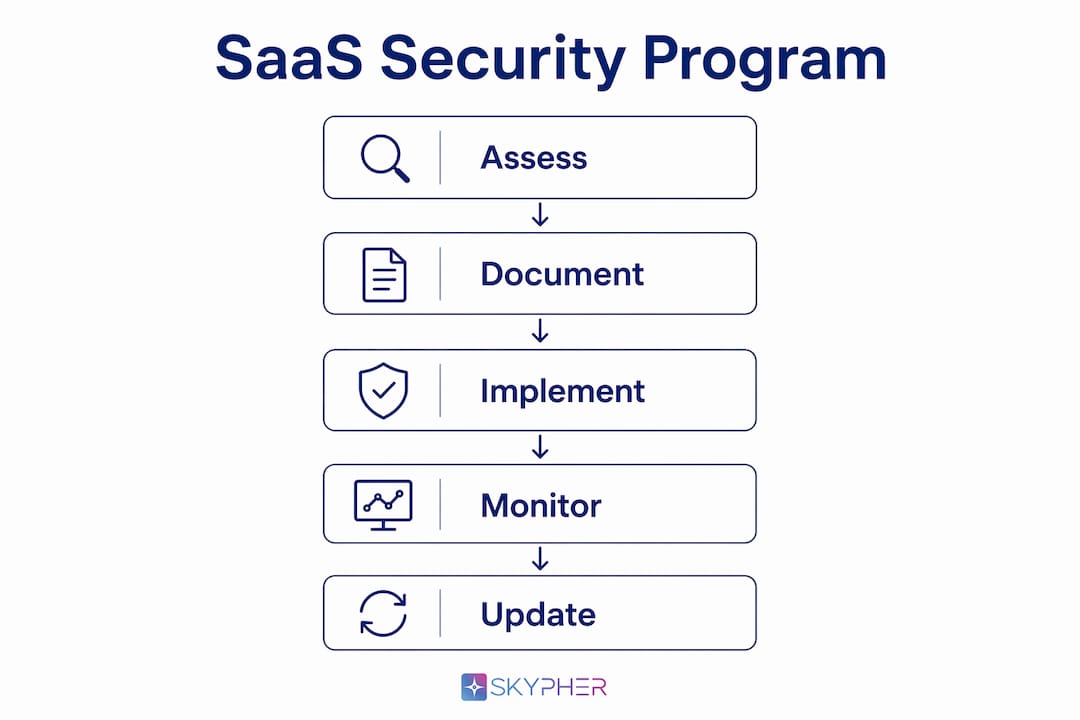
How to build a minimum viable security program efficiently
Pre-Series A SaaS companies do not need full SOC 2 certification to win deals. A defensible security package and roadmap often satisfies SMB buyers and positions the company for enterprise conversations. The goal at the early stage is a credible, documented program, not a perfect one.
A practical starting point is a focused set of 8–10 core security policies. These typically include an acceptable use policy, an access control policy, an incident response plan, a data classification policy, and a vendor management policy. Focusing on this small set of enforceable policies and high-impact technical controls delivers most of the security value with a fraction of the effort.
The 90-day sprint model works well for early-stage teams. Spend the first 30 days documenting existing controls and writing the core policies. Use days 31–60 to implement the highest-impact technical controls: SSO, MFA, secrets scanning, and dependency scanning. Reserve the final 30 days for a gap assessment against SOC 2 Type I criteria and remediation of the most critical findings.
Cost is a common barrier, but it does not have to be. A startup security program can be built for $0–$500 per month using open-source and freemium tools at the pre-seed and seed stages. As the company matures toward Series A and beyond, tool spend typically grows to $2,000–$5,000 per month, adding a GRC platform, a vulnerability scanner, and endpoint detection. SOC 2 Type I audits cost $15,000–$50,000, so timing that investment to coincide with active enterprise pipeline makes financial sense.
Pro Tip: Avoid over-engineering early. A well-documented, consistently followed policy beats a sophisticated tool stack with no enforcement. Buyers read policies; they also ask whether your team actually follows them.
What role does transparency play in cloud security credibility?
A trust center is the single most effective piece of infrastructure for converting security claims into buyer confidence. A high-converting trust center functions as procurement infrastructure, automating access to compliance documents and reducing security review delays. That framing matters: the trust center is not a marketing page. It is an operational tool that serves procurement teams directly.
The content of an effective trust center follows a clear hierarchy:
- Current certifications with expiry dates: Show SOC 2 reports, ISO 27001 certificates, and penetration test summaries with clear dates. Expired documents should be removed or flagged immediately.
- Live external security posture grade: A verifiable, live grade updated frequently signals active monitoring. Evaluation time drops from roughly half a day to about 5 minutes when buyers can see a live posture grade updated every two days.
- Sub-processor list: Name every third-party processor, their location, and the data they handle. Regulated buyers require this before signing.
- Incident response contact and process: A named security contact and a clear disclosure process tell buyers you have thought through what happens when things go wrong.
- Data retention and deletion policy: Enterprise legal teams will ask. Having this documented publicly saves weeks of back-and-forth.
"Compliance is ongoing operational work, not a one-time certification. Buyers distrust outdated certifications because a stale document signals that the underlying program may be equally neglected."
Automated trust centers that embed real-time telemetry and evidence from security tools provide transparency that static PDFs cannot match. Integration of security tools into public dashboards assures buyers that controls are active continuously, not just at audit time. Companies that build this infrastructure report 30–50% faster deal closures and 50–70% reductions in security review cycle times. Those numbers reflect a real operational shift, not a marketing claim.
For more on designing trust infrastructure that builds credibility online, the principles of transparency, consistency, and verifiability apply directly to SaaS security pages.
How to operationalize continuous security and maintain credibility over time
Security credibility decays without active maintenance. A SOC 2 report from two years ago is less credible than having no report at all. That counterintuitive finding reflects how procurement teams think: an old report suggests the program has not been reviewed, updated, or tested since the audit.
The operational practices that sustain credibility include:
- Quarterly trust center reviews: Update all documentation, refresh timestamps, and remove expired artifacts. A stale trust page older than six months actively hurts credibility with procurement teams.
- Automated evidence collection: Connect your security tools to your GRC platform so that evidence flows automatically. Manual collection creates gaps and delays audit preparation.
- Annual penetration testing: Commission an external test at least once per year and publish a summary of findings and remediation status on your trust center.
- Security training cadence: Run phishing simulations quarterly and role-specific security training annually. Document completion rates. Buyers ask about training programs during enterprise reviews.
- Incident response drills: Tabletop exercises twice per year keep the team sharp and produce documentation that demonstrates operational readiness.
The most common failure mode is treating compliance as a project with a finish line. Teams complete a SOC 2 audit, celebrate, and then let the program drift. Six months later, access reviews are overdue, policies are outdated, and the trust center shows a report that is approaching expiration. That drift is visible to buyers.
Pro Tip: Assign a named owner to each trust center section with a calendar reminder 60 days before any certification expires. Ownership without a deadline produces drift; a deadline without an owner produces nothing.
Embedding security into the development lifecycle also sustains posture between formal reviews. Require security sign-off on new feature releases, run automated dependency scans in your CI/CD pipeline, and review access permissions whenever an employee changes roles or leaves. For a structured approach to ongoing compliance practices, a documented checklist tied to quarterly reviews keeps the program on track.
Key Takeaways
Building SaaS security credibility requires continuous operational evidence, transparent trust infrastructure, and a disciplined governance cadence, not a single certification.
| Point | Details |
|---|---|
| Start with identity controls | MFA, SSO, and least-privilege access prevent most SaaS breaches and satisfy multiple compliance frameworks at once. |
| Build a minimum viable program early | Eight to ten core policies and a 90-day sprint toward SOC 2 readiness can be achieved for $0–$500 per month at early stages. |
| Publish a live trust center | Real-time posture grades and current documentation reduce procurement evaluation time from hours to minutes. |
| Treat compliance as ongoing work | Stale certifications and outdated trust pages actively reduce buyer confidence; quarterly updates with timestamps are required. |
| Automate evidence collection | Connecting security tools to a GRC platform keeps evidence fresh and audit preparation fast. |
The uncomfortable truth about SaaS security credibility
Most security teams I have worked with focus their energy on getting certified. They treat SOC 2 or ISO 27001 as the destination. The problem is that buyers do not care about the certificate. They care about what the certificate implies: that your controls are real, current, and enforced. When a procurement team opens your trust center and sees a report dated 18 months ago, the certificate works against you.
The teams that win enterprise deals fastest are the ones who have internalized that security credibility is a communication discipline, not just a technical one. They publish their posture openly. They update their trust center before buyers ask. They respond to security questionnaires in hours, not weeks. That responsiveness signals operational maturity more clearly than any certification.
I have also seen early-stage companies lose deals not because their security was weak, but because they could not explain it clearly. A well-documented program with honest gaps and a credible remediation roadmap beats a polished deck that falls apart under questioning. Buyers respect honesty. They distrust perfection.
The practical recommendation is to start publishing before you feel ready. A trust center with five documented controls and a clear roadmap is more credible than silence. Add to it quarterly. Let buyers watch the program grow. That transparency, over time, becomes your strongest sales asset.
— Gaspard
How Skypher accelerates your security credibility program
Security teams that want to move faster on trust infrastructure and questionnaire response have a direct path with Skypher.

Skypher's Trust Center platform centralizes compliance documentation, publishes live security posture evidence, and connects directly with over 40 third-party risk management platforms including OneTrust and ServiceNow. When a procurement team sends a security questionnaire, Skypher's AI-powered engine can process and respond to 200 questions in under a minute, pulling from a verified knowledge base of your security controls. The platform integrates with Slack, Microsoft Teams, Confluence, Google Drive, and SharePoint, so your security team works within tools they already use. For SaaS companies that need to automate questionnaire responses and publish credible, current security evidence without adding headcount, Skypher is the operational layer that makes it possible.
FAQ
What is security credibility for SaaS companies?
Security credibility for SaaS is the ability to demonstrate active, verifiable security controls to buyers and procurement teams through documented evidence, certifications, and live trust infrastructure. It goes beyond holding a certificate to showing that controls are enforced continuously.
How does a trust center improve enterprise sales cycles?
A trust center with live posture grades and current compliance documents reduces procurement evaluation time from roughly half a day to about 5 minutes. Companies using trust centers report 30–50% faster deal closures and 50–70% shorter security review cycles.
What are the minimum security controls a SaaS company needs?
The minimum credible set includes MFA for all users, SSO-based identity management, least-privilege access controls, audit logging, encryption in transit and at rest, and a documented incident response plan. These controls satisfy the core requirements of SOC 2, ISO 27001, and NIST CSF simultaneously.
How often should a SaaS trust center be updated?
Trust center content should be reviewed and updated quarterly, with visible "last updated" timestamps on every section. A trust page older than six months actively reduces buyer confidence and signals that the underlying security program may be equally neglected.
Does a SaaS startup need SOC 2 to win enterprise deals?
Pre-Series A companies do not always need full SOC 2 certification. A documented security program, a clear remediation roadmap, and a credible SOC 2 readiness plan often satisfy SMB buyers and position the company for enterprise conversations as the program matures.