
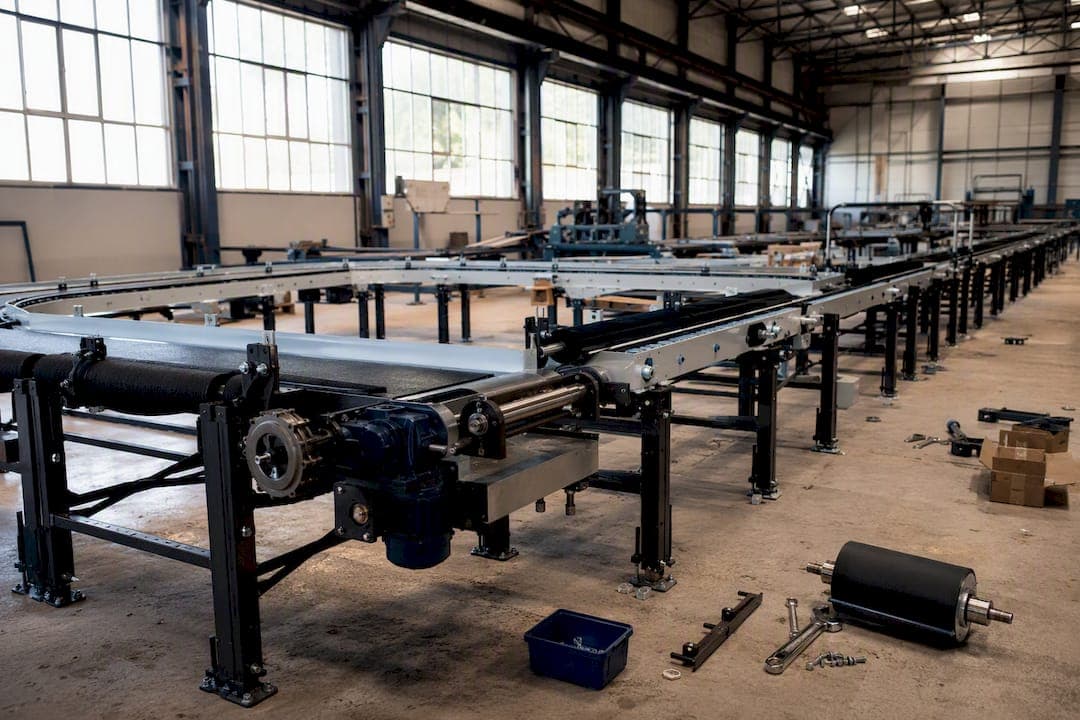
A conveyor system moves material automatically between two points, and it remains the backbone of most industrial and warehouse operations. For an industrial or warehouse buyer, the primary classes to weigh against each other are belt, roller/MDR, chain/slat, overhead/vertical, and pallet conveyors. Each handles a different combination of weight, shape, and environment, and picking the wrong one is the single most common (and expensive) mistake we see in early-stage procurement.
Before you get a quote from anyone, you need two things sorted: your load and throughput data, and a rough sense of which conveyor class fits your product. Belt conveyors remain the most widely used powered conveyor because they handle both regular and irregular items at a relatively low cost. Here's the shortlist to start from:
- Belt conveyors — general case, carton, and light pallet transport
- Roller/MDR conveyors — accumulation, sortation staging, and caseflow
- Chain/slat/drag conveyors — heavy, hot, wet, or abrasive loads
- Overhead and vertical conveyors — elevation changes and floor space constraints
- Pallet conveyors — palletized goods moving through distribution or manufacturing lines
Key Takeaways
Matching conveyor class, load data, and environment specs before requesting quotes is what separates a system that lasts a decade from one that gets ripped out in two years.
| Point | Details |
|---|---|
| Start with load and throughput data | Document weight, dimensions, and cases or pallets per hour before contacting vendors. |
| Match conveyor class to product | Belt, roller/MDR, chain/slat, overhead, and pallet conveyors each suit different loads. |
| Specify environment early | Washdown, freezer, and dusty conditions require different frames, bearings, and belting. |
| Budget beyond the conveyor itself | Controls, installation, commissioning, and spare parts add meaningfully to total cost. |
| Use Skypher for the compliance side | Skypher automates vendor security questionnaires that often accompany conveyor and automation procurement. |
Table of Contents
- Which Conveyor Conveyor Models Show Up Most in Industrial Buying Guides?
- How Do You Choose the Right Conveyor for Your Application?
- What Are the Main Conveyor Types and Where Do They Fit?
- What Components Should You Inspect Before You Buy?
- What Does a Conveyor System Actually Cost?
- How Often Should You Maintain a Conveyor System?
- What Do Buyers Get Wrong When Specifying Conveyors?
- Get Compliance Questionnaires Handled as Fast as Your Warehouse Runs
- Where to Find Detailed Conveyor Specs
- Sources
Which Conveyor Conveyor Models Show Up Most in Industrial Buying Guides?
If you're comparing catalog conveyors against custom builds, seven models come up again and again across manufacturer catalogs and industry buying guides. None of these is a universal answer. Each solves a specific handling problem, and the right pick depends on your product mix, your floor plan, and how much engineering support you actually need.
The Global Industrial Electric Belt Conveyor is a catalog electric belt conveyor built for general case and light pallet handling. It ships in standard widths with fast lead times, which makes it a reasonable first call when you need something working next month, not next quarter.
The Omni Metalcraft Power Belt Conveyor targets medium-duty industrial lines and packaging operations. Its modular configurations and flexible mounting options let you adapt it to odd floor layouts without redesigning your whole line.
The LINKIT Portable Dirt & Aggregate Conveyor is built for a completely different job: construction sites and aggregate transfer where the conveyor itself has to move. Its rugged frame and portability matter more here than throughput specs.
The Hytrol Model TA Medium Duty Slider Bed Belt Conveyor shows up constantly in distribution and fulfillment operations moving cases and totes. It's a known quantity, reliable, and widely serviced, which counts for a lot when you need parts fast.
The Dorner Low Profile Small-Medium Parts Conveyor solves a narrower problem: small-part assembly and inline conveying at workstation height. Its low profile makes it easy to integrate directly into a bench-level process.
The Hytrol Model TL Heavy Duty Horizontal Slider Bed Belt Conveyor steps up in load capacity for heavy manufacturing and pallet transfer applications where the TA-series design isn't robust enough.
The Ashland Belt Conveyor is a general-purpose option with a broad catalog covering varied product types, useful when your material handling needs don't fit neatly into one category.
| Model | Best For | Typical Load / Use Case | Standout Feature | Environment Suitability | Price / Lead Time |
|---|---|---|---|---|---|
| Global Industrial Electric Belt Conveyor | Quick-ship case and light-package transport | Light cartons, general case handling | Off-the-shelf availability, standard widths | Standard indoor | Lower price band, short lead time |
| Omni Metalcraft Power Belt Conveyor | Medium-duty industrial lines and packaging | Medium industrial loads | Flexible mounting, modular configuration | Standard indoor, some washdown options | Mid price band |
| LINKIT Portable Dirt & Aggregate Conveyor | Construction and aggregate transfer | Bulk dirt, aggregate | Portability, rugged outdoor design | Outdoor, heavy-duty | Mid price band, quick deployment |
| Hytrol Model TA Medium Duty Slider Bed Belt Conveyor | Distribution centers moving cases and totes | Cases and totes | Reliable fulfillment-grade design | Standard indoor | Mid price band |
| Dorner Low Profile Small-Medium Parts Conveyor | Small-part assembly and inline conveyors | Small parts at bench height | Low profile, easy integration | Standard indoor, some sanitary options | Lower to mid price band |
| Hytrol Model TL Heavy Duty Horizontal Slider Bed Belt Conveyor | Heavy manufacturing and pallet transfers | Pallets, heavy loads | Higher load capacity, robust frame | Heavy-duty indoor | Higher price band |
| Ashland Belt Conveyor | General material handling with varied products | Mixed product types | Broad catalog flexibility | Standard indoor | Varies by configuration |
Catalog models like these cover most standard operations. When your throughput targets are aggressive, your footprint is irregular, or you need sortation and WMS integration built in, a custom engineered conveyor system usually outperforms a catalog stack, even though it costs more upfront and takes longer to deploy.
How Do You Choose the Right Conveyor for Your Application?
Selection comes down to five variables, and skipping any one of them is how buyers end up with a conveyor that doesn't fit six months after installation.
- Load weight and dimensions — know your heaviest, largest, and lightest, smallest items, not just an average.
- Throughput targets — express this in cases per hour or pallets per hour, not "as fast as possible."
- Product base — rigid cartons, loose bags, and irregular items each favor different belt or roller designs.
- Incline needs — inclines above roughly 18 to 22 degrees typically require cleated or troughed belting.
- Footprint and routing — measure your actual floor plan, including columns and dock doors, before designing curves.
Environmental constraints reshape your component list fast. Washdown environments need stainless steel frames, sealed bearings, and food-grade belting specified from day one, not added later. Freezer applications need cold-rated motors and lubricants. Dusty environments call for sealed enclosures on drives and sensors.
Controls matter just as much as mechanics. Your conveyor needs to talk to your WMS, WES, or WCS, plus any sortation, accumulation, or sensor logic already running in your facility.
Before you send an RFQ, prepare:
- Part sizes, weights, and orientation
- Required speed and duty cycle
- Hours of operation and environment specs
Ask vendors to return:
- Motor and gearbox ratings
- Load tables for your specific configuration
- Lead time and warranty terms
Pro Tip: Send the same spec sheet to every vendor on your shortlist. Inconsistent specs are the number one reason buyers can't compare quotes apples to apples.
What Are the Main Conveyor Types and Where Do They Fit?
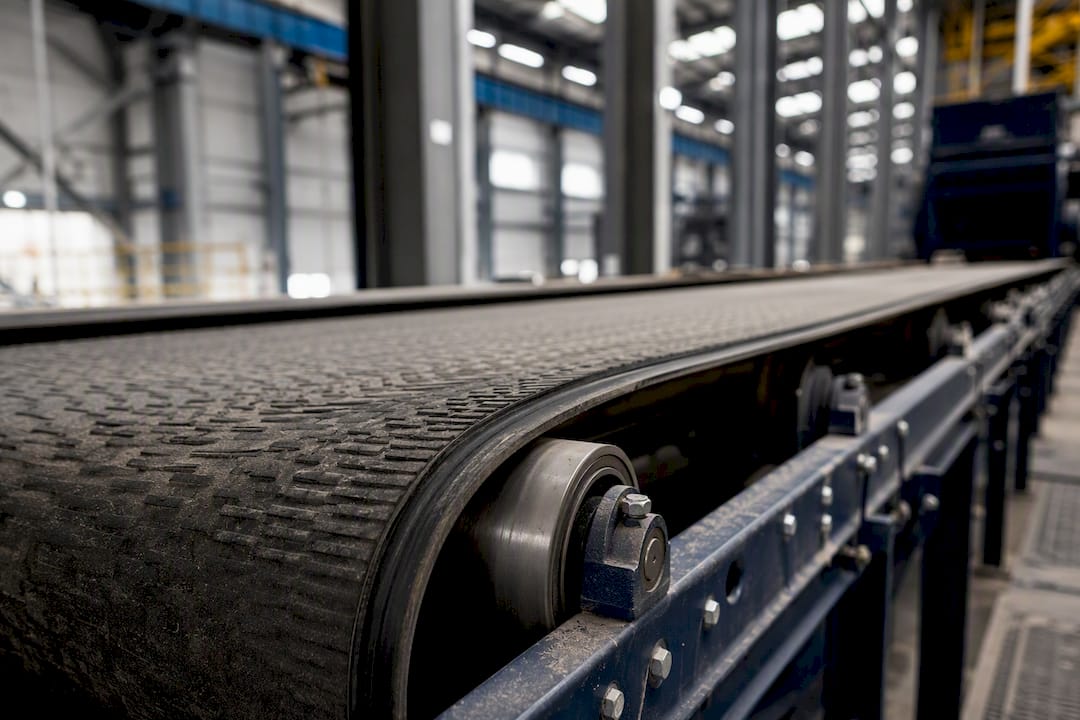
Belt conveyors dominate general material handling because they're versatile and comparatively cheap to install. Standard flat belts handle cartons and cases; troughed belts handle loose bulk material; pipe and sandwich belt variants handle inclines and containment needs that a flat belt can't manage.
Roller and motorized drive roller (MDR) conveyors are the workhorses of accumulation zones and case flow. They let cartons queue without motor strain and integrate cleanly with sortation logic.
Pallet conveyors move heavier, larger loads through distribution and manufacturing lines, often paired with chain-driven sections for the added strength palletized freight requires.
Chain, slat, and drag conveyors take over where belts can't survive: heavy, hot, or abrasive loads in heavy manufacturing environments, like metal stamping lines or foundries.
Overhead and power-and-free conveyors solve a different problem entirely. When floor space is scarce or your process needs elevation changes, moving material through the air frees up your entire floor plan. Vertical conveyors do the same job between levels in multistory facilities.
Food and pharma operations need sanitary, washdown-rated conveyors: stainless frames, open designs that drain and dry quickly, and belting rated for repeated caustic cleaning cycles.
What Components Should You Inspect Before You Buy?
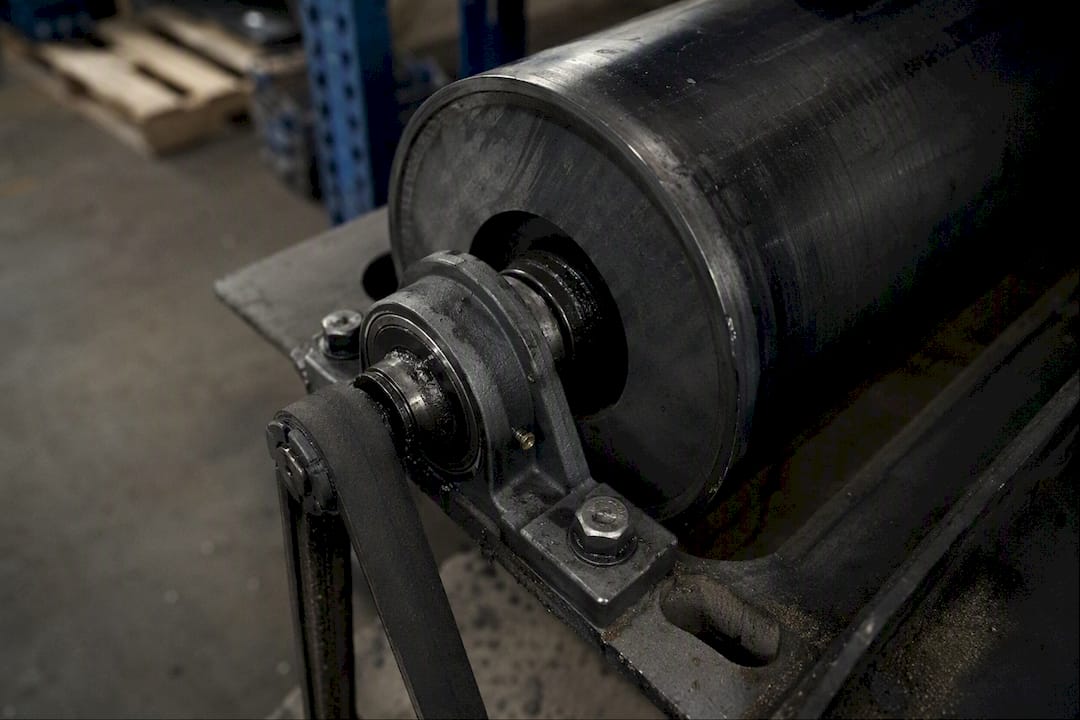
The mechanical core of any conveyor is its drive pulley, idlers, bearings, scrapers, and take-up assembly. Weak points here show up first: a poorly tensioned take-up causes belt tracking issues within weeks of startup.
Motor and gearbox selection deserves real scrutiny. Variable frequency drives (VFDs) let you match conveyor speed to actual demand instead of running everything at full speed constantly, which reduces wear and energy use.
Controls are where modern conveyors earn their keep:
- Photoeyes and encoders for position and speed feedback
- Accumulation logic that stops product without jamming or crushing it
- PLC and WCS interfaces that let the conveyor act on real-time data, not just a fixed schedule
For long troughed or heavy bulk conveyors, synchronized multi-drive arrangements prevent belt slip and keep tension consistent across long spans, a detail that's easy to overlook until a belt starts wandering.
Statistic Callout: Shifting from calendar-based to condition-based maintenance on critical conveyor lines meaningfully cuts unplanned downtime, according to industry integration guidance.
What Does a Conveyor System Actually Cost?
Pricing swings widely based on complexity. A simple catalog conveyor can run in the low five figures, while a fully integrated sortation or pallet-handling system can reach into the mid six figures once engineering, controls, and installation are included.
Several factors push the number higher:
- Custom engineering for unusual footprints or product mixes
- Sortation and merge/divert logic
- Heavy-duty construction for high-load or harsh environments
Beyond the conveyor itself, budget for controls integration, installation labor, commissioning, spare parts inventory, and any service agreement you sign. Payback typically comes from labor reduction or throughput gains, so model both before committing to a design.
Pro Tip: If your budget is tight and your timeline is tighter, a refurbished or modular quick-ship conveyor can bridge the gap while you plan a fuller engineered system for later.
How Often Should You Maintain a Conveyor System?
Reliable conveyors run on a schedule, not on luck.
- Inspect belts, chains, and bearings weekly for wear, tracking issues, or unusual noise.
- Lubricate drive components on the manufacturer's recommended cycle, not an arbitrary calendar.
- Check take-up tension monthly, since a loose belt is the most common failure precursor.
- Test safety devices (e-stops, guards, photoeyes) on a fixed inspection schedule.
- Log every failure with a first-check diagnostic: misalignment, worn scrapers, or motor overload are the usual suspects.
Condition monitoring sensors are worth the investment on any line where downtime is expensive. Compliance teams should also review protective systems and emergency controls as part of routine reliability planning, not as an afterthought.
What Do Buyers Get Wrong When Specifying Conveyors?
The two mistakes we see most often are under-specifying throughput and ignoring integration points until it's too late. A buyer will size a conveyor for average daily volume, then discover it chokes during peak shipping weeks. Others treat controls integration as a plug-and-play afterthought, only to find their WMS and the new conveyor's PLC don't speak the same language.
Our take: hire a systems integrator when your project touches sortation, robotics, or multi-line coordination. Stick with a catalog buy when your need is a single, well-defined transport problem. If you're building out a broader automation or compliance stack around your material handling operation, resources like our streamline security monitoring guide cover the connected-equipment side of that decision.
Get Compliance Questionnaires Handled as Fast as Your Warehouse Runs
Vetting conveyor vendors for a new automation project almost always triggers a security review of your own operations, especially if you're integrating with cloud-based WMS or WES platforms. That's where Skypher comes in: instead of your team spending days manually answering the same vendor security questionnaire over and over, Skypher's AI-driven Questionnaire Automation Tool drafts accurate responses in minutes, pulling from your own verified knowledge base.

It supports every questionnaire format your procurement and security teams will encounter, connects with over 40 third-party risk management platforms, and lets your whole team collaborate on responses in real time instead of passing spreadsheets back and forth. If your facility is scaling up automation and expects more vendor and customer security reviews as a result, set up a Trust Center so partners can self-serve your compliance posture instead of emailing your team for the tenth time this quarter. Start by requesting a walkthrough of the Questionnaire Automation Tool to see how much manual work it removes from your next vendor review cycle.
Where to Find Detailed Conveyor Specs
- Conveyor Belt Overview (Wikipedia) — construction, variants, and use cases for belt conveyors.
- Guide to Industrial Conveyor Systems (IKI) — selection criteria and integration guidance.
- Automated Conveyor Systems (Dematic) — sortation and warehouse software integration.
- Conveyor Systems (Honeywell) — modular conveyor module options.
- Conveyor System Cost Guide (HeavyEquipmentAppraisal) — pricing ranges for new and used systems.
Sources
- Conveyor belt - Wikipedia
- Guide to industrial conveyor systems: types & integration - IKI
- Automated Conveyor Systems - Dematic
- How much does a conveyor system cost? (New, Used) - HeavyEquipmentAppraisal