

TL;DR:
- Conveyor security combines physical guarding, lockout/tagout procedures, and emergency stop systems to protect workers. Effective safety depends on integrating these layers, with documented procedures, regular testing, and adherence to OSHA standards. A strong safety culture relies on proactive inspection, proper training, and comprehensive record-keeping, not just paperwork compliance.
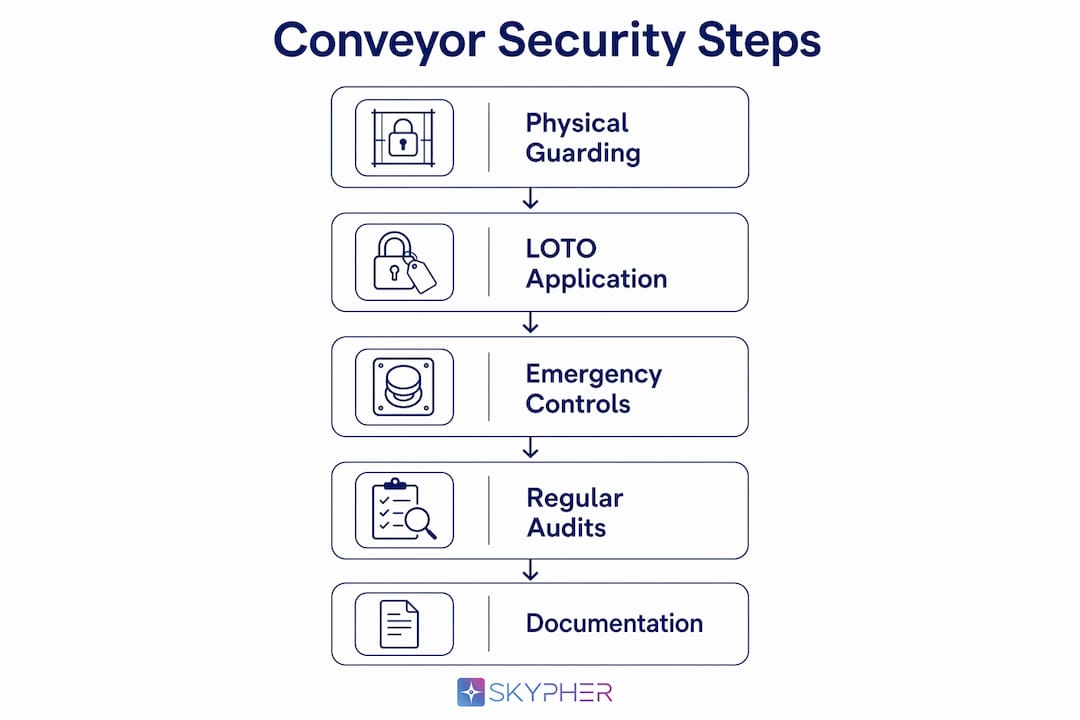
Conveyor security is defined as the combination of physical guarding, lockout/tagout (LOTO) energy control, and emergency stop systems that protect workers from hazardous conveyor components and uncontrolled energy releases. OSHA standards 29 CFR 1910.219 and 29 CFR 1910.147 form the legal backbone of every compliant program. For security professionals and compliance officers, understanding these layers is not optional. A gap in any one layer creates direct exposure to injury, regulatory citation, and operational shutdown.
What are the primary guarding methods for conveyor security?
Physical guarding is the first line of defense in any belt conveyor protection program. OSHA 1910.219 mandates guarding around nip points, drive shafts, couplings, pulleys, and hazardous return idlers. Each of these points can trap, crush, or sever a limb in fractions of a second.

Fixed guards
Fixed guards are rigid enclosures bolted directly to the conveyor frame or structure. They cover nip points, power transmission components, and exposed shafts. Compliance with OSHA 1910.219 requires that guards use tool-required fasteners, meaning workers cannot remove them without a wrench or screwdriver. A guard that a worker can lift off by hand is not compliant, regardless of its physical dimensions.
One critical point most compliance teams miss: meeting gap-size tables in the code is not sufficient on its own. Effective conveyor guarding requires that no worker can reach under, over, or through the guard to contact a moving part. If a gap allows access, the guard fails the standard.
Perimeter guarding and presence detection
Perimeter guarding uses fences, interlocked gates, and access control barriers to keep personnel out of hazardous zones entirely. Interlocked gates connect directly to the conveyor control system and stop the belt when a gate opens. This approach works well for large conveyor systems where fixed guarding at every point is impractical.
Presence detection methods such as light curtains and pressure-sensitive mats are acceptable alternatives when physical guards cannot be installed. These devices stop the conveyor immediately when they detect a person entering a hazardous area. They must be interlocked with the conveyor control system to be compliant.
| Guarding method | Best application | Key limitation |
|---|---|---|
| Fixed guards | Nip points, shafts, pulleys | Requires tool removal for access |
| Perimeter fencing | Large conveyor zones | Does not protect against internal faults |
| Interlocked gates | Controlled access points | Gate bypass defeats protection |
| Light curtains | High-access areas | Requires reliable interlock wiring |
| Pressure mats | Floor-level access zones | Can be defeated by standing outside mat |
Pro Tip: Install anti-tamper fasteners on all fixed guards and audit them quarterly. Workers who repeatedly access guarded areas for minor tasks will find shortcuts. Documented quarterly checks create a paper trail that protects the organization during OSHA inspections.
How does lockout/tagout (LOTO) ensure safety during conveyor maintenance?
LOTO is the procedure that controls hazardous energy before any worker performs maintenance, repair, or adjustment on a conveyor. OSHA 1910.147 requires documented, machine-specific LOTO procedures that address every energy source present. A generic LOTO procedure posted on a wall does not satisfy this requirement.
Conveyors carry multiple energy types that must each be addressed:
- Electrical energy. Disconnect and lock out the main power supply at the motor control center.
- Hydraulic energy. Depressurize hydraulic lines and block any actuators that could move under residual pressure.
- Pneumatic energy. Bleed air lines and verify zero pressure before access.
- Gravitational energy. Block or support any conveyor sections that could drop under gravity.
- Stored belt tension. This is the most overlooked hazard. A loaded take-up system holds significant mechanical energy that can release violently if not arrested before maintenance begins.
Stored mechanical energy in belt tension systems can release high-impact force. Safety arresting devices for take-up zones must be integrated during the design phase because retrofitting them is structurally complex and expensive.
After applying all locks and tags, the authorized employee must verify zero energy state before touching any component. Verification means attempting to start the conveyor, checking pressure gauges, and confirming no movement occurs. Skipping verification is the most common LOTO failure in industrial audits.
OSHA does allow one narrow exception. Minor servicing tasks such as frequent jam dislodging may use alternative controls instead of full LOTO, provided those controls are under the exclusive control of the employee performing the task and prevent restart by anyone else. This exception does not apply to any task involving exposure to moving parts or stored energy.
Pro Tip: Treat interlocks and LOTO as separate tools with separate purposes. Interlocks and LOTO are not interchangeable. Interlocks stop the belt during normal operations when a gate opens. LOTO prevents startup during maintenance. Using an interlock as a substitute for LOTO during service work is a compliance violation and a serious injury risk.
What secondary safeguarding and emergency controls are critical?
Secondary safeguarding fills the gaps that physical guards and LOTO cannot cover during normal operations. These systems respond to unexpected events: a worker caught in a pinch point, a belt jam, or a mechanical overload.
Emergency stop devices must be positioned along the entire conveyor length so workers can stop the belt from any point where a hazard could occur. Three device types are standard:
- Pull cords. Run parallel to the conveyor and can be activated from any point along their length. Preferred for long conveyor runs.
- Push buttons. Fixed at specific stations. Faster to activate but require the worker to reach a set location.
- Stop bars. Horizontal bars that stop the conveyor when pushed. Common in areas with high foot traffic near the belt.
Emergency stop devices must be labeled clearly per ASME B20.1-2024 guidance, and their test cadence must follow a risk-based schedule. A pull cord that fails during a real emergency because it was never tested is a compliance failure and a liability.
Alarm systems add another layer. Sensors that detect belt jams, motor overloads, or misalignment trigger audible and visual alerts before a fault becomes a catastrophic failure. These systems give operators time to respond before a shutdown becomes necessary.
One area where compliance teams frequently make errors involves SCADA systems. SCADA provides visualization of conveyor status but is not reliable as a primary safety control. PLC logic manipulation can mask hazardous states in SCADA displays. Primary safety controls must rely on hardwired interlocks and documented procedures, not software displays.
What are best practices and common pitfalls in conveyor security implementation?
The most effective industrial conveyor security programs share a common structure: they integrate physical controls, procedural discipline, and regular verification. The most common failures come from treating any one of these as sufficient on its own.
Key best practices for compliance officers to enforce:
- Design safety in early. Arresting devices for stored mechanical energy in take-up zones must be planned during equipment specification. Retrofitting after installation is costly and often structurally impossible.
- Use tool-required fasteners on all guards. Workers who can remove guards by hand will do so. Fasteners that require tools create a deliberate barrier and a documented record of tampering.
- Build safe access into the facility layout. Platforms, guardrails, and non-slip surfaces near conveyors reduce slip and fall incidents that occur during routine inspection and cleaning.
- Conduct periodic LOTO audits. Training authorized and affected employees on equipment-specific LOTO procedures is an OSHA requirement, not a recommendation. Annual retraining and documented inspections are the minimum standard.
- Test emergency stops on a defined schedule. Pull cords, push buttons, and stop bars must be tested at a frequency based on the risk level of the conveyor operation.
- Maintain housekeeping standards. Debris accumulation near conveyors creates slip hazards and can interfere with presence detection devices like pressure mats.
Pro Tip: Assign a named individual as the responsible party for each conveyor's LOTO procedure documentation. Procedures that belong to everyone are maintained by no one. A named owner creates accountability and simplifies audits.
A multi-layered defense approach starting with fixed guards, supplemented by presence detection where fixed guards are impractical, and fully interlocked with the conveyor control system is the recognized best practice framework. No single control is sufficient. Each layer compensates for the limitations of the others.
Key takeaways
Effective conveyor security requires fixed physical guards, documented LOTO procedures, and tested emergency stop systems working together as a single integrated program.
| Point | Details |
|---|---|
| Physical guarding is non-negotiable | Guards must prevent reach-around access and use tool-required fasteners to meet OSHA 1910.219. |
| LOTO must address all energy types | Electrical, hydraulic, pneumatic, gravitational, and stored belt tension each require specific isolation steps. |
| Interlocks do not replace LOTO | Interlocks manage operational access; LOTO controls energy during maintenance. Mixing them creates serious injury risk. |
| SCADA is not a safety control | Hardwired interlocks and documented procedures are the reliable primary controls; SCADA is supplemental. |
| Design safety in from the start | Stored energy arresting devices for take-up zones must be specified at design, not retrofitted after installation. |
The gap between compliance and actual safety
The uncomfortable truth I have seen repeatedly across industrial facilities is this: most conveyor incidents happen at sites that passed their last OSHA inspection. The paperwork was correct. The guards were in place on the day of the audit. The LOTO procedures were posted. Then, three weeks later, a worker removed a guard to clear a jam and the belt restarted.
Compliance documentation and actual safety culture are not the same thing. The facilities that sustain genuine safety records treat conveyor security as an operational discipline, not a paperwork exercise. They conduct unannounced guard integrity checks. They investigate near-misses with the same rigor as recordable injuries. They make it easier for workers to follow the safe procedure than to take a shortcut.
The emerging integration of automated detection technologies, including light curtains with real-time logging and SCADA-connected alarm systems, creates new opportunities. But technology does not fix a culture that tolerates bypassed guards. The organizations I have seen get this right invest as heavily in training and accountability as they do in hardware.
The next frontier in automated conveyor safety is better documentation and audit trail management. Facilities that can produce a complete, timestamped record of every guard inspection, LOTO audit, and emergency stop test are far better positioned during regulatory reviews. That is where digital compliance tools become genuinely valuable, not as a replacement for physical controls, but as the system of record that proves those controls are working.
— Gaspard
How Skypher supports conveyor security compliance documentation
Security professionals managing conveyor safety programs face a documentation burden that grows with every new standard update, audit cycle, and vendor assessment. Gathering evidence, responding to security questionnaires from insurers or enterprise clients, and maintaining a current compliance posture across multiple sites takes significant time.

Skypher's AI questionnaire automation tool answers up to 200 security questions in under one minute, pulling from your existing documentation stored in Confluence, SharePoint, Google Drive, or Notion. It connects to over 40 third-party risk management platforms and integrates directly with Slack and ServiceNow. For compliance officers who need to demonstrate conveyor safety program maturity to auditors or enterprise partners, Skypher's security questionnaire guides provide a practical starting point for building a repeatable, auditable response process.
FAQ
What does conveyor security cover?
Conveyor security covers physical guarding of nip points and moving parts, lockout/tagout energy control procedures, and emergency stop systems. OSHA standards 29 CFR 1910.219 and 1910.147 define the minimum legal requirements.
Can interlocks replace LOTO during maintenance?
No. Interlocks stop the conveyor when a gate opens during normal operations, but they do not control stored energy. LOTO is required during maintenance to prevent unexpected startup and release of all hazardous energy types.
What energy sources must LOTO address on a conveyor?
LOTO procedures must address electrical, hydraulic, pneumatic, gravitational, and stored mechanical energy, including belt tension in take-up systems. Each source requires a specific isolation and verification step.
How often should emergency stops be tested?
Test frequency should follow a risk-based schedule aligned with ASME B20.1-2024 guidance. Higher-risk conveyor operations require more frequent testing of pull cords, push buttons, and stop bars.
Is SCADA sufficient as a primary safety control for conveyors?
No. SCADA systems provide operational visibility but are not reliable as primary safety controls because PLC logic manipulation can mask hazardous states. Primary controls must be hardwired interlocks supported by documented procedures.